Ted Gioia on Burning Man: the connections between pop culture and ritual sacrifice. It’s a Labor Day story.

September 3rd, 2021

Share
Ritual sacrifice a thing of the past? Not so fast, says Ted Gioia. (Photo: Brenda Ladd)

Somehow the whole Burning Man phenomenon blew by me these last few decades. I hate crowds, anyway. You never know what a crowd will do … but maybe that’s the point. Jazz scholar and music historian Ted Gioia links the history of music with ancient ritual violence over at “The Honest Broker,” his Substack column. And in his excellent piece, “Why Do They Burn a Man at Burning Man?” he makes striking connections with the work of the French theorist René Girard, the member of the Académie Française who was a longtime Stanford professor.

“How do you celebrate Labor Day weekend?” Ted Gioia asks. “At the annual gathering known as Burning Man, enthusiastic participants set fire to a large wooden effigy—which they call The Man. This is truly sticking it to the man, in the parlance of the counterculture. And the stick here is a log, soaked in fuel and bacon grease, then set ablaze with a large magnifying glass.”

The event regularly draws as many as 80,000 participants. This year, possibly more – because like everything else in the COVID era, it’s gone online. You’ll be able to watch the “virtual burn” here, should it cross your mind to do such a thing.

René Girard’s “Violence and the Sacred” was influential.

Ted continues that “the arbitrary nature of the sacrificial victim is essential to the success of the ritual. That is one of the key learnings we draw from René Girard (1923-2015), a pathbreaking thinker who life’s work focused on the importance of ritualized sacrifice in human culture. I believe that Girard’s 1972 book Violence and the Sacred is one of the most significant scholarly works published during my lifetime—full of rich implications for anyone who cares about the origins of our commercial and cultural institutions, or even about contemporary phenomenon, such as social media and generational conflict.”

So why isn’t René Girard mentioned more frequently in the connection to, say, rock concerts? Music history is rife with ritual sacrifice, he notes. And then he describes the gruesome history of that music – drums and flutes that were used to drown out the screams of sacrificial victims. The examples he cites are memorably grisly.

“In fact, drums are linked to sacrificial ritual in every region of the world. In some places (Africa, South India, etc.), the sacrifice is made to the drum—which is believed to embody a deity or powerful spirit. In other instances, for example among the Incas, the skin of the sacrificial victim is turned into the drum. But whatever the particulars, the drum is viewed with awe, perhaps even fear, in the context of these ritualistic connections.”

Think that’s a thing of the ancient past? Not so fast, says Ted. He remembers a hideous example: “the notorious Altamont concert on December 6, 1969—remembered today for the stabbing death of Meredith Hunter in front of the stage during a performance by the Rolling Stones. But just a few weeks earlier, the murderous Charles Manson gang relied on the Beatles’s song “Helter Skelter” as an anthem in their own quasi-ritualistic killing spree. How strange that the decade would come to a close with the music of the two defining bands of the era—so focused on peace and love, according to the leaders of the counterculture—having their songs co-opted in senseless murder.”

Read the whole thing here. And below, a reminder of how much Sigmund Freud was on the same trail as Stanford’s eminent French thinker.

Uncommon ground: Robinhood’s Vlad Tenev talks to Robert Pogue Harrison

September 2nd, 2021
Share

We aim to take market share and usurp, but we’re very much operating within the system.” ~ Vlad Tenev

In 2013, Vlad Tenev launched the “Robinhood” platform to democratize financial markets. So what common ground does the Bulgarian-American entrepreneur share with Entitled Opinions host and humanist Robert Pogue Harrison, who claims that teaching, thinking, and writing about cultural history has been his lifelong vocation?  

The Stanford professor made a guest appearance on Tenev’s half-hour podcast series “Under the Hood” to explore the connections. Here’s an obvious one: the CEO also started at Stanford, where he envisioned a trading platform to encourage young investors by not requiring minimum accounts or charging commissions. You can listen to the conversation at the Los Angeles Review of Books here.

The fugitive “Robin Hood” was another link. Tenev suggested that Robin Hood’s intent was to democratize resources, adding that “he wanted to open up the forest and have it not just the purview of the king, but open for everyone to hunt.”

Harrison, the author of Forests: The Shadow of Civilization, drew an analogy between the outlaws’ Sherwood Forest and the markets of Wall Street, adding, “Your platform is trying to get the underdogs or the least privileged into a system which traditionally enriches the already rich.”

Both men also share an interest in the work of the late French theorist René Girard, who taught at Stanford for decades. Girard said society’s last taboo is envy, which drives today’s social media. Recalling Girard’s most famous protégé, the early Facebook investor Peter Thiel, Harrison observed, “Facebook is a machine of engendering envy, and people keep upping the ante of how happy they are, how beautiful their kids are, and how wonderful their vacations and meals are. You enter into this mad mimetic escalation of self-representation on one hand, and the envy of your friends and rivals on the other. “ Yet Tenev noted that Robinhood also started with social media, allowing people to interact in ways unimaginable a decade before.

“In our capitalistic society, there’s not just one king. There are several kings. They are the banks, the corporations, the hedge funds, the investment bankers.” ~ Robert Pogue Harrison

The recording of the conversation is over at the Los Angeles Review of Books here.

More potent quotes:

“In our capitalistic society, there’s not just one king. There are several kings. They are the banks, the corporations, the hedge funds, the investment bankers.” ~ Harrison

“You can’t just throw prudence out of the equation altogether.” ~ Harrison

“Do these trading platforms have a declared sense of responsibility in caring for the investors who use it? How does one go about trying to protect the users?” ~ Harrison

“Your Robinhood platform is not revolutionary because it’s not trying to overthrow.” ~ Harrison

“You can’t just throw prudence out of the equation altogether.” ~ Harrison

“We aim to take market share and usurp, but we’re very much operating within the system.” ~ Tenev

He’s just wild about Goethe … and a few others, too.

August 25th, 2021
Share


There is no surer way of evading the world than by art; and no surer way of connecting to it than by art.

Nothing is more terrible
than ignorance in action.

Johann Wolfgang von Goethe has always been shortchanged in the English-speaking world, and one Stanford alum (he got his PhD in 2000) wants to do something about it. Tino Markworth has also studied in Bielefeld (Germany) where he taught in the University of Bielefeld’s Philosophy Department, in London and in Washington, D.C. He also studied in the History of Consciousness program at the University of California, Santa Cruz, and taught in the English Department at Stanford.

His new website, Goethe Global, is here. He says it offers “bite-sized pieces of wisdom” that show that his writing is still relevant to our lives today. “My hope is that these quotes will motivate people to find out more about him and ultimately engage further with Goethe’s longer texts.”

“On the website, you can find Goethe quotes in English, often newly translated, with the German original and the exact source,” he wrote me. “In addition, there are links to free versions of some of Goethe’s works in English and to online resources about Goethe in English.”

Here are a few of the quotes:

we are forced to forget our century
if we want to work according to our convictions.

***

The excellent is rarely found,
more rarely valued.

***

Beauty and Genius
must be removed
if you don’t want
to become their servant.

***

Happy birthday, sir.

… the spirit and the senses so easily grow
dead to the impressions of the beautiful
and perfect, that the ability to feel it
should be preserved by every possible means


Goethe is not Markworth’s only passion. He organized the first international conference on Bob Dylan in 1998 at Stanford, which attracted more than 400 people.

Here’s another passion: he also has a thing for Johann Gottfried Herder, the German philosopher, theologian, poet, and literary critic who was born on this very day in 1744: “All our science calculates with abstracted individual external marks, which do not touch the inner existence of any single thing.”

(P.S. I found this on my internet travels: if you want to read an interview with Goethe, go here.)

Postscript: Neil Silberblatt, who runs the “Voices of Poetry” Facebook page, is a Herder fan, too. Inspired by this post, he reposted a birthday tribute from my own alma mater, “Herder and the Idea of a Nation,” here.

Postscript on August 28: I didn’t realize Goethe’s birthday would come so soon! “Why look for conspiracy when stupidity can explain so much?” ~ Johann Wolfgang von Goethe, born on this date in 1749

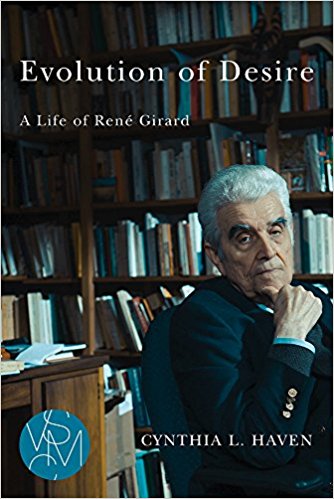
“Evolution of Desire: A Life of René Girard” – it’s #6 at Moscow’s leading bookstore!

August 18th, 2021
Share
Maria Stepanova

Summertime is slow in Russia, but fortunately that hasn’t been the case for sales of Evolution of Desire: A Life of René Girard. Reviews of the brand-new Russian edition, out with the eminent Moscow publisher New Literary Observer last spring, have been slow in reaching sunny California (though we excerpted a terrific article by Alexey Zygmont here, which concluded “it’s hard to wish for a better biography of Girard”).

In English

Hence, I’m reliant on my Russian friends for news. One of them is the eminent poet and publisher Maria Stepanova, who reassured me. “Yes, it is a big hit here – and there have been rave reviews,” she wrote. “I’m so glad it has such a good following.”

One data point, she said, is Moscow’s leading bookstore, Falanster (Фаланстер) – where it’s the #6 bestseller. Note the photo above that is featured on Falanster’s Facebook page. Count six from the left – there. That’s me, with the grey-and-orange spine.

The Falanster cat

Don’t believe me still? Check out the list below, and find out the other books Muscovites are reading, too. I hope my reviews for my book on the French theorist create a larger worldwide audience for the man who wrote about human nature, human history, and human destiny.

I’d love to visit Falanster in person – it’s been too many years since I’ve been in Russia. Meanwhile, I send my love to Moscow, and, as Maria wrote: “Moscow loves ya back!”

Want to visit the homes of the stars? Why?

August 16th, 2021
Share
Editor extraordinaire

Editor-in-chief Boris Dralyuk of the Los Angeles Review of Books may be a celebrated poet and translator now, but he had a brief, humiliating, all-too-youthful stint hawking maps to the homes of the film industry luminaries decades ago. An excerpt from his blog:

For exactly one Saturday, in the summer of 1996, I stood on the corner of Sunset Blvd. and Ogden Dr. hawking maps to the movie stars’ homes. Earlier in the week, six of us, all immigrants from the former USSR, had been rounded up for the job by a Fagin-like fellow — stringy, squinty, coils of white hair sticking out like fried electrical cords from the back of his baseball cap. I don’t remember whether I had my mother sign a minor’s work permit or simply forged her signature, but I do remember that I sold exactly one map.

Unforgettable too was the look of disgust on our Fagin’s face as he peeled a fiver off his soggy roll of bills at 5 pm: my salary. The pay was piddling, the task demeaning. There was little shade on the corner, and I was too easily wounded by the reactions of some of my potential customers, their rude sneers and pitying frowns. To this day I accept every flyer handed to me on the street with a smile, recalling my own unhappy turn as a peddler.

Sellers of star maps were ubiquitous during my early years in Hollywood, but something drove them off them off the streets in the 2000s. I suppose it was the double threat of the internet, which made celebrity addresses free and easy to find, and reality television, which fed viewers the illusion of round-the-clock access to certain celebrities’ private lives: why drive around in the hope of spotting a star in the distance when you can sit at home and watch them squabble in their own kitchens?

Read the whole thing here.

Want to leave the planet? Try visiting the Buddhas of the Gandhara at BAMPFA.

August 13th, 2021
Share

Jeff Bezos had it wrong. You don’t have to pay hundreds of thousands of dollars to leave this planet. All you have to do is go to 2120 Oxford Street in Berkeley to see the current (through October 3) Berkeley Art Museum and Pacific Film Archive (BAMPFA) exhibit, “Beyond Boundaries: Buddhist Art of Gandhara.” It was my own birthday choice (and a gift) a few weeks ago, and it was an out-of-this-world experience. (UPDATE: This exhibit has been extended through March 13, 2022.)

From the exhibit website: “The Gandhara region of northern India served as a crossroads of power, culture, and Buddhist art from the second to ninth centuries AD. Presenting rare images of the Buddha and his life story, this exhibition demonstrates through thirty-six sculptural examples from public and private collections the important cultural exchanges between the Hellenistic world of Greek and Roman art and the native artistic traditions of India. Artisans of this region took a new, humanistic approach to depicting the Buddha in clothing and settings drawn from the West and combined them with descriptive tales of the life and teachings of the Buddha.”

The BAMPFA showing is the first substantial collection of Gandharan Buddhist art in an American museum in some time. And a chance to make some new friends … My own favorite, I think, is the mysterious gentleman at the bottom of this page, from a private collection. Whatever attribute he once held in his left hand has disappeared. So we can’t know for certain who he was intended to be. But the going bet seems to be a Bodhisattva Maitreya, a Buddha of the Future – and a quick Google search suggests he has a lot of brothers of the same name, who look just like him, in other museums.

Listen to a 47-minute virtual tour or get real-life tickets at the website here. Meanwhile, enjoy my photos below.

This 14th century gilt bronze Tibetan Buddha touches the earth, and so demonstrates his victory over the temptations of the demon Mara. He calls upon the earth to testify to his struggles over millennia to achieve perfection. This Shakyamuni Buddha looks to an era when his teachings will be accepted and understood. Note the trendy blue curled hair!
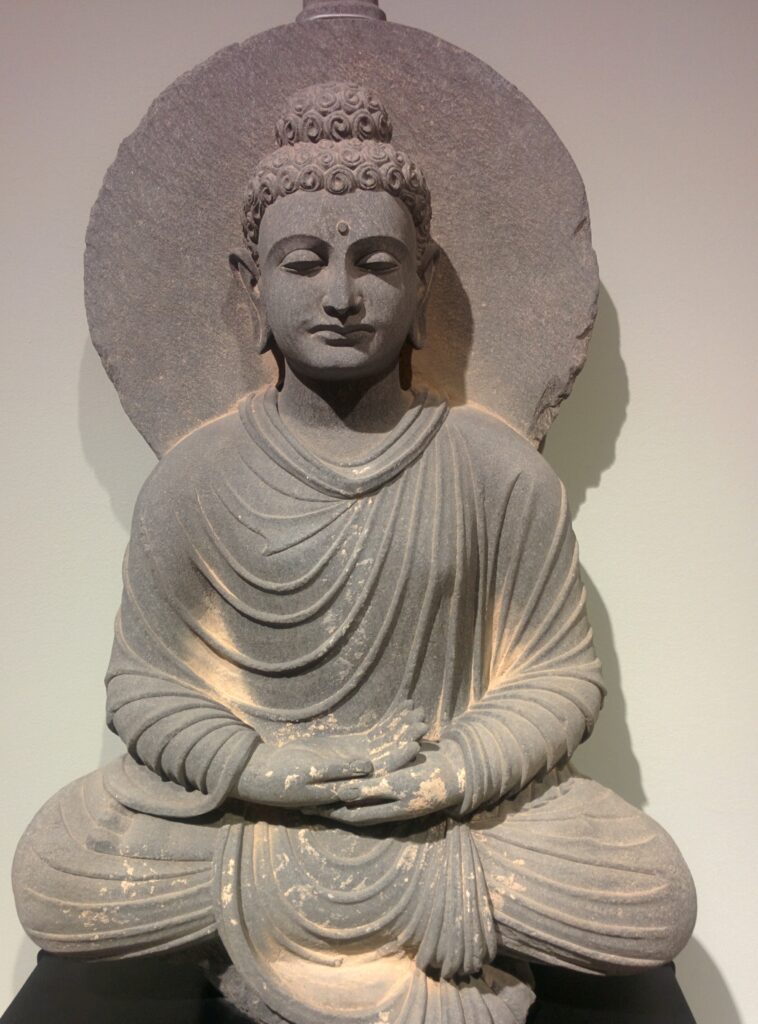
This 3rd century Buddha makes the classic meditation posture, cross-legged in lotus position, with his hands gracefully in his lap.
A seated Buddha making a gesture of reassurance with his raised right hand, 3rd – 5th century AD. In the middle of his palm, the wheel of dharma. He holds the hem of his robe in his left hand.
My guy. If he held a flask or a pot, we could be more certain that he was a Bodhisattva Maitreya, a buddha of the future. What attracts me to him? His slightly wild aspect, with thick curls cascading to his shoulders, the heavy earrings that feature winged lions, the slightly barbaric necklace with monsters on it. What else to like? The ropes of ornament looping around his right shoulder and the armplate on his bared arm. The curled and carefully styled moustache over the sensual mouth, under the serene half-closed eyes. He seems to have a distant Persian cousin to me, but hey, what do I know?


<<< Previous Series of PostssepNext Series of Posts >>>