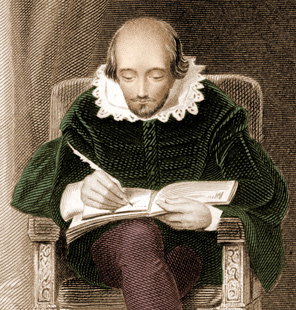
Happy birthday, William Shakespeare! The bard on freedom, imitation, and coronavirus

April 23rd, 2020
Share

On thinking? He had a lot to say about it.

It’s Shakespeare’s birthday, so it only seems appropriate that we baked him a little cake. There’s an even better way to celebrate, however, and that’s to bring our readers’ attention to Scott Newstok‘s How to Think Like Shakespeare, just published by Princeton University Press.

Newstok’s thing is education, and contrary to all-too-commonly held views, Shakespeare got a top-notch one. Newstok outlines the basic principles Shakespeare learned in a Chronicle of Higher Education essay:  a grounding in rhetoric (which has gotten a rather bad name in our time), imitation, inventio, traditio. (Well, honestly, they’ve all gotten a bad name.)

On rhetoric:

Antonio Gramsci described education in this way: “One has to inculcate certain habits of diligence, precision, poise (even physical poise), ability to concentrate on specific subjects, which cannot be acquired without the mechanical repetition of disciplined and methodical acts.” You take it for granted that Olympic athletes and professional musicians must practice relentlessly to perfect their craft. Why should you expect the craft of thought to require anything less disciplined? Fierce attention to clear and precise writing is the essential tool for you to foster independent judgment. That is rhetoric.

On imitatio:

As Michel de Montaigne put it: “The bees steal from this flower and that, but afterward turn their pilferings into honey, which is their own. … So the pupil will transform and fuse together the passages that he borrows from others, to make of them something entirely his own; that is to say, his own judgment. His education, his labor, and his study have no other aim but to form this.”

To add to our little mini-celebration, here’s an excerpt from Newstok’s interview with Scott Jaschik‘s over at the current Inside Higher Education:

Q: And on freedom?

A: When Caliban cries out for freedom, he falls for a drunk Stephano, who sings, “Thought is free.” Yet at this moment, Caliban’s not free — he’s just transferred his bondage to “a new master.” Real freedom would demand not only being slave to no one, but being his own master.

I’ve come to believe that a better translation of the emancipatory artes liberales would be the “crafts of freedom.” These practices cultivate a thinking citizen — the bane of every despot. Such an educational program presumes that freedom is fragile, demanding endless exertion: “there is nothing more arduous than the apprenticeship of liberty.”

I end the book with the fantastic James Baldwin essay “Why I Stopped Hating Shakespeare,” which concludes, “My relationship, then, to the language of Shakespeare revealed itself as nothing less than my relationship to myself and my past.” At first, Baldwin sought freedom from having to read Shakespeare, yet he came to relish the freedom to make Shakespeare his own. In doing so, Baldwin achieved a mutual recognition in Shakespeare that few of us ever reach – “an inner freedom which cannot be attained in any other way” than by inhabiting other minds through art.

“I feel like the crisis has given us a kind of X-ray into everyone’s souls”

Q: What do you think your book can offer today, when we are focused on the coronavirus?

A: That’s kind of an up-to-the-minute version of the utility question, isn’t it? We quickly exhausted the “What Shakespeare Did During the Plague” takes. The plaintive cry of Sonnet 65 comes to mind:

How with this rage shall beauty hold a plea,
Whose action is no stronger than a flower?

I’m starting to feel like the crisis has given us a kind of X-ray into everyone’s souls. To cite one of countless examples I’d never thought I’d see laid so bare: Do you think the postal service should be privatized, or are you grateful for its countless daily decencies? In terms of education, would you cheer if half of all universities went bankrupt, or do you cherish close learning? Should we only read contemporary prose, or might poets from the past have something to offer us?

On a more mundane level: my chapters are mercifully short, well suited to “this distracted globe”! And the book’s packed with apt quotations. At the least, they might provide a momentary stay against confusion; at best, an inspiration to seek out “the treasures that prevail,” a handbook for what matters once we emerge from the wreckage.

Oh yes, the cake… we just pulled it out of the oven!

Dana Gioia’s archives go to Huntington, Stanford – including “tens of thousands” of letters!

April 20th, 2020
Share

Dana Gioia’s books, manuscripts, libretti are now at the Huntington Library.

Dana Gioia is a man of letters in the time-honored sense of the term, influencing our culture as a poet and essayist, but also as a translator, editor, anthologist, librettist, teacher, literary critic, and advocate for the arts. His correspondence was extensive, and it went on for decades. Hence, his archive is a treasure trove, and though he has had offers from other institutions to acquire it, he wanted his papers to stay in California. Now they will. He has donated his substantial archive to the Huntington Library, Art Museum, and Botanical Gardens, which announced today it had acquired the papers of the poet and writer who served as the chair of the National Endowment for the Arts from 2003–09 and as the California Poet Laureate from 2015–19.

Dana Gioia in L.A. with friend, Doctor Gatsby (Photo: Starr Black)

It is the second large donation he has made in the last year. Last August, he gave to Stanford the large archive of Story Line Press, which he co-founded. The papers are the central archive for the New Formalism movement. The archive includes a number of people who have spent time at Stanford, including Donald Justice, Donald Hall, Christian Wiman, Paul Lake, Annie Finch, and of course Dana himself, among others. Stanford Libraries already holds the archive for The Reaper, so this is a natural pairing with that irreverent journal.

The larger Huntington archive includes correspondence with many of the major poets and writers for the last several decades, including Elizabeth Bishop, Anthony Hecht, Richard Wilbur, Ray Bradbury, Rachel Hadas, Jane Hirshfield, William Maxwell, Thom Gunn, Edgar BowersKay Ryan, Robert Conquest, Julia Alvarez, Thomas Disch, Cynthia Ozick,  Donald Davie, Anthony Burgess, John Cheever, J.V. Cunningham, and even some musicians, such as Dave Brubeck. It also includes his own books, manuscripts, and libretti. “Even after I pruned my correspondence, there is a lot of letters – in the tens of thousands,” said Dana.

“When I told my brother Ted that I had made the donation, he commented that I wanted my papers to be at the Huntington because our mother took us there as children. ‘You’re probably right,’ I said. I  still remember seeing the elegant manuscript of Poe’s ‘Annabel Lee’ there nearly sixty years ago. It was my first glimpse into that enchanted kingdom by the sea called poetry.”

The Huntington picked up 71 archival boxes last December – the first part of his donation. Then Dana Gioia had a more urgent task: the next day he flew back to northern California home, which sustained fire damage during last year’s Kincade wildfire.

From the Huntington release:

The archive documents Gioia’s work as a poet through fastidiously maintained drafts of poems and essays from his books, which include five books of poetry and three books of critical essays. He is one of the most prominent writers of the “New Formalist” school of poetry, a movement that promoted the return of meter and rhyme, although his arts advocacy work situates him in a broader frame.

The archive en dishabillé, as Mary Gioia helps organize.

“In his correspondence, you see a writer who has been willing to engage the young and old, the esteemed and emergent—anyone who wants to critically discuss poetic form, contemporary audiences for poetry, and the importance of literary reading during decades when popular culture has become increasingly visual and attention spans have fractured,” said Karla Nielsen, curator of literary collections at The Huntington. “We are delighted that Dana has entrusted his papers to The Huntington, where his collection fits perfectly. He is a local author—he grew up in a Mexican/Sicilian American household in Hawthorne—and even as he attained international recognition as a poet and assumed the chairmanship of the NEA, he remained loyal to the region and invested in Los Angeles’ unique literary communities.”

“I’m delighted to have my papers preserved in my hometown of Los Angeles, especially at The Huntington, a place I have loved since the dreamy days of my childhood,” said Gioia.

While the range of correspondents in the collection is broad and eclectic, the sustained letter writing with poets Donald Justice, David Mason, and Ted Kooser is particularly significant.

Gioia’s work co-editing a popular poetry anthology textbook with the poet X. J. Kennedy from the 1990s to the present will interest scholars working on canon formation during those decades when the “culture wars” were a politically charged issue.

A portion of the materials represent Gioia’s work as an advocate for poetry and the arts at the NEA and as the California Poet Laureate. This work is integral to his career and will be important to scholars interested in the place of poetry and the role of reading for pleasure within greater debates about literacy and literary reading at the beginning of the 20th century. … At The Huntington, Gioia’s archive joins that of another businessman poet, Wallace Stevens; that of a very different but also quintessentially Los Angeles poet, Charles Bukowski; and those of two other New Formalist poets, Henri Coulette and Robert Mezey.

Tens of thousands of letters and much more – now at the library his mother Dorothy Ortiz took Ted and Dana Gioia to visit as children. Dana remembers the Poe manuscript of “Annabel Lee.”

Jane Austen: Is “Mansfield Park” her most daring book?

April 18th, 2020
Share

Henry Crawford leads Fanny Price to the dance.

Is  Mansfield Park  Jane Austen’s “most daring book”? Janet Todd thinks so, and argues in The Times Literary Supplement that the 1814 book “provokes the reader to address the difficult truth of stubborn integrity.” I, too, balked at the priggishness of Fanny Price. I, too, was repelled by her moralizing. On the other hand, I kind of wish I had listened. As for making “astonishingly foolish life-choices” under the influence of some those other great writers of the nineteenth century – oh, ’tis true, tis true. 

One of my earliest memories of literary embarrassment is being asked by a bookish neighbour if I’d read Jane Austen. I was eleven. “Yes”, I replied. But I was mistaken. I had in mind the fantastic Classic Comics version of Jane Eyre with its alluring panel of Mr Rochester.

By nineteen, at Cambridge in the 1960s, I’d uncoupled Jane Austen from Jane Eyre. I read the six novels which F. R. Leavis, the then guru, instructed us to find “great”. I couldn’t oblige. I was startled, then offended, by Fanny Price of Mansfield Park. Why would an author who’d made the robust, witty and self-assured Elizabeth Bennet then create so limp and teary a heroine as Fanny, a creeping killjoy who suffers sunstroke from cutting roses in temperate England and fears the “wilderness” of a tame country estate? Until the ending, I assumed her rival Mary Crawford would get the hero – if, bizarrely, she really wanted him.

Over the decades I became acutely aware that Elizabeth Bennet (in the later chapters) and Fanny Price were more appropriate, self-controlling, guides to life for a young girl than my chosen heroines from Tolstoy and Dostoevsky, the Grushenkas, and Natashas, under whose influence I made some astonishingly foolish life-choices. It wasn’t all the fault of the Russians, of course. It was also the exciting period of Second Wave Feminism, when the stress was on self-fulfilment and self-expression, on being authentic and free from constraining standards of “patriarchy”. Present-day Feminism – I’ve lost touch with what Wave we are now riding – has had half a century to grow more nuanced and diverse, but its emphasis on the individual self and authentic experience remains. So we still try to adjust Jane Austen to our way of thinking – unless we are in the cinema watching her novels as romance and costume drama.

Read the rest at the TLS here.

Teaching Tobias Wolff’s “Old School” to Hungarian teens – along with the reasons for rhyme

April 16th, 2020
Share

A staircase Varga Katalin Gimnázium in Szolnok, Hungary

Can Hungarian teenagers “get” an American novel set all the way back in the Kennedy Era? For a magical semester, author, educator, and translator Diana Seneschal taught her ninth-grade students at Szolnok’s Varga Katalin Gimnázium a novel by Stanford writer Tobias Wolff – in particular, 2003’s Old School. The upshot: they loved it. She had hauled copies all the way from the U.S. for her 33 students, paid for with an honorarium she had received in the U.S. At the beginning of the semester, Diana wrote me: “In addition, they have already read some Frost, we will read a Hemingway story or two, and I will tell them enough about Ayn Rand that they understand the change in the narrator’s response to her writing and attitudes.”

The reaction from her classes was enthusiastic: “One of the students asked her after the first class, ‘Is this book really for me to keep?'”

“When I told him it was, he said he was happy because he expected to reread it in the future. ‘I think this is my favorite book,’” he said.

The Book Haven met Diana via her translations of the eminent Lithuanian poet (and our mutual friend), Tomas Venclova. So it’s fitting we republish this description of one of the classes, in which Wolff’s fictional students discuss poetry:

The third chapter of Tobias Wolff’s Old School, “Frost,” has the following exchange between the narrator and Purcell (p. 44):

Frost. I don’t even know why I bothered submitting anything, given how he writes. I mean, he’s still using rhyme.

Yeah, so?

Rhyme is bullshit. Rhyme says that everything works out in the end. All harmony and order. When I see a rhyme in a poem, I know I’m being lied to. Go ahead, laugh! It’s true–rhyme’s a completely bankrupt device. It’s just wishful thinking. Nostalgia.

The situation was this: At the beginning of the third chapter, we learn that George Kellogg, the excessively benevolent editor of the Troubadour, has won the first contest and will thus get to meet with Robert Frost. Purcell dismisses the whole enterprise.

Stanford author Tobias Wolff

First I asked the students to explain what Purcell was saying. They did it, point by point. Then I asked what they thought of it. In the first section, one student burst out, “That’s what I think.” A few others seemed to concur. They gave reasons: to rhyme, you have to invent something; rhyme sounds pretty, whereas the world often isn’t; rhyme imitates other rhymes and rhymers. Then I asked whether anyone saw or heard rhyme in a different way. Hands shot up. One student said that good rhyme is hard, so you can admire it. Another said that we are drawn to harmony. Another said that rhyme makes a poem memorable. Another suggested that Purcell was speaking out of jealousy. Then we started talking about how rhyme can draw associations between things.

The other section was more subdued but just as perceptive. Most of them rejected Purcell’s complaint from the start. One student pointed out that you can rhyme with the word “chaos,” in which case you aren’t creating harmony at all. Another said that we rhyme all the time, that rhyme is part of our everyday language. Others talked about how rhyme makes you think.

Author, teacher, translator Senechal

This set us up well for the next lesson, where we discussed the rest of the chapter. When I arrived, I saw students discussing the novel in the hallway.

At the start of the lesson, I played a muffled recording of Frost reading “Mending Wall,” which they had read with me. In the first section, no one seemed to know what was going on until the very end, when one student cried out in Hungarian, “Emlékszem!” (“I remember it!”). In the other section, they recognized it right away. We then talked about the passage in Old School where the headmaster introduces Frost, and the one where the narrator’s understanding of “Mending Wall” changes as he listens to Frost reading it aloud. (This is a fictional Frost, but I can imagine Frost reading like this.)

Then the teacher Mr. Ramsey’s challenge: Aren’t those poetic forms–rhyme, stanzas, etc.–outmoded? Shouldn’t poetry reflect modern consciousness? And Frost’s response (of which this quote, from p. 53, is just a fraction):

Grief, not grievance

I am thinking of Achilles’ grief, he said. That famous, terrible, grief. Let me tell you boys something. Such grief can only be told in form. Form is everything. Without it you’ve got nothing but a stubbed-toe cry—sincere, maybe, for what that’s worth, but with no depth or carry. No echo. You may have a grievance but you do not have grief, and grievances are for petitions, not poetry.

You could read all the class lessons here. Or read her blog Take Away the Takeaway here. Or go to her TED talk here

Robert Harrison in NZZ on quarantines, language, literature: “The social conversations of educated, successful people in Silicon Valley are of a poverty that frightens me again and again.”

April 13th, 2020
Share

The brigata gather to hear the tales of “The Decameron” (Painting by John William Waterhouse)

René Scheu, editor of the eminent Neue Zürcher Zeitung, recently  interviewed Stanford’s Robert Pogue Harrison for Switzerland’s eminent German-language daily. Read it in German here. An excerpt in English below:

Mr. Harrison, we are having this conversation via Skype. This is due to the situation we both currently live in. I see you are sitting in your study in your wonderful house on the Stanford campus, which I know is surrounded by nature and trees. Your books can be seen in the background of the room. . .

… yes, my private library, my books! They are my friends, in times of crisis and in normal times.

So, to be perfectly honest, how is your life in quarantine?

My life in quarantine is undoubtedly less dramatic than that of my relatives and friends in Italy. They are no longer allowed to leave the house, and the state intervenes drastically in their private lives–this put pressure not only on liberal minds. In California, we are required to stay indoors whenever possible, but we are not legally required to do so. So I feel restricted, but I don’t feel like a prisoner in my own house.

It sounds almost like you save yourself for your new position as a dedicated observer. Is that impression right – or are you constantly rubbing your eyes hoping to wake up from this surreal nightmare at some point?

Harrison on language: “we use it to shape ourselves.”

I feel–as others do these days–a constant mental and emotional tension that is paralyzing in the long run. It stems from a basic mood of angst–and I think we should use the German word in an existentialist sense here. On the one hand, we feel angst very concretely, so to speak in every waking second of this crazy time, and at the same time it remains–in contrast to angst–very diffuse. What are we afraid of? Well, in fear we get the world as such, the being as a whole, is lost. Martin Heidegger says that the big picture is slipping away from us.

***

In order not to go crazy, you held a semi-public seminar about Giovanni Boccaccio’s Decameron, the quarantine book par excellence, above all.

I agree . . .

Briefly, pro memoria: It is about the Black Plague in 1348, which wiped out half of the European population. Seven women and three men retire to an estate and tell 100 stories to celebrate human life. They all survive.

No question: Boccaccio’s masterpiece is the book of the hour. And although some now quote it, it’s not only literary, but also its practical relevance is wide and still underestimated. It doesn’t celebrate escapism or pleasure in the face of catastrophe, no, it celebrates prudence in life, which is prudent for survival.

Boccaccio is relentless in his introduction, in which he describes the raging plague in Florence with unprecedented levels of detail. He differentiates between those who isolate themselves and renounce all social contact, those who live as if there is no tomorrow, and those who take flight. But nobody escapes the plague, it affects everyone.

Yes, the great Boccaccio provides a clinical sketch of life in the sign of black death. Those who only fight for survival will not survive. That is one of his cruel points.

When medicine and faith fail, only storytelling helps, according to Boccaccio.

Ten young people withdraw to the country, organize their lives, make every day precise, eat, drink, dance in a perfectly designed setting and tell ten stories in ten days, each in this environment. This storytelling is the human immune response to a physiological as well as a sociological crisis. Boccaccio focuses on this second meaning, and today, under the sign of the coronavirus, we think about it far too little.

***

In a comprehensive sense, the ten young people are rebuilding a world in their minds that is a substitute for the world they had previously lost through the plague.

Interlocutor René Scheu, editor-in-chief  of NZZ

I think now you’ve touch the heart of it. Institutions cannot revitalize them–but they regulate their days, make agreements, and adhere to them. And in their minds they create a new world into which they literally merge. It is a world with new, funny, and tragic protagonists with whom they can identify to a certain extent–because the center of every good story is always the same: being human. Sharing a common world helps them achieve mental stability and health. And this in turn ensures their survival. Narrative as a strong immune response: that’s what is at stake here.

The first tale is about a cheater and a sinner. Ser Ciappelletto lies so consistently and convincingly, even in the last hours of his life as he confesses, that he ends up going down in history as a saint. This novella is a story about the art of novellare itself, and it is as if Boccaccio told us that a good story need not necessarily be true. Or is it about a different, as it were poetic, truth?

The story of Ser Ciappelletto is about falsehood and lies, of course. But this mafioso was a first-rate cheater, and in the end, in the face of death, he was even able to convince the priest of his goodness. Ser Ciappelletto was a fantastic narrator before the Lord. As soon as the story about him goes viral and people continue to talk about what a pious and godly person this man was, it has an all-round positive effect: the listeners want to emulate Ser Ciappelletto’s example. They also want to become such a charitable and godly person, as he was supposed to be. It is here that history has proven itself on a higher level. To put it in a nutshell: only a really good story is true in the sense that it has a productive effect and that it helps people to advance in their own lives. It becomes true by making it true.

So Boccaccio was an incorrigible optimist because he shows how the worst person can make a story that inspires other contemporaries.

On the one hand, Boccaccio shows us how a bad cheater makes other people stronger in their belief–and on the other hand, he lifts the veil and lets us see how we indulge in fictions. But we need these fictions to outgrow ourselves in life. So for Boccaccio there are only stories that help us live better and stories that help us live worse. That is its form of radicalism.

Storytelling is a pretty dangerous thing.

Storytelling is not the pleasure of a few privileged people who escape the plague, no, storytelling is at the heart of our social life. Every institution, every religion, every civilization is based on a good story. Let us  think of our founding stories – those of Western Christian culture, our state, our age. All of these stories – which are somehow true, but never quite and literally – all of these stories strengthen our identity, and nothing man-made could exist without them. But as powerful as stories are, fake news can also be dangerous. They are highly contagious, infect our minds, and make us sick.

The good news is that really good stories go more viral than fake ones. They help to increase mental fitness. Boccaccio provides a lot of such stories in his Decameron. In this respect, he actually left us a kind of survival guide that we can use at any time.

Good stories strengthen the immune defense of the symbolic being that we humans are. Bare life is not a purpose in life, even if the plague or the corona virus is raging, although the latter is rather mild in comparison.

Pampinea speaks of the ben viver d’ogni mortale, of the good life worth living of every mortal.

The story of Ciappelletto (Vatican Library)

If you ignore the shape and the culture, you may survive biologically, but not as a person. We becomes an animals – Boccaccio compares uomini with capre in his description of the raven in Florence, he speaks of bestialità. Anyone who behaves like an animal will eventually become an animal.

So is Boccaccio the discoverer of what psychologists today call self-efficacy?

In a way, yes. Depending on how I present myself, I can influence the behavior of others–and these others in turn affect me. So in the end, whatever you say, think or do, it affects your fellow human beings and yourself. On the sixth day in the Decameron, there are some stories that deal with that. Male protagonists behave in rough and vulgar ways towards women. But women react with elegance, and men are ashamed of themselves and change their behavior by showing themselves at their best. It’s as if  women increase men’s self-esteem. So I think you are absolutely right with your inspiration: Boccaccio is a real humanist in that he constantly wonders how we can do it.

Boccaccio sees man as a being that forms itself. Almost 150 years later, Pico della Mirandola will deliver the programmatic text for this new, modern anthropology with his Speech on Human Dignity: God has created an unfinished creature that is not fixed and therefore called to form itself.

Boccaccio’s heroes are never passive victims of circumstances or fate, but are always creative actors. They take the initiative and show imagination, sensitivity, or quick comprehension to achieve their goals, be they noble, or profane, or sexual in nature. So you can say: the protagonists always make the best of themselves and the situation they are in, they learn and improve constantly. Their behavior is not set in stone, but adapts to the circumstances–and that is what makes Boccaccio so fascinating for us modern people.

***

Our whole social life is inconceivable without using our language. Through it, we become the beings that we are. We use it to shape ourselves every day. Depending on how we speak of ourselves, we act accordingly. In this respect, the language has a domesticating and ennobling function. We must never forget that!

Are the tech geniuses populating Silicon Valley aware of this?

I’m less optimistic on this front. The Valley is full of extremely intelligent people who articulate themselves artfully, but in a very prosaic, technical way. They are only interested in an understanding of problems and content, not the form, the beauty, the punchline. Let’s take the handwriting. When I attended school, the essay was graded according to two criteria: content and form, because both together make up the beauty of the story. And take a look at the handwriting of our tech geniuses today, if they even pick up a pen–they remind you of children’s handwriting.

Now you sound like a harsh cultural critic. Most people use a keyboard anyway or speak to their smartphone–this is easier and more efficient.

Yes, of course. But if you can no longer write, you may not be able to speak well. The social conversations of educated, successful people in Silicon Valley are of a poverty that frightens me again and again. Of course, when it comes to closing a deal, no novellare is required, although it certainly has a positive effect on sales. But the same poor language that applies in business has long shaped everyday social life. And this makes us poorer. When I go out to eat with a tech entrepreneur and we talk about where we’re from and what we’re doing here, I want to hear a story from him. What fascinates us about people is not the facts of their life, it is the stories they tell about themselves!

And the stories are dying out?

No. It’s just that they have been outsourced to only some of us. They watch fantastic Netflix series because they satisfy this basic human need. These are professionals at work, no question, and they know how to tell a good story well. The art of novellare has not changed since Boccaccio. So now people sit in front of the screen and consume stories, but they no longer work on their stories themselves. And that’s guaranteed to make your own life poorer.

If we look at the same Netflix series, we can at least talk about it and form a community.

Naturally. But we also have to do this with eloquence and elegance–we ourselves have to become storytellers, no one can do this work for us. But it is the most beautiful job I know.

We learn to tell stories when we read stories.

Read! Read! Read! Read Boccaccio. It will change your life. For Boccaccio, generosity and gratitude are the two greatest virtues: be grateful for what you have received. And pass it on with the same generosity. And that’s exactly how it is: literature is a gift that never ceases to give itself. Why shouldn’t we, now in quarantine, be so wise to accept this gift and become a giver ourselves?


Ted Gioia on music as a survival tool: was it a precursor to language?

April 9th, 2020
Share

Ted talking music, as always… (Photo: Brenda Ladd)

According to Spencer Kornhaber, writing in The Atlantic, “It might seem like a no-brainer that togetherness is a primary benefit of music. But think about that idea in relation to the ways of listening enabled by 20th- and 21st-century technology. When you tune your earbuds to a playlist on a crowded subway, or blast your favorite album alone in your car, what are you doing? You’re regulating your own mood. You’re occupying your mind. You’re enjoying an art form that captures the ineffable. These are great things. But if you’re plugging into a greater human whole, it’s only in a notional way: a feeling of closeness with the singer, perhaps, and with their far-flung fan scene, maybe. To unlock music’s pleasures, past generations had little choice but to do it in a more directly social way. And by past, I mean ‘very past.’”

What inspired the article? None other than Ted Gioia , we’ve written about him here and here and here, and elsewhere:

This thinking had been informed by reading Ted Gioia’s 2019 book, Music: A Subversive History, which took a sprawling and feisty look at songs’ role across all of human existence. What Gioia makes clear up front is that music in our distant past was a survival tool. To say it helped cohere Stone Age humans into communities is an understatement; music may have actually been a precursor to language. It also may have helped people scare predators away, or herd them so as to hunt them. Music’s physiologically entrancing properties were put to use both in warfare and in medicine.

What’s most difficult for a modern reader to comprehend is that early songs may have existed without some concepts we think of as integral. The notion that music could express a singer’s inner life had to be invented, Gioia argues. So did the idea that songs even had defined, nameable authors. “Note that I haven’t used the word audience yet,” Gioia writes in an early chapter on prehistoric times. “Certainly there were participants—there always are in rituals, where even those who remain silent are integrated into the proceedings … In contrast, the concept of an ‘audience’ for a musical performance is foreign to many traditional cultures. The hierarchies of modern-day entertainment, which radically separate performer from spectator, rarely apply to these situations, in which everyone is invited to contribute, to some degree, in the musical life of the community.”

He goes on, “For the same reason, music is frequently connected to dance in traditional societies—so much so that any attempt to isolate a ‘song’ and assess it in the same way a musicologist studies a movement of a Beethoven symphony is often an exercise in futility and self-deception.”

Read the whole fascinating article here.

What’s my upper during these times?  Maurizio Marchini singing “Nessun Dorma” from Puccini‘s Turandot during the tight quarantine in Italy, during the height of the pandemic. (You can read more about him here.)


<<< Previous Series of PostssepNext Series of Posts >>>