
The meaning of love in politics: What Hannah Arendt wrote to James Baldwin

August 2nd, 2019

Share

Today is James Baldwin‘s birthday. To celebrate, here’s a portion of “Letter from a Region of My Mind,” which appeared in The New Yorker on November 17, 1962 – and then Hannah Arendt‘s reply. In his essay, Baldwin concluded: 

When I was very young, and was dealing with my buddies in those wine- and urine-stained hallways, something in me wondered, What will happen to all that beauty? For black people, though I am aware that some of us, black and white, do not know it yet, are very beautiful. And when I sat at Elijah’s table and watched the baby, the women, and the men, and we talked about God’s – or Allah’s – vengeance, I wondered, when that vengeance was achieved, What will happen to all that beauty then? I could also see that the intransigence and ignorance of the white world might make that vengeance inevitable – a vengeance that does not really depend on, and cannot really be executed by, any person or organization, and that cannot be prevented by any police force or army: historical vengeance, a cosmic vengeance, based on the law that we recognize when we say, “Whatever goes up must come down.” And here we are, at the center of the arc, trapped in the gaudiest, most valuable, and most improbable water wheel the world has ever seen. Everything now, we must assume, is in our hands; we have no right to assume otherwise. If we – and now I mean the relatively conscious whites and the relatively conscious blacks, who must, like lovers, insist on, or create, the consciousness of the others – do not falter in our duty now, we may be able, handful that we are, to end the racial nightmare, and achieve our country, and change the history of the world. If we do not now dare everything, the fulfillment of that prophecy, re-created from the Bible in song by a slave, is upon us: God gave Noah the rainbow sign, No more water, the fire next time!

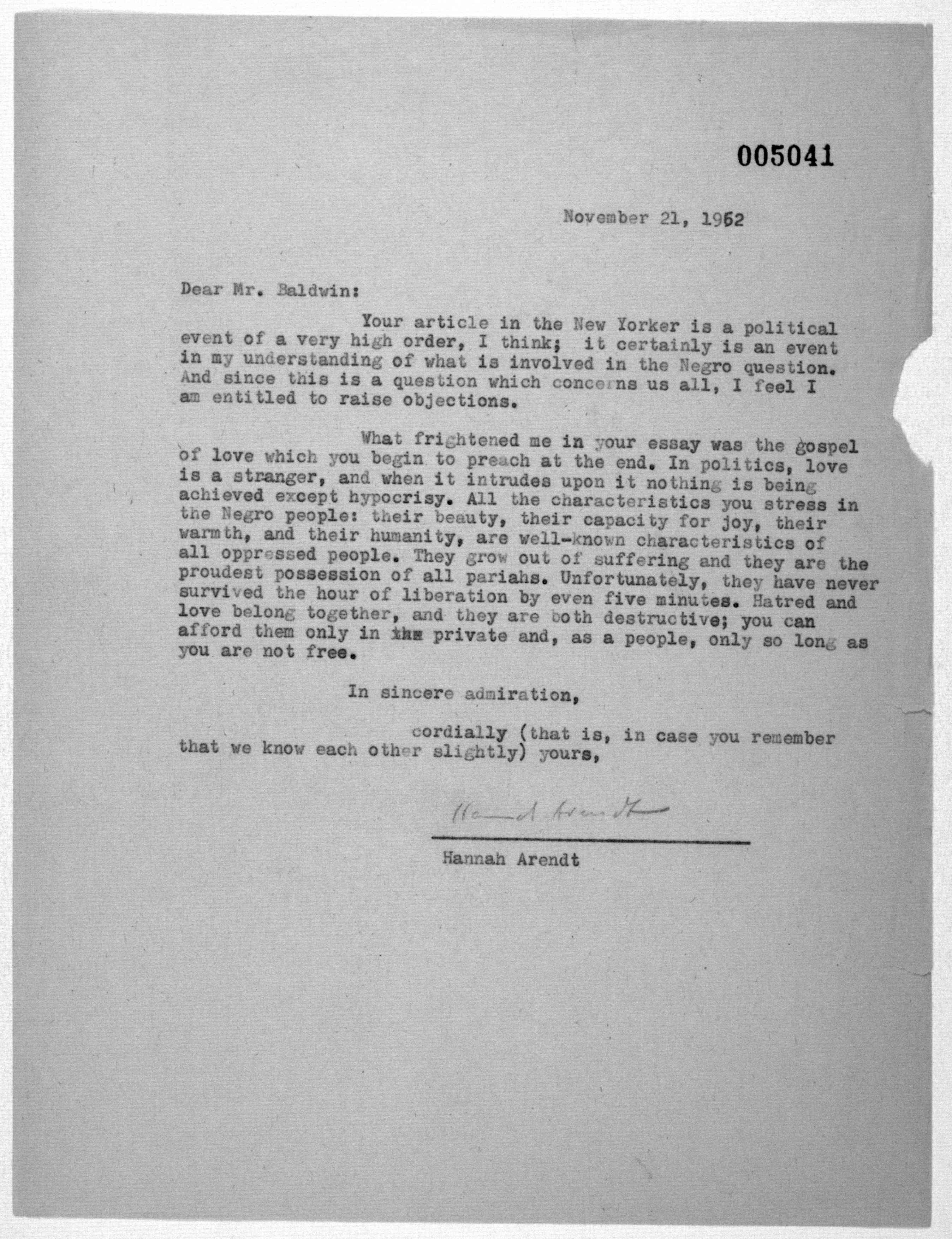
Here’s what Hannah Arendt, who knew him slightly, replied in a letter that is now at the Library of Congress:

November 21, 1962

Dear Mr. Baldwin:

Your article in the New Yorker is a political event of a very high order, I think;  it certainly is an event in my understanding of what is involved in the Negro question.  And since this is a question which concerns us all, I feel I am entitled to raise objections.

What frightened me in your essay was the gospel of love which you begin to preach at the end. In politics, love is a stranger, and when it intrudes upon it nothing is being achieved except hypocrisy. All the characteristics you stress in the Negro people: their beauty, their capacity for joy, their warmth, and their humanity, are well-known characteristics of all oppressed people. They grow out of suffering and they are the proudest possession of all pariahs. Unfortunately, they have never survived the hour of liberation by even five minutes. Hatred and love belong together, and they are both destructive;  you can afford them only in the private and, as a people, only so long as you are not free.

In sincere admiration,

cordially (that is, in case you remember that we know each other slightly) yours,
Warsaw at war, and a message of peace: “So this German takes off all his clothes…”

August 1st, 2019
Share

Sendler at the time of her interviews with Skinner. She died in 2008.

Today is the 75th anniversary of the beginning of the Warsaw Uprising in 1944. If you want to see Mikołaj Kaczmarek’s remarkable new “colorizing” of photos from the year-long Polish struggle that resulted in the defeat and destruction of Poland’s capital, go here

‘I was in shock – the past just came right out at me.” (Photo Mikołaj Kaczmarek)

According to Kaczmarek, “The first photo I tried was the girl next to a grave. When I finished, I was in shock – the past just came right out at me.” 

“They lived in a time of apocalypse and whether they wanted to or not they had to fight and they often died,” he said. “The colorization made me realize that they were people just like us, they just happened to live at that time.”

Meanwhile, we haven’t written for some time about Mary Skinner, the filmmaker who made In the Name of Their Mothersabout Holocaust heroine Irena Sendler‘s efforts that saved 2,500 children from the Warsaw Ghetto (see here and here and here and here). Below, an excerpt from Skinner’s interviews with Sendler in Warsaw, 2004. (Sendler died at 98 in 2008), where she describes living through the Warsaw Uprising:

“The Warsaw Uprising is in progress. I am in this Red Cross hospital but, in fact, it is a Home Army hospital. There are about a hundred patients. This is the end of August, and we have nothing to eat. One of the patients is a servant from a landowner’s family. She tells the hospital director that in the house opposite – which is destroyed, but the basement is intact – her employers left behind an entire basement full of food. Hams and sausages, everything. So we walk into this basement. And we’re loading sacks full of all this food – and in walks a German. He was startled to see us and we were alarmed to see him. His first reaction was to jab my leg with his bayonet. I have a scar on my leg to this day.

So he was startled. We were, too. He asks us what are we doing here and we tell him in our broken German that we came to pick up the food. He stood there, and he saw us behaving in a normal way. He tells us that he is in search of some civilian clothing. “I‘ve had enough of this killing. It has been five years now and I just want to get out of this and I’m looking for some civilian clothing.” So the servant says that her employers, before they left, had packed a suitcase full of good clothes. “So get out of your uniform and we’ll have you dressed.” So this German takes his clothes off and we dress him from head to toe in a very elegant suit and we tell him, “Just run away and stop all this killing and don’t kill anymore.” He said, “I’ve been killing for five or six years now. I have a wife and children and the war is almost over. I’ve had enough.” So we said, “Just run away and quit killing.”

And so he did.

Gjertrud Schnackenberg on the sound of poetry and the “unaging, perpetual chant” of bees

July 29th, 2019
Share

“We live in a vast sound universe.”

Gjertrud Schnackenberg, the great poet with the impossible name, has a two-part interview here and here. It’s not recent: the interview was published five years ago over  Canadian poet Susan Gillis’s top-notch blog (a more recent interview is here). There’s an even older interview with Jonathan Galassi, her publisher at Farrar, Straus, and Giroux over at Bloodaxe Books here. The 2011 piece is also excellent. Here’s an excerpt from the Gillis blog:

Poetry’s sympathetic vibration is like a buzzing tuning fork that awakens a nearby tuning fork to its own buzzing, or like a detonation in the street outside that inspires a door inside to pop open, or like the kung-note struck by the lute-tuner in ancient China to provoke a nearby lute-string to sound its own kung-note – or like the reverberations of the big bang still resounding and vibrating throughout all that exists: we live in a vast sound-universe, which is, mercifully, largely inaudible to us, but nonetheless oscillating everywhere, from superstrings to supernovae. Thousands of years ago, in the practice of meditation, the Vedic seers detected this perpetual vibration, and called it the “unstruck sound.” I think this pre-existent, anterior vibration is the force-field from which poets and composers strike their sound-worlds. Or perhaps it is the other way around: generative, reverberative, fugitive – and billions of years deeper and older than any vocabulary – the pitches, undertones, overtones, harmonies, dissonances, white noise, and rhythm-oceans from which we’re made, and in which we’re immersed, are an auditory, and sub-auditory, equivalent of the Poet’s description of poetry in Timon of Athens, when he says that whereas the “fire i’ the flint shows not till it be struck,” this unstruck thing – poetry – “provokes itself.”

He heard a hum…

Mallarmé describes the sympathetic vibration of poetry as being characteristically always on the verge of vanishing, a vibration in whose vanishing trace the poem “begins itself.” Less subtly, more concertedly, Mandelstam repeatedly describes what amounts to the “autonomous force” of poetry, and unforgettably, in Hope Against Hope, Nadezhda Mandelstam describes the “hum” that Mandelstam heard (and suffered) as a prelude to the starting-up of a poem, a hum that engulfed him, sometimes stopping him in his tracks, sometimes driving him out of doors to pace the streets, and often “tormenting him with its resonance” until he was able to start and finish the poem and be rid of it — a hum so audible and palpable to him that he told his wife that she should be able to hear it as well:

I witnessed his throes at such close quarters that M. always thought I must also be able to hear the “hum.” He even reproached me sometimes for not having caught part of it.

In ancient Greece, poetry and the art of writing were associated not only with gods and their divine concerns, but with honeybees. I love this ancient association, not only for its metaphor of honeyed speech, which is largely what the Greeks meant, but also for its dimension of resounding auditory energy. Personally, for me, the under-resonance I hear in a true poem is indistinguishable from the resonating buzz of a beehive; for me, poetry has to thrum. In the presence of poetry I love, when I read it silently, I often gradually (or sometimes abruptly) begin to overhear this seamless, thrumming continuum of bees preoccupied with their unaging, perpetual chant, their sonic evocation of the “unstruck sound.”

Read the whole interview here and here.

Remembering polymath scholar Dick Macksey: “There was no one like him, and no one will follow in his tracks.”

July 25th, 2019
Share

Richard Macksey,  at home and in the world – at the same time.

Johns Hopkins Humanities Prof. Richard Macksey, who died earlier this week, was born in two places at once. It seems somehow fitting. The anecdote is retold by Frederick N. Rasmussen in The Baltimore Sun today. In the professor’s words:  “I was born in a delivery room that was half in Glen Ridge and half in Montclair, N.J., so I have birth certificates from both towns,” he told the Johns Hopkins University newspaper in 1999. “You could say I was born in two places at once. But they are so alike, you wouldn’t notice the difference.”

Today Dick Macksey would have been 88. As good an excuse as any to cite some of the anecdotes, praise, and tributes for him, after our post on the day of his death here.

From Rachel Wallach in Lithub:

More than leading a life of aloof intellectualism, Macksey also existed fully on the human plane. A night owl, he was regularly spotted grocery shopping and volunteering at Baltimore’s The Book Thing late into the evening and in the early morning hours; he liked to solve the trivia questions posed during Orioles games at Memorial Stadium; and he featured his cat, Buttons, as his Facebook cover photo. A fan of film and film history, Macksey was an inaugural founder and supporter of the 1970s Baltimore Film Festival, a predecessor of today’s Maryland Film Festival.

It may have been partly due to his ability to exist on just a few hours of sleep that his presence had a way of being ever-present. Former student Rob Friedman, who graduated in 1981, remembers waking up at 1 a.m. to hear Macksey’s voice drifting through his apartment window, and glimpsed the professor walking down St. Paul Street and “yakking with five students.” On another occasion, Friedman awoke early and stepped outside at 6 a.m., only to find Macksey driving by and waving. …

A legendary figure not only in his own fields of critical theory, comparative literature, and film studies but across all the humanities, Macksey possessed enormous intellectual capacity and a deeply insightful human nature. He was a man who read and wrote in six languages, was instrumental in launching a new era in structural thought in America, maintained a personal library containing a staggering collection of books and manuscripts, inspired generations of students to follow him to the thorniest heights of the human intellect, and penned or edited dozens of volumes of scholarly works, fiction, poetry, and translation.

Macksey loved classical literature, foreign films, comic novels, and medical narratives—all subjects he taught at one time or another. Conversations with him were marked by a tendency to leap from one topic to another, connected by his seemingly boundless knowledge, prodigious memory, and sense of humor. For many at Hopkins and far beyond, he was no less than the embodiment of the humanities, both in intellect and spirit.

Whimsy: a card he emailed to me.

“Dick Macksey was a Johns Hopkins legend,” says James Harris, a professor at the Johns Hopkins School of Medicine, director of the Developmental Neuropsychiatry Clinic, and a longtime friend of Macksey’s. “He was a teacher, mentor, and friend to generations of Hopkins faculty and students. To me, he was the most erudite, kind, gracious, and considerate person I have ever known. He will be deeply missed and always remembered as the epitome of what makes Johns Hopkins a world-class university.”

From The Baltimore Sun:

“He was a man who read and wrote in six languages, was instrumental in launching a new era of intellectual thought in America, maintained a personal library containing a staggering collection of books and manuscripts, inspired generations of students to follow him to the thorniest heights of the human intellect, and penned or edited dozens of volumes of scholarly works, fiction, poetry, and translation,” Ms. [Rachel] Wallach wrote.

Rob Friedman, who graduated from Hopkins in 1981, studied with Dr. Macksey. “He was exuberant, funny, playful and an enthusiastic eccentric who lived on three hours of sleep and got up each morning at 6,” said Mr. Friedman, a businessman who lives in New York City.

“He loved everything and he loved to learn. There was nothing that didn’t enthrall him. He was extraordinarily generous, and he loved imparting his knowledge and listening to what you had to say,” he said. “For 60 years, he contributed his intellectual life to Hopkins and mentored generations and generations of students.”

And the Book Haven makes a humble appearance at the end:

Milton S. Eisenhower, former president of Hopkins, once said that going to Dr. Macksey with a question “was like going to a fire hydrant for a glass of water.”

“Dick was courteous, generous, witty, and talking with him was exactly as Milton Eisenhower said,” Cynthia Haven, a Palo Alto, Calif., author and blogger, who had been a visiting scholar at Stanford University, wrote in an email.

“For that reason, he was a tough man to interview: as digression piled on digression — each one a fascinating key to literature, history, philosophy, or a range of other subjects — it could be hard to recall what you had asked in the first place,” Ms. Haven wrote. “He was absolutely unforgettable. There was no one like him, and no one will follow in his tracks. He was unrepeatable. It was a privilege to know him.”

On Dick Macksey’s Facebook page, which has a cover photo of his cat Buttons, one former student recalled his lectures in which “digressions across diverse disciplines all tie back to the topic at hand; and somehow, everything made sense.” Within the first two classes, however, intimidated students dropped out en masse, which puzzled the professor. The student wasn’t a native English speaker, however, and wondered what she might have missed in the wide-ranging lectures. While munching on cookies during a break, she turned to a fellow undergraduate student and asked if she understood what he had said. “The girl, looking relieved by my inquiry, shared, ‘Oh no, not at all.’”


Postscript on July 29: Book Haven reader George Jansen writes to tell us that the Washington Post obituary is here,  and the first quotation is from Evolution of Desire: A Life of René Girard:  “In 1966, he organized an academic conference that introduced Jacques Derrida and other French critics to the nation, along with the new academic concept of deconstructionism. The gathering ‘changed the intellectual landscape of the nation: It brought avant-garde French theory to America,’ literary scholar Cynthia L. Haven wrote.”

Farewell Richard Macksey, legendary polymath and “the jewel in the Hopkins crown” (1931-2019)

July 22nd, 2019
Share

Approaching Richard Macksey with a question was like going to a fire hydrant for a glass of water. That was a comment made by Milton Eisenhower, brother of President Dwight Eisenhower and a former president of Johns Hopkins University. It is the best summation of the legendary polymath, polyglot, and bibliophile Dick Macksey that I know. I got to know the Johns Hopkins professor while doing research for Evolution of Desire: A Life of René GirardHe was one of the more difficult interviews I’ve ever done. Usually “difficult” interview means that the subject isn’t forthcoming. In Dick Macksey’s case, it was the opposite: I was losing control of the interview at every moment, as digression piled on digression, anecdote led to more anecdotes, until I couldn’t remember what I had asked.

Chez Macksey: a personal library of 70,000 books, many of them rare.

Dick Macksey died this morning, after several months of ill health. He was three days shy of his 88th birthday. I have written about him in several blogposts, notably: “Western Civilization Cannot Do Without Him” here, “An Autographed Copy of Canterbury Tales? I Believe Him”  here , and “He Lived on Three Hours of Sleep and Pipe Smoke” here. He is at the heart of my Evolution of Desire chapter about the renowned 1966 Baltimore conference that brought Jacques Derrida, Jacques Lacan, and French thought to America – it’s included in its entirety in Quarterly Conversation here. Writer Kate Dwyer wrote  “Meet the Man Who Introduced Derrida to America: On the Remarkable Legacy of Richard Macksey,” a profile of him earlier this year over at LitHub. I’m personally convinced Western civilization cannot do without him. Now it will have to.

The Eisenhower remark is “a funny quote, but it doesn’t include the generosity,” according to former student Robert Friedman in the short  film below. Another, Betty Sweren said, “Dick really is the jewel in the Hopkins crown.” She added, “We all think of him as the great guru.”  The Hopkins community praised his optimistic, enthusiasm, humility: “He makes you feel like he’s learning from you as well.”

“There was always this rumor that when he was up for his PhD and doing his orals, they couldn’t stump him on anything,” the Oscar-nominated cinematographer Caleb Deschanel, another former student, said. “Finally, exasperated, one of his interviewers decided to ask him about 16th-century French cooking or something and he goes, ‘well that’s great that you should ask that question, because it happens to be one of my hobbies.’”

His lifestyle was his teaching, too.

His legacy will live on in his unimaginably comprehensive personal library of 70,000 volumes. His capacious campus home was turned over to them. Among the many treasures: a signed copy of Proust‘s Swann’s Way, first editions of Faulkner, Hemingway, Wharton. Dick Macksey’s library was featured in Robaroundbooks’s “Bookshelf of the Week” here. In the combox, one former student, Bill Benzon, chimed in with a memory of his own: “I was a student of Macksey’s back in the 1960s and was in that library shortly after it was constructed (out of a garage). It wasn’t so cluttered then, but the shelves were full. Macksey was a film buff and would have people over to his place regularly to discuss films. He lived a couple blocks away from campus so it was easy to see a film on campus and then go over to Macksey’s for the discussion.”

‘His whole lifestyle became part of his teaching,” said one former student, and his door was always open to students, generations of them, with informal seminars that lasted till midnight.”There’s no topic that bores Dick. He can regale you with stories till three in the morning,” said another. His writing  was “a way of not limiting yourself to one particular way of thinking.” Well, isn’t that exactly what  the role of the humanities is supposed to be? Isn’t the absence of that precisely what’s poisoning with our thinking, our politics, our education, our public discourse?

“I don’t think there will ever be another person like Richard Macksey,” Prof. Frank Moorer. For that reason, and many others, he will be missed. Is missed already.

Postscript: On Twitter, a few posts by Sonoma State’s Dean Hollis Robbins, a former student. (We have corrected an error above, he actually died three days shy of his 88th birthday. It’s nice to know I share a birthday with him.)

“Then she spoke, in Polish, slowly. She said, ‘Co teraz?’ What now?”

July 19th, 2019
Share

Born in a refugee camp in Germany, writer John Guzlowski came to America in 1951 with his parents, Jan and Tekla Guzlowski. They were “Displaced Persons”: “When we landed at Ellis Island we were unmistakably foreign… We were regarded as Polacks – dirty, dumb, lazy, dishonest, immoral, licentious, drunken Polacks. I’ve felt hobbled by being a Polack and a DP, Displaced Person,” he wrote. His father had spent five years as a slave laborer in Buchenwald Concentration Camp and came to America with a trunk made from planks from a barrack’s wall. His mother was also in a slave labor camp, but only at the end of her life was she willing to break her long silence, telling the story of how the women in her family were raped and murdered by the Germans. 

In poetry and prose, Guzlowski spent thirty years obsessively writing about his parents’ wartime trauma and its long after-effects in their lives. Here’s “My Father Tells me How he Met My Mother,” from his book, Echoes of Tattered Tongues, retold in his father’s voice. He explains: “The German guards were trying to empty out Buchenwald, the camp he was in. The Germans didn’t want to leave any evidence of the atrocities they had committed. So they sent the men in the camp on a death march hoping that the skeletons the men were would just fall to the ground and die during the march.”

We came upon a small slave camp in the woods, three or four buildings, a fence of barbed wire, a closed gate.

Some of us were dying and fell to our knees right there. Others kept walking and stumbling toward that gate. There was no one around, no German guards, no soldiers. They must have run away because they thought the war was finished and the Americans were near. There were no prisoners either that we could see in the barracks beyond the fence. We thought that maybe the ones who’d been there had been taken like us on a death march.

It was so quiet.

One of the men, a Frenchman, stepped up to the gate and shouted hello. That’s all he said. He said it in German first and then French, but no one answered. It sounded funny in French, “Bonjour, bonjour.”

Jan Guzlowski, on arrival in America in 1951

An army truck stood in front of one of the barracks buildings, and I thought I saw some movement there. Even with only one good eye, I could see it. Someone moving near the back of the truck. I pointed this out to the Frenchman, and he saw it too. And we both shouted then, him in French and me in Polish. I shouted, “Dzien dobry, dzien dobry.” I felt foolish saying, “Good day.” There had not been a good day for a long time.

A woman then came out of one of the barracks. Like us, she was dressed in rags, striped rags. She stumbled to the gate and stopped there. She looked at us, and we looked at her. No one said anything for a while. I could see she was weak. She held the gate so tightly with her hands so she wouldn’t fall.

I couldn’t speak. I had not seen a woman for months and had not talked to one for years. The Germans would kill you for talking to a woman.

Then she spoke, in Polish, slowly. She said, “Co teraz?” What now?

I didn’t know what to say. My tongue was like a rock in my mouth.

She said it again, “Co teraz?” And I still didn’t know what to say, or what would happen, or if the world would end that day or not. I was hungry and spent, and I didn’t know anything.

I looked at her and felt so weak, felt like I was going to fall and join my brothers dying behind me, and your mother pulled the gate open and said, “Proszę wejdź.” Please come in.

And I did.

“A New Year’s Eve party In 1958. My sister Donna is between them. I’m the grumpy one.” – Says John Guzlowski


<<< Previous Series of PostssepNext Series of Posts >>>