Posts Tagged ‘Virginia Woolf’

Nicolás Maduro: After the Scapegoat – a guest post by William C. Green

Monday, January 5th, 2026

Share

Nothing makes “the meaning of life” less persuasive than much talk about it. The same is true of hope for the new year. “You gotta have hope. Mustn’t sit around and mope. Nothing’s half as bad as it may appear. Wait’ll next year and hope.” So sang Peggy Lee, back when I was growing up. The sentiment is familiar, almost compulsory—cheerful, reassuring, and exhausting. Hope becomes a duty, something you are supposed to have rather than something to live with.
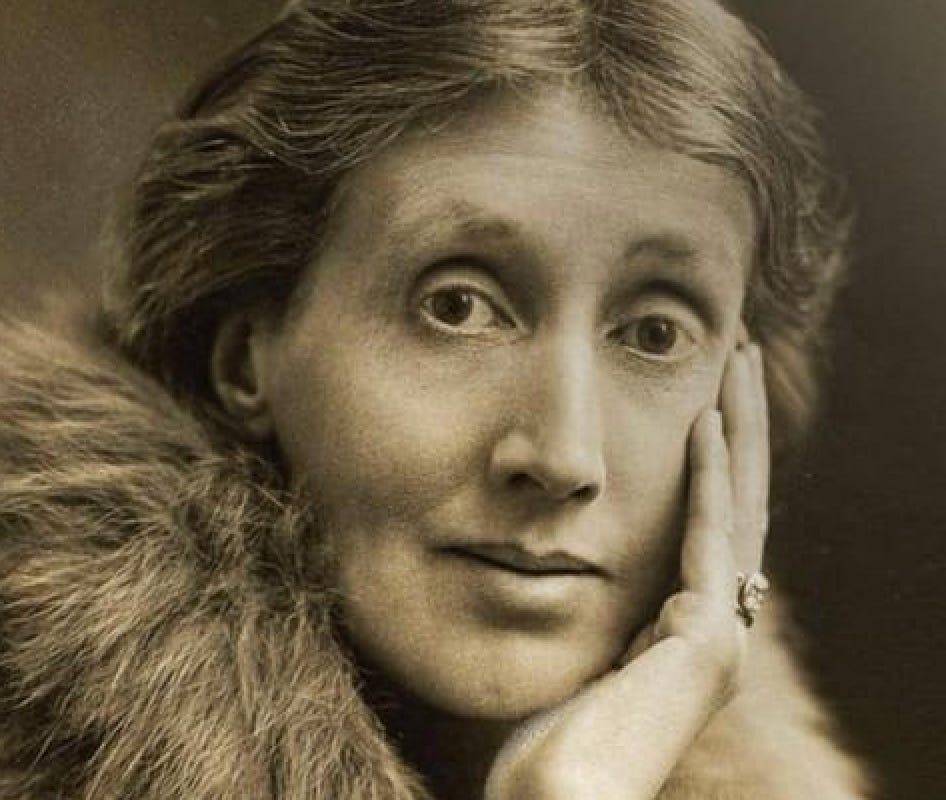
Virginia Woolf thought about life differently. She believed it isn’t made up only of events or achievements, but of brief “moments of being” that don’t announce themselves—flashes of awareness that shimmer and vanish, yet leave a trace. A sentence that names a feeling not quite articulated before. An insight that unsettles what once seemed settled. A question that stays alive days or even weeks later. These moments don’t arrive labeled as hope, but they change how we see.

Public life increasingly runs in the opposite direction. It is shaped less by what people hope to build together than by who they are against: red versus blue, “real America” versus its enemies, every election a last stand, every defeat a betrayal. Nothing is allowed to settle. The fight must always go on, because without the fight, there is nothing left to hold.

We see this whenever leaders keep conflict alive by pointing outward—toward a villain abroad (the latest, Venezuela’s Maduro), a traitor within, or a threat just vague enough to absorb blame. The names change. The effect doesn’t.

René Girard identified the pattern. When enemies are required to define who we are, common purpose becomes common hatred. Imitated desires ensure rivalry, and relief is found by assigning blame. Sometimes the target is a group—“godless liberals,” Trump supporters. Sometimes it is an abstraction that cannot answer back: the economy. In each case, a scapegoat absorbs the disorder, creating unity not through truth but through exclusion. Politics knows this rhythm well.

Friedrich Nietzsche named a similar dynamic ressentiment. Blame supplies meaning. Frustration no longer seeks remedy; it seeks an offender. “I am right” is no longer enough—it must become “you are wrong.” Morality becomes adversity. The weakness politics fears is renamed vulnerability in personal relationships—and treated as moral capital.

We see this logic at work in ordinary places: a school board meeting where every proposal sounds like an attack; a neighborhood forum that turns into a trial; an online exchange where no concession counts, only the next offense. Solving the problem matters less than naming the culprit. Even victories feel thin—each one merely reveals the next foe—until resolution itself begins to look suspect, or even a letdown. (Photo at right by Ewa Domańska)

Rivalry demands a victim, and ressentiment a target. Hostility becomes the point. Identity forms around opposition, and when one grievance fades, another takes its place. Without an enemy, the story collapses.

Earlier struggles for justice, however flawed, aimed at ends that could at least be named and settled: a law changed, a right secured, a barrier removed. Now facts, compromises, and even concessions rarely curb anger, because politics feeds on grievance rather than resolution.

The roots are as much psychological as political. Nietzsche saw how suffering that cannot be acted upon becomes someone else’s fault. Hurt hardens into judgment; disappointment turns into injustice. It can feel easier to be wronged than responsible. We imitate one another’s desires and then turn on one another when those desires collide. Small differences are exaggerated to keep opposition alive. (Photo of René Girard by Ewa Domańska)

Democracy has to offer other sources of commitment—ones that do not depend on having an enemy. People need things worth showing up for together: work worth doing, care given and received, shared projects that draw energy from devotion rather than grievance.

For us, that may begin—or begin again—modestly: staying at the table when it would be easier to walk away and feel justified. Doing the unglamorous work of keeping a school, a neighborhood, a church, a union, or a family from coming apart, even when no victory can be claimed and no one notices.

It is tempting to think moral seriousness must announce itself as a crisis. Moral life begins sooner than that. It is practiced without spectacle, sustained in situations with no spotlight and no applause: taking out the trash for an elderly neighbor, watching a friend’s kids, fixing a loose step, shoveling a driveway before work—the low hum of ordinary care.

These “moments of being” belong to no side. They offer no scapegoat, no enemy to drive out. There is nothing glamorous about them—only the steady practice of showing up.

The world does not move only through power or headlines. Sometimes it moves through memory, attention, and ordinary acts that never become slogans. The full circle isn’t flashy. It holds.

Notes and reading

  • Venezuela – Maduro abducted. The familiar patterns discussed in this post apply: mimetic rivalry, ressentiment, and scapegoating.

    Sunday morning: While a U.S. citizen, I grew up in Venezuela, which became my home country—alma mia. The Hugo Chávez > Nicolás Maduro regime has been brutal and corrupt. So was the right-wing dictatorship that Venezuelans themselves had overthrown in 1958, to the dismay of the U.S., which had been receiving 90% of national oil revenues from the American oil companies that effectively owned the oil fields and have since been nationalized under incompetent management.

    What followed the earlier dictator’s demise was an attempt at democracy that descended into chaos: the very dynamic that had enabled authoritarianism to return under a different banner then inspired the rise of the left-wing regime just overthrown.
    Apparently, the U.S. president expects to “run the country” with the (former) dictator’s loyal Vice-President, not the Nobel Peace Prize-winning opposition leader, María Machado, whose electoral victory had been denied by Maduro and called “rigged.” The U.S. itself backed the extraction of Machado in December 2025, just four weeks ago, even though she had become a vocal supporter of our own president.
    — One response to Donald Trump could be, “Been there. Done that. It doesn’t work.”

Media commentary is now overwhelming. Among the strongest are Timothy Snyder, an American historian of Europe and a public intellectual in both the United States and Europe, and Joyce Vance, a former U.S. Attorney.


The figure of the scapegoat extends beyond its biblical origins in Leviticus to many religious and cultural rituals of expulsion intended to contain disorder and restore unity. Mary Douglas’s Purity and Danger and Freud’s Totem and Taboo remain classic studies of how pollution, exclusion, violence, and belonging intertwine in human communities. Earlier cultures marked the New Year by naming and containing scapegoating; we mark it by denying it—while practicing it endlessly.

Friedrich Nietzsche, On the Genealogy of Morals, trans. Walter Kaufmann and R. J. Hollingdale (1989). First Essay, §§10–11.

René Girard, Violence and the Sacred, trans. Patrick Gregory (1977), esp. chs. 2–4; and The Scapegoat, trans. Yvonne Freccero (1986).

“low-humming rhythm of simplicity”—Rituparna Sengupta, “Each Leaf a Second,” World Literature Today (January/February 2026). Sengupta researches and writes on literature, cinema, and popular culture. O. P. Jindal Global University, India.

Moral progress is annoying – Daniel Kelly and Evan Westra, Aeon (June 2024). Affective friction: the misalignment between our internalized norm psychology and new or unfamiliar social norms. Kelly and Westra are philosophers at Purdue University who work on issues in moral and cognitive science. (Compare “cognitive dissonance”)

[Virginia Woolf—The phrase “moments of being” comes from her autobiographical writings. See Woolf, Moments of Being, ed. Jeanne Schulkind (1976).]

More from the remarkable William C. Green:

Christmas, after all

Room for Love

About 2 + 2 = 5

2 + 2 = 5 is a reader-supported publication. To receive new posts and support this work, consider becoming a free or paid subscriber.
Can metaphysical ugliness promote beauty?

Monday, January 1st, 2024
Share
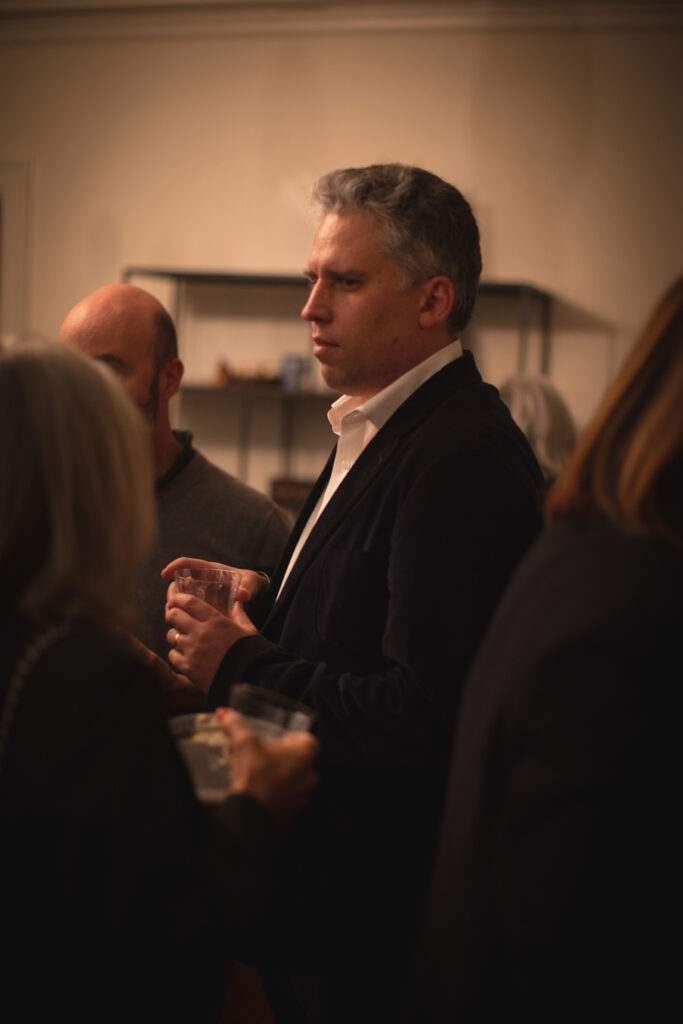
Proust lover Trevor Cribben Merrill

How do authors get away with shallow, shabby, venal, morally deficient characters who appall us … but nevertheless, we read on? Trevor Cribben Merrill, author of Minor Indignities, explains: “the ‘spirit of the author’ shields the reader from the characters, ‘drawing the poison’ from their negative qualities of arrogant stupidity, shallowness, and triviality.” He writes about it on Genealogies of Modernity, a project supported by the National Endowment for the Humanities to explain “how we became modern.”

Trevor writes: “This essay is about as close as I have come to articulating an artistic credo.” Excerpt from “Three Lessons in Beauty” below:

We would not want to spend time with Proust’s snobs. In their most honest moments, even his characters describe the fancy dinner parties they attend as boring and stifling. But to read about these soirées, and the people at them, is another matter. Similarly, if we were to encounter him in real life, Jane Austen’s Mr. Collins would be a bore; on the page, he is at once a bore, and, with his absurd boasts about the size of the chimney-piece at Rosings Park, a pure delight. In both cases the authors make us enjoy the sort of people we would try to flee at a cocktail party. It is not only that Proust’s prose and metaphors are exquisite, but that he turns the wretched maneuverings and deceit of his snobs into poetry. Out of pretense, dullness, and even malice, Austen, too, makes art.

The formal innovations of the great masters always have a certain discreetness about them,” he writes. [italics his]

His characters disgust us, and yet…

Recently while sick in bed I listened to Beethoven’s Piano Sonata 31, Op. 110 performed first by Rudolf Serkin and then by Glenn Gould. Composed in 1821, Op. 110 is the next to last of the composer’s piano sonatas, and falls squarely in his “late” period, during which he created many of his most beautiful and formally adventurous works. Beethoven is known for bridging classical and romantic styles. In his late years, however, he was also drawn to the contrapuntal music of the earlier baroque period.

The Op. 110 sonata is especially notable for its third movement, which employs musical structures from different moments in the history of music: classical homophony (a melody played by the right hand unfolding over chords played gently by the left); a more impassioned, stormy section expressing romantic emotion; and a fugue divided into two parts. In Serkin’s interpretation, and even more so in Gould’s, this fugue, built on a short, ascending theme, sounds very much like Bach. By paying reverent homage to the polyphony of Bach and Handel, Beethoven, as if by accident, created a novelty in the homophonic form par excellence, the sonata.

Can’t catch her in the act.

In one of his essays Milan Kundera praises this third movement of the Op. 110 sonata for “its extraordinary heterogeneity of emotion and form.” And yet, he adds, “the listener does not realize this, because the complexity seems so natural and simple.” From this beguiling naturalness Kundera draws the following lesson: “the formal innovations of the great masters always have a certain discreetness about them; such is true perfection; only among the small masters [petits maîtres] does novelty seek to call attention to itself.”

This observation calls to mind Virginia Woolf’s comment about Jane Austen: “of all the great writers,” she is “the most difficult to catch in the act.” One of Austen’s formal innovations occurs in Northanger Abbey, where she makes her “defense of the novel” as an art that gives “unaffected pleasure” while truthfully representing human nature in beautiful language. Austen admired Henry Fielding, who included mini-essays on the novel at the beginning of each of the eighteen books of Tom Jones.

When she shares her own thoughts on fiction half a century after Fielding, however, she makes them emerge seamlessly from her characters’ obsession with Gothic fiction, and—with the discretion of a great master—tucks them in at the end of chapter five. What in Fielding comes across as theoretical reflection added on to the fictional narrative is in Austen woven into the work’s fabric. In this way she keeps one foot in the aesthetic of the eighteenth-century novel, with its obtrusively playful authorial interventions, while bringing a new level of unity and polish to her chosen form.

To what other artists or works of art might Kundera’s insight apply? Because the kinds of formal innovations he singles out avoid drawing attention to themselves, it takes a certain amount of knowledge about a given art form to come up with good examples. And conversely, attempting to catch a glimpse of such shy novelties promotes a deeper appreciation for the habits of great artists as well as for the inner workings of artistic tradition. 

Read the whole thing here.

One of the best nonfiction books of all time? Join us for Virginia Woolf’s “A Room of One’s Own” on April 11!

Wednesday, April 5th, 2023
Share

Please join us for a discussion of Virginia Woolf‘s 1929 A Room of One’s Own at 7 p.m. (PST) on Tuesday, April 11, in Levinthal Hall, Stanford Humanities Center, 424 Santa Teresa Street on the Stanford campus.

The Guardian called the book “a landmark in feminist thought and a rhetorical masterpiece” and rated it one of the top 100 non-fiction books of all time. Read about that here.

According to a contemporary review in The Los Angeles Times: “If you miss this book, which is profound and subtle and gently ironic and beautifully written, you will have missed an important reading experience.” Another Look will consider the work’s legacy a century later. The Bloomsbury author’s iconic book, an extended essay, is in public domain and widely available.

Panelists will include: Stanford Prof. Robert Pogue Harrison, author, director of Another Look, host of the radio talk show and podcast series “Entitled Opinions,” and a regular contributor to The New York Review of Books and Stanford Prof. Tobias Wolff, one of America’s leading writers, a founding director of Another Look, and a recipient of the National Medal of Arts.

Constance Solari is a writing coach and the author of four novels, including 2012’s Sophie’s Fire: The Story of Saint Madeleine Sophie Barat. Maria Florence Massucco, is a PhD candidate in Italian Studies who specializes in the 20th century novel. You’ll remember her from our discussion of Dorothy Strachey‘s Olivia.

Join us in person or virtually, but please register here. Or scan the QR code. We look forward to seeing you on April 11th! It’s going to be a great discussion.


Pop open the champagne! Happy Public Domain Day! ?

Friday, January 1st, 2021
Share

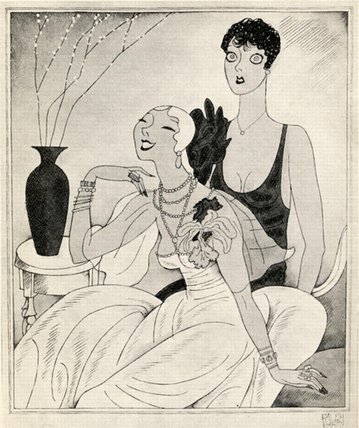
Ralph Barton’s illustration for “Gentlemen Prefer Blondes.” It’s also in public domain now.

For those of us who keep an eye on such things – including bloggers, everywhere – we have some exciting news, and it rolls around every New Year’s Day. (So if you didn’t send cards this year, you’ll have another opportunity on January 1, 2022.) Happy Public Domain Day! What? You’re not excited? Well, am.

As of today, F. Scott Fitzgerald‘s The Great Gatsby is up for grabs. So is Virginia WoolfMrs. Dalloway,  Ernest Hemingway‘s In Our Time, and Franz Kafka‘s The Trial (in German). Excerpt as much as you like. Be my guest.

Plenty more books published in 1925 have entered the public domain, as of today.  According to Jennifer Jenkins, a law professor at Duke University who directs its Center for the Study of the Public Domain. “And all of the works are free for anyone to use, reuse, build upon for anyone — without paying a fee.”

“Works from 1925 were supposed to go into the public domain in 2001, after being copyrighted for 75 years. But before this could happen, Congress hit a 20-year pause button and extended their copyright term to 95 years Now the wait is over,” Jenkin’s writes on the Duke website.

1925 was the year of seminal works by Sinclair Lewis, Gertrude Stein, Agatha Christie, Theodore Dreiser, Edith Wharton, Aldous Huxley … and, among musicians some works by Bessie Smith, Ma Rainey, the Gershwins, Duke Ellington and Fats Waller, among hundreds of others. And 1925 marked the release of important works by silent film comedians Buster Keaton and Harold Lloyd.

According to NPR:

Free! Free! Free!

It’s difficult to overstate the importance of having work in the public domain. For example, can you imagine the holidays without It’s A Wonderful Life? That movie happened to be unprotected by copyright, so it was able to be shown — a lot — for free, contributing to its establishment as an American Christmas classic.

It also means books can be published more cheaply and made available for free online; that old “orphan” films can be preserved by archivists; that scholars can access and publish material more easily; that musicians can sample and experiment with the songs of an earlier generation and that classic characters can be given new life and new interpretations.

While the most successful creators often leave behind legal estates to manage the care (and finances) of their famous books, plays, operas and so forth, most aren’t so lucky. “For the vast majority of authors from 1925, no one is benefiting from copyright protections,” Jenkins tells NPR. Having their work enter the public domain is a way to keep it circulating in the culture for artists and historians to use for education and inspiration.

Overlooked Anita Loos

May we throw in our own bid for greater circulation? This year also marks Anita Loos‘s underrated classic and comic masterpiece of the Flapper Era, Gentlemen Prefer Blondes: The Illuminating Diary of a Professional LadyHere’s what I wrote when we featured the book at Stanford’s Another Look book club for forgotten, overlooked, and otherwise neglected books way back in May 2013:

Edith Wharton called Anita Loos’ Gentlemen Prefer Blondes “the great American novel” and declared its author a genius. Winston Churchill, William Faulkner, George Santayana and Benito Mussolini read it – so did James Joyce, whose failing eyesight led him to select his reading carefully. The 1925 bestseller sold out the day it hit the stores and earned Loos more than a million dollars in royalties. …

Everyone, of course, has heard of Gentlemen Prefer Blondes, but the short novel’s fame was eclipsed by the 1953 movie of the same name, starring Marilyn Monroe and Jane Russell. Once the bombshell blonde vamped “Diamonds Are a Girl’s Best Friend,” the effervescent Jazz Age novel became a shard of forgotten history. Who has taken the send-up novel seriously since?

You can check out the catalog for 1925 copyrighted works here. Or check out the podcast for the Stanford panel discussion with Hilton Obenzinger, Mark McGurl, and Claire Jarvis here. (Claire placed the book in the tradition of the courtesan’s diary.)

Meanwhile, go ahead! Excerpt as much as you like! It’s on the house!

Postscript: The biggest fish of all: George Orwell is in public domain today. According to The Guardian: “George Orwell died at University College Hospital, London, on 21 January 1950 at the early age of 46. This means that unlike such long-lived contemporaries as Graham Greene (died 1991) or Anthony Powell (died 2000), the vast majority of his compendious output (21 volumes to date) is newly out of copyright as of 1 January. Naturally, publishers – who have an eye for this kind of opportunity – have long been at work to take advantage of the expiry date and the next few months are set to bring a glut of repackaged editions. …As is so often the way of copyright cut-offs, none of this amounts to a free-for-all. Any US publisher other than Houghton Mifflin that itches to embark on an Orwell spree will have to wait until 2030, when Burmese Days, the first of Orwell’s books to be published in the US, breaks the 95-year barrier. And eager UK publishers will have to exercise a certain amount of care. The distinguished Orwell scholar Professor Peter Davison fathered new editions of the six novels back in the mid-1980s. No one can reproduce these as the copyright in them is currently held by Penguin Random House.” Read the rest here.

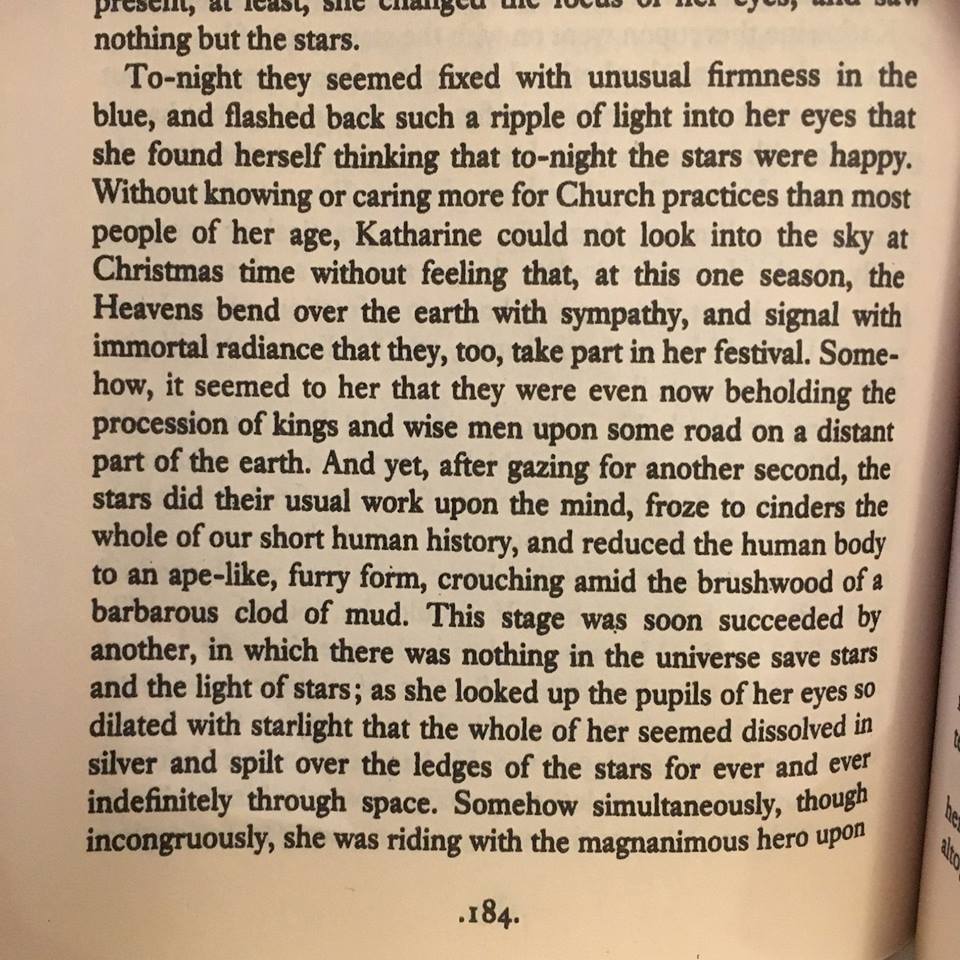
Holiday greetings from the world, and one from Virginia Woolf: “at this one season, the Heavens bend over the earth with sympathy…”

Monday, December 24th, 2018
Share

…at this one season, the Heavens bend over the earth with sympathy, and signal with immortal radiance that they, too, take part in her festival.”

A quick holiday message from your exhausted correspondent at the Book Haven – and a better one from Virginia Woolf, from her novella Night and Day The passage comes to us courtesy Book Post, Ann Kjellberg‘s subscription-based book review, offering a “bite-sized newsletter-based book review delivery service, sending paying subscribers high-quality book reviews, by distinguished and engaging writers, direct to their inboxes.

We’ve enjoyed greetings from around the world in our own inbox, and thought we’d share a few from senders who have appeared in the Book Haven pages: Swedish author and translator Bengt Jangfeldt, and his wife, the Russian actress Jelena Jangfeldt, writing from Stockholm; Swedish poet Håkan Sandell sends his julekort from Oslo; cat-loving Russian scholar Valentina Polukhina sends a few felines from her London home; and an Upernavik, Greenland, winter image arrived from Polish photographer, and regular Book Haven contributor, Zygmunt Malinowski in New York City. We’ll be hearing more from him in a few days.

Meanwhile, have a wonderful holiday with family and friends with plenty of good cheer!


Steve Wasserman: “The world we carry in our heads is arguably the most important space of all.”

Monday, September 25th, 2017
Share
He’s back in Berkeley

We’ve written about Steve Wasserman before – here and here and here. On Saturday, he gave the keynote address at the 17th Annual North Coast Redwoods Writers’ Conference at the College of the Redwoods, Del Norte, in Crescent City. The subject: “A Writer’s Space.” He’s given us permission to reprint his words on that occasion, and we’re delighted. Here they are:

Not long after I returned to California last year to take the helm of Heyday Books, a distinguished independent nonprofit press founded by the great Malcolm Margolin forty years ago in Berkeley, my hometown, I was asked to give the keynote speech at this annual conference. I found myself agreeing to do so almost too readily—so flattered was I to have been asked. Ken Letko told me the theme of the gathering was to be “A Writer’s Space.”

In the months that have elapsed since that kind invitation, I have brooded on this singular and curious formulation, seeking to understand what it might mean.

What do we think we mean when we say “a writer’s space”? Is such a space different than, say, any other citizen’s space? Is the space of a writer a physical place—the place where the writing is actually done, the den, the office, the hotel room, the bar or café, the bedroom, upon a desk or table or any available flat and stable surface?

Babylonian shopping list

Or is the “writer’s space” an inner region of the mind? Or is it a psychological place deep within the recesses of the heart, a storehouse of emotions containing a jumble of neurological circuitry? Is it the place, whether physical or spiritual, where the writer tries to make sense of otherwise inchoate lives? In either case, is it a zone of safety that permits the writer to be vulnerable and daring and honest so as to find meaning and order in the service of story?

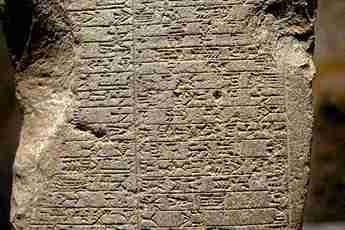
Perhaps it will be useful to begin at the very dawn of writing when prehistory became history. Let’s think, for a moment, about the clay tablets that date from around 3200 B.C. on which were etched small, repetitive impressed characters that look like wedge-shape footprints that we call cuneiform, the script language of ancient Sumer in Mesopotamia. Along with the other ancient civilizations of the Chinese and the Maya, the Babylonians put spoken language into material form and for the first time people could store information, whether of lists of goods or taxes, and transmit it across time and space.

It would take two millennia for writing to become a carrier of narrative, of story, of epic, which arrives in the Sumerian tale of Gilgamesh.

Writing was a secret code, the instrument of tax collectors and traders in the service of god-kings. Preeminently, it was the province of priests and guardians of holy texts. With the arrival of monotheism, there was a great need to record the word of God, and the many subsequent commentaries on the ethical and spiritual obligations of faithfully adhering to a set of religious precepts. This task required special places where scribes could carry out their sanctified work. Think the Caves of Qumran, some natural and some artificial, where the Dead Sea Scrolls were found, or later the medieval monasteries where illuminated manuscripts were painstakingly created.

First story

Illiteracy, it should be remembered, was commonplace. From the start, the creation of texts was bound up with a notion of the holy, of a place where experts—anointed by God—were tasked with making Scripture palpable. They were the translators and custodians of the ineffable and the unknowable, and they spent their lives making it possible for ordinary people to partake of the wisdom to be had from the all-seeing, all-powerful Deity from whom meaning, sustenance, and life itself was derived.

We needn’t rehearse the religious quarrels and sectarian strife that bloodied the struggle between the Age of Superstition and the Age of Enlightenment, except perhaps to note that the world was often divided—as, alas, it still sadly is—between those who insist all answers are to be found in a single book and those who believe in two, three, many books.

The point is that the notion of a repository where the writer (or religious shaman, adept, or priest) told or retold the parables and stories of God, was widely accepted. It meant that, from the start, a writer’s space was a space with a sacred aura. It was a place deemed to have special qualities—qualities that encouraged the communication of stories that in their detail and point conferred significance upon and gave importance to lives that otherwise might have seemed untethered and without meaning. The writer, by this measure, was a kind of oracle, with a special ability, by virtue of temperament and training, to pierce the veil of mystery and ignorance that was the usual lot of most people and to make sense of the past, parse the present, and even to predict the future.

A porous epidermis

This idea of the writer was powerful. It still is. By the time we enter the Romantic Age, the notion of a writer’s space has shed its religious origins without abandoning in the popular imagination the belief that writers have a special and enviable access to inner, truer worlds, often invisible to the rest of us. How to put it? That, by and large, artists generally, of which writers are a subset, are people whose epidermises, as it were, are more porous than most people’s. And thus they are more vulnerable, more open to the world around them, more alert, more perspicacious. Shelley put it well when he wrote that, “Poets are the unacknowledged legislators of the world.” Think Virginia Woolf.

By the end of the nineteenth century, writers in their person and in their spaces are widely celebrated and revered, imbued with talents and special powers that arouse admiration bordering on worship. It is said that when Mark Twain came to London and strode down the gangplank as he disembarked from the ship that had brought him across the Atlantic, dockworkers that had never read a single word of his imperishable stories, burst into applause when the nimbus of white hair atop the head of the man in the white suit hove into view. Similarly, when Oscar Wilde was asked at the New York customs house if he had anything to declare, when he arrived in America in 1882 to deliver his lectures on aesthetics, he is said to have replied: “Only my genius.”

Applause, applause

Many writers were quickly enrolled in the service of nationalist movements of all kinds, even as many writers saw themselves as citizens in an international republic of letters, a far-flung fraternity of speakers of many diverse languages, but united in their fealty to story. Nonetheless, the space where they composed their work–their studies and offices and homes—quickly became tourist destinations, sites of pilgrimage where devoted readers could pay homage. The objects on the desk, writing instruments and inkwells, foolscap and notebooks, the arrangement of photographs and paintings on their walls, the pattern of wallpaper, the very furniture itself, and preeminently the desk and chair, favorite divan and reading sofa, lamps and carpets, all became invested with a sacredness and veneration previously reserved only for religious figures. Balzac’s home, Tolstoy’s dacha, Hemingway’s Cuban estate, are but three of many possible examples. Writers were now our secular saints.

Somehow it was thought that by entering these spaces, the key to unlocking the secret of literary creation could be had, and that by inhaling the very atmosphere which celebrated authors once breathed, one could, by a strange alchemy or osmosis, absorb the essence that animated the writer’s imagination and made possible the realization of native talent.

(more…)