Evolution of Desire: A Life of René Girard – The Movie!

March 16th, 2018
Share

You’ve heard of Evolution of Desire: A Life of René Girard the book. Here’s the movie! Ever so tiny a bit of it, anyway – a full feature film with famous stars in the lead roles is forthcoming … Ian McKellen to play René… well, not really. Film rights for my book will have to be sold first. That will be after translation rights in Swahili, and the Braille edition, and the audio book, and…

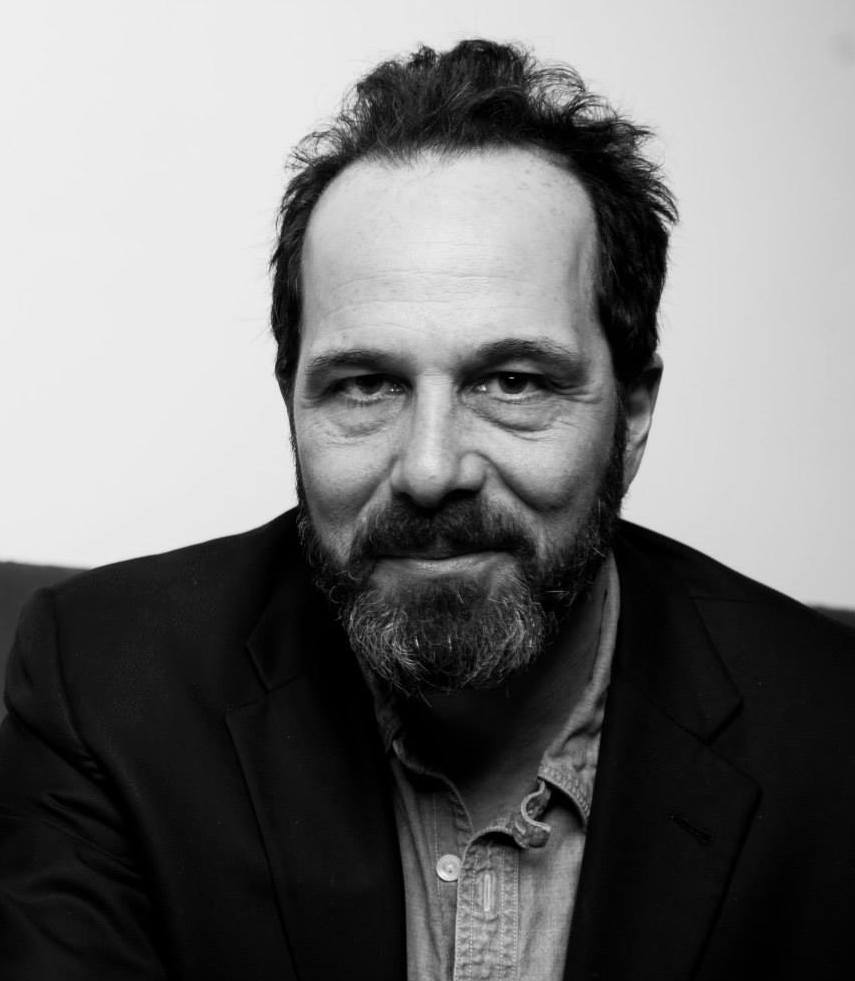
Launch videos are all the rage now, though I’m new to the genre, I’ve had an immersion experience  with the first. It includes the footage is from my 2008 interview with René, shortly after I returned to beautiful Palo Alto and met the genial sage. That’s when I wrote my Stanford News Service profile, “René Girard: Stanford’s provocative immortel is a one-man institution” here, and my Stanford Magazine article, “History is a test. Mankind is failing it” here. In fact, the latter article has the marvelous Michael Sugrue photo I’m thrilled to feature on the cover. To my mind, it is the best portrait of René in old age.

Anyway, it’s short (and sharp as a knife, not blurry, like the image on the cover below suggests). Three minutes long (with a snippet of Bach’s Prelude from my friend, one of the Bay Area’s preeminent cellists, Burke Schuchmann). Enjoy.

“It has happened. So it can happen again.” Philip Gourevitch on genocide

March 13th, 2018
Share

The aftermath in Rwanda (photo: DFID)

We live in an era of genocides. Author Philip Gourevitch is one of its experts, probing how genocide happens, how the murderers rationalize their participation, and how they live with themselves later. With his new research, he reports the on the survivors, who now continue their lives alongside those who have murdered their friends and families. His Entitled Opinions interview is up at the Los Angeles Review of Books channel here.

Gourevitch today (Photo: Victor G. Jeffreys II)

We Wish to Inform You That Tomorrow We Will Be Killed with Our Families: Stories from Rwanda was named by The Guardian as one of the top 100 non-fiction books of all time. He is now working on a sequel,  You Hide That You Hate Me and I Hide That I Know, describing the aftermath of the 1994 genocide, in which Hutus slaughtered 800,000 of their Tutsi neighbors in a hundred days.  The new book considers how people continue their lives under impossible conditions, and the nature of evil.

Gourevitch has been staff writer at The New Yorker for over two decades, and prior to that editor of The Paris Review.

In his 2016 Entitled Opinions conversation, Gourevitch discusses not only the history of Rwanda, but the complexity of truth, how justice can be a backward-looking concept that rationalizes the thirst for revenge, and how self-comforting notions of “never again” lead us to believe that we are immunized from the repeated cycles of the past. Entitled Opinions host Robert Harrison, a Dante scholar, notes how the Inferno’s damned are often frozen in one moment of their past that forecloses the future – however, in Rwanda, reconciliation was a national necessity. “How on earth do you live with this – both in the local sense, and in the broader sense of all the stories we tell ourselves about our common humanity?” Gourevitch asks.

He also discusses the new genre of his work, creating “books that are based on reporting, that are fact-checkable, that are drawn from intensely close observation and a lot of interviews.” He tries to write in a way that captures not only the facts, but the human pathos he faces as he returns again and again to the land that was the site of what has been one of the greatest genocides since World War II.

The interview is over at the Los Angeles Review of Books channel here.

Potent Quotes

“We were telling ourselves that we stand against these things and it would never happen. But we had done nothing much to stop it. In fact, we got out of the way, even as we were telling ourselves that would never put up with such a thing again.”

“It has happened. So it can happen again. It can happen anywhere. I think that is the truer dark lesson: this is a human potential in humankind, a permanent potential in our condition.”

“There’s no full justice possible in a situation like this. There simply isn’t.”

“Memory and grudge are so close, especially with these historical score-settlings.”

“One of the things that very striking in Rwanda, from early on, was this talk that ‘We’re going to have to have some form of forgiveness.’”

“The problem with justice is that it’s not terribly satisfying, because it is backward-looking.”

A luftmensch in search of the perfect conversation: NYPL’s “curator of public curiosity”

March 10th, 2018
Share

A fellow luftmensch: Paul Holdengräber at NYPL

I have met amazing people on Twitter, and one of my golden finds was Paul Holdengräber. We both love literature, but we have something more in common: we’re both luftmenschen.
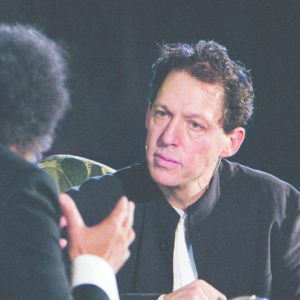
At work. (Photo: Jori Klein/NYPL)

There’s a Yiddish word for someone who may not be terribly grounded,” he says. “It’s a beautiful word: luftmensch. It means someone who has his feet firmly planted—in midair. There’s something of an untethered balloon in me.” It beats Merriam-Webster’s definition: “an impractical contemplative person having no definite business or income.” Not true. I have a definite “business” of sorts: I’m a writer, a journalist, a blogger, an author. And Paul? He’s the director of public programs for the New York Public Library. He founded LIVE from the NYPL, and organized its literary conversations. Since February 2012, he has hosted The Paul Holdengräber Show on the Intelligent Channel on YouTube.

“‘I’m the curator of public curiosity.’ I’m the midwife,” he told Will Corwin at Art Papers last year.  “When you are in the audience, you are hopefully an interested listener. In some ways, you want to be in my seat—or maybe you don’t want to be in my seat, but you imagine what you would have asked. But my goal—as I did with David Lynch, Ed Ruscha, JAY-Z, Zadie Smith, Patti Smith, or Philip Glass—is to represent the audience as best as I can, their interests and curiosities. The question that I’m trying to phrase is—I’m hoping—the question that the audience as a whole, and some people in particular, may have.”

Once-a-year sanity. (Photo: L.A. Cicero)

A regular guest of his conversations is Werner Herzog. “I speak to him at least once a year to remain sane,” he says.

He has a reason for being a luftmensch. He was born in Texas and has an American passport. His parents, however, were Austrian Jews fleeing Vienna and the Nazis. They did so via Haiti, which had no immigration quota for Jews, and then Mexico, where his sister was born. When his mother was having a problem pregnancy, his father, a former medical student who had become a farmer in the New World, whisked his wife to Houston, where the best hospitals were located. Voilà! Paul was born an American citizen. And then the family moved to Brussels.

Paul studied philosophy at the Université Catholique de Louvain and the Sorbonne. The connection of philosophy with his his current line-of-work is obvious:

Tzara in 1923

“Yes, I believe deeply that we come to thought through words—thought is made in the mouth, or some such sentence from Tristan Tzara. Philosophy, as we believe it to be, started with a conversation. I don’t particularly think about how it will play itself out when written down. I think there’s such a difference between the written word and the spoken word. Some people speak in paragraphs; I don’t know what I speak in— I suppose my claim to a profession is to make other people speak, to find a way of giving them words and to find a way of bringing about a thought. I feel that through speaking we can discover ourselves. Not dissimilar is the word autobiography: auto-bio-graphein. It literally means “the life coming-to-be through its writing”; so, the self coming to life through writing and discovering itself through writing. Some people discover themselves through writing, if we consider literary history, from Rousseau to other great people who wrote autobiographies.”

His mother was fourteen when she left Vienna, “so she had seen enough to know it was terrible and to never, ever talk about it. But she transmitted the trauma. When the Austrian government, through the Austrian president, awarded me with the Austrian Cross of Honor for Art and Science—a funny thing to give a cross to a Jewish boy—I said to my mother, ‘I don’t think I should accept.’ She said, very firmly, ‘Be gracious, don’t mention the unpleasantness, and my story is not yours.’ Which is quite something.”
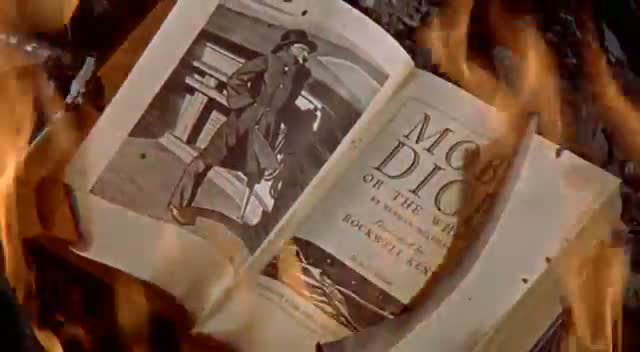
“Memories I don’t have…”

“My trauma is a secondhand wound; it’s a transmission of trauma. The [words] transmission and tradition are the same in Hebrew: they [translate to] “what is passed on.” So I’m living with the memory of something I never experienced, the memory of something I don’t know. I was inspired by Nathalie Zadje, a psychoanalyst who studied transmission of trauma from the point of view of certain émigré cultures, particularly in North Africa, and how different that transmission is in different cultures. She studied how trauma passes from one generation to the next. But I grew up very obsessed with the Holocaust, very obsessed with my parents’ history, maybe in a way that was unhealthy. I do think that my interest in Edmund du Waal, Werner Herzog, Anselm Kiefer, and Claude Lanzman all comes from the way in which the world was transformed, changed, and to some extent destroyed. When Jonathan Demme invited me to speak to him about Fahrenheit 451, both the Truffaut movie and the Ray Bradbury story, the burning of the books brought back memories that I don’t have.

His goal in life? “As I think of it, I’m after the perfect conversation. I’m after the Platonic idea of what the best possible conversation could be, and therefore it eludes me like a collector who would hope in some way never to have the last piece in his collection. If he did, then it would be the death of the collector.”

Read the whole conversation here.

Is evil really banal? Why Arendt’s Eichmann in Jerusalem shocked the world.

March 8th, 2018
Share

Both sides now.

In 2012, I eagerly, perhaps a bit worshipfully, attended Margarethe von Trotta‘s acclaimed film, Hannah Arendt, describing how the heroic philosopher came to be at the 1961 Jerusalem trial of the notorious Nazi Adolf Eichmann. As everyone knows now, the German-Jewish thinker found no monstrous  incarnation of evil, but rather a banal bureaucrat following orders. And so she fell out with Jewish leaders, Israelis, much of New York’s intelligentsia, and writers like Saul Bellow, too.

Now I have a better idea of the other side, after reading Harvard Professor Ruth R. Wisse‘s”The Enduring Outrage of Hannah Arendt’s ‘Eichmann in Jerusalem’: Fifty-five years later, her book still has the power to shock—and disgust.” It was one of the thousand tabs on my browser, waiting to be read (in this case, waiting for three weeks), in another publication I rarely read, Commentary. (I’m a sucker for anything on Arendt – read her moving discussion of refugees here.)

The background: The international military tribunal in Nuremberg did not focus on the Jews, in part because Eichmann had never been caught. He had fled to Argentina with his family. According to Wisse, “It is now known that the Germans and the CIA were aware of Eichmann’s whereabouts and never acted on their information. When Fritz Bauer, a member of the German investigative commission, realized that his superiors were contriving not to go after Eichmann, he got the information to the Israelis, who captured him in Argentina and flew him to Jerusalem.”

Wisse continues: “The trial itself was without precedent or parallel. The Israeli poet Natan Alterman wrote that it ‘would fill an eerie void that has been hidden somewhere in the soul of the Jewish people, in the history of its lives and deaths, ever since it went into exile.’ The void he referred to could not have been filled previously because the Jews had never been in a position to prosecute their murderers. Now they were. Given that this was the first and, as seemed likely, the only time that Jewish survivors would be able to confront one of the individuals responsible for the murder of their relatives, the event assumed outsized importance.”

“When it became known that Hannah Arendt would be covering the trial for the New Yorker, there was great anticipation. ‘A foolproof choice,’ wrote Marie Syrkin, one of American Jewry’s leading intellectuals. ‘Who better qualified to report on the trial in depth than Hannah Arendt, scholar, student of totalitarianism and of the human condition, and herself a German Jewish refugee who came to the United States after the rise of Hitler?’ wrote Wisse. “Indeed, of all the German refugees who had been admitted to America just before or at the start of the war, none was better known or more widely admired than Arendt, who had been accepted by the New York intelligentsia not merely as one of their own, but as prima inter pares. Hence the shock when her articles appeared in February and March 1963 and then in the expanded book later that year. Rather than report on the trial as a journalist or observer, Arendt used it as an occasion to expand her theory about totalitarianism—the subject of her most ambitious book.”

Enter Israeli poet Haim Gouri, who published daily dispatches in a left-labor newspaper, later published as, Facing the Glass Booth.

Like Arendt, Gouri is struck by the contrast between Eichmann’s apparent impassivity and the evils he is known to have committed, and, like her, he too later becomes agitated when the witnesses for the prosecution describe Jews herded to their death “like sheep to the slaughter.” But the report tracks his evolution. “Like everyone else present, I felt close to the line separating sanity from madness, but in my case it was for the first time,” he writes. “I felt I was beginning to comprehend the incomprehensible, however wide the gulf separating me from those who were there for even a single day.” Gouri is humbled as he follows the proceedings: “[We] who were outside that circle of death have forgiveness to ask of the numberless dead whom we have judged in our hearts without asking ourselves what right we have.” To state only the obvious, Gouri came to gain understanding, Arendt to impose her understanding on the trial. Gouri’s account follows the sequence of developments. Arendt surmises, synthesizes, and summarizes.”

Gouri was writing for a Jewish readership in a Jewish language in a Jewish country, Arendt for the New Yorker. She did her research relating to the trial in Germany and most of the writing as a research scholar at Wellesley College. In her book on the Eichmann trial, the historian Deborah Lipstadt points out that Arendt left Jerusalem on May 10 and missed five weeks of witness testimony; she was also absent for the prosecution’s cross-examination when Eichmann was at his sharpest.

In short, “The mass murderer who wanted to persuade the court that he was not the agent of his crimes found an ally in a philosopher who, to make her thesis work, needed to prove he lacked moral agency.”

It’s a controversial, passionately argued article. Whether you agree or disagree with Prof. Wisse, it’s worth a look here. Trailer of the movie below.

Steve Wasserman, Chateaubriand on the smell of home

March 6th, 2018
Share

It is a pleasure to have Steve Wasserman back on the West Coast as publisher of Berkeley’s Heyday Books, after years as editor-at-large at Yale University Press and, prior to that, his nine-year stint as the editor of the Los Angeles Times Book Review, when it was the best in the nation. (We’ve written about him here and here and here.)

But the mini-reviews he occasionally offers on Facebook are equally available to all coasts, whether here or Kamchatka or North Africa. Here’s one yesterday, on one of his favorite writers, Chateaubriand.

Heading into the homestretch of my re-reading of Proust‘s last volume, “Time Regained,” and have come upon the passage I well remember–where Proust gives explicit acknowledgment to one of his most admired inspirations: the remarkable memoirs of Chateaubriand, recalling the vanished world that preceded Proust’s by a century and more.

Proust finds in Chateaubriand a kindred spirit, quoting the following sentence as having given him the same “sensation of the same species as that of the madeleine”: “Yesterday evening I was walking alone. . .I was roused from my reflections by the warbling of a thrush perched upon the highest branch of a birch tree. Instantaneously the magic sound caused my father’s estate to reappear before my eyes; I forgot the catastrophes of which I had recently been the witness [he refers here to the terrors of the French Revolution] and, transported suddenly into the past, I saw again those country scenes in which I had so often heard the fluting notes of the thrush.”

Proust then goes on to cite the following sentences as perhaps among the loveliest in Chateaubriand’s lengthy recollections: “A sweet and subtle scent of heliotrope was exhaled by a little patch of beans that were in flower; it was brought to us not by a breeze from our own country but by a wild Newfoundland wind, unrelated to the exiled plant, without sympathy of shared memory or pleasure. In this perfume, not breathed by beauty, not cleansed in her bosom, not scattered where she had walked, in this perfume of a changed sky and tillage and world there was all the diverse melancholy of regret and absence and youth.” (I too had similarly been prey to such emotions, as indeed my return to California eighteen months ago was in no small measure prompted by my inability to rid myself down the decades of the scent of night jasmine, eucalyptus, and a wee bit of the Berkeley tear gas, which had clung so insistently to my nostrils, inflaming my imagination and beckoning me to return to what even after forty years away I still considered home.)
It is to be regretted that, in 2018, nearly a fifth of the way into the twenty-first century, we still have no felicitous English translation of the complete unexpurgated Chateaubriand (other than A.C. Kline’s workmanlike effort available only in an online iteration) but must instead make do with abridgments or in the case of the latest New York Review Books publication the first twelve volumes of the forty-two that exist in French. Well, it’s a start. Highly recommended.

Golden thoughts for a nuclear age: from the introduction of Evolution of Desire: A Life of René Girard

March 4th, 2018
Share

My colleague and friend, Artur Sebastian Rosman at the University of Notre Dame (we met via Czesław Miłosz) has been eager to run an excerpt from my forthcoming Evolution of Desire: A Life of René GirardHe finally did so at his Notre Dame magazine last week. It begins at the beginning, the very first page of my book:

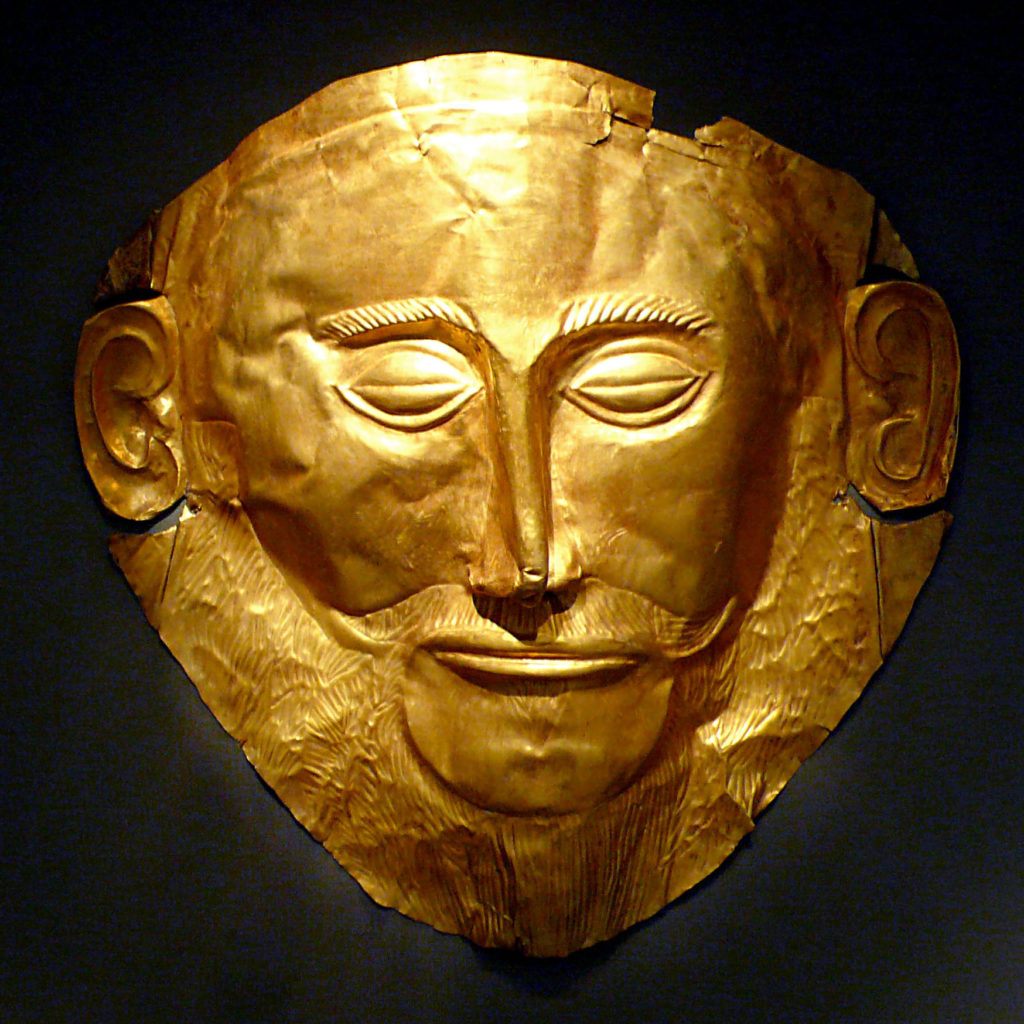
Armed with a copy of the Iliad and a shovel, Heinrich Schliemann set out to find Troy in 1871. Two years later, he hit gold.

He was vilified as an amateur, an adventurer, and a con man. As archaeologists refined their methods of excavation in the subsequent decades, Schliemann would also be deplored for destroying much of what he was trying to find.

Nevertheless, he found the lost city. He is credited with the modern discovery of prehistoric Greek civilization. He ignited the field of Homeric studies at the end of the century. Most importantly, for our purposes, he broke new ground in a figurative, as well as literal, sense: he scrutinized the words of the text, and believed that they held the truth.

“I’ve said this for years: in the global sense, the best analogy for what René Girard represents in anthropology and sociology is Schliemann,” said the French theorist’s Stanford colleague, Robert Pogue Harrison. “Like him, his major discovery was excoriated for using the wrong methods. The others never would have found Troy by looking at the literature—it was beyond their imagination.” Girard’s writings hold revelations that are even more important, however: they describe the roots of the violence that destroyed Troy and other empires throughout time.

Like Schliemann, the French academician trusted literature as the repository of truth, and as an accurate reflection of what actually happened. Harrison told me that Girard’s loyalty was not to a narrow academic discipline, but rather to a continuing human truth: “Academic disciplines are more committed to methodology than truth. René, like Schliemann, had no training in anthropology. From the discipline’s point of view, that is ruthlessly undisciplined. He’s still not forgiven.”

I have appreciated Harrison’s analogy, though some of Girard’s other friends will no doubt rush to his defense, given Schliemann’s scandalous character—but Girard scandalized people, too: many academics grind their teeth at some of Girard’s more ex cathedra pronouncements (though surely a few other modern French thinkers were just as apodictic). He never received the recognition he merited on this side of the Atlantic, even though he is one of America’s very few immortels of the Académie Française.

For Girard, however, literature is more than a record of historical truth, it is the archive of self-knowledge. Girard’s public life began in literary theory and criticism, with the study of authors whose protagonists embraced self-renunciation and self-transcendence. Eventually, his scholarship crossed into the fields of anthropology, sociology, history, philosophy, psychology, theology. Girard’s thinking, including his textual analysis, offers a sweeping reading of human nature, human history, and human destiny. Let us review some of his more important conclusions.

He overturned three widespread assumptions about the nature of desire and violence: first, that our desire is authentic and our own; second, that we fight from our differences, rather than our sameness; and third, that religion is the cause of violence, rather than an archaic solution for controlling violence within a society, as he would assert.

He was fascinated by what he calls “metaphysical desire”—that is, the desire we have when creature needs for food, water, sleep, and shelter are met. In that regard, he is perhaps best known for his notion of mediated desire, based on the observation that people adopt the desires of other people. In short, we want what others want. We want it because they want it.

Read more here.


<<< Previous Series of PostssepNext Series of Posts >>>