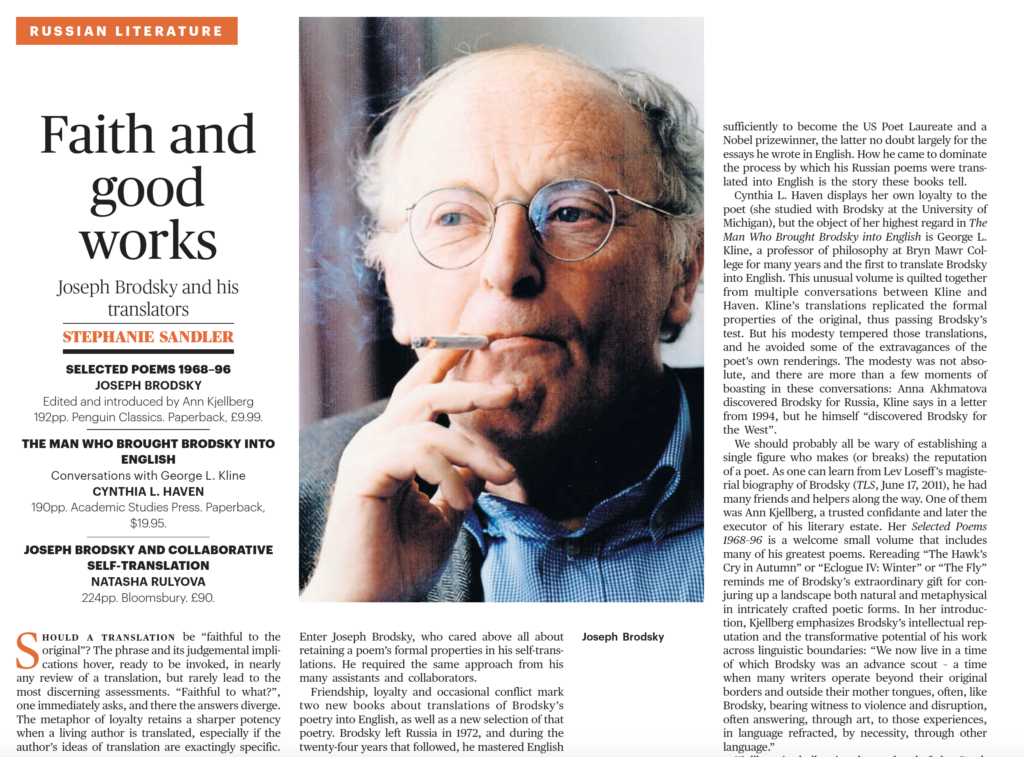
The Man Who Brought Brodsky into English: Conversations with George L. Kline is finally in the pages of the Times Literary Supplement. We’d seen the online version, but there’s nothing like viewing the printed page – so here it is for you. In the words of reviewer Stephanie Sandler: “[George] Kline emerges as human, warm and vividly idiosyncratic in the pages of [Cynthia] Haven’s volume …” Also reviewed, the Selected Poems 1968-1996, edited by Ann Kjellberg, and Joseph Brodsky and Collaborative Self-Translation, by Natasha Rulyova.
From Ann Kjellberg’s introduction to the new Selected, which was published in English in The New York Review of Books and in Russia’s Colta: “We now live in a time of which Brodsky was an advance scout – a time when any writers operate beyond their original borders and outside their mother tongues, often, like Brodsky, bearing witness to violence and disruption, often answering, through art, to those experiences, in language refracted, by necessity, through other language. In Brodsky’s moment there was a cluster of poets, some from the margins of empire, some, like Brodsky, severed from their roots – Walcott, Heaney, Paz, Milosz, to name a few – who brought with them commanding traditions, as well as the imprint of history’s dislocations. We would do well now to attend to their song, standing as they did in our doorway between a broken past and the language’s future.”
And read the whole story of Brodsky’s “rich, complicated legacy” in the TLS here.
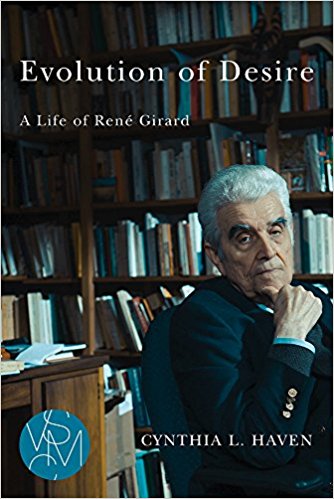
Attention, all Russians and Russian speakers: Evolution of Desire: A Life of René Girardis available for pre-order with the tony Moscow publisher, издательство НЛО – for the rest of us, NLO (New Literary Observer). The cover features René Girard among the rocks of Half Moon Bay … so, a California note for this French theorist. You can pre-order the Russian version here.
From the book jacket (see left, above)
“All desire is a desire for being,” said the renowned Franco-American philosopher René Girard. Our desires determine who we are, but they do not belong to us: since they are mimetic (that is, imitative and mirrored), we become an endless series of other people’s reflections. Desire is a lifelong evolution: we begin to imitate as children, we compete at school and at work, we want more, we suffer without getting what we want, we have deathbed regrets. Cynthia L. Haven’s book is a first-of-its-kind biography of Girard, based on conversations with him, his family, his friends and colleagues from France and the United States. In it, the life of the thinker becomes an illustration of his theory, which is analyzed not as a speculative concept, but as a philosophy of life, which Girard was the first to put into practice. Years of study in his native Avignon and then chilly occupied Paris, the fateful move to the United States, religious conversion in the late 1950s, the discovery of the violent origins of culture, doubts, recognition and its temptations – the reader will learn how the philosopher’s spiritual and creative evolution unfolded from his first work, Deceit, Desire, and the Novel, through his seminal Violence and the Sacred, to the dark apocalyptic prophecies of his final book, Battling to the End.
Oh yes, for you Russians:
«Любое желание — это желание быть», — говорил знаменитый франко-американский философ Рене Жирар. Именно наши желания определяют, кто мы, однако нам они не принадлежат: будучи миметическими (подражательными и зеркальными), они превращают нас в бесконечную серию чужих отражений. Желание — это эволюция длиною в жизнь: мы начинаем подражать еще детьми, соперничаем в школе и на работе, хотим все большего, страдаем, не получая желаемого, и раскаиваемся на смертном одре. Книга Синтии Л. Хэвен —первая в своем роде биография Жирара, основанная на беседах с ним самим, его близкими, друзьями и коллегами из Франции и США. Жизнь мыслителя предстает в ней иллюстрацией к его теории, которая анализируется не как умозрительная концепция, но как философия жизни, которую Жирар первый же и стремился практиковать. Годы учебы в родном Авиньоне и промозглом оккупированном Париже, судьбоносный переезд в США, религиозное обращение в конце 1950-х, открытие насильственных истоков культуры, сомнения, признание и его соблазны — читатель узнает, как разворачивалась духовная и творческая эволюция философа от первой работы «Ложь романтизма и правда романа» через фундаментальный труд «Насилие и священное» к мрачным апокалиптическим пророчествам его заключительной книги «Завершить Клаузевица».
Синтия Л. Хэвен — литературный критик, журналист, сотрудник Национального фонда гуманитарных наук (США). Thanks to Maria Stepanova, Helga Landauer, and NLO’s Sergey Elagin for help making this book happen. The book will be officially out in a few weeks. Again, you can pre-order it here.
Jazz scholar Ted Gioia is one of the latest internet refugees who have taken harbor at Substack, a subscription newsletter service for long-form blogging. He’s launched his column, Culture Notes of an Honest Broker, with a bang. In one of his posts, he revisits the 1933 death of Allene Lamson, whose husband David Lamson, a sales manager for Stanford University Press, was charged with the murder. Lamson was sentenced to hang, and imprisoned for three years in San Quentin prison before he was exonerated.
Poet with a passion for justice
“The case was based entirely on circumstantial evidence,” Ted writes. “A pipe found in the trash might be a murder weapon, although that was never more than hypothesis. His pregnant housekeeper might be Lamson’s lover—which seemed plausible until she gave birth to a redheaded baby who looked just like her redheaded boyfriend. Another woman in Sacramento might be Lamson’s mistress, but the evidence there never held together, and the prosecution didn’t dare put her on the stand during the ensuing trial. Above all, Larson’s character and personality—described by many acquaintances as ‘kind’ and ‘considerate,’ especially in his relationship with his wife—might be a charade, a violent, angry man hiding behind a gentle exterior.”
The hero of the story was Stanford poet-critic Yvor Winters, who investigated the case and wrote a pamphlet, The Case of David Lamson, that was instrumental in the ruling that the frail Allene Lamson died an accidental death. As Ted notes, the case, which dominated the news, was also an influential event for Winters’s wife, the poet Janet Lewis. The case led her to write The Wife of Martin Guerre(1941) and two other novels featuring “cases of circumstantial evidence.” I’ve written about her here and here.
Nowadays, Yvor Winters is too little known, though he was a powerful and influential critic and a notable poet. Ted writes:
Novelist of circumstantial evidence
“When I studied literature as an undergraduate at Stanford, Winters’s name was still said with awe and respect, although he had been dead for almost a decade at that point. But, more than any other individual, Winters had put literary studies at Stanford on the map. His work as poet and critic was known and cited all over the world, conveying an authority and erudition that none of his peers in the Department of English could match in those days. It’s important to recall that Stanford wasn’t yet an ultra-elite institution when Yvor Winters joined the faculty in 1934. And it definitely wasn’t a university associated with poetry. But he changed all that—a list of writers whom Winters taught or mentored would eventually include Edgar Bowers, Thom Gunn, Donald Hall, Philip Levine, Donald Justice, N. Scott Momaday, Robert Pinsky, Robert Hass, J.V. Cunningham and Kenneth Fields. People even talked about Winters as the progenitor of a whole school of poetry.”
“So I heard Winters’s name often during my student days. But no one ever told me about his involvement in a tabloidesque murder case decades before—or that he got a man off of Death Row. I only learned many years later about this strange crime story. And the reason for this silence, I now realize, is that many of Winters’s peers mocked and derided his fixation with a murder case and subsequent decision to play the role of amateur private eye. He was almost a laughingstock for this obsession—and it undermined the dignity both of Winters the professor, the Department of English, and the entire University.”
Read the whole story, “When a Famous Literary Critic Unraveled Silicon Valley’s Most Sensational Murder Case,” chez Ted Gioia here. (And if you go to Patrick Kurp‘s blog, Anecdotal Evidence, you can read Winters’s poem for Lamson’s heroic attorney.)
From Yvor Winters’s “The Case of David Lamson” (Courtesy Ted Gioia)
We don’t live in an age that honors the dead much. Obituaries have all but disappeared from newspapers except for the most famous (not the most laudable, the most famous) and various homemade operations have sprung up to fill the gap, allowing do-it-yourself memorials from the bereaved on commercial websites … which isn’t the same.
Moreover obituaries are often late, published long after the bereaved are past the first shock of grief. So with composer Howard Boatrite (we wrote about him here), who died on April 26 at age 89. His close friend and collaborator, the former Philadelphia Inquirer book editor Frank Wilson, wrote about him over at his blog Books Inq:
John Donne famously wrote that “any man’s death diminishes me, because I am involved in mankind.” But there are degrees of involvement. If you have known someone, as I knew Harold, for half a century, the sense of diminishment takes some dealing with.
“Harold was large. He contained multitudes.”
Harold was born on April 2, 1932 and grew up in the Germantown section of Philadelphia. He was a friend of my late first wife, Zelda. They went to Germantown High together and both attended St. Luke’s Episcopal Church. If memory serves, Zelda took me to meet him sometime during the Christmas season in 1969.
I had heard his music, but was not terribly familiar with it at the time. What drew us together was our mutual familiarity with the school of philosophy known as scholasticism. I’d visit him at the house on Waverly Street in Center City that he shared with harpsichordist Temple Painter and he would visit us in our house in Germantown. Zelda’s daughter Gwen studied piano and theory with him.
Harold was largely self-taught, but he did study with Stanley Hollingsworth. I’m guessing that was when he was living in Detroit and driving a truck, having dropped out of Wayne State University. Sometime later he was awarded a fellowship to the Tanglewood Music Center, where he studied composition with Lukas Foss and attended Aaron Copland’s orchestration seminars.
In 1961, pianist Rudolf Serkin invited him to be composer-in-residence at the Marlboro Music Festival. In 1967, he was given a doctor of music degree by Combs College of Music, and shortly thereafter he was appointed to the faculty of Haverford College, where he would teach theory and composition until 1980. From 1974 to 1977 he served on the music panel of the Pennsylvania Council on the Arts, and in 1982, to mark his 50th birthday, the Pennsylvania Alliance for American Music presented series of concerts devoted to his music. His music seems also to have been featured often at the Prague Autumn International Music Festival. Conductor Marc Mostovoy, when I emailed him about Harold’s passing, wrote back:
I was introduced to Harold’s music by Temple Painter, who was engaged as Concerto Soloists’ harpsichordist when I began the orchestra back in the 1960s. Over the years, Concerto Soloists (now the Chamber Orchestra of Philadelphia) performed eight of Harold’s orchestral works, premiering at least five, and playing a number of them many times.
I was immediately attracted to Harold’s music: tonal, yet contemporary; intellectual, yet moving. He thought long and hard about every note he committed to paper, constantly striving for the best possible solution. As a consequence, his output is relatively small, but the quality very high.
He served for many years as new music consultant to Concerto Soloists, helping select works the Orchestra would program each season – advocating for music well-crafted, and that the public could appreciate.
He was an excellent teacher as well. Concerto Soloists performed numerous works of his students to whom he passed on the mantra of quality over quantity. He espoused the importance of learning from great composers of the past, especially J.S. Bach, and writing music that was beautiful. I consider him an extremely important Philadelphia composer and teacher of our time.
… I saw Jeri Lynne Johnson conduct Harold’s music a number of times. I don’t know how much time she spent with Harold, but her conducting of his music gives the impression that she knew him very well. To paraphrase Whitman: Who hears these notes touches a man. (I must add that Marc Mostovoy has the same uncanny skill, though his Harold is one seen from a different, but equally authentic, angle.) Again, to paraphrase Whitman, Harold was large. He contained multitudes.
Postscript: The Philadelphia Inquirer obituary was published on June 2, here.
I don’t keep up with po biz much, but the mechanics and finances of getting poems published today is no small matter to writers everywhere, and increasingly it’s a “pay to play” game. That’s according to Ren Powell over at the website Review Tales. She’s a published poet – in Norway. The native Californian has six full-length collections of poetry and more than two dozen books of translation. She lives on the Scandinavian coast.
In a world where stand-up comics pay for stage time and artists pay for exhibition space, perhaps it was inevitable that “reading fees” and “submission fees” would become commonplace. The fees are small, she admits: “I know it isn’t much, but I keep thinking of a gambler who throws down a chip or two at a time… for hours. For years.”
She writes:
“We support visual artists and musicians when they scoff at being asked to work free ‘for the exposure.’ But writers are actually paying for exposure. Worse actually: paying for a lottery ticket for possible exposure.
“I’ll be the first to admit that I will do a lot for a pat on the back, for someone to sincerely tell me that they liked my poem or my book. But how much am I willing to invest financially for this? Crawling my way through the ranks with submission fees to reach the New Yorker could have a very high price tag.
“I understand supply and demand. I understand how hard it is for literary journals and publishers to make ends meet. I do. I’m just not convinced that getting their financing from hopeful writers isn’t exploitative.
“Please know that I am not offering a solution. I don’t have an alternative model up my sleeve. And to be honest, I wouldn’t be surprised if, a week or so from now, I were to give in and pay a submission fee. But I hope not.”
During COVID she was drawn to bookbinding, papier mâché, and painting. “The limited series is expensive to make – and expensive to buy, so I also made print-on-demand facsimiles. Thus, crossing over into “self-published” territory entirely. And I don’t know how I feel about that.”
We haven’t finished talking about Adam Zagajewski, who died last month. We never will. Now we have Ilya Kaminsky‘s amazing tribute in The Yale Review (We wrote about the Ukrainian poet and novelist hereand here.)
His article, “Going to Lvov,” begins:
“…a world of books within him”
I will always remember how, on a street corner in Chicago, the late Polish poet Adam Zagajewski turned to me and breathlessly said, “Oh, how much I hate Dante!”
I kept laughing all the way to my train. But of course, like everything Adam said, it made perfect sense in context. He was teaching at the University of Chicago that semester, away from his hometown of Kraków. I saw him twice a month when I visited Chicago for work. On that occasion, as usual, our conversation began with a report of what we had been reading: in my case, Dante, in Adam’s, Kobayashi Issa’s haiku. He loved the short lyric, its self-contained inner life, and minimalists like Pascal and E. M. Cioran; the latter he quoted often. But he also struggled with Cioran’s pessimism: “I can’t tell you how many times I wanted to toss that book against the wall.”
“A skinny man who carried a world of books within him, Adam Zagajewski was the kind of person who would offer to drop you off at your hotel after a poetry reading only to pull over midway to better focus on a conversation about poetry. He would email the next day to recommend some more poets he loved, without any of that Bloomian anxiety of influence. None of this was a performance: he was a very shy person, gracious, precise. He believed in the soul—that the soul must live in lyric poetry. That, most of all.
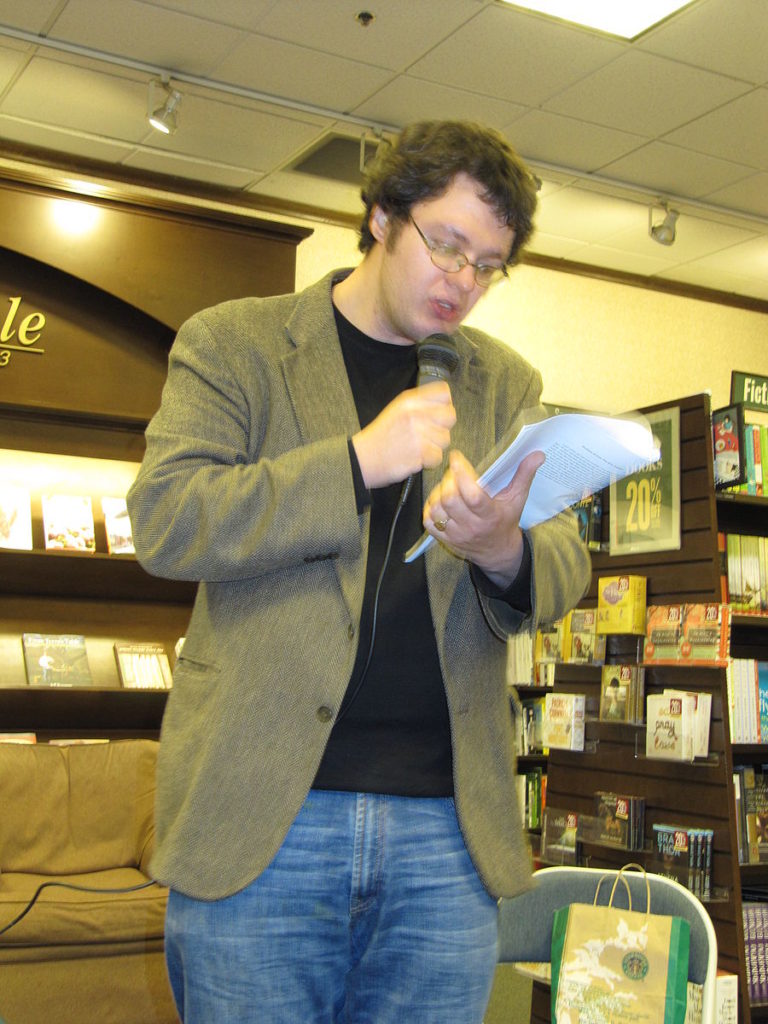
Poet, novelist Kaminsky at a reading
“What I love about his own poems is how, in the second half of the horror that was the twentieth century, knowing what happened to Gabriel García Lorca, César Vallejo, Marina Tsvetaeva, Osip Mandelstam, Paul Celan, and countless others, Adam insisted that a poem can be both an elegy for what happened and also a hymn to life. He gave us, if not a healing, then a way to go on, to give each other a measure of reprieve, music, and “gentleness.”
“To Go to Lvov” gives us context the poem, “a dream that refuses to end”: “Think of this poem, written in the 1980s, in a time when half of Europe was still under Soviet rule. Think of the joy it gives, composed in the shadow of a pained, disjointed requiem like Celan’s “Death Fugue.” Think of how much it took for a refugee and a child of refugees—for a man whose people died in exile—to stand up and imagine a way forward.”
In “To Go to Lvov,” the city’s rhythms are in the poem’s repetitions, line breaks, and sentence patterns. At the end of twentieth century, in a postwar poem about exile we expect an elegy, a protest, a dirge, but instead receive an ode’s joyful, impossible praise.
Much like “Late Beethoven,” this poem juxtaposes tonalities: humor, high lyricism, heartbreak. There is that same tension between description and invocation.
Oh! Oh! Oh! Go to the link to read Adam Z.’s matchless poem for the late Beethoven, called, justly enough, “Late Beethoven.” The poem, and Ilya’s tribute, are over at The Yale Review here.
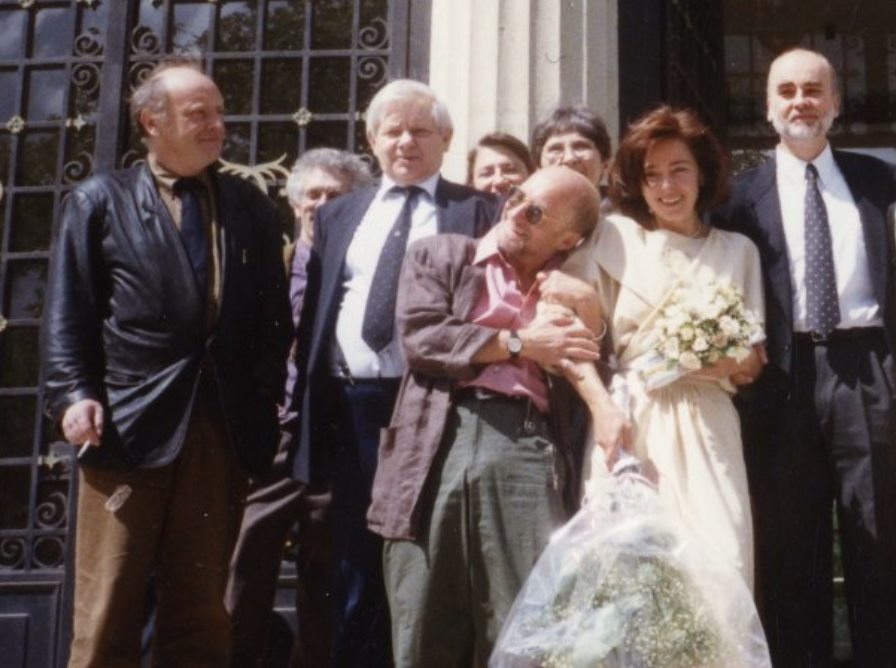
Postscript on May 11: Sculptor Jonathan Hirschfeld has identified the playful man in the pink shirt. It is Adam’s lifelong friend, the actor Wojciech Pszoniak, who passed away at 78 last October. (Some may remember that he played Robespierre in Andrzej Wajda‘s 1983 Danton.) Adam was grieving deeply for his friend. The Bulgarian-French thinker Tzvetan Todorov, who died in 2017, is in the back row on the left.
Adam Zagajewski’s wedding to Maja Wodecka. Joseph Brodsky and Zbigniew Herbert at left.