
René Girard and the roots of terrorism
January 12th, 2015


Time to go back, for sure.
We are all thinking about Paris this week, but I prefer not to let terrorists shape my thoughts about the city. I miss it terribly, so I turned again to Marcia de Sanctis‘s excellent new guide, 100 Places in France Every Woman Should Go.

Best person evah? Twain thought so.
I say “turned again,” because I had to put it away rather abruptly after she sent it to me last fall. After a quick glance through, I began scribbling notes, picking quarrels, marking passages with stars, brackets, exclamation points, or question marks in the margins. The book is addictive, like crack, and I could see I wasn’t going to get much done unless I hid it somewhere in the midst of my piles of books and papers. And so it waited.
Marcia is a former television news producer for ABC, NBC and CBS News and an accomplished journalist (we’ve also written about her here), and she hardly needed a boost from me: the book quickly hit the New York Times Travel Best Seller list shortly after its release last November. Not bad, considering it was published by a small, off-the-beaten-track house. Coincidentally, the publisher is in Palo Alto – Travelers’ Tales, an imprint of Solas House.
The book abounds with solid advice on where to shop, where to go for a long afternoon walk, where to find the best wines, and where to eat, eat, eat. Typical of her advice on the latter: “Some of the best meals I’ve ever had in France have been haphazard affairs, slapped together with a quick trip to the Marché d’Aligre near the Bastille – ripe Rocamadour cheese and saucisson aux noix, bread, and a salad of mâche trucked in that morning from the Loire Valley. It’s important to dine like this in France … while uncorking a decent Beaujolais from the corner store…
There’s also plenty of amusing, and sometimes poignant, stories about women (including the “Veuve” of Veuve Clicquot in Reims). Here’s one about a teenager who has become an obsession, at least once, in every girl’s childhood – but in this case, Joan of Arc also attracted an adult monomaniac, and a male one at that. Marcia writes:
 “Mark Twain‘s inspired book on Joan of Arc stands above the rest. He became fascinated with her when he was a teenager himself in Hannibal, Missouri, after picking up a sheet of paper in the street that turned out to be from a book about Joan of Arc. Many years later, he spent fourteen years researching and writing Personal Recollections of Joan of Arc, her life story as told to a fictitious childhood friend who traveled with her as page and secretary. The author of Tom Sawyer and Huckleberry Finn believed this to be his greatest work. His near-worship for her was boundless – for her magnanimity, convictions, faith in God, intellect and the sheer unbridled strength of body and purpose. ‘There is no blemish in that rounded and beautiful character,’ he writes in a later essay. ‘She is easily and by far the most extraordinary person the human race has ever produced.'”
Another girl story: the scandalous and powerful Eleanor of Aquitaine (1137 – 1204), wife of England’s Henry II. As queen of France, she had accompanied King Louis VII on the Second Crusade. As the wife of Henry II, she led a rebellion against her husband with three of her sons in 1173 – and lost. Henry imprisoned his 50-year-old wife for fifteen years – more like a house arrest, really. Well, we’ve all seen The Lion in Winter, haven’t we? Marcia continues:

A Book Haven kind of gal.
“And then, upon Henry’s death and Richard’s ascension to the English throne, she rose again. The dowager queen defended the kingdom while he was away on the Third Crusade (and imprisoned by the Holy Roman Emperor), even against her machinating youngest son John, who had been Henry’s favorite. ‘We can learn a lot about perseverance and hope from Eleanor,” says [colleague] Sue Morris. “She started a full second life after seventeen years in prison.’ And she rode until the end of her days, even in her early eighties, seeking wise political matches for her children and grandchildren.
“By then, she was already installed at the convent at Fontevraud. It is believed she had a hand in designing her gisant – the tomb effigy that bears her likeness – and here is where the story of Eleanor ends with a breathtaking statement. Usually the tomb of a queen shows her in sweet repose, the bible laid peacefully upon her chest. Eleanor, however, is actively reading her prayer book. Alive, for eternity.”

The “veuve” was real.
For this concluding image of the enormously rich Eleanor, quietly reading a book into the next world, I can forgive Marcia for bringing Dan Brown‘s The Da Vinci Code into her account of Vézelay, and for all the little villages and people I wish she’d mentioned. Isn’t a hundred stories enough?
Tonight, we’ve roamed Auvergne, Languedoc-Roussillon, and the French Pyrénées. Let’s end with Normandy, and Mont-Saint-Michel, which I’ve never ever seen (so far): “It is arrogant, aloof, arrestingly dignified … The abbey might be just a lovely relic if not for the milky expanse of the bay in which it sits. Each can only be understood in relation to the other – the ocean’s perilous strength against the architectural beauty and vice versa.”

Francophile (Photo: Ron Haviv)
“I stopped at the West Terrace, where I looked down and saw the angry sea and clouds like waves of steel wool, Brittany to the west, Normandy to the east. I gazed up at the spire. There was Archangel Michael, brandishing his sword skyward, hip thrust to one side, looking dull in the mist. I walked in near solitude around the colonnades of the cloister, whose boxwood hedges seemed impossibly green. I strolled back down to town on the outside steps and turned back to see the Merveille. Two hundred thirty-five feet of sheer verticality and simple lines, walls thrown up in some fit of ancient genius. I ate dinner at La Mère Poulard, whose pricy omelet was nevertheless perfection. … The rain had ended, the remaining clouds lapped the full moon. I descended the hill to see the abbey from sea level, blazing like a fireball. The delicate spire looked blue, and Michael was gold again. I walked back up to the church to take in those walls that seemed to spring straight up from the rock I stood on.
“I was completely alone. The sound of my boots on the stone path resounded in the night. There was no crowd, the Breton biscuit stands and T-shirt shops, locked up. The air was frosty. ‘One looks back on it all as a picture; a symbol of unity; an assertion of God and Man, in a bolder, stronger, closer union than ever was expressed,’ wrote the American writer Henry Adams in 1905 about Mont-Saint-Michel. More than any other cathedral or abbey in France, I get a sense here of what fragile, earthly creatures we are, but also how optimistic, and how unstoppable. If ever I need reminding of the latter, I will make my way there again some rainy winter night.”

“Arrogant, aloof, arrestingly dignified …” (Photo: David Iliff)
 I wrote some weeks ago about the demise of The New Republic, our culture of “juvenescence,” and the difficulty of faking cultural heft. At least William Deresiewicz is on the same wave-length. Kind of. In case you missed it, the aptly named Michael Schulson has recently published a Salon Q&A with Deresiewicz – he indirectly called Chris Hughes, the youngster whose mismanagement trashed the century-old institution, an “entitled little shit,” so naturally that phrase made it into the headline. Deresiewicz was a contributing editor to the ill-fated magazine, and says that Hughes missed the point: that The New Republic has never made money. “The Nation loses money now, Harper’s loses money now, and they’ve been reliant on benevolent plutocrats who recognize that there are more important things than the market and are willing to run them not as profit-making institutions but as institutions that have value for other reasons.”
But the real subject of the interview is his new book called Excellent Sheep, which discusses how our best universities have succumbed to the marketplace, and what it’s done to kids. (He wrote a controversial article about the topic, “Don’t Send Your Kid to the Ivy League,” in the July issue of The New Republic here.) A couple excerpts from the interview:
It’s been a rough year for higher education, with athletic and sexual assault scandals at UNC, Florida State, and, of course, the University of Virginia. Does your takedown of elite colleges apply, more broadly, to the culture of higher education in the United States?
Yes and no. I certainly think a lot of what I’m saying applies beyond selective colleges. This is a more general trend in the way we understand education around the world, which is that we understand it in purely practical market-oriented terms. My feeling is that this reflects a wider understanding of what life and society are for. We’ve basically reduced what it means to be human to market terms, to getting and spending. So education, which is about preparing you to be human, has also been reduced to those terms.
The specific things you’re talking about, I don’t know that they’re really directly connected to what I’m talking about. They are connected in this sense: because colleges for several decades have been forced by specific changes in government policy to treat their students as customers, schools have focused on everything except instruction in core liberal arts fields. That also includes a lot of spending on athletics, and on the kind of culture that athletics and fraternity life create. …

Can’t buy heft.
I’m thinking of Joshua Rothman’s response to your book, over at The New Yorker. He argues that the problem isn’t with higher education, but with a contemporary world that pushes us to live accelerated, anxious, market-oriented lives. In Rothman’s view, there’s a nostalgia for the premodern in “Excellent Sheep.”
If you can point to a single passage in the book that expresses that kind of nostalgia I’d be very interested to see it. I don’t feel it and I don’t say it.
The notion of higher education as involving not only vocational preparation and intellectual development, but something that used to be called character or moral development, has been foundational to American higher education from the beginning. I’m not looking back nostalgically at some golden age; what I’m pointing out is that there has always been this higher idea in higher education, and it’s only in the last 40 years that we’ve lost it.
Modernity created a new idea about what it means to be young. To be young [in modernity] is to step outside of your own life. It’s a phase between childhood and adult life where you get to look at the world and think about it and question it and decide what you want the world to look like. This was, in many ways, the engine of revolutionary energy during modernity for about 200 years. When college became the norm, at in least certain circles, that notion of youth as the time where you step outside of the world and you become a little rebellious and critical and you think about what you want the world to look like, that was also central to college. Rothman wants to talk about modernity, but he really didn’t talk about the modern idea of youth, which is not about acceleration. It’s about dissent.
I’m talking about the switch from modernity to postmodernity. Postmodernity, as I’m understanding it, is the time of neoliberalism or Reaganomics or market fundamentalism, where the only thing that matters about you is your function in the marketplace, your ability to make money and spend it. It’s postmodernity that is destroying the modern concept of youth, and creating a new concept of youth where you go to college not to step outside the world and question it but simply to prepare yourself for the kinds of acceleration that Rothman talks about as belonging to adult life. …

You don’t feel like MOOCs can feed thinkers and intellectual culture?
I think they have a role to play, but at a very much lower intellectual level. Listen, real learning happens dialectically, right? Where did you go to college?
Yale.
You went to Yale, and you probably took lots of seminars where you had really great discussions and lots of interactions with fellow students and teachers. That’s where education happens; it doesn’t happen by learning how to program computer code online. It’s great that people can do that, but that’s not the same thing. That’s a technical education.
Read the whole thing here.
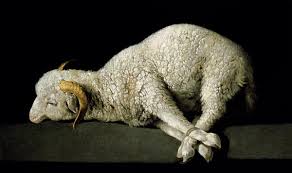
Mercy, please.
I think the better of Friedrich Nietzsche for this: “On January 3, 1889, he suffered a complete mental collapse when he saw a horse being flogged by a coachman in the city of Turin. He embraced the neck of the horse and wept uncontrollably. That moment of lucid insight into animal torment marked the end of his sanity.”
The incident is described in Robert Pogue Harrison‘s blog post yesterday, “Our Animal Hell,” in the New York Review of Books, which considers the Pope’s recent remarks on animals, and compares it with our deplorable treatment of animals. I cannot describe how strongly I feel about this topic – people tend to blow you off when you attempt such a thing – so I’m glad Robert has done some of the talking for me, and more eloquently than I have ever done. The post is illustrated with Francisco de Zurbarán‘s famous painting (at left), which I have always found almost unbearable. If you read much about René Girard, you’ll run across the image a lot, used to illustrate his thoughts about sacrifice – he argues, plausibly, that the story of Abraham and Isaac is not a parable of blind and murderous obedience, but rather marks an anthropological shift from the sacrifice of humans to the sacrifice of animals as a substitution. If you read much of the Old Testament, you’ll realize the ancient city of Jerusalem must have reeked the smell of animal blood and reverberated with the cries of terrified creatures.
An excerpt from Robert’s piece:

With you on this one, Robert. (Photo: L.A. Cicero)
“We like to think of ourselves as the stewards or even saviors of nature, yet the fact of the matter is, for the animal world at large, the human race represents nothing less than a natural disaster. This applies to all creatures, from those we allow to roam ‘wild’ in designated nature preserves to those we cram together on our chicken farms; from the dancing bears of Anatolia to the bald eagles of Alaska, with their collar monitors; from the laboratory animals we test our cosmetic products’ chemicals on to the sharks whose fins leave the oceans to swim around in our nuptial soups. All creatures are under our yoke; and all, including our beloved horses, dogs, cats, and canaries, are subject to human persecution in one way or another.
“From a quantitative point of view our species guilt is more aggravated today than it ever was in the past, when Plutarch or Pythagoras cried out against animal murder and the consumption of animal flesh. As the French philosopher and biologist Jean Rostand put it, ‘Science has made us gods even before we are worthy of being men.’ While the scale of animal death has increased exponentially, the main issue today is no longer death but the coercive reproduction and perpetuation of animal life under infernal conditions of organic exploitation. Industrialized farming today, in its manipulation of the biological processes of genesis, growth, and multiplication, forces animals like cows, calves, turkeys, pigs, ducks, and geese into artificial, barely endurable forms of existence. Far more demonic than the slaughters and animal sacrifices of the past, our relegation of `these creatures to a standing reserve of consumable stock reduces their ‘lives’ to a worldless, merely mechanical process of flesh production.”
Nicholas Kristof expressed some of the same thoughts in a recent column in The New York Times: “Torture a single chicken and you risk arrest. Abuse hundreds of thousands of chickens for their entire lives? That’s agribusiness.”
Read the whole thing here. Please.

Little Star, the annual journal of poetry and prose run by Ann Kjellberg, has just published its sixth issue. It includes new work by Per Pettersen, César Aira, Eliot Weinberger, Linda Gregerson, Lydia Davis, A. J. Snijders, Gerbrand Bakker, Ange Mlinko, Georgi Gospodinov, Eugene Lim, Jacqueline Waters, Menno Wigman, Les Murray, Tim Parks, Darcie Dennigan, Rowan Ricardo Phillips, John Moran, Eugene Ostashevsky, Major Jackson, and others.
 Little Star is “a sophisticated, wise and fierce little magazine. Filled with works in translation, painfully underrated writers like the brilliant Kathryn Davis and lovingly put together, I was impressed with it from start to finish,” writes Jessa Crispin. Added John Banville: “A very fine venture indeed… everything such a magazine should be.”
My issue (you can order your own here) arrived with an unusual note: “Help us out! Send us a picture of you reading this issue where you live – info@littlestarjournal.com; @littlestarmag ”
How could we resist? … but how could we comply? I staggered around Stanford, helplessly attempting a nonchalant selfie while trying to hold my cellphone steady and trying to look like I was engrossed in a journal at the same time. All the while feeling a little bit ridiculous. It didn’t work out very well. I have several dozen photos to prove it.
Finally two passing strangers asked if I needed help. I explained my mission, and they snapped the photo above, with me at the feet of Rodin‘s Jean d’Aire (I tell his story here). I wish I’d taken their names! I could have given them a photo credit! At any rate, I got favorited on Twitter by my friends at the Center for Writers and Translators at the American University in Paris; a friend I haven’t met yet, Blake Eskin; and Little Star itself.
Happy New Year everyone! Meanwhile get a copy of Little Star – and good luck with that selfie!

Yes…I see the resemblance…
Those who don’t live in Eastern Europe, where memories of life under Communism during much of the last century linger, don’t fully comprehend the chilling effect across that region of what’s been happening under Vladimir Putin’s rule:
Our respite was short-lived in the end.
But after long hardships it had seemed
It would never draw to a close. Friends
Invoked poetry and feasted in gardens …
When I saw Tomas Venclova‘s new poem “Caligula at the Gates,” in The Irish Times (the translator, Ellen Hinsey, had kindly dropped a note to let me know), I associated it with the Lithuanian poet’s autumn sojourn in Rome. Not so, he told me – it was, in fact, written in August, in Montenegro, one of his favorite haunts. And the subject is “Mr. Putin, of course.” Well, of course. The Roman touch is a common metonymy, he reminded me, though I shouldn’t have needed reminding. My head has been far away from current events – a luxury not afforded everyone in the world. I’ve always maintained that Tomas Venclova, who is one of the leading figures in literary Europe, and whose poetry has been published in more than twenty languages, and he should be better known in the United States, where he has been resident at Yale for years and years now (resident, that is, when he’s not on the road, as he is much of the time)…

They have the same scowl.
We ridiculed the words of the prophets
But, agelessly, they proved to be true …
This poem, in particular, has been already published in Poland, Germany, also in Russia. But you don’t have to be located in any particular part of the world to sense the following:
Blow out the candles and close the gates.
Beyond them – Caligula and the plague.
Read the whole thing here.
| M | T | W | T | F | S | S |
|---|---|---|---|---|---|---|
| 1 | ||||||
| 2 | 3 | 4 | 5 | 6 | 7 | 8 |
| 9 | 10 | 11 | 12 | 13 | 14 | 15 |
| 16 | 17 | 18 | 19 | 20 | 21 | 22 |
| 23 | 24 | 25 | 26 | 27 | 28 | 29 |
| 30 | 31 | |||||
The Book Haven is proudly powered by
WordPress
Entries (RSS)
and Comments (RSS).
© Stanford University. 450 Serra Mall, Stanford, California 94305. (650) 723-2300. Terms of Use | Copyright Complaints
