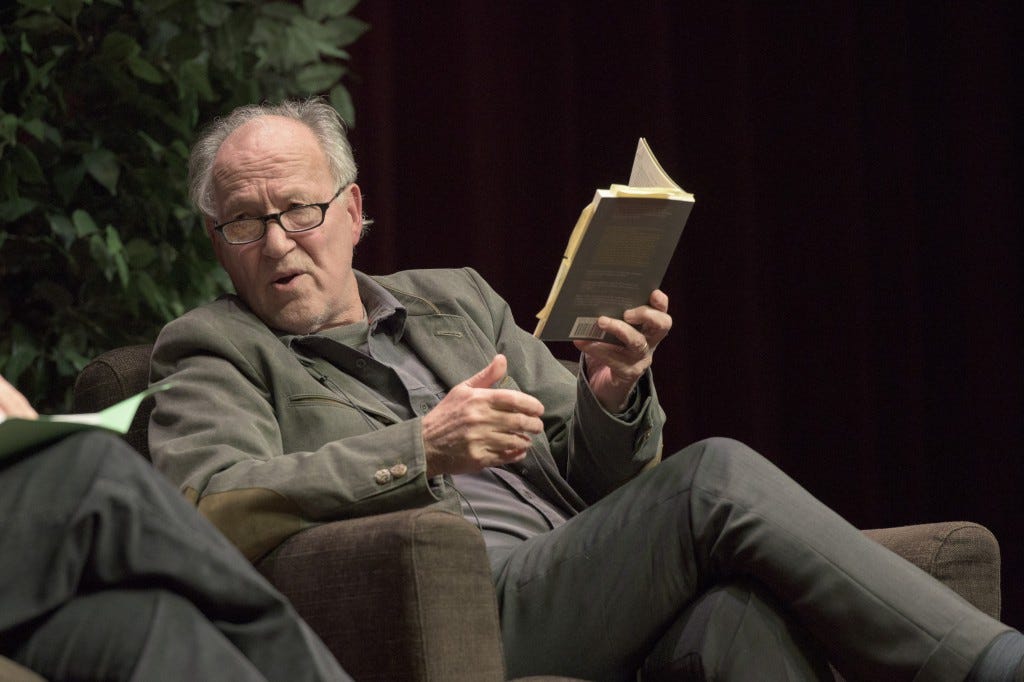
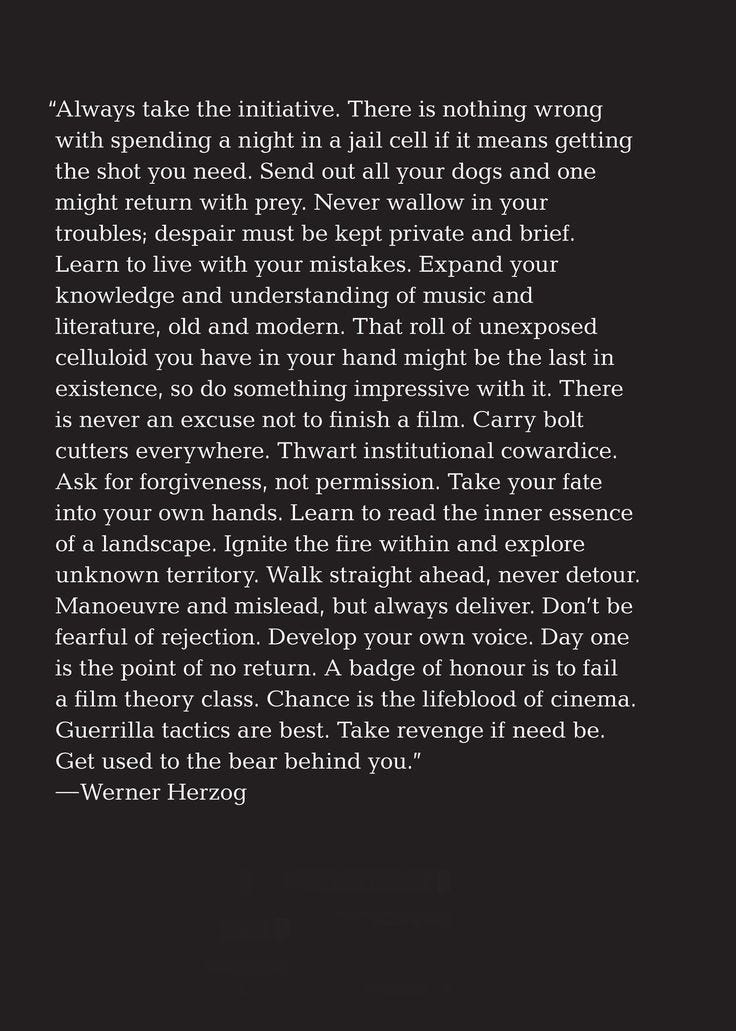
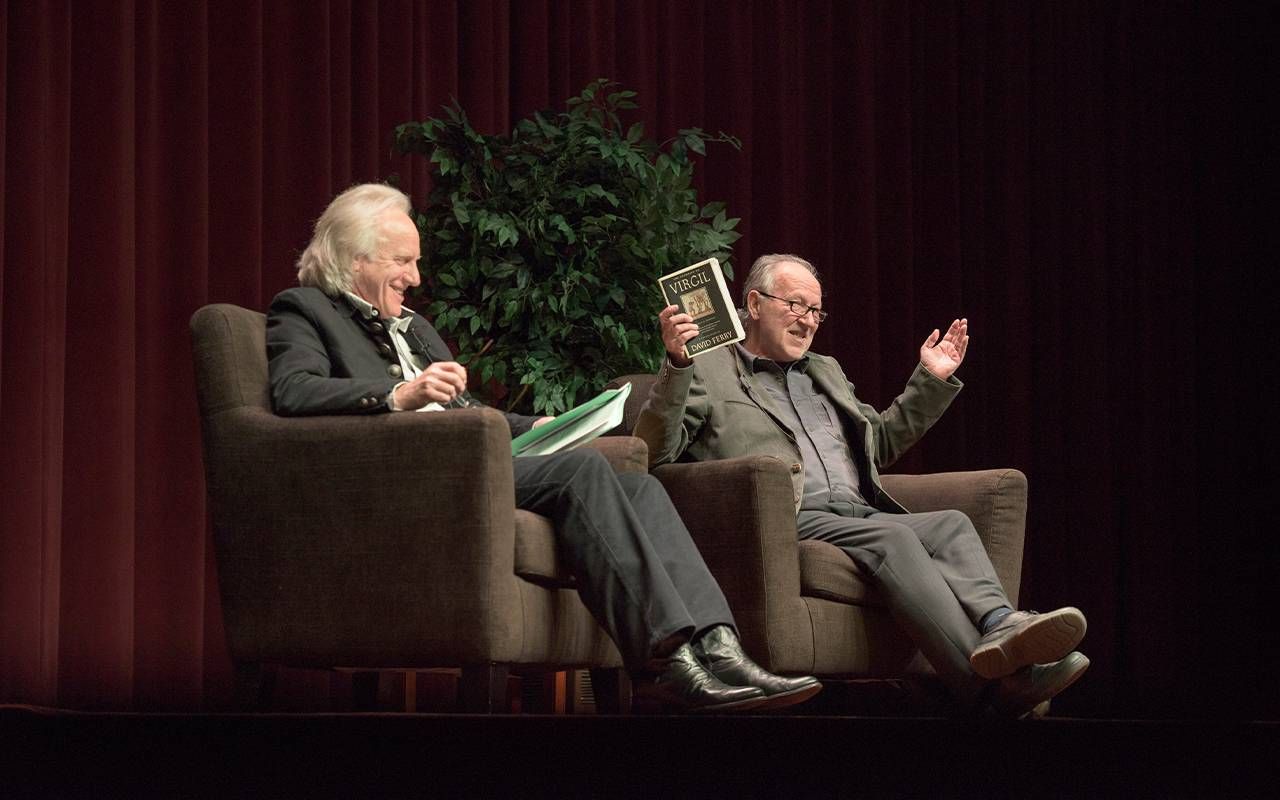
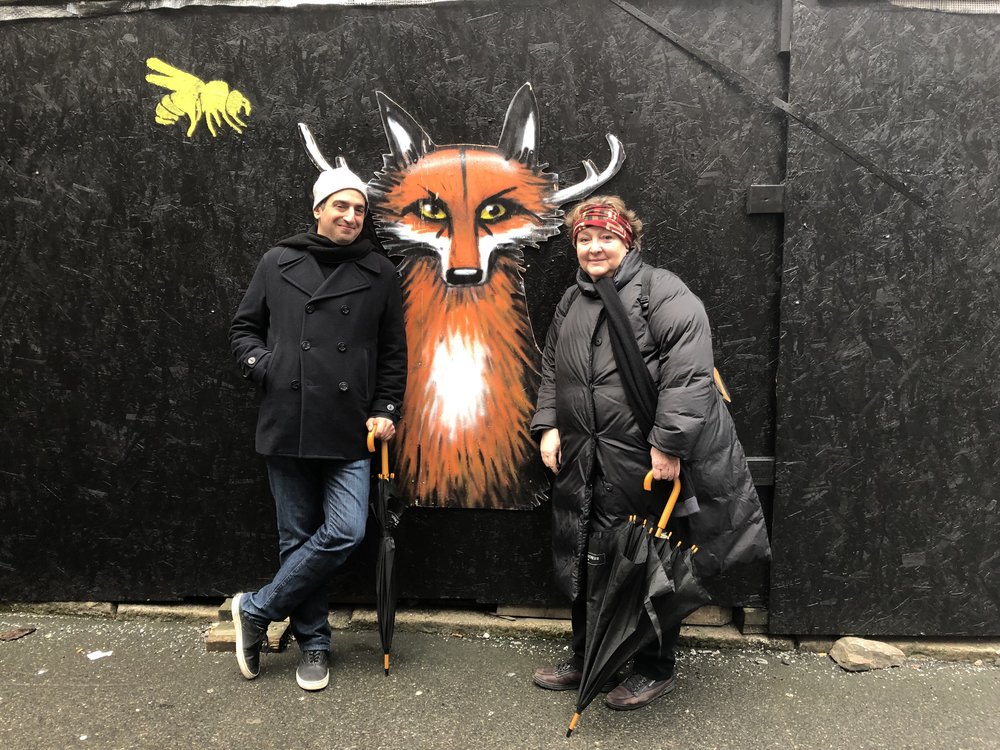
A few gentle reminders from filmmaker Werner Herzog: “A badge of honor is to fail a film theory class.” “Thwart institutional cowardice.” And a few moments about my minutes onstage with the outspoken legend.
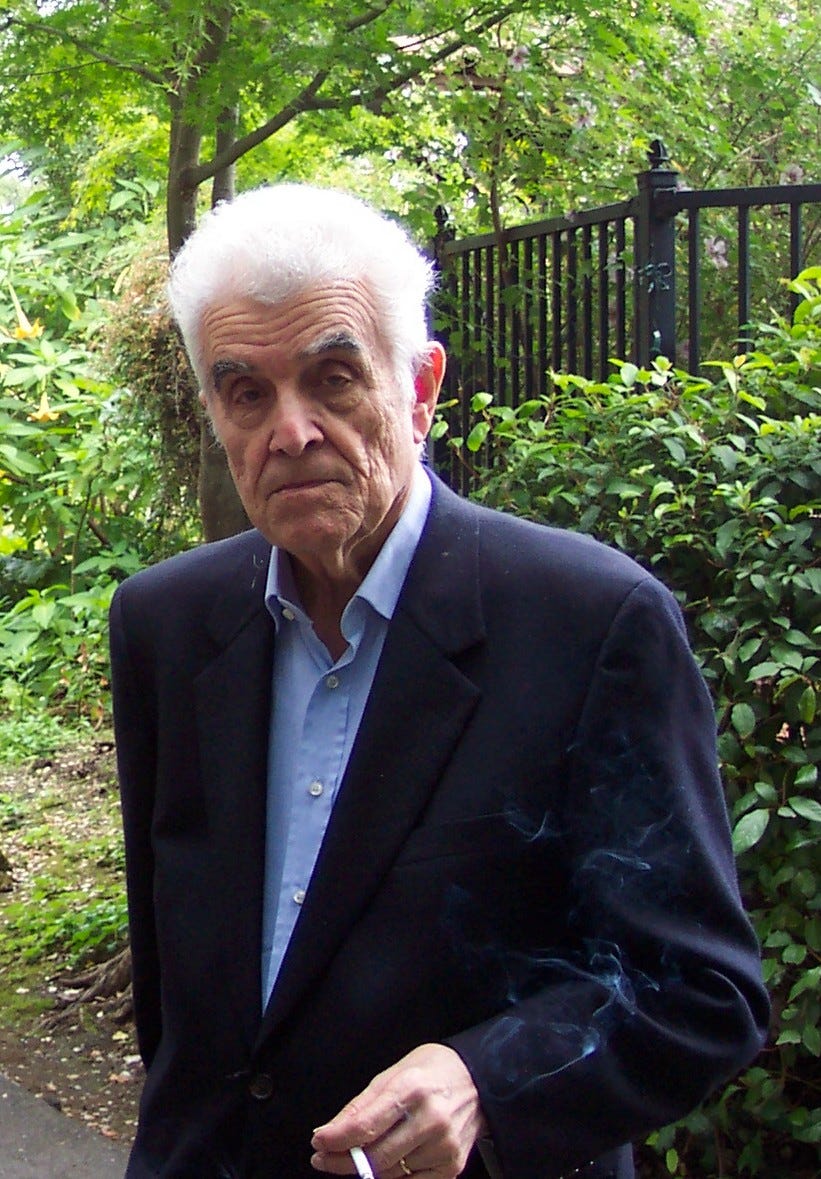
Herzog quibbles about a point.(Photo: L.A. Cicero/Stanford University)
Cynthia’s Substack is a reader-supported publication. To receive new posts and support my work, consider becoming a free or paid subscriber.
The Another Look is a community book club for everyone, founded by National Medal of Arts winner (and Stanford professor) Tobias Wolffand I launched it in 2012. It’s offered online and in-person, and currently boasts what I believe is the largest book club in the world with 4,088 members. Join our mailing list here, and we’ll inform you of upcoming events.
Perhaps our greatest moment was on a rainy night, February 2, 2016, we featured an onstage event at Stanford with legendary filmmaker Werner Herzog discussing J.A. Baker‘s The Peregrine– and so much more. The film is now available on youtube, in a full-length version (here) and a highlights version (here). Or look to the links below.
Another Look’s director, Prof. Robert Harrison, a regular contributor to the New York Review of Books and host for the popular “Entitled Opinions” radio talk show, was the interlocutor for the discussion.
The event was covered by Caille Millner in the San Francisco Chronicle (here). Meanwhile, you can watch the highlights version below, and the full hour-and-a-half discussion below on the link below.
I return to these maxims which enjoin us to “thwart institutional cowardice.” And this koan: “Manuever and mislead, but always deliver.” You’ll find favorites of your own.
True story: At the carefully managed 2016 event, I was appointed as the person to keep the crowd from swarming Herzog after the onstage conversation. It wasn’t too cautious: afterward the crowd did climb onstage, as the managers of the had event feared. A solitary woman trying to manage a mob. Herzog gently pushed me away, and let the crowd storm him. He was laughing, and he loved it.
If you’d like to read my interview with artist/photographer Lena Herzog, Werner’s wife, go here.
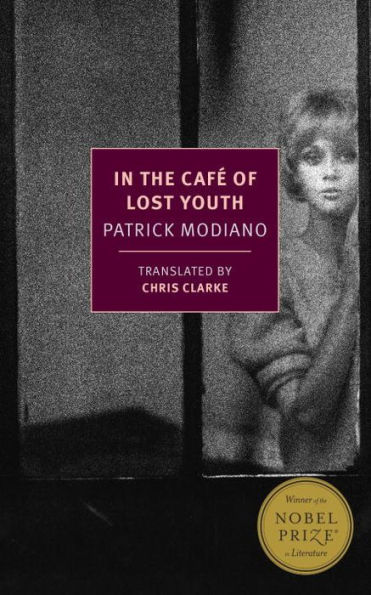
On Wednesday, 18 February, 2026, Another Look will present Nobel prizewinning Patrick Modiano’s 2007 novella, In the Café of Lost Youth(New York Review Books). The event will take place, as always, at 7 p.m. at Levinthal Hall, 424 Santa Teresa Street on the Stanford campus.
They will be joined by Chloe Edmondson, a lecturer in Stanford’s Department of French and Italian. She is the France-Stanford Center Fellow for the Roxane Debuisson Collection on Paris History. You will remember her from our event Madame de LaFayette’s The Princesse de Clèves in 2019. We have invited Stanford actor, director, and drama professor and Rush Rehm to round out the panel. (You will remember Rush from our 2016 event on Joseph Conrad’s The Shadow-Line: A Confession.)
The Nobel announcement recognized Modiano’s “consistent exploration of memory and the elusive nature of personal history, often set against the backdrop of occupied Paris.”
He has been praised for his “subtle, clear style and his ability to bring anonymous lives to light, making him a modern-day Proust in the eyes of some.”
According to World Literature Today, “Modiano’s fictional world is not postapocalyptic, like the fictional worlds of Beckett, but postrelational . . . a world where familiar patterns, whether placed in memory, neighborhoods, or situations, are dispersed and left to languish on the wind.”
Nothing makes “the meaning of life” less persuasive than much talk about it. The same is true of hope for the new year. “You gotta have hope. Mustn’t sit around and mope. Nothing’s half as bad as it may appear. Wait’ll next year and hope.” So sang Peggy Lee, back when I was growing up. The sentiment is familiar, almost compulsory—cheerful, reassuring, and exhausting. Hope becomes a duty, something you are supposed to have rather than something to live with.
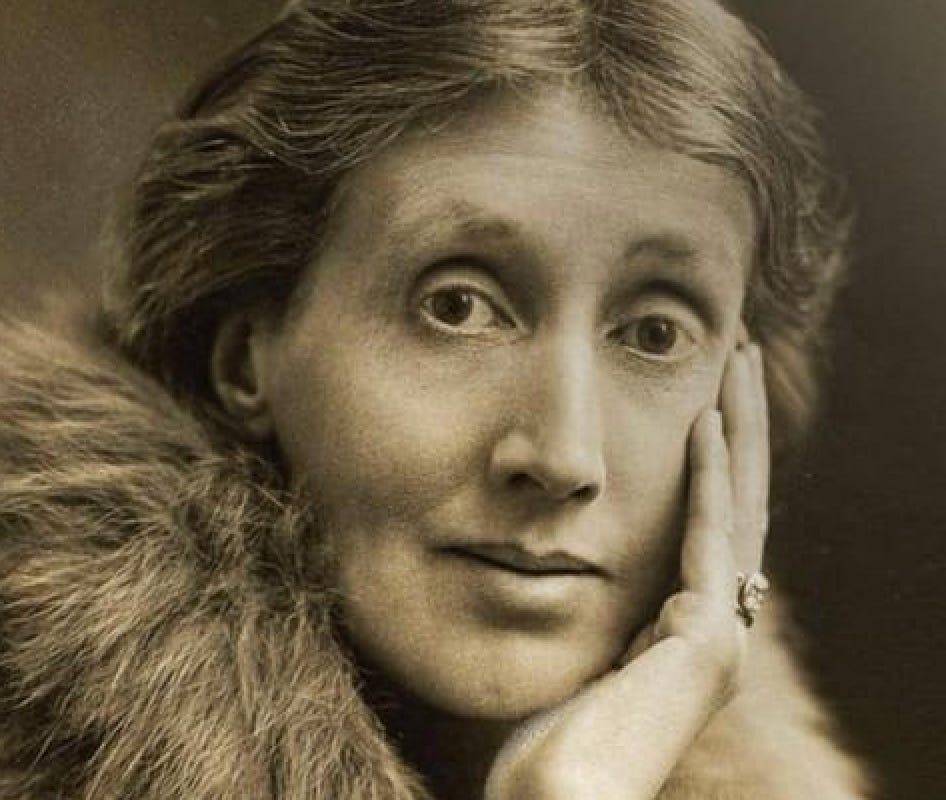
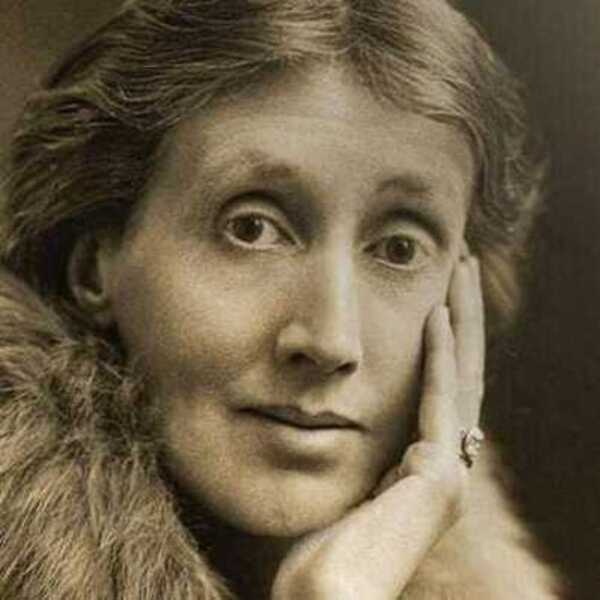
Virginia Woolf thought about life differently. She believed it isn’t made up only of events or achievements, but of brief “moments of being” that don’t announce themselves—flashes of awareness that shimmer and vanish, yet leave a trace. A sentence that names a feeling not quite articulated before. An insight that unsettles what once seemed settled. A question that stays alive days or even weeks later. These moments don’t arrive labeled as hope, but they change how we see.
Public life increasingly runs in the opposite direction. It is shaped less by what people hope to build together than by who they are against: red versus blue, “real America” versus its enemies, every election a last stand, every defeat a betrayal. Nothing is allowed to settle. The fight must always go on, because without the fight, there is nothing left to hold.
We see this whenever leaders keep conflict alive by pointing outward—toward a villain abroad (the latest, Venezuela’s Maduro), a traitor within, or a threat just vague enough to absorb blame. The names change. The effect doesn’t.
René Girard identified the pattern. When enemies are required to define who we are, common purpose becomes common hatred. Imitated desires ensure rivalry, and relief is found by assigning blame. Sometimes the target is a group—“godless liberals,” Trump supporters. Sometimes it is an abstraction that cannot answer back: the economy. In each case, a scapegoat absorbs the disorder, creating unity not through truth but through exclusion. Politics knows this rhythm well.
Friedrich Nietzsche named a similar dynamic ressentiment. Blame supplies meaning. Frustration no longer seeks remedy; it seeks an offender. “I am right” is no longer enough—it must become “you are wrong.” Morality becomes adversity. The weakness politics fears is renamed vulnerability in personal relationships—and treated as moral capital.
We see this logic at work in ordinary places: a school board meeting where every proposal sounds like an attack; a neighborhood forum that turns into a trial; an online exchange where no concession counts, only the next offense. Solving the problem matters less than naming the culprit. Even victories feel thin—each one merely reveals the next foe—until resolution itself begins to look suspect, or even a letdown. (Photo at right by Ewa Domańska)
Rivalry demands a victim, and ressentiment a target. Hostility becomes the point. Identity forms around opposition, and when one grievance fades, another takes its place. Without an enemy, the story collapses.
Earlier struggles for justice, however flawed, aimed at ends that could at least be named and settled: a law changed, a right secured, a barrier removed. Now facts, compromises, and even concessions rarely curb anger, because politics feeds on grievance rather than resolution.
The roots are as much psychological as political. Nietzsche saw how suffering that cannot be acted upon becomes someone else’s fault. Hurt hardens into judgment; disappointment turns into injustice. It can feel easier to be wronged than responsible. We imitate one another’s desires and then turn on one another when those desires collide. Small differences are exaggerated to keep opposition alive. (Photo of René Girard by Ewa Domańska, used with permission)
Democracy has to offer other sources of commitment—ones that do not depend on having an enemy. People need things worth showing up for together: work worth doing, care given and received, shared projects that draw energy from devotion rather than grievance.
For us, that may begin—or begin again—modestly: staying at the table when it would be easier to walk away and feel justified. Doing the unglamorous work of keeping a school, a neighborhood, a church, a union, or a family from coming apart, even when no victory can be claimed and no one notices.
It is tempting to think moral seriousness must announce itself as a crisis. Moral life begins sooner than that. It is practiced without spectacle, sustained in situations with no spotlight and no applause: taking out the trash for an elderly neighbor, watching a friend’s kids, fixing a loose step, shoveling a driveway before work—the low hum of ordinary care.
These “moments of being” belong to no side. They offer no scapegoat, no enemy to drive out. There is nothing glamorous about them—only the steady practice of showing up.
The world does not move only through power or headlines. Sometimes it moves through memory, attention, and ordinary acts that never become slogans. The full circle isn’t flashy. It holds.
Notes and reading
Venezuela –Maduro abducted. The familiar patterns discussed in this post apply: mimetic rivalry, ressentiment, and scapegoating.
Sunday morning: While a U.S. citizen, I grew up in Venezuela, which became my home country—alma mia. The Hugo Chávez > Nicolás Maduro regime has been brutal and corrupt. So was the right-wing dictatorship that Venezuelans themselves had overthrown in 1958, to the dismay of the U.S., which had been receiving 90% of national oil revenues from the American oil companies that effectively owned the oil fields and have since been nationalized under incompetent management.
What followed the earlier dictator’s demise was an attempt at democracy that descended into chaos: the very dynamic that had enabled authoritarianism to return under a different banner then inspired the rise of the left-wing regime just overthrown. Apparently, the U.S. president expects to “run the country” with the (former) dictator’s loyal Vice-President, not the Nobel Peace Prize-winning opposition leader, María Machado, whose electoral victory had been denied by Maduro and called “rigged.” The U.S. itself backed the extraction of Machado in December 2025, just four weeks ago, even though she had become a vocal supporter of our own president. — One response to Donald Trump could be, “Been there. Done that. It doesn’t work.”
Media commentary is now overwhelming. Among the strongest are Timothy Snyder, an American historian of Europe and a public intellectual in both the United States and Europe, and Joyce Vance, a former U.S. Attorney.
The figure of the scapegoat extends beyond its biblical origins in Leviticus to many religious and cultural rituals of expulsion intended to contain disorder and restore unity. Mary Douglas’s Purity and Danger and Freud’s Totem and Taboo remain classic studies of how pollution, exclusion, violence, and belonging intertwine in human communities. Earlier cultures marked the New Year by naming and containing scapegoating; we mark it by denying it—while practicing it endlessly.
Friedrich Nietzsche, On the Genealogy of Morals, trans. Walter Kaufmann and R. J. Hollingdale (1989). First Essay, §§10–11.
René Girard, Violence and the Sacred, trans. Patrick Gregory (1977), esp. chs. 2–4; and The Scapegoat, trans. Yvonne Freccero (1986).
“low-humming rhythm of simplicity”—Rituparna Sengupta, “Each Leaf a Second,” World Literature Today (January/February 2026). Sengupta researches and writes on literature, cinema, and popular culture. O. P. Jindal Global University, India.
Moral progress is annoying – Daniel Kelly and Evan Westra, Aeon (June 2024). Affective friction: the misalignment between our internalized norm psychology and new or unfamiliar social norms. Kelly and Westra are philosophers at Purdue University who work on issues in moral and cognitive science. (Compare “cognitive dissonance”)
[Virginia Woolf—The phrase “moments of being” comes from her autobiographical writings. See Woolf, Moments of Being, ed. Jeanne Schulkind (1976).]
Winter is a great time for reading. Here’s our suggestion for 2026. The next “Another Look” book club event at Stanford will feature a Nobel prizewinner. You won’t want to miss it. (Did we mention that “Another Look” is the biggest book club in the world?)
On Wednesday, 18 February, 2026, Another Look will present Nobel prizewinning Patrick Modiano’s 2007 novella, In the Café of Lost Youth(New York Review Books). The event will take place, as always, at 7 p.m. at Levinthal Hall, 424 Santa Teresa Street on the Stanford campus.
They will be joined by Chloe Edmondson, a lecturer in Stanford’s Department of French and Italian. She is the France-Stanford Center Fellow for the Roxane Debuisson Collection on Paris History. You will remember her from our event Madame de LaFayette’s The Princesse de Clèves in 2019. Valerie Kinsey, a Stanford lecturer in Writing and Rhetoric Studies, will round out the panel.
The Nobel announcement recognized Modiano’s “consistent exploration of memory and the elusive nature of personal history, often set against the backdrop of occupied Paris.”
He has been praised for his “subtle, clear style and his ability to bring anonymous lives to light, making him a modern-day Proust in the eyes of some.”
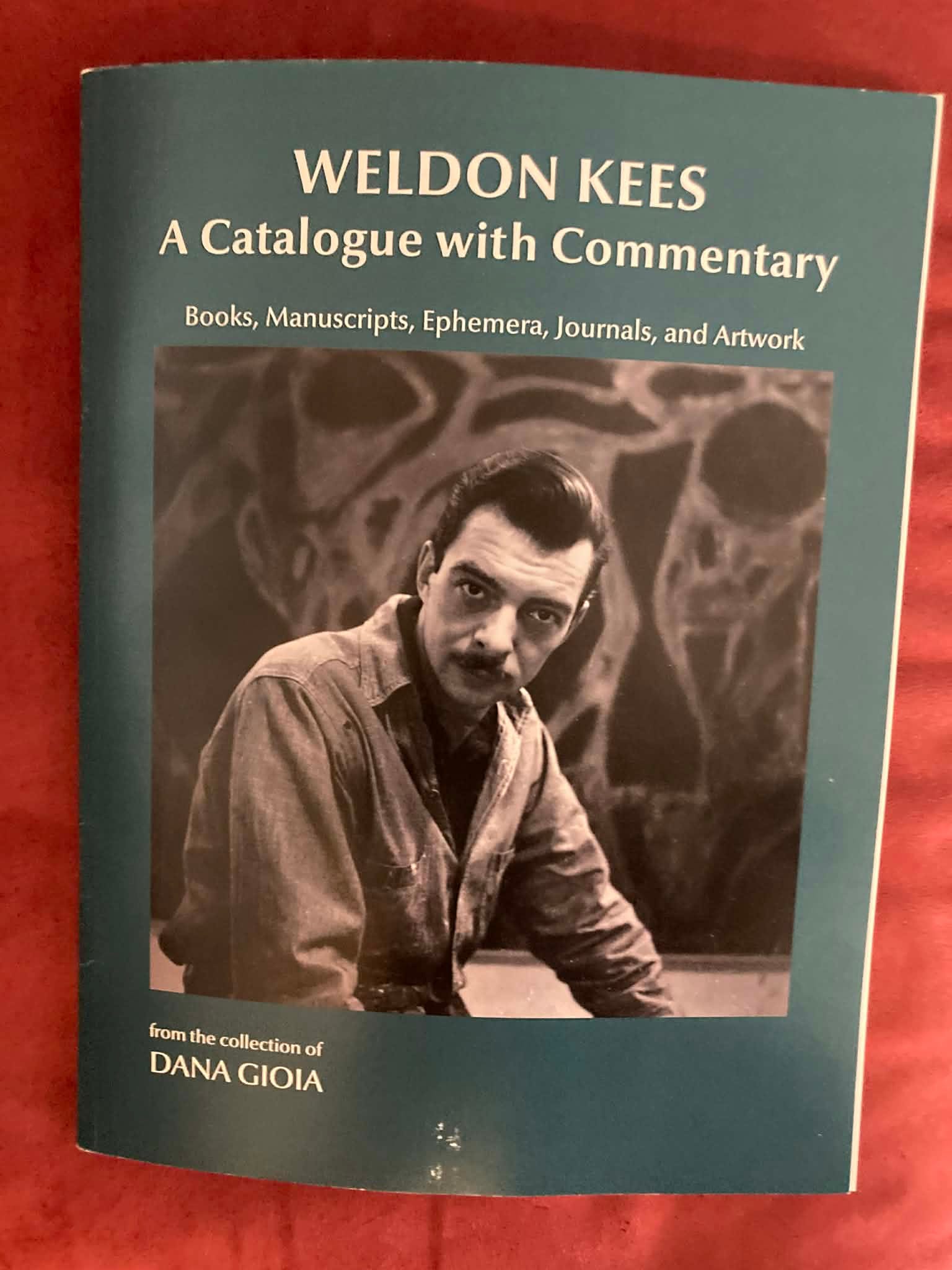
From my mailbox: Dana Gioia, poet and former chairman of the National Endowment for the Arts, sent me the latest fruits of his labors. Dana has long been a champion of the of the overlooked poet Weldon Kees (1914-1955). According to poet Donald Justice, “Kees is original in one of the few ways that matter: he speaks to us in a voice or, rathre, in a particular tone of voice that we have never heard before.” Dana has just published a catalogue of his own collection with commentary, including works of fiction and non-fiction, broadsides, journals, music and recordings, critical works, and more. Here is the preface:
I first discovered the poetry of Weldon Kees in 1976—fifty years ago—while working a summer job in Minneapolis. I came across a selection of his poems in a library anthology. I didn’t recognize his name. I might have skipped over the section had I not noticed in the brief headnote that he had died in San Francisco by leaping off the Golden Gate Bridge. As a Californian in exile, I found that grim and isolated fact intriguing.
“I had found the poet I had been searching for.”
I decided to read a poem or two. Instead, I read them all, with growing excitement and wonder. I recognized that I was reading a major poet. He was a head-spinning cocktail of contradictions—simultaneously satiric and terrifying, intimate and enigmatic. He used traditional forms with an experimental sensibility. He depicted apocalyptic outcomes with mordant humor. I had found the poet I had been searching for. Why had I never heard of him? Embarrassed by my ignorance, I decided to read everything I could find by and about him.
It was a Saturday afternoon. I had the rest of the weekend free. I drove to the main branch of the Minneapolis Public Library, heady with anticipation. I was eager to read all of his books. I also wanted to see what other readers thought about him. I knew my way around libraries—an important skill in those pre- internet days. Whatever books and commentary existed, I would find.
What I found after two days of searching was nothing. There was not a single book of any kind by or about Weldon Kees in the Minneapolis library system. His work, I also discovered, did not appear in standard anthologies. (I had read one of the only two anthologies that had ever featured a large se- lection of his poems.) There was no biography. There were no entries about him in the standard reference works. Nor were there chapters on him in the numerous critical books on contemporary poetry.
He went unmentioned in the biographies of his contemporaries. There had never even been a full-length essay published on his work.
By Sunday evening, I realized why I had never heard of Kees. Hardly noticed during his lifetime, in death he had been almost entirely forgotten. A suicide at forty-one, Kees had succeeded in his last endeavor—vanishing. His body had never been recovered. Kees had been washed away from posterity with- out rites or remembrance. All his work was out of print. Worse yet, most of it—the stories, novels, plays, and criticism—had never been collected. Some of it, such as his first novel, had been lost entirely. Only the poems, a small, brilliant body of work, survived precariously—without criticism or commentary, almost without readers.
I decided then I would write a long, comprehensive essay on his work. It was not the sort of thing I had done before. I could not begin, however, without knowing more. I did not own any of his books. I knew few facts about his life. I began to search, gather, and collect. I not only found books, journals, and eventually manuscripts; I found people who had known and worked with him. I also discovered I was not alone in my intense admiration.
Three years later I published my essay in a special issue of the Stanford literary magazine, Sequoia, edited by my brother [jazz scholar] Ted Gioia. The issue stirred up a surprising amount of interest. I was soon planning an edition of his short stories, which had never been published in book form. That task led me to new material and new people. I had not realized that Kees had been a true polyartist who had not only mastered fiction and poetry, but also painting, photography, filmmaking, and jazz. I kept working on new projects, and the collecting never stopped. His audience also grew, though not among academics. His admirers were writers, artists, printers, and musicians.
This catalogue documents some of what I found in my search for Weldon Kees. It is not a conventional bibliography. It describes a personal collection with commentary. It tries to tell the story of a writer through his books. It evokes Kees’ polymathic imagination from his art, music, and photography. It also reveals the existence of three of his large notebooks which document his prime years as a poet. I wrote this little book mostly for myself and a few friends. I hope it appeals to other readers, writers, and collectors. If this book is for you, you’ll know it.
Find some of Weldon Kees’s poems at the Poetry Foundation here.
Robert Harrison‘s radio show Entitled Opinions has devoted fans all over the world – from Australia to China, Mexico to Russia. One blogger called the intellectually powered interviews, initially broadcast from Stanford’s radio station KZSU (90.1 FM) and available for free download on iTunes. It’s been called “one of the most fascinating, engaging podcasts in any possible universe.”You can explore the range of his interviews over at his new website here: https://entitled-opinions.com/
“Entitled Opinions” was born before “podcast” was even a word. iTunes was born only three months earlier. It found an international audience quickly. Now the program has come of age – it’s twenty years old.
The Rosina Pierotti Professor in Italian Literature, who is also an acclaimed author and regular contributor to the New York Review of Books, has recorded more than 300 conversations since 2005, featuring some of our era’s leading figures in literature, philosophy, science, and cultural history, including Richard Rorty, René Girard, Peter Sloterdijk, Shirley Hazzard, Orhan Pamuk, Colm Tóibin, Marilynne Robinson, Paul Ehrlich, Michel Serres, Hayden White, andAbraham Verghese.
To celebrate, he’s recorded a retrospective podcast with Christy Wampole, one of his former students who was there with him from the beginning. She is now assistant professor of French at Princeton University.
What did a fourth/fifth century saint from north Africa have to teach us about René Girard‘s mimetic theory?Philosophy professor Alexander Douglas of the University of St. Andrews has kindly allowed us to publish an excellent excerpt from his new and acclaimed book, Against Identity: The Wisdom of Escaping the Self, Penguin). Here it is:
“Three quarters of what I say is in Saint Augustine,” René Girard said in an interview some years ago.1 To understand Girard’s view of the human predicament, we can look at the Confessions of this early saint. One story that Augustine tells of his youth, with much contrition, is about how he and his friends stole some pears:
“Close to our vineyard there was a pear tree laden with fruit. This fruit was not enticing, either in appearance or in flavour. We nasty lads went there to shake down the fruit and carry it off at dead of night, after prolonging our games out of doors until that late hour according to our abominable custom. We took enormous quantities, not to feast on ourselves but perhaps to throw to the pigs; we did eat a few, but that was not our motive: we derived pleasure from the deed simply because it was forbidden.”2
At first it seems odd for Augustine to make so much of what seems like a minor teenage prank. But the imagery – the fruit that is enticing because it is forbidden – makes it clear that Augustine is using this episode as an allegory for the Fall of humanity.3
What Augustine wants to do with this story is probe into the mystery of our fallen condition. He is troubled by the fact that “there was no motive for my malice except malice”; his petty crime “lacked even the sham, shadowy beauty with which even vice allures us.”4 The object was not to eat the pears, nor to upset the owner of the vineyard, nor even entertainment – the theft was not challenging enough to constitute an exciting heist. It was simply to demonstrate his ability to act however he willed. Responding to no reasons, done to no conceivable purpose, this wanton act was meant to express his radical freedom. To conjure an action out of nothing, for no reason at all – what could be more radically free?
However, as Augustine looks back on the act, he realizes that it was not as original as he thought. In two ways, it was imitative, not original. First, his urge to express his own radical freedom was less a self-expression than an imitation of God’s omnipotence: a crippled sort of freedom, attempting a shady parody of omnipotence by getting away with something forbidden.”5 Secondly, he engaged in the act only because his friends did it too: “as I recall my state of mind at the time, I would not have done it alone; I most certainly would not have done it alone.”6 Augustine struggles to work out the reason for this. It is not simply that he did it for the sake of camaraderie. Nor was it only to share a joke. It was simply that “to do it alone would have aroused no desire whatever in me, nor would I have done it.”7
The theory of mimetic desire is very close to the surface of what Augustine writes here. His desire to act was prompted, or at least enhanced, by the apparent desire of his friends. Yet they were in the same position – only wanting to do it because the others did. This might look like a circular explanation, but in fact it shows how desire can emerge from nearly nothing, creating the illusion of the spontaneous will. We are prone to desire what others around us appear to desire, and this appearance can be a matter of a misread signal, a rumor, an accident mistaken for a ploy.8 Once an imitator has taken on a desire from the apparent desire of a model, however, she immediately becomes a model to others, and the mimetic cycle begins. Desire really does emerge where there was none before. It is never conceived by a radically free subject from nothing. Instead, it can emerge from a mimetic cascade, seeded by misperception.
Augustine’s story brings out two crucial aspects of Girard’s theory of identity. The first is that we readily believe ourselves to be little centres of omnipotence: freely deciding what to do, breaking rules, overcoming constraints and resisting impulses. The second is that the more we entertain this myth, the more profoundly we are in fact influenced by the examples of others. The radical egoist is an avid imitator in denial. This combination of prideful egoism and unconscious mimesis is the formula for the fallen condition in Augustine, and in Girard.
An excerpt from a Free Press conversation between historian Niall Ferguson and Bari Weiss, newly named editor-in-chief at CBS News. Listen to the whole thing here . Meanwhile, an excerpt below:
It’s been two years since the October 7 massacre. Over at The Free Press, the event was remembered with with an hour-long conversation about anti-semitism, terrorism, between A different kind of loss. You can listen to the full podcasthere. Niall Ferguson on October 7 and Our Changed World
Historian Niall Ferguson in conversation with Bari Weiss of at The Free Press. Towards the end, the conversation turned to a topic dear to my heart: the importance of reading.
I’ve written about that a lot on Werner Herzog: “Our civilization is suffering profound wounds because of the wholesale abandonment of reading.”
An excerpt from the conversation:
Ferguson: Conspiracy theories have been in the ascendant for some time. I think that they’ve benefited from the internet, but what makes you susceptible to a conspiracy theory is that you are actually post-literate or pre-literate. You haven’t really read the books that would make you skeptical about the Protocols of the Elders of Zion or skeptical about some of the claims that are now being made by [Tucker] Carson and other people on what Jim Lindsey calls the “woke right”… The problem is that people are highly susceptible to old conspiracy theories, and of course conspiracy theories have for centuries made Jews the villains if they have not read any real history. And I think that is part of what concerns me about the way history is taught in our schools, in our universities.
It is no longer being taught in the way that might make people able to defend their minds against this kind of poison.
You asked, ‘What can we do?’ Well, it sounds banal, but I think reading books is not a bad start. After all, what made me able to recognize the intentions of the perpetrators on October 7, 2023, was that I’ve read a lot of accounts of the violence against Jews that occurred in the early stages of the Holocaust, before the Holocaust was industrialized in Auschwitz, when the Holocaust was a series of wild pogroms directed against the Jews of Eastern Europe.
You know, if you’ve read accounts of those hideous events, then you know what a pogrom is like. You don’t need to have experienced one. You’ve read about it. I think reading firsthand accounts of historical events is still the most powerful way to prepare yourself for what the present and future may throw at you.
And I don’t think that people read enough. I don’t think they read nearly enough of the kind of books I read when I was researching “War of the World,” the kind of books I assigned when I was teaching the Third Reich special subject at Oxford.
I’ll just give you one example, the one thing that I would urge people to read. The Diaries of Victor Klemperer, who was Jewish, although converted to Christianity, but defined as a Jewish professor in Dresden in the 1930s and 1940s, are a wonderful account of what it is to be a Jew in a society where your rights are whittled away. You start thinking you’re a German with full civil rights. The diaries begin pre-Hitler. And then with every passing week after 1933, your rights are whittled away until you have none at all and are made to wear a yellow star and are waiting for deportation to the death camps.
I think those are some of the most important books that have ever been published about the experience of life in a totalitarian regime. People who get confused, who think somehow we’re on a path to totalitarianism, should read those volumes. It’s a good reality check. And we should read those volumes wherever we live and ask ourselves the question: “Is some similar process at work? Is that the feeling that Jews in Britain have started to feel?” I begin to think that it is, even if the source of the threat is a very different one from National Socialism. If the source of the thread is Islamism and its useful idiots on the left, that’s a very different source.
But what if the end result is the same? If you haven’t read any history, if you haven’t read Klemperer, you don’t really know what to look for. So that’s my banal advice. I guess the historian has nothing left in the end to offer but books.
Bari Weiss: You have so many to read of yours that if people have not read, for example, The Tower and the Square, and so many others of your incredible works, I recommend that they go and do that immediately.
This peppery 1970 letter from director Stanley Kubrick to James T. Aubrey, then president of the MGM , comes to us courtesy Clarence Major.
P.S. Whoops! Snopes has the scoop on this one: “The facsimile was traced back to its source, a satire website called Gloss News. It appeared in an article published on 31 May 2014 and titled “Corman Creates Catastrophe, Kubrick Cringes.” The premise of the article was that MGM was so determined to make a sequel to 2001 over Stanley Kubrick’s objections that studio executives went to extraordinary lengths to make it happen. … ‘Are we alone in wishing this film had actually been made?‘”
Join us at 7 p.m. (PST) on TUESDAY, SEPTEMBER 16, when Another Look presents Yoko Ogawa’s 2003 The Housekeeper and the Professor, a surprising story about what it means to live in the present, and about the curious equations that can create a family. The hybrid event will take place in Stanford’s Levinthal Hall, at the Stanford Humanities Center at 424 Santa Teresa Street on the Stanford campus.
Haven’t heard of her? You should. She won the American Book Award and every Japanese literary honor.
According to Nobel prizewinner Kenzaburō Ōe, “Yōko Ogawa is able to give expression to the most subtle workings of human psychology in prose that is gentle yet penetrating.”
The story: a brilliant math professor has a peculiar problem: ever since a traumatic head injury in a car accident in 1975, he has lived with only eighty minutes of short-term memory. His brain is like a tape that begins to erase itself every eighty minutes. An astute young housekeeper is hired to care for him. Her 10-year-old son becomes intrigued by the mysteries of math and befriends him. And every morning, as the Professor and the Housekeeper are introduced to each other anew, a strange and beautiful relationship blossoms between them. the Professor’s mind is still alive with elegant equations from the past. And the numbers, in all of their articulate order, reveal a sheltering and poetic world to both the Housekeeper and her young son.
According to Pulitzer-winning author Junot Diaz, “It’s a story about love, which is quite different from a love story. It’s one of the most beautiful novels.”
Our panelists for the event:
1) Robert Pogue Harrison, director of Another Look and host for the popular radio show Entitled Opinions; he is Stanford’s Rosina Pierotti Professor of Italian Literature, Emeritus.
2) Indra Levy, associate professor in East Asian Languages and Cultures, is a senior fellow at the Freeman Spogli Institute for International Studies as well as an associate professor in Comparative Literature. She is the inaugural recipient of the Irene Hirano Inouye Memorial Award, Terasaki Center for Japanese Studies, at UCLA.
3) The third panelist is Rosaley Gai, the daughter of Chinese immigrants. She was swept up in the world of Japanese-language media, anime, and video games, which eventually led to her interest in J-pop and Japanese dramas. At Stanford she is working for a doctorate in Japanese literature and media.
4) And we are adding a surprise fourth for this occasion: Lernik Asserianis the Director of Stanford Undergraduate Research Institute in Mathematics (SURIM) and a Stanford Summer Bridge Program instructor. She has a PhD in Applied Mathematics at University of Southern California (USC), and is the recipient of a number of awards at Stanford and USC. She spent two-and-a-half years as a student researcher at NASA’s Jet Propulsion Laboratory (JPL) SIRI Internship Program, California Institute of Technology (Caltech) MURF Internship Program, and JPL Year-Round Internship Program, working on various projects in Earth Sciences.
This event is sponsored by Stanford Continuing Studies and the Division of Literatures, Cultures, and Languages. It is free and open to the public. Registration is encouraged, but walk-ins are welcome.
Another Look interviews Yōko Ogawa and translator Stephen Snyder, author of The Housekeeper and the Professor
On Tuesday, September 16, Another Look will spotlight Yōko Ogawa’s The Housekeeper and the Professor, a surprising story about what it means to live in the present and about the curious equations that can create a family.
Don’t forget to register for the September 16 event, in zoom or in person, here:
Ogawa’s book is translated by Stephen Snyder, professor of Japanese Studies at Middlebury College in Vermont and a leading translator of Japanese literature. Both agreed to talk to Another Look for the upcoming event.
In addition to his work with Yōko Ogawa, Snyder has translated Kenzaburō Ōe, Ryu Murakami, and Miri Yu, among others. His translation of Natsuo Kirino’s Out was a finalist for the Edgar Award for best mystery novel in 2004. His translation of Yōko Ogawa’s Hotel Iris was short-listed for the Man Asian Literary Prize in 2011.
Both author and translator offered to answer a few questions about this surprising book, as well as the complex dynamic between translator and author, as we prepare for our Stanford celebration of Ogawa’s book. Cynthia Haven was able to ask both translator and author a few questions.
Questions for author Yōko Ogawa:
Yōko Ogawa generously offered to answer a couple questions for Another as well. She is busy with the serialization of her next novel, so her comments are necessarily brief:
Question #1 for Yoko Ogawa: I’ve read of your interest in The Diary of Anne Frank and its influence on your work. Can you elaborate a little?
One of the major reasons I was drawn to The Diary of a Young Girl is that, within the confinement and restrictions of being locked away, there existed the infinite freedom of writing a diary. The ability to make such seemingly contradictory states coexist gives people vitality. I believe I have continued to pursue this in my fiction.
The Professor can only retain memories for 80 minutes. But by letting his mind play within the infinity of numbers, he enriches his life. Here too, we find the coexistence of the finite and the infinite—of contradiction.
Question #2 for Yoko Ogawa: Can you tell us a little about the author’s interest in mathematics?
The farther something is from language, the more I want to write about it in fiction.
Chess, birdsong, mementos, numbers… All are things that require no words. To express the silent nature of numbers through language—this too contains the allure of contradiction.
Questions for translator Steven Snyder:
Your collaboration with Yōko Ogawa has been a fruitful one. How did your work together begin?
I am extremely fortunate to have been asked to translate so many of Yōko Ogawa’s works. More than twenty years ago, I was asked to translate “A Cafeteria in the Evening and a Pool in the Rain” for a literary journal that ceased publication shortly after I had finished the translation. Yōko’s agent suggested that we send the story to TheNew Yorker, and after it was published there, Picador agreed to publish the first book-length works.
You’ve translated the dystopian The Memory Police, The Diving Pool, Hotel Iris,and of course our fall feature for Stanford’s Another Look book club, The Housekeeper and the Professor. How was the work different on each? How did your understanding of Ogawa’s work change with each translation?
I translated The Diving Pool first, followed by The Housekeeper and the Professor, Hotel Iris, Revenge, then The Memory Police and, most recently, Mina’s Matchbox. The works are quite different—novels, novellas, and linked short stories—and the tone varies considerably from lighter works, such as The Housekeeper and the Professor and Mina’s Matchbox, to much darker ones, such as The Memory Police and Hotel Iris, but Ogawa’s style is consistent. Her prose is always lucid and stately, her imagery always original and striking. As I’ve translated these works – and read many others that have not been translated into English – I feel I’ve come to understand the common themes and the larger authorial vision that unites her work. A reader could explore this by making a careful comparison, for example, between The Housekeeper and the Professor and Hotel Iris. While one work is charming and uplifting and the other extremely dark, they share a common structure and any number of motifs, though employed to very different ends. As I’ve translated successive works, I have also come to feel that I am better able to grasp the essence of Ogawa’s style in Japanese and create an idiom for it in English that evolves from work to work but is also informed by the general consistency of her practice.
What are the challenges of translating Ogawa’s work? What inevitably gets lost in translation?
A great deal is inevitably lost in any translation, especially one between languages as different as Japanese and English. The genius of Japanese linguistic economy – elided pronouns, formulaic nominal patterns repeated verbatim, etc. – is impossible to reproduce in English without making the prose seem nonsensical. English can seem wordier, more explicit, less suggestive, but a consistent translation strategy, especially with the luxury of being able to develop it over several works, can help mitigate the loss. There are also challenges specific to certain works and scenes.
In The Housekeeper and the Professor, perhaps the most difficult scene was the one where the professor helps Root with his homework assignment on palindromes. Palindromes are, by definition, untranslatable. With the help of the editor, I had to find English language palindromes to substitute for the Japanese ones Root and the professor quote or invent. In a moment of translation serendipity, when the professor proposes the final palindrome, in Japanese he says “Reito toire,” a nonsense phrase that translates as “frozen toilet,” but searching through English palindromes, we discovered “I prefer pi”—a choice that could not have been better suited to the theme of the novel.
We’re not the first to showcase The Housekeeper and the Professor. You note it has been a featured book in colleges and cities around the world – why do you think that is so? What reaction have you heard from readers around the world? Any stories about its reception?
I suspect it was adopted as common reading by libraries and colleges because it combines a moving human story with a clever and stimulating introduction to some basic math concepts. I think some of us who have little skill in mathematics are attracted to the gentle, manageable explanations. One town that selected the book for its library reading program invited a guest who had a disability that resembled the professor’s and asked him to discuss the experience of memory loss. Sitting next to him at dinner added a new understanding to my own reading of the novel.
In a New York Times interview in 2019, you said, “Her narrative seems to be flowing from a source that’s hard to identify.” Has it been any easier to identify in the years since? Can you share what you have learned?
Did I say that? I suppose I was referring to the extraordinary range of Yōko’s work and her amazing productivity, but also to the mysterious way she structures a narrative for extraordinary effect. The linkages between the eleven stories in Revenge, for example, are as clever and complex as they are illuminating and central to the power of the work, but it’s difficult to say where that particular narrative impulse originates—even when reading as closely as a translator must.
What’s next for you two? Is there another book in the works?
Yes, I am currently translating Chinmoku hakubutsukan under the working title “The Museum of Silence.”
Prof. Robert Pogue Harrison had a question that is on all our minds: Does Ogawa have a passion for mathematics? How did the idea for this book come to her?
I noticed that in 2006, she worked alongside the mathematician Masahiko Fujiwara to co-write “An Introduction to the World’s Most Elegant Mathematics,” a dialogue on the extraordinary beauty of numbers. Surely that was an influence – The Housekeeper and the Professor was published two years later. What has she said about it?
Professor Harrison is correct, Yōko does indeed have a passion for mathematics, though the influence runs the other way. She published The Housekeeper and the Professor (originally Hakase no aishita suushiki) in 2003 as a result of her longstanding interest in mathematics and, on the basis of its great success in Japan, began the discussion with Professor Fujiwara that resulted in the book mentioned. Like many writers, Japanese or otherwise, she tends to develop great passions for a variety of subjects, many of which result in a novel. Her interest in chess became the wonderful “Holding a Cat, Swimming with an Elephant,” which has not yet been translated into English but has been translated into French by Martin Vergne.
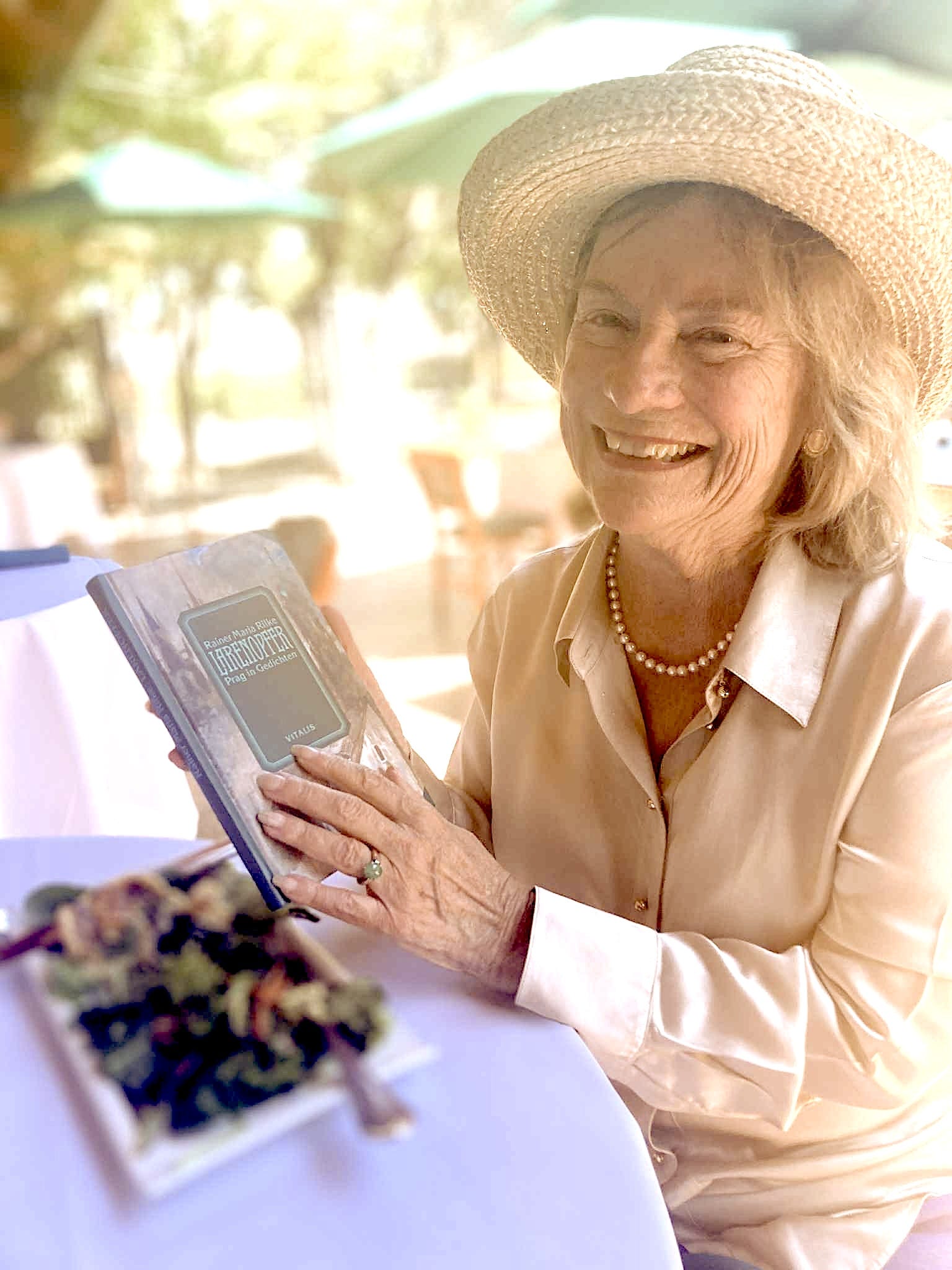
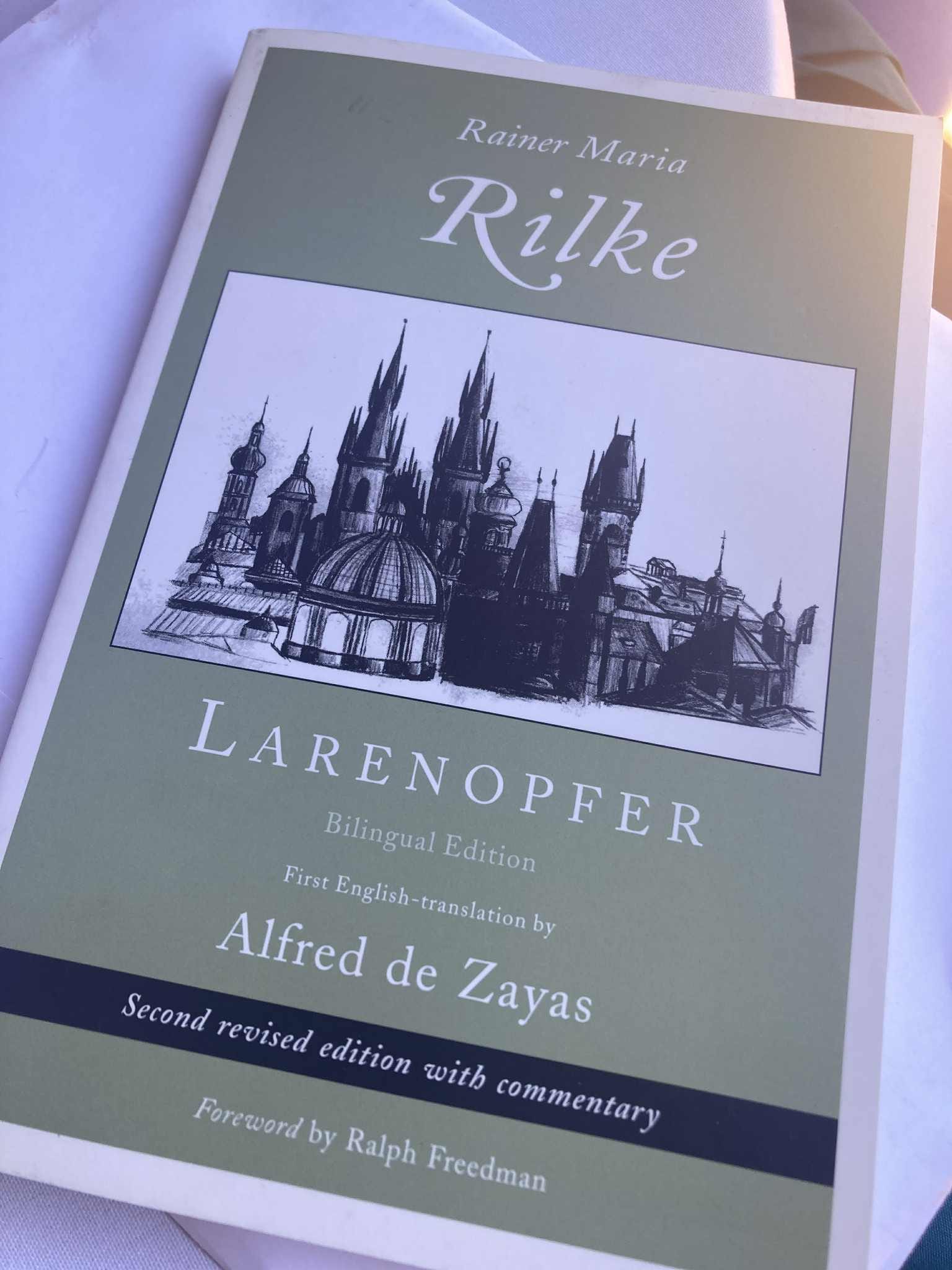
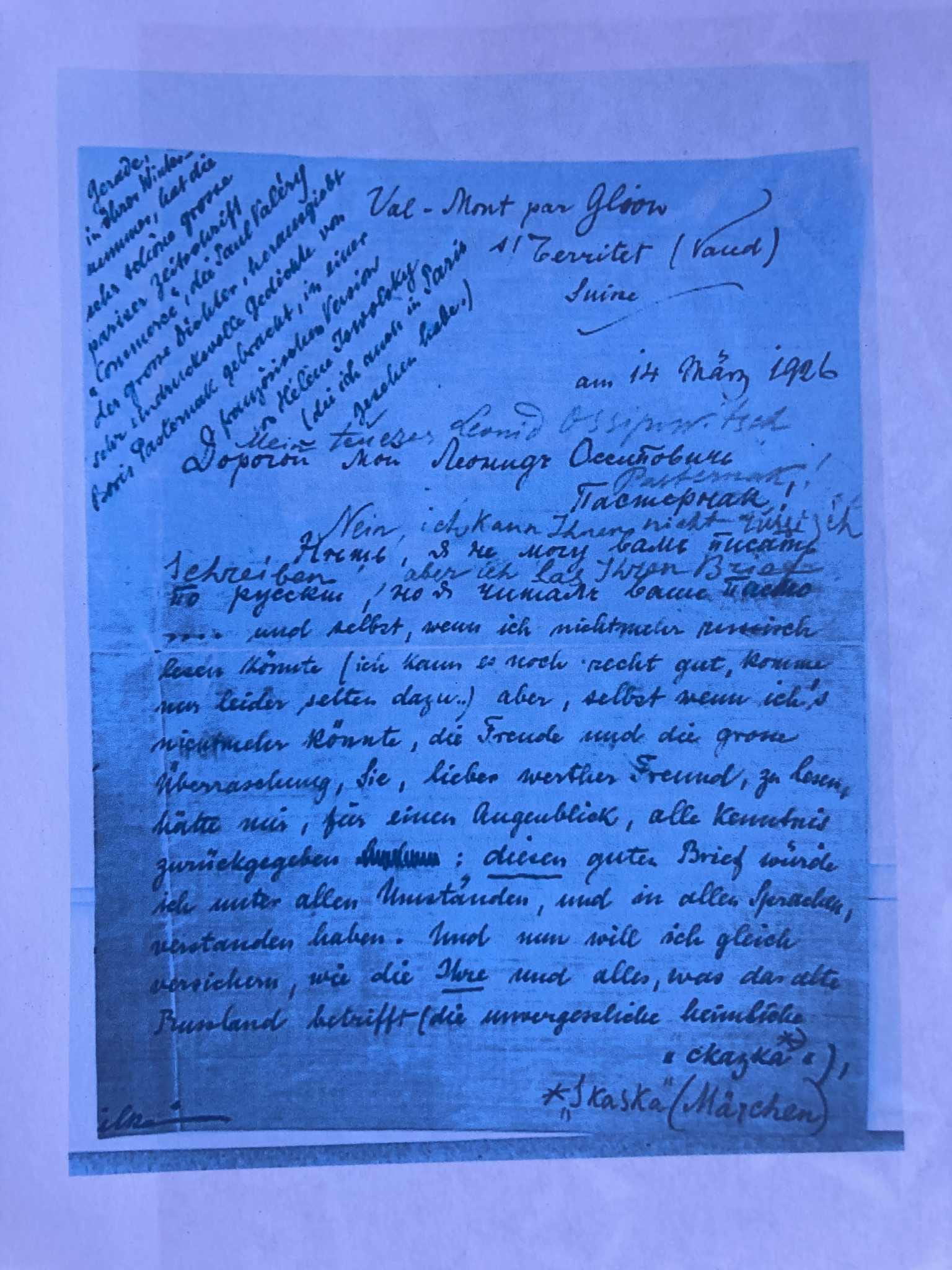
Archivist extraordinaire Elena S. Danielson(at right) kindly took me out to the Stanford Faculty Club for lunch last week. The kindness didn’t stop with the tiramisu. The former director of the Hoover Library & Archives also gave me a new edition of Rainer Maria Rilke‘s “Larenopfer” – to celebrate the 150th anniversary of the poet’s birth. The volume includes ninety of Rilke’s early poems from turn-of-the-century Prague, in German and English. Another treat, a copy of a 1926 letter from Rilke to Leonid Pasternak, the Russian poet’s father, an eminent painter.
In the letter dated March 14, 1926, the celebrated poet, already seriously suffering from the fatal illness that would end his life nine months later, wrote a lengthy, detailed, and graciously cordial letter to a Russian artist living in Berlin, Leonid Pasternak (1862-1945), the father of poet and novelist Boris Pasternak, who remained at that time in Moscow. Despite premature rumors of Rilke’s death, news reached Leonid that he was still alive, though ill, and celebrating his 50th birthday. Elated by the good news, the artist sent the great writer a birthday greeting by way of his publisher, since he didn’t have Rilke’s mailing address.
Rilke responded as soon as the letter finally reached him at the isolated medieval stone tower where he was writing his final masterpieces in an obscure corner of Switzerland. He starts out in Russian, which they had once used for their correspondence, but he switches quickly to German as his Russian skills had faded; he knew Pasternak, originally from multicultural Odessa, was fluent in German. (On the original paper, someone, possibly a family member, lightly penciled in a translation of the brief Russian phrases into German.) Rilke goes on to emphasize his continuing love of Russian culture and his faith that it will be restored, despite the chaos cause by war and revolution. And he renews their ties of friendship.
Before the Great War, Leonid had met the then unknown poet, just in his mid-twenties in Moscow in 1899, and once again by chance at a train station with the artist’s 10-year-old son Boris in 1900. A couple more brief encounters in Italy in 1904 and a few letters. That is all.
And yet they both remembered each other with great fondness. Both had a talent for lasting intellectual friendships. In his memoirs Leonid writes of the 1899 meeting: “Before me in my studio stood a young, very young, delicate, blond foreigner in a Loden coat … And already after the first short conversation we were like good old friends (which we later became).” (Die Familie Pasternak: Erinnerungen, Bericht, Geneva: Éditions Poésie Vivante, 1975, p. 62) The cordial feelings lasted even though they had no contact during the turbulent war years.
The 1926 letter in question – the first page shown here – had been published in German, but the original artifact with its still elegant handwriting, despite serious illness, conveys far more meaning than the copy in cold print. The Pasternak family carefully preserved this artifact for many years through the trauma of war, relocation, and exile. It was treated as something of a holy relic for the family. Starting in 1996, the Pasternak family began donating family papers to the Hoover Institution Archives at Stanford University for safekeeping. Among the many treasures in the collection is this original letter. In the published version, there is a brief postscript printed at the end. The original document shows this added afterthought displayed prominently in the upper left-hand corner of the first page. This brief note, crammed at the top, was even more important than either the writer Rilke or the recipient Leonid Pasternak realized at the time:
Gerade in ihrer Winter-nummer, hat die sehr schöne grosse pariser Zeitschrift “Commerce”, die Paul Valéry der grosse Dichter herausgibt sehr eindrucksvolle Gedichte von Boris Pasternak gebracht, in einer französischen Version von Hélène Iswolsky (die ich auch in Paris gesehen habe.)
Here is a translation of the note: “Just now, in its winter issue, the very beautiful, big Paris journal, Commerce, that Paul Valéry, the great poet publishes, are very impressive poems from Boris Pasternak, in a French translation by Hélène Iswolsky (whom I also saw in Paris).”
The full significance of the letter, especially the note in the corner, was not well understood in the English-speaking world until Nicolas Pasternak Slater translated and published the family correspondence in 2010. (Boris Pasternak: Family Correspondence 1921-1960, translated by Nicolas Pasternak Slater, Stanford: Hoover Institution Press, 2010. Reviewed in The Book Haven in 2011 here.) Leonid did not forward the original letter from Berlin to Boris in Moscow – he feared it might be lost – so he gave it to his daughter Josephine, who was also in Germany. Boris had previously written in August 1925 that he was devastated when he heard (erroneously as it turns out), that Rilke had already died.
When Boris learned about the letter from Rilke to his father, and got the news that Rilke was not only still alive and but had actually mentioned his poetry in the March 14, 1926 letter, Boris wrote to his sister from Moscow: “Our parents told me about Rilke’s letter, which has so thrown me that I haven’t been able to work today. What excited me wasn’t what probably pleased Papa and Mama, since after all I only got to hear of it by ricochet—that someone, somewhere, in France or England, knows me, is translating me, mentions me—but naturally I haven’t seen any of this with my own eyes…you need to know what Rilke was for me, and when this all started. This news was a short-circuit between widely separated extremes of my life. The incongruity of it shattered and devastated me, and now I don’t know what to do with myself.
Boris had told his sister that he had been dreaming, in fact quite unrealistically, of visiting Rilke – whom he had briefly encountered as a child 26 years earlier – in the poet’s medieval Swiss tower. At this point Boris was just trying to survive in Moscow after the devastations of the Great War and the catastrophic conditions precipitated by the Russian Revolution and Civil War while his father, mother, and sisters enjoyed the temporary safety of Germany. They would later be forced to leave Germany for England.
On top of everything else, you need to know who Valéry is—assuming this really is Paul Valéry, which is totally unlikely!” (Correspondence p. 43.)
(At right: the poet Rilke, painted by Leonid Pasternak)
Once Boris Pasternak in Moscow knew that Rilke was still alive, he and his dear friend, the poet Marina Tvetaeva, living in France, began a brief but passionately poetic three way-epistolary romance with Rilke in Sierre, Switzerland just before Rilke died. Rilke wrote something on the order of 17,000 letters in his lifetime, corresponding right up to the end of his life December 29, 1926. (The exact number of letters is not knowable, but it is certainly more than 10,000.) Of this remarkable correspondence, the last letters with Rilke in Sierre, Switzerland, Tsvetaeva in Paris, and Boris Pasternak in Moscow are among the most lyrical and most beautiful. And this remarkable exchange was initiated by the March 14, 1926 letter in question.
More on the two photos: “Rilke (1875-1926) in Moscow,” by Leonid Pasternk, an oil painting made in 1928, so a posthumous portrait based on earlier sketches depicting Rilke as a young man when he visited Moscow, prior to World War I, as an unknown poet. Apparently painted in Berlin some two decades later, the portrait is now in the Pinakothek Museum in Munich. A version in pastels is preserved at the Ashmolean in Oxford, in the UK where many family members live today.
Please join us at 7 p.m. (PST) on Tuesday, September 16, when Another Look presents Yoko Ogawa’s The Housekeeper and the Professor, a surprising story about what it means to live in the present and about the curious equations that can create a family.
The hybrid event will take place in Stanford’s Levinthal Hall, Hall at the Stanford Humanities Center at 424 Santa Teresa Street on the Stanford campus.
According to author Kenzaburō Ōe, “Yōko Ogawa is able to give expression to the most subtle workings of human psychology in prose that is gentle yet penetrating.”
The story: a brilliant math professor has a peculiar problem: ever since a traumatic head injury in a car accident in 1975, he has lived with only eighty minutes of short-term memory. His brain is like a tape that begins to erase itself every eighty minutes.
An astute young housekeeper is hired to care for him. Her 10-year-old son becomes intrigued by the mysteries of math and befriends him. And every morning, as the Professor and the Housekeeper are introduced to each other anew, a strange and beautiful relationship blossoms between them. The Professor’s mind is still alive with elegant equations from the past. And the numbers, in all of their articulate order, reveal a sheltering and poetic world to both the Housekeeper and her young son.
According to Pulitzer-winning author Junot Diaz, “It’s a story about love, which is quite different from a love story. It’s one of the most beautiful novels.”
We will be announcing panelists soon. Meanwhile, register on the link below for hybrid or in-person attendance (we welcome walk-ins, too, but encourage registrations, which allow us to plan).
“Often when we see immeasurable suffering, we feel overwhelmed. But every one of us has the capacity to make one person suffer less every day. Every day go forth and do what you can do.”
Jul 19, 2025
(Image credits: L.A. Cicero)
Fifteen years ago, I had the “Dalai Lama” beat at Stanford. The occasion: the Dalai Lama was swinging through the campus for a 2010 visit and auditorium lecture. As the arts and humanities writer at Stanford, I wrote about the visit. A big reason for the Dalai Lama’s presence was his friend Dr. James Doty, a Stanford neurosurgeon and neuroscientist, who was founding a center for compassion called CCARE at Stanford. Over the years, he gave $29 million to charity, according to the Wall Street Journalin an article titled “Giving Till It Hurts.” That was about 99% of his net worth.
James R. Doty died on Thursday, July 17. He was 69. He had been struggling with serious medical challenges following a surgery last October.
Here’s what I wrote back then for the Stanford News Service on the Dalai Lama, on my tour of duty with James Doty:
“I want to stand to see more faces,” the 75-year-old Dalai Lama said, refusing a chair to address the capacity crowd in Maples Pavilion Thursday.
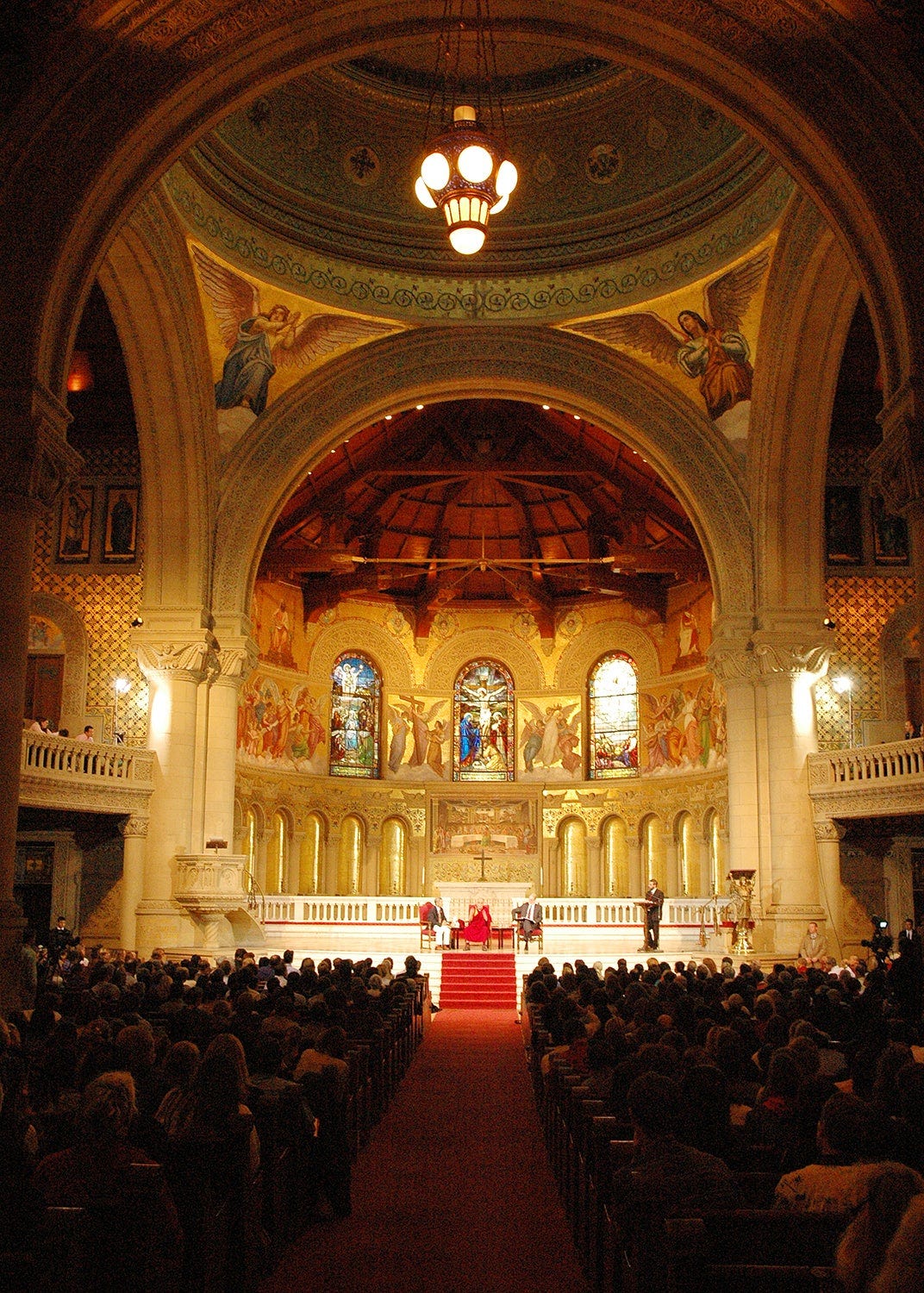
There were plenty of them to see. The spiritual leader spoke to about 6,300 people on “The Centrality of Compassion in Human Life and Society” and, as this year’s Rathbun Visiting Fellow, about 1,000 students for the “Harry’s Last Lecture on a Meaningful Life” series in Memorial Church a few hours later (see photo below). But in both venues, the message was the same.
He repeatedly stressed a secular approach to compassion that reaches beyond individual creeds and beliefs. He spoke of the need for mutual respect and friendship, the care and education of children, and ongoing dialogue for conflict resolution.
Evident throughout was his fascination with science, the neurology of the mind and brain, the interest in the intricate distinctions between mind and body that led him to be a founding benefactor for the Center for Compassion and Altruism Research and Education (CCARE) at Stanford.
The 14th Dalai Lama, Tenzin Gyatso, is an old friend at Stanford: This week marks his third visit in recent years, with the promise of more to come. His talk was peppered with personal anecdotes, and although he spoke in a broken, heavily accented English, occasionally consulting his translator – Stanford visiting research scholar Thupten Jinpa – his infectious chuckle quickly had the audience eating out of his hand.
He chose to focus on what unifies us: Beyond race, ethnicity, nationality and religion, “We all have the desire to achieve a happy life, and everyone has the right to achieve a happy life,” he said.
“We are 100 percent the same on this level,” he said. “My enemy also has every right to work on suffering.”
“We human beings are created as social animals. Any social animal in order to survive depends on community,” he said.
In answer to complicated situations of deceit and injustice, he emphasized taking a holistic view – “compassion, combined with wisdom, always helps a broader perspective.”
(Image credit: L.A. Cicero) “Someone who takes advantage of you and unjustly does something – ultimately, they will suffer, even within this lifetime.” He advocated action out of “a concern for their well-being.”
Violence and non-violence can appear the same, he said, and can be distinguished by motivation. “Out of hatred, out of desire to cheat,” someone could “smile, using some nice word, and with some gift.”
“It looks non-violent. But look at the motivation – they want to cheat, they want to harm. It is essentially violence,” he said.
A parent, on the other hand, “out of concern for others’ well-being may sometimes use some harsh word or disciplinary action. It looks rough, but it arises out of a sense of concern. Therefore it is essentially not violence.”
He repeatedly praised Tibet’s southern neighbor, India – a stable democracy that has thrived under a secular constitution for 70 years. He recently attended a dedication for a Buddhist temple in Patna, and recalled its invocation for Buddha’s blessings on the Indian state of Bihar. The Dalai Lama told those attending that “the Buddha’s blessing must go through human hands, human actions.”
The Dalai Lama presented “Harry’s Last Lecture on a Meaningful Life” in Memorial Church. At left is his longtime interpreter Thupten Jinpa and at right is the Rev. Scotty McLennan, the dean of religious life at Stanford. (All photos L.A. Cicero)
Affection begins in the home, he said, and particularly from mothers – but this biologically rooted compassion will not extend far beyond the family unless extended by reasoning and unless the understanding our own well-being is linked to the love of others.
Perhaps the most surprising digression was his memories of childhood in a family of barley farmers in northeastern Tibet – an uneducated, illiterate mother who was kindly and compassionate, and an affectionate father who sometimes lost his temper.
He noted societies with abundant material wealth where the youth is nevertheless plagued with “a lot of suicide, a lot of depression,” he said.
His engagements in the Bay Area included a visit with 400 students in East Palo Alto on Wednesday.
During a question-and-answer session, about the poor – why one is unable to bridge the “compassion gap” from feeling sympathy to acting with compassion – the Dalai Lama recalled a night in Bombay, where he saw the “really poor people, hundreds,” and uncared-for and drug-addicted people.
“But nothing can be done,” he said, pointing to the need to weigh considerations. “Sometimes when I saw these things, I only pray. You should be realistic: If you can do something on the spot, do it.”
The Dalai Lama presented “Harry’s Last Lecture on a Meaningful Life” in Memorial Church. At left is his longtime interpreter Thupten Jinpa and at right is the Rev. Scotty McLennan, the dean of religious life at Stanford. (Image credit: L.A. Cicero)
At the Memorial Church gathering, largely question-and-answer, one student asked about the Buddhist injunction to overcome desire – if one is choosing to live a meaningful life, isn’t the desire for a meaningful life just another layer of desire?
The Dalai Lama agreed that the Buddhist texts say that desire is the cause of suffering, but added that “without desire, movement is not possible. Even wishing happy life, a happy life for others – all is desire.”
“Desire leads our action. Action must come from motivation. Motivation comes from desire,” he said.
He encouraged the students to practice contemplation and self-discipline.
In a valedictory note, he turned the future over to the students gathered to hear him. “This century, whenever we face problems, we have to find ways through dialogue,” he said. The 200 million people murdered in the last century, he said, underscore the need for non-violence, mutual respect and compassion.
“You belong to the 21st century,” he said. “My people belong to the 20th century. We’re ready to say goodbye.”
Stanford neurosurgeon James Doty, the director of CCARE, told the Maples Pavilion gathering: “Often when we see immeasurable suffering, we feel overwhelmed. But every one of us has the capacity to make one person suffer less every day. Every day go forth and do what you can do.”
***
Said a friend Julie Neelama Eyres on Dr. Doty, writing on Facebook “He was so full of life, energy, irreverence, love, kindness and purpose! He founded the center for compassion CCARE at Stanford University and I’m blessed to have been able to work together with him on this mission. His teachings, books, unique spark and loving presence were such a gift to me and to countless others around the globe.”
This article and many others from the Stanford News Service are now archived and no longer publicly available. To celebrate this poet, historian, and so much more, I thought I’d make at least this one available to all of you. Enjoy!
Robert Conquest is a man of contradictions: He has been called “a comic poet of genius” and “a love poet of considerable force” – but he made his mark as one of the first to expose the horrors of Stalinist communism.
Susan Sontag was a visiting star at Stanford in the 1990s. But when she was introduced to Robert Conquest, the constellations tilted fora moment.
“You’re my hero!” she announced as she flung her arms around the elderly poet and acclaimed historian. It was a few years since she had called communism “fascism with a human face” – and Conquest, author of The Great Terror, a record of Stalin’s purges in the 1930s, had apparently been part of her political earthquake.
Sitting in his Stanford campus home last week and chatting over a cup of tea, the 93-year-old insisted it’s all true: “I promise.We had witnesses.” His wife, Liddie, sitting nearby confirmed the account, laughing.
Robert Conquest published his seventh collection of poems last year and a book of limericks this year, finished a 200-line poetic summa and is working on his memoirs.
Conquest, a Hoover Institution senior research fellow emeritus, moves gingerly with a walker, and speaks so softly it can be hard to understand him. But his writing continues to find new directions: He published his seventh collection of poems last year and a book of limericks this year, finished a 200-line poetic summa and is working on his memoirs.
He’s been a powerful inspiration for others besides Sontag. In his new memoir, Hitch-22, Christopher Hitchens described Conquest, who came to Stanford in 1979, as a “great poet and even greater historian.” The writer Paul Johnson goes further, calling Conquest “our greatest living historian.” Conquest is still, however, a man of contradictions. With The Great Terror, published in 1968, he became the conscience of an era, a historian denouncing Stalinism when communism was trendy with the left in the West. His new book collects scabrous and salacious limericks.
His advice to young poets is unconventional: “Write under a pseudonym, and pretend it’s a translation from the Portuguese.”
Not a serious poet? Think again. He’s just completed a poem that may prove to be among his greatest. His 200-line reflection, forthcoming this fall in the British magazine Standpoint, opens:
Into one’s ninetieth year. Memory? Yes, but the sheer Seethe as the half-woken brain’s Great gray search-engine gains Traction on all one’s dreamt, seen, felt read, Loathed, loved… And on one’s dead.
Which makes one’s World, one’s Age, appear Faint wrinkles on the biosphere Itselfthe merest speck in some Corner of the continuum.
The poem moves in scope from the caves of Lascaux to the minutest observations of the deteriorations of age, from “the skin-and-psyche blend” of sex and love to “dark matter.”
“I don’t think any poet has written as well about aging as he has,” said R. S. Gwynn, Conquest’s friend and fellow poet.
“As a poet Bob is funny, intensely lyrical and deeply reflective,” Gwynn said. “Whenever I read him I think of how rarely we are allowed to see a mind at work, and what a mind it is.” The new unpublished poem would appear to be light-years from his polished little limericks with their exuberant, far-fetched (and not always successful) rhymes.
Yet Conquest takes his limericks seriously.As he writes in the introduction to his pseudonymous A Garden of Erses: Limericks by Jeff Chaucer: “While, under the protection of portentous apologetics, the meaningless, and the structureless can now pass for serious verse, the limerick remains a voice of talent and common sense, and it lends itself to (or rather demands) a specially skilled oral recital.” While Gwynn insisted the poems are certainly Conquest’s, Conquest himself says they were mixed up with those by some friends, including Kingsley Amis and Philip Larkin. He’s not even sure anymore which ones are his.
At the very least, he is the editor and a significant, if not sole, contributor. Given his more prominent role as a Stanford historian, some might consider him a “gentleman poet.” Conquest cackles at the notion.
“Limericks are not very gentlemanly – or it’s a special kind of gentleman.” Whatever the provenance of the limericks, this stanza from “This Be the Worse,” a poem included in his collection Penultimata, published last year, is certainly his, and has the same esprit.
To each of those who’ve processed me Into their scrap offame or pelf: You think in marks for decency I’d lose to you? Don’t kid yourself.
Angry old man? Not in the least. David Yezzi, writing in the Yale Review, said that although Conquest “has lodged his share of barbed lines and rhymes where they will be hard to get rid of,” his recent poems remind us “with the immediacy of a dose of smelling salts, that he is not only a comic poet of genius but also a love poet of considerable force.”
Hitchens, speaking of Conquest’s “devastatingly dry and lethal manner,” also wrote that his was “the softest voice that ever brought down an ideological tyranny.” Naming Conquest among his handful of favorite poets, Hitchens called him not only “the king of the limerick” but also “the dragon slayer ofthe Stalinoid apologists.”
It’s hard to believe now that Stalin ever had any apologists at all, but that was not the case when Conquest wrote The Great Terror. Reading like a thriller, the book is a detailed log of Stalin’s assassinations, arrests, tortures, frame-ups, forced confessions, show trials, executions and incarcerations that destroyed millions of lives. It was especially impressive because Conquest, who wrote the book as a freelancer, had to rely largely on what is called “unofficial material.”
“Of course history isn’t a science,” he said. Balancing and assessing incomplete, partial and uneven information, he had to figure out what was omitted and focus on eyewitness accounts that contradicted “other things printed on beautiful paper.”
The book instantly became a classic of modern history, and other titles followed, including The Harvest of Sorrow: Soviet Collectivization and the Terror-Famine (1986) and a 1977 translation of Solzhenitsyn’s 1,400-line poem, Prussian Nights, undertaken at the author’s request.
In the preface to the 40th anniversary edition of The Great Terror, Conquest wrote: “One of the strangest notions put forward about Stalinism is that, in the interests of ‘objectivity’ we must be – wait for it- ‘non-judgmental.’
But to ignore, or downplay, the realities of Soviet history is itself a judgment, and a very misleading one. Let me conclude with Patrick Henry saying in 1775, ‘I know no way of judging of the future but by the past.””
“His books made a huge impact on the debate about the Soviet Union, both in the West and in the East. In the West, people had always had access to the information about Communism but were not always ready to believe in it,” said Radosław Sikorski, Poland’s minister of foreign affairs, while awarding Conquest the country’s Order of Merit last year. (Conquest received a U.S. Presidential Medal of Freedom in 2005.)
“We longed for confirmation that the West knew what was going on behind the Iron Curtain,” Sikorski said. “Robert Conquest’s books gave us such a confirmation. They also transmitted a message of solidarity with the oppressed and gave us hope that the truth would prevail.”
He wasn’t always a champion in this cause. The British-born Conquest was a member of the Communist Party while at Oxford between 1937 and 1938.
“He always tended to extremes,” the British Labour politician Denis Healey told the Guardian in 2003. Not anymore, according to Hitchens, writing in the Wall Street Journal: “A few years ago he said to me that the old distinctions between left and right had become irrelevant to him, adding very mildly that fools and knaves of all kinds needed to be opposed.”
Poet and Nobel laureate Czesław Miłosz, speaking in 1992, called Conquest “the poet who was right.” Miłosz recalled a time when speaking the truth about communism meant being shunned in the West’s intellectual community. Even Sontag took considerable heat for her reversal in the 1980s – which came a decade-and-a-half after Conquest’s book.
Conquest retired at 90. That means “if I don’t feel like it,I don’t work,” he said. But so far he seems to feel like it. He’s working on memoirs and has “far more material than people can use,” though he never kept any notes.
He still has a research assistant. And Liddie, his fourth wife, whom he married in 1979, is the point person for manuscripts, correspondence and interviews, and offers the occasional correction. When her husband leaves the room briefly, Liddie notes that his Bulgarian is splendid, and so is his French, contrary to his modest protestations.
A younger friend recently wrote Conquest a heartfelt letter that had a bit of a farewell flavor to the poet’s ear, and Conquest was worried. Was his younger correspondent seriously ill?
Liddie had to suggest the idea that maybe the letter-writer, reasoning a nonagenarian might pass away at any moment, was concerned about him. Apparently, the thought hadn’t occurred to Conquest. After all, he’s just finished his 200-line poem. And now, he said, “I’ve got a lot of prose to catch up with.”
. “You are in constant dialogue with the voice of shame, the brutal self-critic.“
Jazz pianist Frank J. Barrett received the Jazz Legacy Award from the Tri-C Jazz Festival in Cleveland last week, after a long lifetime in jazz. He certainly deserves it. (I wrote about him a few years ago here.)
He is a former pianist with the Tommy Dorsey Orchestra, author of Say Yes to the Mess: Surprising Leadership Lessons from Jazz. He is also a professor in Weatherhead School of Management at Case Western University. I found his talk inspirational, and I’m not even a jazz aficionado. (Although he’s gone some way to making me one.)
What he said:
“I think jazz offers lessons for all of us – musicians and non-musicians. Playing jazz is a spiritual experience. It’s a spiritual journey. Why? Because the goal of jazz is to pay attention in the moment, to let everything else fade away, which means that you are in constant dialogue with the voice of shame, the brutal self-critic, the one that says that what you know is not enough, that you’re not good enough, that someone else can play better than you. We are constantly working to keep that voice silent, as much as possible, and try to say “yes” to what emerges. It is life on the edge of the unknown. We take action with no guarantee that what we do is going to be successful, is going to lead somewhere positive. But we do it anyway. We are constantly throwing ourselves in over our heads. If you read autobiographies and writings of mystics, like Teresa of Avila, and accounts of jazz musicians, you can’t tell the difference.
“It’s important to know that this is not just individual experience. In our country there’s so much emphasis on individuality. Maybe it’s one of the offshoots of the libertarian spirit that has taken over our country, the belief that the individual is autonomous and supreme. Jazz says that’s not true.”
“In this country we valorize leadership. There are so many books on leadership. Whoever talks about followership? Is it possible that followership can be a noble calling? We don’t have a vocabulary for it, so we don’t notice it and can’t even talk about it. But in jazz we do. We call it comping, short for accompanying. It means staying with the soloist, being committed to help that person be their very best. It means seeing their gift sometimes better than they see it themselves, with the belief that something good is going to come. You can’t do it too well or too pronounced because then you would become another soloist and no one is going to call you for gigs. This is a vocabulary, and a theory, and a model that this country needs. What does noble followership look like? That’s what this country needs. Because if we had good high-quality followership, a commitment to help the other think out loud, learn as they go, then we would have great leadership. We would bring the best out in each other.
“Bill Moyers passed away last month. Some of you may recall the series he did on Joseph Campbell. Joseph Campbell’s phrase was “follow your bliss.” I thought about that and I don’t think it’s quite right. I think what is better is to say “follow your gift.” Find your gift and follow that. That’s what jazz is devoted to, an invitation to continually discover your gift, to find the edge of your competence and pursue where your gift lies. And it’s about trying to find the gift in each other. The only way to find your gift is by experimenting and discovering. You are creating and discovering at the same time. Jazz musician’s life is devoted to experimentation. A life of experimentation is a spiritual life.”
”The work that Dominick Farinacci and others are doing at Tri C, developing young jazz musicians, is so inspirational. They are changing these students’ lives, teaching them much more than jazz – the joy of discovery, the experience of collaboration in the midst of the unknown, and more. Thank you to Tri C for this recognition. I treasure the memory of the whole weekend. I also had a chance to play with the all stars, especially Anthony Taddeo.
In closing: “This is such a pleasure and a surprise. It’s been sheer positive energy and so inspiring. I’m so heartened by the work you are doing here in this college. You have a fan for life in me.”
Actress and singer Grace Wade as the betrayed and angry goddess Juno.
This month Seneca made his first appearance in the Bay Area in many years, if ever. The occasion was a staged reading of The Madness of Hercules, on Saturday, June 14, at St. Patrick’s Seminary in Menlo Park. The dramatic setting in front of the brick portico at dusk intensified a drama that needed no intensification. Let’s hope it’s the start of a Seneca revival. It’s long overdue.
In addition to the mesmerizing performance of Grace Wade as Juno/Megara, the other performers included: Kyle Ryan as Hercules; John O’Malley as Amphytrion; Joseph Bissex as Theseus/Lycus.
The text is newly translated by poet and former NEA chair Dana Gioia, also a former California poet laureate. The new edition of Seneca’s play was published by Wiseblood Books. (Excerpt from the text coming in another post.) Buy the book. More than a third of the volume is an insightful introduction to “Seneca’s Tragic Vision,” Seneca and European Culture, Roman Tragedy and Roman Politics, Seneca’s life, and more.
The slim volume was praised by poet Frederick Turner: “Dana Gioia’s Hercules Furens is a poetic and critical tour de force. By giving us a translation as graceful, vivid, and natural as the original must have been, he paradoxically brings out its essential strangeness to our sensibility. His poetry makes it a sort of dark existentialist Bunraku theater, an allegory of the horrors of Nero’s Rome and perhaps a warning to us today. His coinage of the term ‘lyric tragedy,’ connecting the play with the birth of opera fifteen hundred years later, aptly notes that strangeness.”
“It’s a fantastic translation, clear and powerful. Dana Gioia does a great job of reconciling Seneca’s calm philosophy and emotionally charged drama.” That’s a mini-review by someone known online only as “TheophileEscargot.”
The Antigone Journal ran Dana’s interview with Mateusz Stróżyński, a classics professor at the Adam Mickiewicz University in Poznań. Here’s an excerpt:
What drew you to Hercules Furens? Does this tragedy help illuminate or reflect any contemporary situation or circumstance?
DANA GIOIA: I’ve always been interested by verse tragedy, even before I knew I was going to be a poet. I didn’t study Greek tragedy in high school, but I read Sophocles and Euripides on my own (in the Robert Fitzgerald and Richmond Lattimore translations). The first elective course I took at Stanford was a two-term freshman seminar on tragedy taught by a courtly older man who chaired the Spanish Department. (He preferred Racine to Shakespeare and often lamented the haphazard methods of Golden Age Spanish theater.) We read every major tragedian in the Western tradition, except Seneca. That struck me as odd. There was a similar silence at Harvard grad school. Finally, when I left academia, I explored Seneca. I knew Classical Latin poetry but nothing about Roman tragic theater. I read Thyestes in translation, and I was dazzled by its violent splendor. I read the other plays, one by one.
I chose Hercules Furens to translate because of its fabulous account of the Underworld. The play was the missing link between Virgil’s Aeneid and Dante’s Inferno. My interest wasn’t scholarly. Those poems were foundational to my own sense of being a poet. I particularly admired Virgil and Dante’s ability to create powerful, multi-leveled narratives that never lost their lyrical impulse. Musicality is the necessary magic of narrative poetry. It is also a quality missing from most contemporary poetry. From Seneca I learned how to present drama that alternates between regular action and sudden but sustained moments of extreme emotion. You can call these high points verbal arias or poetic oratory. In theater, they are called “show-stoppers”. Seneca’s lyric tragedies helped me write poetic texts for opera.
MATEUSZ STRÓŻYŃSKI: I became interested in Hercules Furens during my research on Euripides’ Heracles and Medea, which I began around 2010. I tried to look at the meaning of infanticide in those two plays, from a psychoanalytic perspective, trying to bring together my interest in Classical drama and psychoanalysis as well as my experience as a practising psychoanalytic psychotherapist. What struck me was that Seneca’s Hercules was much more similar to Euripides’ Medea than to his Heracles. Both seem to give an incredible insight into what has been conceptualized in psychoanalysis as pathological narcissism, especially by authors such as Herbert Rosenfeld, Heinz Kohut, and Otto Kernberg.
Seneca’s Hercules (like Medea) describes a destruction of the inner capacity to love and depend on others, through a desire to control both the self and the others. I think the horrifying sterility of the Underworld in Seneca reflects the inner emptiness and deadness of a narcissistic personality, which inevitably manifests itself in aggression and destruction. But as we can see in Seneca, this narcissistic dynamic is often masked by a narrative of saving the world from monsters in order to bring peace and harmony.
Hercules, at first, is presented by others and himself as a saviour and monster-killer who is going to establish a mythical Golden Age. But the ultimate result is that his wife and his children are destroyed in a most horrifying way.
I think this narcissistic dynamic, which has taken control over Western society in the last few decades, has been depicted powerfully also by J.R.R. Tolkien (the Ring in Lord of the Rings destroys the soul of its bearer in exchange for invisibility and power) and J.K. Rowling (in the Harry Potter novels, the Horcruxes of Voldemort give him ‘immortality’ at the price of splitting his soul). Seneca’s play is unfortunately prophetic in the way it describes how we, as a society, sacrifice what is most fragile and precious in our pursuit of utopian control over our own bodies and minds, and those of people around us.
I have a special reason for taking an interest in the play, besides my more than a quarter-century friendship with Dana. He dedicated to me, with the words, “Tanquam Explorator.” I treasure that. Thank you, Dana!
Today is Nobel poet Joseph Brodsky’s 85th birthday. What better way to celebrate than by celebrating the books that have celebrated him.One is by my humble self, the book by Ellendea Proffer, who with her husband, the late Carl Proffer, brought the future Nobel poet to America. There’s lots more. Go here.
Oh, there’s another good way to celebrate, perhaps the best: return to his books, essay, and lectures. See more here. Thanks to Vladimir Maksakov for compiling a list. You can see the rest of his list here. (What? It’s in Russian, you complain? C’mon. It’s the 21st century. Google Translate is a thing. And you probably have an automatic translate button in the upper righthand corner of your Mac.)
Three of the booksrecommended by Vladimir Maksamov – from Russia with love:
A biographical novel and memoirs written on principle and forced from an artistic point of view – Brodsky asked to close access to his diaries, letters and family documents for 50 years. It is all the more interesting to get into the space on the edge of fiction, where Losev reconstructs the main biographical myth of the poet. And this seems a convincing move, because such a biography in many ways continues poetry. Friendship with the hero of the book – and the fact that the author himself was a good poet – adds color to this largely unique text.
Memories of Brodsky in the USA. From Joseph to Joseph, teaching, cultural bilingualism, finding a new poetic voice – and all this against the backdrop of Brodsky’s everyday life. It’s hard not to see in this an objectified metaphor: everyday life was still poeticized, and Brodsky, fortunately for world culture, very successfully fit into the new realities for himself. The book is read with nostalgia: the USA of those years was much more hospitable than today.
Translation: Svetlana Silakova Published by Academic Studies Press, 2023; “New Literary Review”, 2024
Conversations of the first and in many ways the main translator of Brodsky into English. Meetings with Brodsky and the KGB, episodes of an almost spy story, the deepest level of work with texts – all this against the backdrop of a huge love for Russia. But in addition, these conversations are also an attempt to talk about the possibility of dialogue and the willingness to come to the aid of a person who found himself in exile. It seems that both the Soviet and American sides in the realities of the Cold War knew how to value culture much more than we think.
READ ABOUT THE REST OF THE VLADIMIR MAKSAKOV’S SELECTIONS HERE
And light a candle for the poet’s birthday. A good 85th to you, Joseph, wherever you are.
Stanford English Professor Shelley Fisher Fishkinhas written lots about Mark Twain, and the Book Haven has written about it here and here and here, among other places. She’s just published a new book – and we mean new, only a few weeks out with Yale University Press: Jim: The Life and Afterlives of Huckleberry Finn’s Comrade.
Her birthday was celebrated today with a party with her husband Prof. Prof. James Fishkin, a Stanford politics and communications scholar. They share a birthday, so I thought I’d celebrate both with a post about Shelley’s new book, breaking the Book Haven’s long four-month silence. (Yes, there’s a story; we won’t tell it here, today.)
Shelley read from her afterword at the celebration, and she has allowed us to whet your literary appetite with it, as she talks about Huck and Jim, the runaway slave:
I am filled with humility when I realize even a writer as gifted as Mark Twain had such trouble getting his fellow Americans to look at themselves in the mirror. The more I study American history, the more I am persuaded that Huckleberry Finn evokes – perhaps as only a work of art can – both the boldness of founding a nation on the ideals laid out in the Declaration of Independence and the brazen hypocrisy that allowed those ideals to be violated so fully from the start. It is perhaps unsurprising that the persistence of racism in our world has fostered a myopia that has prevented many – including myself – from recognizing Jim’s full humanity until now.
After immersing myself in the historical conditions surrounding Jim’s life, the experiences Twain had that led him to challenge prevailing myths about race in the novel, the debates among critics about who Jim really is, the ways in which actors and directors have portrayed him on stage and screen, how his words and his character have been depicted in some of the sixty-seven languages in which we can encounter him, and the controversies surrounding him in the ntion’s high school classrooms, I find myself returning to the text itself with fresh eyes.
I am awed by Jim’s astute ability to weigh the complexities of any situation. By his compassion. By his sense of justice. By his creativity. By his strength. By his integrity. By his refusal to let a world that denies that he is even human constrain his ability to love.
And I am still stunned by Twain’s daring experiment of presenting Jim only through the eyes of a chlld with such a limited understanding of what he is seeing.
And then I realize what trust Twain had in us, his readers. He trusted in our ability to read between the lines and understand things that Huck never did. He trusted us to see through the whitewashed history of America’s racist past that was being presented as truth even at the time he wrote and that has continued to be foisted on each new generation ever since. He trusted us to read the story he placed before us and to recognize the phenomenon that he would later call the “lie of silent assertion” – “the silent assertion that there wasn’t anything going on in which humane and intelligent people were interested … and are engaged by their duty to try to stop.”
Do we have the courage to honor that trust, to be the readers he hoped we could be? The jury is still out.
Stanford’s William Mahrt, a leading scholar in early music, died today at 85. He conducted Gregorian chant for more than 60 years and inspired and guided generations of scholars. He directed Stanford’s Early Music Singers and St. Ann Choir, a Gregorian schola.He was also a personal friend. This is an article I wrote for Stanford Report about Bill Mahrt on October 2nd, 2007.
For nearly two millennia, the sound has been a regular pulse beneath the skin of Western civilization. It reverberated through Dante’s mind as he scratched out the cantos of the Purgatorio. It was the inaudible vein of thought running beneath the chords of Mozart’s Requiem. Crusaders trudged to the East with these melodies in their heart, but they were too late – Jerusalem had echoed with it centuries earlier. It was ubiquitous, universal – that is, until about 40 years ago.
William Mahrt directs the St. Ann Choir, which he says has had a “fruitful interaction” with Stanford’s doctoral students of musicology, who find it “a very wonderful laboratory for the study of the music of history.”
The tide may be turning, and, if so, it will be William Mahrt’s moment in the sun.
The origins of Gregorian chant are enigmatic. It appears to have its roots in fourth-century Jerusalem. The link with Pope Gregory the Great (590-604) is the byproduct of early spin, based on what is probably an erroneous assumption that he composed and collected early chant.
The otherworldly effect of the music is hard to describe, but Mahrt, an associate professor of music at Stanford, recently gave it a try: “It is what we call monophonic – that is to say, it’s a melody that’s unaccompanied,” he said. “A free rhythm has an ability to evoke eternal things, more than passages tied down to regular time. It’s a sprung rhythm that has a freedom to it – like Hopkins’ poetry.”
Mahrt has conducted Gregorian chant for more than 40 years without a break. He is the director of Stanford’s Early Music Singers and of the St. Ann Choir, a Gregorian schola at St. Thomas Aquinas Church in Palo Alto. He instructs singers in the mysteries of “the chant,” as well as the glorious polyphonic music that came after it. In fact, it’s possible that there is more chant sung in Palo Alto than anywhere else in the country, with the possible exception of monastic communities. Mahrt has inspired and guided generations of scholars and singers.
One of his star students, Kerry McCarthy, now an assistant professor of music at Duke University, is the author of Liturgy and Contemplation in Byrd’s Gradualia and one of the world’s leading scholars on William Byrd, the preeminent English composer of the Renaissance.
“One of the best decisions I’ve made in my life was to come to Stanford and work with Bill,” McCarthy said. “The things I learned from him here I could not have learned anywhere else. Not just in the classroom, but in performance. Especially in performance.”
Acclaimed music writer and jazz scholar Ted Gioia recalls going to hear the St. Ann Choir, composed of students and members of the community at large, when he was studying for an MBA at Stanford. Often he found only a few fellow listeners in the pews.
“The thing I most miss about Palo Alto is going to those Gregorian Masses,” he said. “It’s so energizing. That was the best-kept secret in Palo Alto. Bill was the person who really opened my ears to that. He had a profound influence on my conception of music – through the force of his example.”
Mahrt’s work has indeed been quiet. Furthermore, he has encountered resistance from a church that has not always valued its own heritage.
“There’s a huge resistance from the clerical establishment to doing any of this,” said Stanford alumna Susan Altstatt, who has been a member of the St. Ann Choir since 1967. “Bill has lived a charmed life in this regard. Bill has managed to do what he’s doing by talking to bishops and priests and knowing what he’s talking about. He’s a hero, as far as I’m concerned.”
Mahrt explained the resistance: “Gregorian chant went out of style when the language was changed” – that is, when the universal Latin was changed to the vernacular English. “In the absence of any good solution about what to replace the chant with, I would say commercial interests stepped in and hawked a progressively cheaper and cheaper music, and the commercial interests still prevail today.”
For example, one of the leading publishers of “missalettes,” the flimsy and disposable paperbacks that include “new” church music, distributes 4.3 million of the quarterly copies a year and owns 10,000 music copyrights. That’s a lot of commercial interests.
The result was summarized by one disgruntled reviewer on Amazon.com: “The Roman Catholic Church, seeking to be more ‘relevant’ to its flock in the antispiritual climate of the second half of the 20th century, abandoned its ancient Latin liturgy and dignified music in favor of poorly worded vernacular texts and worse music. This music usually tends toward banal couplets set to insipid tunes strummed on ill-tuned guitars and whined into a microphone to the banging of a tambourine.”
Mahrt said there is a reason for the ill-tuned guitars and whining: “The standard of performance in recorded pop music is very high. A little combo in a church can’t possibly keep that standard. There isn’t the same standard for chant. Its whole criteria are different. Singers can master it in a different way.”
Unlike other kinds of music, McCarthy said, “You don’t have to have to have wonderful technique and learn to breathe from your diaphragm and so forth and have 20 years of voice lessons. It’s on a very human scale. It’s really self-regenerating. You can sing especially psalms for hours without getting tired, and there aren’t many kinds of music you can say that about.”
According to Mahrt, the St. Ann Choir has created a “fruitful interaction” with Stanford’s doctoral students of musicology, who find it “a very wonderful laboratory for the study of the music of history.” Members of the choir, which performs the year-round cycle of chant, are perhaps the staunchest advocates of the music anywhere: “This is one of the major cultural landmarks of Western society,” Altstatt said. “Its preservation is very important. It has to be sung – it has to come through the human voice. You have to be taught, in a living tradition. You can’t get it through a book. You get hooked on it, you internalize it and need to do it. It’s a splendid thing.”
In recent years, a younger audience, seeking music with a little more history and meaning than its usual fare, has become hooked in a different way: A generation has snapped up Gregorian chant and made recordings into crossover hits. In the last decade, the Benedictine monks of Santo Domingo de Silos’ Canto Gregoriano would become one of the world’s biggest-selling classical compact discs, with worldwide sales topping 6 million.
But the commotion and hoopla miss the point, Mahrt said. “Chant does arise out of silence, and it goes back to silence,” he said. “In our own culture, we sometimes don’t have any silence. I think among students, for instance. They go into the dorms and the walls are thumping 24 hours a day. There is never a chance to be alone, in silence, within your own residence. But the fact is, I think, myself, the best location for the contact with God is in silence.
“When silence occurs, then you can look interiorly and find an order and a purpose that the noise of the media running day and night obscures. So, likewise, the chant, which is pure, a single melody, is not complicated, arises out of silence and goes back into it, as a way of returning to that interiority.” (At right, Mahrt in 1985)
Early interest
Mahrt grew up in a small farming community in eastern Washington – a place where “church music” meant sentimental hymns sung by a “little choir of ladies who sang to a harmonium.” His University of Washington master’s thesis as a pianist was the work of Robert Schumann. Mahrt discovered the chant at the University of Washington. Dominican friars, who were Catholic chaplains at the university, desperate to augment their choir, told him, “You have to sing chant for Holy Week.”
“It’s the hardest chant of the year in some ways. So we did it,” he recalled. “And I said this is what I’ve been missing. This is what I’ve been waiting for. I joined the Cathedral Choir and sang chant there for the next two-and-a-half years.”
He headed to Stanford to study Mozartand also joined the St. Ann Choir, which had been launched by one of the university’s mathematics professors in 1963. A year later, the professor departed for another university and handed the reins to Mahrt. The year was a landmark in chant in another way: That was the year the Catholic Church began using local languages in the liturgy, and the chant was all but abandoned.
“Our choir was started one year before the language changed – if we had tried to start one year later, we might not have been able to do it,” Mahrt said. “I saw this music becoming less and less popular with people who were entranced with folk music.”
The leap from Mozart to the chant was not as radical as might be supposed; Mahrt points out that “certainly Mozart grew up knowing chant – a very 18th-century chant.”
“Most composers through the 19th century – in Austria, France, Italy – simply had chant in their background, and in their daily experience of church. It’s something the history books don’t tell you,” Mahrt said.
Mahrt carried on for the next 40 years largely alone. He said he knew his decision to dedicate his life to chant’s preservation would meet conflict, struggles and disappointments. “It’s worth it. Somebody’s got to keep it. It has to be kept alive in various places throughout the world. So we’ve got to do it.”
His persistence may be paying off. Pope Benedict XVI, himself a musician, has taken an interest in restoring musical traditions, as well as encouraging the Latin Mass. The 1,700-year-old Gregorian chant might be an idea whose time has come again. In fact, it might be an idea rather hard to kill.
“One wonderful thing about chant is it’s almost viral,” said McCarthy, who has started her own chant group at Duke. “People who learn it tend to go somewhere else – academics, especially, tend to be migratory birds. When we move to the new place, we start a chant group ourselves. I calculate that in about 60 years, we’ll have taken over the world.”
Mahrt’s group has spawned spinoffs across the United States, besides the one at Duke. Alstatt’s daughter Alison, who is doing doctoral work in medieval music at the University of Erlangen in Germany, joined the St. Ann Choir when she was 11 and has started a group in Berkeley, where she had been a student at the University of California. There are now groups in Los Angeles, Cleveland and Arkansas.
Mahrt has even found a substitute to direct the choir – finally allowing him to take a more active role in promoting chant nationally and internationally, given the recent renewal of interest. Does he feel free at last, after four decades of being tethered to the annual cycle of chant? Mahrt looks up in wonderment at the question: “It’s a fulfillment, not an oppression. I miss it when I go away. It is a routine, but the music and liturgy are all part of the rhythm of life.”
Postscript from jazz scholar and Substacker Ted Gioia on January 1, 2025: “Not many knew that Gregorian chant and medieval/Renaissance polyphony flourished in Palo Alto — but I’d be there, and I’d see René Girard there too. It was all because of William Mahrt—a beatific soul (who also encouraged my jazz teaching at Stanford, at a time when some were skeptical about its legitimacy). He we beloved by those who knew him.”
The tributes continue to pour in:
From David A. Lawrence: “Bill’s unprecedented accomplishments as both a scholar and the leader of the St. Ann’s Choir are well-documented. What I feel compelled to add, in the wake of my shock at the news of his passing, is what an entirely sweet human being he was. In a profession that does not lack competition for awards, accolades and promotions, Bill was kind to everybody. In my 50 years at Stanford I never once heard anyone mention a harsh word about him. In addition, he was a superb teacher. In my early years on the faculty I would disguise myself as a student and sneak into his classes. Of course Bill knew about it, and had absolutely no problem with it. I was particularly struck by the fact that, while his primary focus may have been on a composer like Guillaume de Machaut, nobody taught the music of Johannes Brahms with greater insight and sensitivity than Bill. I will miss him terribly—both professionally and personally. Rest in peace, dear man.
From Patrick Hunt: “As usual, Cynthia Haven’s insight, gentle appreciation and honed writing go to the heart of a matter, in this case Mahrt’s beloved legacy on medieval chant. I was always struck by Mahrt’s meditative quietude and humility, never one to seek attention even when so well deserved. Well done, Cynthia!”
From John O. Robison: Bill came to Stanford as a young professor in September 1972, when I had just finished my MA and was beginning the doctoral program. I always thought that hiring Bill was one of the Stanford Music Department’s greatest accomplishments! He was such a tremendous teacher and mentor during my doctoral years at Stanford, and most of my research projects were done under his guidance. Whenever it was time to delve into a new research project, he would simply say “Okay, what do you want to do next?” and let me pursue that topic (anywhere from c. 1000 to 1800) to its fullest potential. I flew out to California for his 80th birthday party in March 2019, gave him one of my Ralph Marlin fish ties as a small present (which I am sure he never wore), and had a nice time explaining how important his mentorship has been to me as a performing musicologist working in vastly different areas of research. He was a very kind person, one who was incredibly dedicated to chant and Catholic church music, and whose presence will live on through all who were fortunate enough to know him. – John O. Robison, Prof. of Musicology, University of South Florida
Poet and former National Endowment for the Arts chairman Dana Gioia has been busy. He’s just published a spate of new books: Poetry as Enchantmentand Other Essays (Paul Dry Books); Dana Gioia: Poet & Critic (Mercer University Press, edited by John Zheng and Jon Parrish Peede); and last and shortest (205 pages), Weep, Shudder, Die: On Opera and Poetry, also with Paul Dry Books. He calls the last “an idiosyncratic book about the extravagant and alluring art of opera.” He also calls opera “the most intense form of poetic drama.” We couldn’t agree more.
From the Preface:
“This is a poet’s book about opera. To some people, that statement will suggest writing that is airy, impressionistic, and unreliable, but a poet also brings a practical sense of how words animate opera, lend life to imaginary characters, and give human shape to music. And a poet knows about love. There is no art that I love more than opera. I have written this book for those who, sharing the devotion, have wept in the dark of an opera house.”
He adds that “the libretto is not a shabby coat rack on which the magnificent vestments of music are hung. Operas begin with their words. Strong words inspire composers, weak words burden them. Ultimately singers embody the words to give the music a human form for the audience.”
A mutual friend of ours, poet Boris Dralyuk, author of My Hollywood and Other Poems, concurs: “As an opera lover myself, I agree with him. Especially when it comes to the way that libretti tends to be overlooked for music: “The literary elements of opera are misunderstood. There is an assumption that in opera words hardly matter, that great operas can be built on execrable texts. But the libretto is not a shabby coat rack on which the magnificent vestments of music are hung. Operas begin with their words. Strong words inspire composers, weak words burden them. Ultimately singers embody the words to give the music a human form for the audience.”
He continues: “Dana Gioia has done as much as any living poet in the last half century to restore music and drama to the increasingly tuneless and predictable realm of American verse. Now, with Weep, Shudder, Die, the fruit of a lifelong love affair with opera, he restores poetry and drama to their rightful place in the realm of classical music. Gioia argues that ‘in opera the words come first,’ but that the real gift of the medium—to poet, composer, performers, and audience—is the opportunity to collaborate in the creation and experience of a uniquely stirring work of art, a meeting of Muses like no other. This brief book is itself a showcase of critical acuity and stylistic flair, which, like the best librettos, will leave you humming long after the performance is complete.”
To borrow a thought from Measure for Measure, we are not dead though we have slept.
The Book Haven has been gone for over a month – and we’re coming back!
According to my “Google alert”, a welter of Book Haven sites seems to have cropped up in our absence.Today alone, we learned of the Bronx Book Haven, Helen’s Book Haven connected with Junior Eurovision, and a Book Haven in Kenya.
Be at ease. The Book Haven at Stanford has encountered some technological difficulties and limitations, but we carry on… with news about the book world, poets, and writers.
A letter from Alexander Deriev, husband of the late poet Regina Derieva. The Russian couple have a helluva back story. I wrote about her in “Writ on Water,” an 2014 essay for the Times Literary Supplement here. And I’ve written about her on the Book Haven here and here and here.
She and her husband have a helluva back story. from the age of six, she lived obscurely in Karaganda, Kazakhstan, “perhaps the most dismal corner of the former Soviet Union – once the centre of a vast prison camp universe, later just a gloomy industrial city,” according to the distinguished Lithuanian poet Tomas Venclova. For him, Derieva’s precise, epigrammatic poems limn “the concentration camp zone, where space is turned into emptiness, and time turned into disappearance”.
The couple met at the Karaganda black market, while buying books. She was a pianist and the daughter of a KGB higher-up, he is an artist The two shared a love of Andrei Platonov and Truman Capote. They were Russian Jews, then fled to Latvia to convert (bypassing the corrupt Russia Orthodox Church, which has notorious state ties). Then they settled in Israel, before finally relocating to Stockholm, where she is buried after her death in 2013.
Now she has a new book out, Selected Clouds with Bondarenko M. O. , notwithstanding her death a decade ago. Deriev writes:
“Dear Cynthia, on Friday, September 20, Russian troops attacked Odessa again with ballistic missiles. Despite the bombing, the launch of Regina’s Selected Clouds in Odessa’s Literary Museum went well. About 40 or 50 people attended). However, several more presentations of this book will be arranged in other localities soon.” Photographers Stepan Alekyan and Vladimir Bogatyrov documented the event, which included translator Oleksandr Hint, and Kateryna Chernenko, the librarian of Odessa Regional Scientific Library.
The reading continued smoothly as the missiles fired. Grace under pressure.
Postscript: The poet Regina Derieva was also a great collector of seashells – many of them now housed at the Swedish Museum of Natural History. Alexander recently found one gastropod that bears the name Cynthia. See the attached photos of this shell. Canefriula cynthia (H. C. Fulton, 1902) – 36 mm, Humboldt Bay, New Guinea. He notes: “It is unlikely that the British malacologist, Hugh Coomber Fulton (1861-1942), when naming the newly discovered mollusk, had in mind the verses of Propertius addressed to Cynthia. Most likely, he used the epithet of the Greek goddess Artemis.” I’m flattered.
“I’d say you’re always involved personally with the biography you’re writing, no matter how hard you work to muss the trail.” That’s what friend and fellow author James Marcus told mesome time ago.
I’ve been on the road, so I’m a bit late to the table. Here’s what Lawrence A. Rosenwaldconcluded in his New York Times review: “If this were a show — a staging of a masterpiece — I would pay good money to see it. Not because it is perfect or unprecedented, but because it is alive and provocative.“
Glad to the Brink of Fear: A Portrait of Ralph Waldo Emerson is, before anything else, a personal text. That is a difficult distinction, generally, especially when addressing Emerson, and even more so when discussing a biography about him. ‘All history becomes subjective,’ he writes in ‘History,’ ‘in other words there is properly no history, only biography.’ What has passed before our time remains a dead text without translation. It is only at the point of contact — at the moment of subjectivity — that history can be said to exist at all. When Emerson says biography he of course means the life we have now, as it grows and will be read in another present. But Marcus has not written a traditional biography, though biography certainly occupies the majority of his book. Glad to the Brink is a personal text because it is about Marcus, the point at which Waldo became subjective, or when the former discovered in the latter something of ‘[h]is own secret biography [. . .] in lines wonderfully intelligible to him, dotted down before he was born.’
““I wanted my hero to behave like one.”
“A portrait, then, is an appropriate subtitle, since it is made up as much of the sitter as it is of the paintbrush. Glad to the Brink moves from chapter to chapter, decided not by chronology or analysis, but by emotion; by proximity; the occasions when, as Marcus puts it, the spectre of American letters ‘spoke to me most directly’.
“The result is a flesh-and-blood Waldo, ageing and suffering the degradations of lecture tours and unwanted social calls, the humid nights spent with women and men on his mind, days and years worn into his desk, relatives passing out of his hands and into the Sleepy Hollow cemetery. Marcus’s prose, as well as his choice of scenes, complements this physicality. Unlike Waldo, he is conversational, practical. ‘When do you become yourself?’ he writes in the first chapter. ‘[T]he question is trickier than it sounds. At birth, we are presented with the raw materials of identity. But these are almost random. They are winnings from a game of genetic roulette, just waiting to be cashed out. What comes next is a long trek down the wind tunnel of childhood, the buffeting impacts of family and society and religion.’”
Andrew Epstein writing in The Times Literary Supplement, which calls him a “marvellous stylist.” He writes: “For Marcus, Emerson ‘was an aphorist forever seeking the minimalist blow to the head.'”
“I liked doubt.” Kamel Daoud (Photo: Claude Truong-Ngoc, Wikimedia Commons)
In Albert’s Camus’ 1942 The Stranger, a French shipping clerk named Meursault shoots an Arab man on the Mediterranean beach. Algerian author Kamel Daoud retells Camus’ famous story from the point of view of the dead man’s family: “My brother’s name was Musa. He had a name. But he’ll remain ‘the Arab’ forever.”
Another Look discussed The Stranger in 2015 – now we’ll read Daoud’s 2013 retelling of the story, seventy years later. Please join us at 7 P.M. (PST) on Wednesday, November 13, 2024, at the Stanford Humanities Center when Another Look presents Kamel Daoud’s The Meursault Investigation. James Campbell,writing in the Wall Street Journal, calls it “a shrewd critique of a country trapped in history’s time warp.”
Panelists will include Stanford Prof. Robert Pogue Harrison, author, director of Another Look, host of the radio talk show and podcast series Entitled Opinions, and a regular contributor to the New York Review of Books, and Stanford Prof. Tobias Wolff, one of America’s leading writers and the founding director of Another Look, as well as a recipient of the National Medal of Arts.
Stanford lecturer Michaela Hulstyn will round out the panel. Her Unselfing: Global French Literature at the Limits of Consciousness was published with the University of Toronto Press in 2022. Her research interests encompass the global French literary world, including texts by modernist figures in France and Belgium along with writers from Algeria, Rwanda, and Morocco.
Like Camus, Daoud was born in Algeria. He says Camus “cured” him in a time and place where ideology has become preeminent. “His priority is not an ideology, but his life, his body,” according to The Financial Times.
“The problem was I liked doubt,” Daoud said.”I was deeply wary of totalitarian explanations. I was born in a collectivist period. The primary value was the group, not the individual. And I am profoundly individualistic.” He now lives under a fatwa.
We are announcing our fall event a little bit early, to allow you time to revisit The Stranger and reacquaint yourself to Camus’s timeless classic. You’ll want to keep it handy.
It’s possible to get too much writing advice from famous writers, but so far I don’t think I’ve hit that threshold. I love hearing other writers explain what “works” for them. So below, some long-ago advice Oxford don and Narnia expert C. S. Lewis, shared with an American schoolgirl way back in 1959.
Incidentally, Lewis famously answered every letter he got, no matter who the sender was. Consequently, he spent hours every day in correspondence.
As for the letter below, my favorite chunk of advice is #6. I’ve long adhered to it: “When you give up a bit of work don’t (unless it is hopelessly bad) throw it away. Put it in a drawer. It may come in useful later. Much of my best work, or what I think my best, is the rewriting of things begun and abadoned years earlier.” (I should add that many large plastic bins stored in the garage testify to my adherence to this advice.)
Patrick Kurp, host of the matchless blog Anecdotal Evidence, doesn’t write reviews often. Why? Because he has posted on his blog daily, literally daily, for many years now. How does he do it? (We at the Book Haven wish we could say the same about our own humble efforts!) So when he does write a review in addition, it something of an event.
On the website On the Seawall,hosted by Ron Slate, Patrick Kurp considers Arthur Krystal’s A Word or Two Before I Go: Essays Then and Now & Some Unfinished Business: The Lives of F. Scott Fitzgerald by Arthur Krystal.
An excerpt:
A Word or Two Before I Go is his [Krystal’s] fifth collection of essays and in it he returns to several of his abiding hobbyhorses, including Jacques Barzun, boxing and F. Scott Fitzgerald. Some Unfinished Chaos is Krystal’s first book devoted to a single subject and it often reads like a set of linked essays. No one is likely to read his Fitzgerald biography for the day-to-day details of the novelist’s life, which are thoroughly documented elsewhere. Krystal was drawn to him by The Great Gatsby and the rest of the fiction, but he stuck around for Fitzgerald’s intriguingly complicated and very American character.
Trust him? Maybe not.
One of the epigraphs to the biography, borrowed from the novelist himself, succinctly poses Krystal’s approach: “There never was a good biography of a good novelist. There couldn’t be. He’s too many people if he’s any good.” Krystal resists reducing Fitzgerald to a tidy thesis and defies the tendency to romanticize his alcoholism and the Jazz Age. He lauds the novelist’s professionalism: “[H]e could barely function without a drink, so when he sat down to write, he exercised a control absent elsewhere in his life.” In Fitzgerald he has found his ideal subject, a writer whose life mingled self-destructiveness, immaturity and a literary gift almost unmatched among American writers of fiction:
“One minute you want to hug Fitzgerald, the next you want to wring his neck, not because he was a moralist who behaved like a swine, or a romantic who behaved like a vulgarian — one can chalk that up to booze and false bravado — but because it’s difficult to know when to trust him.”
Since Montaigne, essays have served as literature’s formless form. Almost anything goes. Krystal, typically, is uneasy with the designation “essayist.” It is, he writes, “too grand and too definitive and yet at the same time restrictive.” Krystal is a storyteller even in his essays. He’s an anecdotalist and, the reader suspects, a novelist manqué (he wrote several as a young man, never published).
Read the whole thing here.It’s short.Meanwhile, you might also enjoy today’s post on Anecdotal Evidence. It begins:
On Thursday I gently slipped my brother some Montaigne without him knowing the source. It wasn’t plagiarism, exactly, and it was paraphrased. It’s a well-known passage from the essay “That to philosophize is to learn to die,” one that always reminds me of Spinoza:
“It is uncertain where death awaits us; let us await it everywhere. Premeditation of death is premeditation of freedom. He who has learned to die has unlearned how to be a slave. Knowing how to die frees us from all subjection and constraint.” Read the rest here.
Interest in René Girard from an unexpected source: the current issue of Air Mail, which describes itself as a “mobile-first digital weekly that unfolds like the better weekend editions of your favorite newspapers.” Dramatist, novelist, and poet Matthew Gasda writes: “We are all Girardians now—whether we know it or not. The concepts minted in the early 1960s by the late French literary critic and philosopher René Girard explain the pathologies of the smartphone age as elegantly as Freud’s explained bourgeois neuroses at the turn of the last century.”
Gaspa is a voice worth listening to. Two years ago, the New York Times noted: “Matthew Gasda spent years writing plays on his electric typewriter, and almost no one seemed to care. With Dimes Square, his depiction of a downtown crowd, he has an underground hit.” And so he’s been a voice worth listening to ever since.
Which is especially good for All Desire is a Desire for Being, just out with Penguin Classics U.S. (The U.K. edition was published last year.) You can buy the book here. Meanwhile, read Gasda’s review of the book.
He continues: “While Freud was renowned in his own time, Girard, who died in 2015, is still far from a household name. A distinguished scholar and the author of nearly 30 books, he never broke through to a mass audience like his contemporary Harold Bloom, who transitioned from high theory to cultural critiques in the 1990s. Girard was not a public intellectual; he was a quietly influential, if recondite, academic: the Velvet Underground, not the Beatles.”
“Just as you don’t need to be a Marxist or a Freudian to find class struggle or the Oedipus complex useful, you do not need to be a Girardian, or a Catholic, to find Girard useful. Girard’s dogged attention to what he calls, echoing Nietzsche, the ‘eternal return’ of the scapegoat mechanism (the cruelty and stupidity of the mob) deserves our attention. Girard warns us, with moving pathos, that we are always on the verge of reprising the horrors of history; we are still prone, especially in times of crisis and change, to retribution and revenge (digital or physical).”
He continues: “All Desire Is a Desire for Being is not a reissue but a new collection of essential essays and aphorisms selected by [Cynthia] Haven. It’s the ideal way to read Girard, who only ever had one big idea. He was the kind of thinker Isaiah Berlin would have called a hedgehog, not a fox. But what an idea. Mimetic rivalry is a profound and disturbing discovery, and Girard dedicated his long and distinguished career to its explication. If he is right, we have to question whether the world we are actively creating—or perhaps passively re-creating—is not very, very wrong.”
Read the whole thing here. The bad news: it’s behind a sort of a paywall. The good news: all you have to do is include your email address at the bottom of the page to get access. Enjoy.
I paid a visit to an old friend today. Last time we visited was six years ago at her temporary digs in Wawel Castle, on a bitterly cold winter day in Kraków – and Polish winters have a sharp bite that has to be experienced to be believed. She was only about two feet away from my face, and no one else was around – as a friend observed, the experience changes when you can see the craquelure up close.
Today she seems to have found a more permanent home at the Muzeum Czartoryskich. Leonardo da Vinci’s 21″ x 15″ oil painting is one of Poland’s great treasures. Stanford archist Elena Danielson described her as “wonderful in person, and much finer and far more mysterious than the Mona Lisa.”
Joy Zamoyski Koch commented on the provenance of the painting: “Lady with an Ermine was purchased in 1798 by Prince Adam Jerzy Czartoryski for his mother (my 4th grandmother) Princess Izabella and incorporated into the family art collection at Pulawy (which is also a museum worth visiting).
“She rescued it from the invading Russian army in 1830, sent it to Dresden, then to Czartoryski family in exile in Paris, and finally to Krakow in 1882.
“In 1939, the Germans seized it and sent it to the Kaiser Friedrich Museum in Berlin. The following year, Hans Frank, the Governor General of occupied Poland, requested its return to Krakow. In 1945 it was taken to Frank’s country home in Bavaria, where it was duly liberated by American troops who returned it to the Czartoryski Museum in Kraków.”
Said one of my bros: “Very cool! I have liked that painting for many years – the ferret and girl have the same look on their faces.” How many people have noticed that?
We’ve written about Trevor Cribben Merrill‘s novel Minor Indignitieshere. We’ve written about Trevor here and here and here). And we’ve also written about fascinating substack, Writing Fiction After Girard, and we recommend a look, especially today, as he writes about “Dana Gioia and René Girard on the Art of Revision.”
An excerpt:
The British novelist Muriel Spark (author of The Prime of Miss Jean Brodie among many others) is said to have revised her work very sparingly, if at all. In this interview on the BBC she cheekily summarizes her novel-writing method: “I begin at the beginning, I write the title, then I write my name, I turn over, I write the title of the book, I write ‘chapter one,’ and then I write on. I leave a space so I can make alterations as I go along, but I don’t revise it afterwards. And then it goes to the typist, and she types it, and I revise that, and that’s the book. That’s finished.”
Trevor riffs on that theme: “’Man mistrusts everything that is effortless,’ the philosopher Joseph Pieper once wrote, and much as I love her novels, I will confess to mistrusting Spark’s approach to the art of fiction. But this may only be because I am so incapable of emulating it. I am the sort of writer whose drafts are usually bad to an embarrassing extent, though as a rule I only realize this in retrospect. Perhaps you have had the experience of sending what you think is a finished piece of writing off to a friend. No sooner has it escaped your control than its flaws become glaringly, horrifyingly obvious. Or else you close your laptop and go to bed in the smug belief that you have written something masterful, only to wake up the next morning, reread the previous night’s pages, and realize how abysmally wrong you were. If these experiences have the ring of familiarity about them, then you and I are the same sort of writers.
The first reaction in such cases is usually to do everything possible to save face—frantically revise and resend, begging your recipient to ignore the previous message; delete the subpar pages and, chalking their mediocrity up to fatigue, pretend they never existed. I suspect that this is because most of us, deep down, feel somehow that we should be capable of tossing off novels (or poems, plays) with the same ease as Muriel Spark. We see our imperfect drafts as evidence of a shameful defect from which our artistic betters have been spared.
On April 19, Stanford celebrated the remarkable and many-faceted career of Professor Robert Pogue Harrison, Rosina Pierotti Professor in Italian Literature in the Department of French & Italian. We published Andrea Capra‘s tribute to him “How to Think with Robert Pogue Harrison,”on the Book Haven. Capra, a grateful former student, is now Cotsen Postdoctoral Fellow in the Society of Fellows at Princeton. Today, we share the presentation from a colleague who attended the festivities. Pierre Saint-Amand, Yale University’s Benjamin F. Barge Professor of French (he was formerly at Stanford), focuses his research on 18th-century literature, especially the libertine novel, the philosophy of the Enlightenment, the French Revolution, and literary criticism and theory.Some of you may remember also him from the Another Look 2019 discussion of Madame de LaFayette’s landmark 1678 novella, The Princesse de Clèves.He was a brilliant addition to the Another Look panel, and a lively presence at Stanford day-long symposium for Robert Harrison as he officially transitioned to “emeritus.” Here’s what he said:
I am pleased to say a few words about Robert Harrison as we open this conference on the occasion of his retirement. These will be not savant words but words of affection. Robert and I were both young assistant professors in the early eighties, here at Stanford. Robert was then a specialist of Dante, fresh from Cornell, having written on the Vita Nuova. I am glad I had a front row seat to the immediate rise of his global success and his amazing career. I saw him mutate to become a philosopher, in the old sense of the term, one expressing his views on the human condition, and a public intellectual as he took to the waves. Everything started with Forests: The Shadow of Civilization, a prescient book of which I remember the humble and patient beginning. Robert put it together assembling erudition and swaps of visionary poetic language, going from Vico to Zanzotto. I am attached to Robert’s early books, as I felt a part of them when they were being written, and as they got especially a second distinguished life in French. Robert enjoyed naming these translations (beautifully realized by Florence Naugrette): he repeated those names as if they contained a special essence; he would say Forêts, Jardins, Les Morts. They were not books but some kinds of ecstatic emanations of the originals. Robert was a true professor of French and Italian; he was the eminent bridge of these two linguistic regions of this department and certainly the major intellectual spirit linking the two communities.
Pierre Saint-Amand
He writes beautifully of this place, Stanford, that he will never attempt to leave, as I did (for Robert likes the woods as much as I like the city life). The university, he writes in Jardins, gave him so much. It’s strange to think of Robert as a man of institution, but he valued the university, this university, as a place of humanist exception and certainly of civilized friendship. He sees the university positively as a perfected garden. He has stayed here to live at Stanford, finding his habitat, his habitation, on the most perfect and secret street, Gerona Road, a hidden route in a wooden local. Robert finally left a modest cottage in a garden where he wrote his most precious books, now, for his house: a modern construction barely elevated above the land; an almost invisible structure hidden in the landscape of trees. This place resembles him and entertains his monastic and savage legend. I am reminded that in the cottage the forest once came magically to him when a branch of foliage pierced through a window to keep company to his computer. That was an awesome sight, a miracle of provoked thought, we could say, that wanted to prove to Robert he was writing the right books on nature.
Robert is retiring. He will be gone from his classroom, gone from the Quadrangle, but you will still be able to hear him when he takes to the waves. For he has this other life, really a voice, a mix of rock’n’roll and oracular antiquity. Who says KZSU like Robert Harrison? Where is the location of that electronic space that invites his baritone eloquence? You say it comes from the Stanford campus, better it is a global digital agora. That’s where you will find Robert Harrison, Robert the prophet, warning us of the impending doom and delivering an activism of the thought. In the manner of Hannah Arendt, his muse, he sees those dark clouds threatening of a rain that doesn’t come. Recently, Robert has left the forest for the cosmos (I mean by that the worlds) making an even more giant intellectual, philosophical, and critical leap. We have all become followers of Entitled Opinions, hooked to the news of dark times. Robert though has a secret, a pharmakos at the ready, nothing other than the poetry of his vision, a poetry that is always the promise of a survivable redemption.
Robert Pogue Harrison with Chloe Edmondson and Pierre Saint-Amand discussing Princesse de Clèves (Photo: David Schwartz)
Mike Peich tirelessly shares his fine press books to visitors. Here in 2014
Way back in 1995, a literary movement was born: the West Chester Poetry Conference, with 85 poets and scholars in attendance gathering in the small burg outside Philadelphia. The original core faculty members included Annie Finch, R. S. Gwynn, Mark Jarman, Robert McDowell, and Timothy Steele.
Mike Peich’s “Aralia” fine press books on display
They had a mission. In a world where poetry has become almost irrelevant, the poets gathered in West Chester wanted to return it to a general audience. Their weapons of choice? Traditional forms, rhyme and meter, those age-old tools of the poet’s craft, which fell out of fashion in the last century but were making a startling comeback. Why did it appeal? Because it echoes with cadences that have been familiar to English-speakers for centuries.
The conference was co-founded by a maverick California poet, Dana Gioia, and a local fine-press printer, Michael Peich. It soon became perhaps the largest such ongoing symposium in America, with more than 200 by the time the century turned. The Philadelphia Inquirer called it “a true event, one of the most important such conferences in the United States.” Over the years, it’s pulled in such heavyweights as Richard Wilbur – arguably America’s greatest living poet – as well as Anthony Hecht and Britain’s Wendy Cope, among others. Together, Gioia and Peich made this small suburban campus into an unlikely literary mecca.
The birthday boy: Mike Peich turned 80 last weekend on May 18.
Not everyone was a fan of what the West Chester conference represented. The movement that gave birth to it – loosely called “New Formalism” – has been locked in a David-and-Goliath struggle with several of the more powerful institutions in today’s poetry world. Notable among them is Philadelphia’s prestigious American Poetry Review, which in 1992 published a blistering attack on it as “dangerous nostalgia” with a “social as well as a linguistic agenda.” Another critic labeled the group “the Reaganites of poetry.” And a recent issue of the American Poetry Review makes a dismissive reference to “neo-conservative formalism.”
Meanwhile, many of the West Chester veterans praised him in – what else? – poetry, beginning with Dana himself, riffing on Tennyson‘s “Ulysses” with his good friend and fellow poet David Mason:
ULYSSES IN WEST CHESTER or Michael Peich Turns Eighty
It little profits that an idle man By a still press, with a half-empty can Of beer should undertake a survey of his life. One might as well carve water with a knife, And water passeth underneath a bridge. He flushes and returneth to the fridge.
The long day wanes. The game shows now begin. The existential question—switch to gin? It is the evening makes him think this way, As repetitious as a roundelay. He can’t stay up too late, can’t see the stars, The doctors have forbidden him cigars.
Old age hath yet its honor and its trauma, From scheming poets and their endless drama, Their endless readings and their endless woes, Self-laureled poets with their souls of prose. No blinded Cyclops roaring in a rage Is half as awful as some poet’s page.
Such steady service to the Thankless Muse Would drive a less heroic man to booze. (A recreation he can’t even try; His poet friends have drunk his cellar dry.) But wise Ulysses sees his shelf and smiles. The books he printed are his Happy Isles.
Turn off the screen, and let the low skies darken. Time to reread Dick Wilbur, Kees, and Larkin. Though much is taken, he will undertake— For Dianne and his worthy spirit’s sake— To strive, to seek, to find, and not to growse, Or let another poet in the house.
From Meg Schoerke
Tell all the truth but tell it “Peich”— Success in Printing lies Not in Broadsides, nor Matchless proof, No Letter out of Line— But Truest—be—the Type of man For whom Ink Brayers roll— His Font of Generosity And Impress on our Soul—
From Leslie Monsour
Dear Mike,
The time has come, now that you’re eighty, To turn to matters deep and weighty. By now, you must be sage and wise; No need for doubt or compromise. Of lessons, you have gathered plenty. Your insight measures twenty/twenty. Now share with us your deepest findings And what you’ve learned from life’s hard grindings. And, while you share all this and more, Don’t hesitate to freely pour, Along with your profoundest self, That twelve-year-old Macallan…up there…on the shelf.
The great Romantic poet speaks of acts Of “unremembered . . . kindness and of love,” As, in our human lives, redeeming facts, Graces descending like a blazing dove. How many are the poets you have aided In finding their first feet in verse and rhyme? Your memory of such things may, now, have faded As do most things beneath the wash of time.
So, at the rounding of these eighty years, I write to recollect your kindest deeds While offering you as well my hearty cheers As your ninth decade in the world proceeds, Such cheers come as a sonnet to ensure That they and you alike may long endure.
From Robert B. Shaw
For Michael Peich’s Birthday
Poets, if you are out to seek a paradigm for life and art, observe how Peich has scaled his peak. What’s eighty years? A fresh new start.
Unfortunately, I never met Mike. This counts as a strike Against me. No like On FaceBook. Dislike Me. I’ll take a hike, You poets, a shrike Among songbirds.
From Mark Jarman & Robert McDowell
Celebrating Michael Peich Is like riding a Schwinn bike.
Though he’s hardly a tyke, He’s still someone we like.
He’s younger than Ike, He’s Mighty Mike!
Need a patched dike? Depend upon Mike.
Transcontinental Mike Drives home the golden spike.
You’ll quickly cycle Through the best rhymes for Michael.
But he is unique Like the tip of Pike’s Peak.
If it’s favors you seek Any day of the week
In a pet or a pique He will soothe you and speak
Of the beauty of books In crannies and nooks
Handcrafted, handmade And never mislaid.
That’s the magic of Mike Whom you know that we like.
On horseback or trike Our Michael will strike.
And what is our takeaway? 80 bells for his birthday!
And a personal favorite from David J. Rothman:
Michael Peich Is no longer a tyke. His thoughts are more weighty Now that he’s…fifty.
Steve Wasserman among his 20,000 books (Photo: Ximema Natera, Berkeleyside/CatchLight)
The story of small publishing houses in today’s world often aren’t happy ones.Here’s the story of one that is.
I know Malcolm Margolin, the legendary founder of the valiant publishing house, Heyday Books in Berkeley.I know his successor, Steve Wasserman, even better. I wrote for Steve when he was the editor of the Los Angeles Review of Books when it was the best newspaper in the nation. And now I’ve published with Heyday – well, I wrote about that here and here. Czesław Miłosz: A California LIfeis now a reality, and about to appear with Kraków’s Znak, the Polish poet’s favored publisher. I’ll be writing from Kraków as that event happens next month.
This, however, is the story of Heyday. Here’s an excerpt from Joanne Furio‘s articlein Berkeleyside. Read the whole thing here:
In November 2016, four months after becoming the publisher of Heyday books, the independent, alternative press Malcolm Margolin founded in Berkeley in 1974, Steve Wasserman faced what he described as “a major hiccup.” The nonprofit imprint was $250,000 in the red and couldn’t pay salaries. There were few options, including the possibility of closing up shop.
“We had to really look at each other and say, maybe we could throw a 40th anniversary wake and celebrate the achievements that were made during the first four decades of Heyday,” he said. “On the other hand, if you look at the sweat equity that was put into the place over those 40 years, maybe there was something worth nurturing and a path forward.”
The staff chose a path forward. As Wasserman put it, everyone — himself included — cinched their belts and took a temporary pay cut. The 15-member staff was also reduced by a third.
“Fortunately, the business rebounded,” he said. “We put our house in order, and now we are thriving. We’re in the best fiscal position we’ve ever enjoyed in 50 years.”
***
Heyday’s occupied a few rented offices around Berkeley over the years and is now in a ground-floor suite of a newish apartment building at 1808 San Pablo Avenue in Northwest Berkeley. Some 20,000 books belonging to Wasserman line the walls, practically from floor to ceiling. Storing the books in the Heyday offices, where employees had access to them, was a condition of his hiring and seen as a win-win for both. Wasserman’s been hauling them around the country for years.
For Wasserman, returning to Berkeley closed a circle. He went to Berkeley High and UC Berkeley and has returned to the North Shattuck neighborhood he grew up in. He joked that his hometown has become “the La Brea Tar Pits of the counterculture,” which he also played a role in.
At Garfield Junior High (now King Middle School), he organized the first demonstration against the Vietnam War in 1965. In 1968, he co-led a successful student strike there that founded the first Black history and studies department at an American high school. In 1969, he organized a sleep-in to protest the military occupation of Berkeley, a.k.a. People’s Park.
***
Wasserman had known Margolin for years when he learned of the opening and called him. “‘Why would you want to leave the New York big-time to work at Heyday, this farshtunken publisher in Berkeley?’” Wasserman recounted, providing the translation for the Yiddish word farshtunken, which means “stinking.”
Malcolm Margolin at his home in 2021 by Christopher Michel
“‘After all,’ he said, both flattering me and slightly insulting me, ‘you’re a big-time New York publisher. Why would you want to waste your time?’” Wasserman said. “I said, “What do you think big-time New York publishers do? They do the same thing you do. They look for good ideas and for fresh, original voices. The scale is different, the work is the same.”
Wasserman sees his role as a steward to safeguard Heyday’s editorial and publishing program in a fiscally responsible way that honors the DNA of its founder as he helps write its second chapter — in his own way.
“While Malcolm’s shoes are singular,” he said, “I walk in my own shoes.”
Since taking the helm, Wasserman has stabilized Heyday’s balance sheet and expanded its stable of writers to include the Pulitzer Prize-winning author Jane Smiley. “We’re expanding in every realm,” he said.
Under Wassermann’s stewardship, Heyday’s no longer in the red and has managed to break even every year. Each year, the imprint has raised about $1 million, with sales revenue at just over $2 million. Sixty-five percent of its revenue comes from book sales, according to Heyday’s 2023 Annual Report.
***
Recent books Wasserman has shepherded include Linda Rondstadt’s Feels Like Home (with Laurence Downes), Tony Platt’s The Scandal of Cal and Don Cox’s Making Revolution: My Life in the Black Panther Party.
In addition, Wasserman has recently tried on the hat of “author.” At the suggestion of staffers, he has collected his essays in a memoir titled Tell Me Something, Tell Me Anything, Even if It’s a Lie, due out Oct. 8. The book is being blurbed by such literary heavyweights as Joyce Carol Oates and Vivian Gornick.
He has also written, with Gayle Wattawa, Heyday’s general manager, the intro to the book Heyday at Fifty: Selected Writings from Five Decades of Independent California Publishing, coming out Aug. 13 to celebrate Heyday’s 50th anniversary. Gary Snyder, Jane Smiley, Ursula Pike, Greg Sarris and Susan Straight are among the contributors.
Looking ahead, Wasserman is encouraged by Heyday’s prospects in an industry that appears to be rebounding from the gloom-and-doom predictions of a decade ago. He noted that more independent bookstores have opened up in the last five years, and e-book sales have declined. He admits that attention spans are shortening, and that remains a challenge, but books as we know them are not disappearing anytime soon.
“Ultimately, I want to no longer be the best-kept literary secret in the state of California. I want us to be the principal independent publisher that would-be authors think about when they want to publish their books,” he said. “My ambition is that we become a magnetic pole that attracts to our side like iron filings writers of ambition and talent who yearn to be published by us. And I want to do that by continuing the bespoke tradition that has been so well established, which is part of our identity.”
He’s been called one of the America’s leading humanists,and now he’s taking a step back. Robert Pogue Harrison, Rosina Pierotti Professor in Italian Literature in the Department of French & Italianat Stanford and has formally retired and is now professor emeritus – but thank goodness he promises not to go away! We need him!
The all-day event to celebrate him on Friday, April 19, was intellectually rich and joyous, as everyone would have predicted. But perhaps the talk that might have the most immediate applications in today’s world was Andrea Capra’s lively presentation – “Matters of Ordinary Mentorship or: How to Think with Robert Pogue Harrison.”Mind you, not on learning how to think like Robert, but rather learning how to think with Robert. That mightbenefit all of us, in academia and out.Andrea, who is Cotsen Postdoctoral Fellow in the Society of Fellows at Princeton, gave permission for us to republish his talk as a Book Haven essay. I think we can all learn something from it – about Robert, and about thinking.Here goes:
One of my most memorable Robert Harrison moments occurred in the second year of my PhD. I had just begun dipping my toes into the waters of academic conferences, and that year, I submitted an abstract for the Canadian Association of Italian Studies. My topic was Beppe Fenoglio’s Una questione privata, a story about love, friendship, and jealousy featuring Milton, a young university student who has joined the Resistenza against the Republic of Salò. With the candor typical of a second-year PhD student, I aimed to unravel, once and for all, the theme of death in this novel. To this end, I was ready to summon a formidable array of concepts gleaned from the readings I had undertaken over the previous two years. With scarce interest for matters of internal consistency and theoretical coherence, my paper began by invoking Derrida’s lecture ‘La différence,’ was carried forward by the winds of Ernst Junger’s essay The Forest Passage, and concluded with a barely hinted—at yet profound, or so I thought—Heideggerian thrust.
In my paper, Milton, the protagonist of Una questione privata, symbolized what Derrida termed faisceau—a complex assemblage which, by possessing the structure of weaving, allows different threads and lines of meaning to diverge in several directions, just as they are always ready to intertwine with others. Indeed, these threads did intertwine—through an act of hermeneutical tailoring, I was the one weaving them together by referencing Junger’s The Forest Passage. In my paper, Milton’s deviation from the structured activities of the Resistenza in order to ascertain whether his beloved one had betrayed him, mirrored what Junger describes as ‘the forest rebel’—an individual whose claim to freedom is, I quote, “an affirmation of one’s desire as destiny.”
Andrea Capra learned from a maestro
But Milton’s story ends in disaster. Fully aware that his plan is doomed to fail, Milton nevertheless carries it forth. He dies, shot, in the midst of the action – and there I thought I had found it. In that act of willed martyrdom, I saw Milton being-towards-death – with all the hyphens in the right place too. There, my Milton expressed, I quote, “one’s ownmost and most extreme potentiality-of-being, that is, the possibility of authentic existence.”
As if I had discovered a magic formula to unveil the unplumbed depths of Fenoglio, I eagerly sent the paper to Robert. Knowing he liked Una questione privata, I was excited to share this theoretical concoction with him. Hours later, after teaching my Italian 103 class, I was on my way to Axe and Palm to grab some lunch when my phone rang. Typically, Robert took no more than a couple of days to read my writings, but I was somewhat surprised that this time, not even four hours had passed. I picked up the phone—and oh boy.
While I shall not disclose the content of that phone call out of a sense of pride, let it suffice to say that within minutes, my hopes of radically changing the reception of Fenoglio’s work had become a relic of the past.
“I did not ignore his comments. They lingered and festered.”
At first, I was baffled by Robert’s strong criticism. His intellectual style is deeply philosophical, which he applies to his readings of literature as well. I believed I was doing just that by weaving in the thoughts of Derrida, Junger, and Heidegger into my analysis of Fenoglio. To my surprise, the parts of my paper that Robert criticized most vigorously were those where I engaged with concepts from these thinkers. However, as everyone who knows me is aware, I can be somewhat stubborn, and so I presented the paper without making any changes. At the conference, nothing particularly bad happened—after all, in the humanities, one can indeed get away with murder, especially as a graduate student in a rapidly shrinking discipline.
While I was stubborn enough not to alter my paper in response to Robert’s critiques, I did not simply ignore his comments. In reality, they lingered and festered—the fact that I am sharing this anecdote with you today is a testament to their lasting impact. You see, Robert and I have had our fair share of intellectual disagreements over the years. Yet, I greatly admire him—his style, his intellect, his generosity, and his straightforwardness. This dynamic of occasional disagreements and enduring respect has fostered an extraordinarily productive intellectual relationship. While Robert never hesitated to critique my Latinate formulations and occasionally Byzantine sentences, given my respect for him I could not dismiss his insights lightly. And I must also add that, as I now know, criticizing a student’s work often requires more time and effort than simply endorsing it—professors sometimes choose the quickest and most frictionless path to conclude a conversation with their students.
But not Robert. And so I kept ruminating on his critique of my paper on Una questione privata. Over time, I realized that Robert’s main criticism wasn’t about my choice of approaching Fenoglio from a philosophical point of view. Rather, the problem was that in my paper Fenoglio was crushed by the theoretical weight of the names and concepts I employed. By relying too much on conceptually dense formulations, I did not promote legibility. Robert wouldn’t describe himself as a Cartesian – and in fact, some of my favorite pages of Robert are those where he describes Cartesians in revolt, such as he does in Forests – but Robert taught me that one’s ideas must be clear and distinct before they can be set free in our communities. This is, after all, an ethical imperative: if our goal is to communicate something, then legibility is key. My ideas, in that paper, were neither clearly nor distinctly conveyed. My use of Derrida, Junger, and Heidegger was obfuscating, rather than illuminating. The point was not to get rid of these thinkers – the point was that I wasn’t using them properly. Instead of carefully moving within Fenoglio’s novel, I was stampeding around, raising a cloud of dust that served no purpose. In fact, that dust prevented my ideas from being clearly seen.
Robert Harrison at University of Notre Dame in 2022.
Robert, I believe, was inviting me to rely more on ordinary language, rather than on the hyphenated and Latinate formulations of high-theory. Not because we should dismiss theory – but because theory works at its best when it is at its lightest. Otherwise said, if my words could convey the nuances and insights of Derrida, Junger, and Heidegger without my rookie attempts at parroting their style, then I would be doing a service to my primary source, to those thinkers, and, most importantly, to my audience.
“Contempt for ordinary language is contempt for the humanities.”
It is today my belief that once ordinary language is laughed out of the room, philosophical theories are no longer held responsible at all to the ways we actually speak and actually live. And aren’t the humanities ultimately for a good part connected to how we actually speak and live? To me, it is clear that the descriptions of human life we find in the novels of Samuel Beckett or in the poetry of Giacomo Leopardi are not mere entertainment. In my view, and among other things, they teach us to perceive and describe what goes on in social and individual life. To echo what Hilary Putnam once said, contempt for ordinary language is, at bottom, contempt for the humanities.
Robert’s work – in which I also prominently include his advising role – is a reminder that thinking and living are intimately connected. I am not sure he would speak of “ordinary language” à la Wittgenstein, Austin, or Cavell in relation to this connection. But so what? In the end, this is my way of thinking with Robert – not of thinking like Robert. An intellectual mentor in the trust sense of the term is someone who seeks to develop the voice of his mentee – not someone who wishes to see his own voice replicated.
My understanding of ordinary language philosophy is intimately tied to my work in phenomenology. This too is greatly influenced by Robert’s mentorship. It is with Robert that I truly started getting my hands dirty with phenomenology, and doing something with it rather than simply reading about it. This took place over long office hours and individualized reading sessions – with the most meaningful one probably being a legendary quarter when Robert, Corey Dansereau, and I, read and discussed Peter Sloterdijk’s book Not Saved. Essays After Heidegger.
An invitation to pay attention to the ordinary
I bring together ordinary language and phenomenology for a key reason: isn’t Husserl’s invitation to go back to the things themselves an invitation to pay attention to the ordinary? If we understand Husserl’s sentence as a rally cry to focus on the ways that things are given in experience, and to shift from what he terms a “natural attitude” to a “phenomenological attitude”, then we must for a good part resort to the language of the ordinary – even if just as a starting point. In phenomenology, this shift of attitudes involves a methodological bracketing, known as epoché, which suspends assumptions and judgments regarding a situation to explore the structures of consciousness underpinning it. Yet, in undertaking a transcendental reduction, we must be cautious not to throw out the baby with the bathwater. In other words, by doing phenomenology it is my contention that we build upon the ordinary, rather than dismiss it. This is because ordinary concepts and ordinary words are essential to describe ordinary experiences – in fact, this is what we do all the time.
Let me give you an example of how this may work in practice. As some of you know, I’m currently finishing a manuscript on how horror manifests in literary works not belonging to the horror genre. Why this seeming reluctance towards the horror genre? It’s in fact something different than reluctance – it represents a return to the ordinary. Consider how we already use the word horror beyond the horror genre. In languages such as English, Italian, French or Spanish, the word horror comes already socialized. Perhaps you used this word to evoke the catastrophes unfolding around the globe, such as natural disasters, violations of human rights, or forced displacements. Perhaps it reminds you of the illness that all of a sudden took hold of the life of a loved one. Or maybe, less tragically so, it brings back those couple of truly horrifying minutes that you experienced the last time you flew through turbulence.
Robert Harrison as DJ for “Entitled Opinions” podcast series
In such cases, we may resort to the word ‘horror’ and its derivatives because horror is mundane, widespread, and a facet of our life. Indeed, we use this word to speak about the concrete phenomena of our lives. For these reasons, my manuscript focuses on depictions of, for instance, warfare, poverty, or sexual violence, rather than on zombies, vampires, or masked serial killers. In so doing, I posit that moments of horror are interwoven into the fabric of literature across genres, like the varied experiences we encounter in our lives.
In this project, I reconnect horror to lived experience, while studying its aesthetics beyond the commodified motifs of the horror genre. This rediscovery of horror is achieved through a rereading of the modern Italian canon, showing a literary tradition not associated with horror to be in fact rife with it. To this end, Ireclaim the ordinary word horror in all its power to analyze Giacomo Leopardi’s pages on existential suffering, along with Primo Levi’s writings on Auschwitz, Elena Ferrante’s descriptions of violence, and the works of various other writers.
In pursuing this project, I cannot say that I always followed Robert’s suggestions. And yet, as I’ve been discussing, my thinking on the topic is profoundly affected by Robert’s mentorship. How to make sense of this apparent contradiction?
The eminent Japanese author Jun’ichirō Tanizaki has been called an “ecological prophet.”
Please join us for a discussion of his 1933 classic In Praise of Shadows. It’s coming up fast! Another Look will discuss Tanizaki’s 73-page essay at 7 p.m. (PST) on Monday, April 29, at Levinthal Hall in the Stanford Humanities Center at 424 Santa Teresa Street on the Stanford campus. This is a hybrid event, so you can come in person or via zoom, but we encourage you to register either way (link below).
Some more praise for the book: “Tanizaki sums up what he feels Japan has lost in becoming modern. In brief, it is his view that the traditional Japanese arts thrived in the shade, and that the glaring light of the Twentieth Century is destroying them,” wrote Edward Seidensticker in The Atlantic in 1955. “At the end of the essay he suggests that we try turning down the lights.”
Ethen Wood, the associate director of Stanford’s Sustainable Architecture + Engineering, grew up in San Francisco’s Zen Buddhist community in the 80’s and spent part of his childhood in a Zen Buddhist monastery in the mountains of Carmel, without electricity. “This was part of a concerted effort by the temple to stay true to the traditions and historic experiences from Japan,” he said.
The book is available on amazon.com or abebooks.com, at Kepler’s in Menlo Park, and Bell’s Books in Palo Alto (call first). It’s also available on Kindle. Register on the link below.
Panelists will include Stanford Prof. Robert Pogue Harrison, author, director of Another Look, host of the radio talk show and podcast series Entitled Opinions, and a regular contributor to the New York Review of Books, and three special guests: Mark Gonnerman, who has a Stanford PhD in religious studies, has been a student of Japanese histories and cultures since he first ventured to Kyoto in the mid-1970s. Meri Mitsuyoshi is a longtime Another Look aficionado whose appreciation of Japanese aesthetics is informed by study of ritual and intergenerational cultural transmission.
This event is sponsored by the Stanford Division of Literatures, Cultures, and Languages, the Continuing Studies Program at Stanford, and the Stanford Humanities Center.
April is here! That means the 21st annual “A Company of Authors,” hosted by Peter Stansky, Frances and Charles Field Professor of History, Emeritus, is making its annual appearance with the daffodils and California poppies.
Master of Ceremonies Stansky
Drop by to hear the latest Stanford offerings on Saturday afternoon, April 20th, at Levinthal Hall in the Stanford Humanities Center at 424 Santa Teresa (for those of you who attend Another Look events, you know the venue). Or attend virtually by zoom.
Below, the bill of fare for the afternoon – stop by for a session or two, or stay the whole afternoon. And come say hello to me! I’ll be presenting my Penguin Classic AllDesire is a Desire for Beingduring the 1 p.m. first session. I’ll be chairing the panel on Poetry and Fiction at 3 p.m.
Marjorie Perloff, one of America’s leading poetry critics, has died at 92. At Stanford, she was the Sadie Dernham Patek Professor of Humanities emerita. There will be many tributes in the days and weeks to come. Meanwhile, a few words of an early Facebook tribute fromStanford’sHilton Obenzinger, who interviewed her for his “How I Write” program:
Marjorie Perloff
She lived a full life, fleeing Vienna as a child and ending up a leading critic. She always had an acute vision of current poetics, and she could be raucous and demanding and irritating and sometimes oddly narrow-minded, racially blinded on occasion, but she cultivated new experimental directions in poetry with a passion that was brilliant. I remember she sponsored a series of readings by avant-garde poets at Stanford. There were good turnouts – but with a remarkable absence of English Department faculty. She participated in a “How I Write” conversation. All I had to do was get her going and I didn’t have to say very much, she would just roll on in brilliant and funny bursts. Here’s an excerpt from the book that came from those conversations,. How We Write: The Varieties of Writing Experience:
Marjorie Perloff finds her subjects in a serendipitous or meandering fashion. She was asked to write an “omnibus review” of a hundred books of poetry, but she veered off when she discovered the work of one poet, Frank O’Hara, in an anthology. She was completely enthralled, and was compelled to write one of the earliest critical books about O’Hara’s work. “You’re going to write about something that speaks to you,” Perloff explained. “It does not mean it’s the greatest work; it just speaks to you. Nobody could be more different from me than Frank O’Hara, an Irish-American, gay, Catholic, male poet.” But she loved his work, his sense of humor; and she knew she liked the kinds of irony that O’Hara employs—so this became her project. Perloff explained that she has had to understand her own taste, “knowing what you like and don’t like,” and consequently her subject becomes a very personal choice, one that grows from that self-knowledge. “There are going to be certain things I never do like, that are, for me, sentimental,” and O’Hara was not one of those.
But it’s not only taste; it’s what she can offer to the conversation. Poets would often ask Marjorie Perloff why she hadn’t written about them or why she hadn’t written about some other writer. “It doesn’t mean you don’t like them,” she explained; but she may not have anything particular to say that hasn’t been said already. “There are a lot of people I like that I haven’t written about because I don’t feel I have anything to say that other people haven’t said. But that doesn’t mean that I don’t find them very interesting; it just means—Let’s take somebody like Faulkner, for instance. I adore Faulkner. But I don’t have anything to say about Faulkner, particularly.”
From Boris Dralyuk on Twitter: “I had this theory (ha…) that Marjorie was related to Shelley Winters. Like SW, she was a force, magnetic and grand. It was a joy to get her notes when she caught pieces of mine she liked, and it hurts to think that ’25 will arrive without one of her sumptuous New Year’s letters.“
From Derek Beaulieu on Twitter: “Rest in peace Marjorie Perloff (1931-2024); an incredible scholar, critic, and colleague … Marjorie passed away peacefully, surrounded by her family. She was herself to the end – funny, opinionated, generous, and fiercely devoted to her friends and family.“
Postscript from Peter Y. Paik of the University in Seoul, South Korea: “Ages ago when I was an undergrad interested in avant-garde poetry, it was Marjorie Perloff who made me want to pursue an academic career. I admired the clarity and grace with which she wrote on the most demanding sorts of texts, so much the inverse of much of the theory-heavy scholarship at the time. While my research interests moved in other directions, one of my fondest memories of graduate school was of getting to meet her in person at a conference in Cornell in 1995. She had an unabashed love for what she studied, which gave an invigorating and spirited quality to her conversation. Marjorie always retained the passion that drives one to study literature but which too often flags and flares out in the grind of the ivory tower. I pay my respects to a life well-lived, and offer the prayer that there will be more like her in the future.“
“At Stanford, Perloff had a profound and lasting impact on her students and colleagues. Robert Pogue Harrison, the Rosina Pierotti Professor of Italian Literature, Emeritus, team-taught Introduction to the Humanities and two graduate seminars on the French 19th century poets Charles Baudelaire and Arthur Rimbaud with Perloff in the late 1990s. ‘No one who spent an hour in Marjorie’s company could ever forget her,’ said Harrison, professor of French and Italian. ‘In addition to being the best scholar of modern poetry of her generation, she was multi-lingual, immensely articulate, and a tour de force of wit and storytelling. She gave greatly more to Stanford than she took from it. Team-teaching with her was an exhilarating experience that I will always cherish.’”
“We were talking about the horrifying and exciting possibilities of Chat GPT, and I asked, ‘What if it starts to write books like you?” Ijaz reminded Harrison. “And you said, ‘I’m not worried that A.I. will be able to think metaphorically, or write books like mine. I’m worry that it will hasten the day when human beings themselves will no longer be able to think metaphorically and lose access to those depths.’ What do you think is happening in the Humanities? Have students already lost access to their metaphoric depths?”
Robert Pogue Harrison
“I think so, yeah,” Harrison admitted. “At Stanford, when I arrived in the 80s, there was the whole war over the Western canon. It had gone from Western Civilization to ‘Civilization, Ideas and Values.’ So, when they changed the reading list from Western Civ. to ‘C.I.V.,’ essentially, they threw out all the poets. They retained Thomas Aquinas but threw out Dante. They retained Machiavelli and threw out Shakespeare. They retained the theorists, the people who think in terms of concepts, but not in terms of images. So, this isn’t even due to technology, it’s just the fact that our culture is getting more and more prosaic, and professors are more and more in the profession of trafficking in concepts and not in spirit. So, it’s that de-spiritualization. And we’re becoming completely illiterate in terms of the language of imagery, symbol, metaphor. This increasing literalization of reality is a terrible blight on the poetic imagination.”
For Harrison and many of his listeners, that has consequences: This weakening of the full breadth of the human experience is accelerating at the very same moment that the zealots of Tech utopianism would have A.I. replace the human creative capacity all together. Harrison thinks that many of his colleagues are too consumed with indoctrination to see this grim writing on the wall.
“Rather than them being an antidote or tonic or some kind of corrective to the general disaster that has been visited upon our ordinary human intelligence by technology, and the whole sorcery of the screen, I think the majority of my colleagues in the Humanities – according to my general awareness of the tribe to which I belong – won’t be in a position where we should expect much from them,” Harrison offered. “They won’t be providing a productive alternative or some kind of counter-impulse to the worst disfigurations … It seems to me that it’s just going to render everyone more and more vulnerable to fraud, propaganda, ideological manipulation and greater political polarization. And it’s the same technology that enhances and enables all of these exploitations of human loneliness.”
Aqsa Ijaz
The conversation turned to AI, perhaps inevitably: NYU professor Gary Marcus, who spoke recently about the extreme confusion society will now face between reality and unreality.
“What criminals are going to do here is create counterfeit people,” Marcus said. “It’s hard to even envision the consequences of that. We have built machines that are bulls in a China shop. Powerful, reckless and difficult-to-control.”
In other words, as these forms of machine learning teach themselves how to play to people’s egos and vanity, breathing in our collective online behavior – and how we use social media to desperately grasp for breadcrumbs of affirmation – these bots get better and better at gauging how a person secretly likes to imagine themself. They will learn to cater to such vulnerabilities, doing so from the guise of some vaguely independent, apparently all-knowing ghost. This alone gives A.I. the potential to be as addictive, or more addictive, than any force we’ve yet encountered in our mammalian experience, especially when love and sex are forced into the equation. And Marcus’s reference to criminals? Up until this point, con artists of average intelligence have been successfully preying on isolated, withdrawn and hurting people, often managing to catfish those victims for tens of thousands of dollars; or in some cases hundreds of thousands. Now imagine what a predictive “super-intelligence” can do to isolated, withdrawn and hurting people.
Can Silicon Valley and the academic breeding ground that bolsters it somehow chain this part of the genie?
Having taught at Stanford University for 38 years, Harrison has little faith that the ivy league institutions will be the answer … Read the whole thing here.
Merrill (far left) with IWP alumni from Norway, Honk Kong, and Japan
“Only connect,” E. M. Forster famously wrote. Forster’s dictum is a plan of action for writer, poet, editor, and translator Christopher Merrill, who is the director of the International Writing Program (IWP), based at the University of Iowa. It’s been callled the “United Nations of Writers.” The late W.S. Merwin called him “one of the most gifted, audacious, and accomplished poets of an extraordinary rich generation.” He’s in Hong Kong right now to celebrate the IWP’s 29th anniversary.
IWP organizes a number of programs that connects literary communities overseas with distinguished American writers. He delivered a short keynote address celebrating the connections at the Hong Kong Book Festival.
He offered some thoughts on literary residencies:
“When I was hired in 2000 to rebuild the storied International Writing Program, there was concern in the leadership at the University of Iowa that another academic institution might seek State Department funding to create a literary residency like ours, thus undercutting our partnership with that federal agency, which dates to the IWP’s founding in 1967. This did not worry me, partly because I had so many administrative fires to put out, and partly because it seems to me that any literary residency is a good thing not only for individual writers but for the larger community: when poets and writers are given space to read, write, and reflect, good things usually follow.
“I often return Robert Hass’s poem, ‘Spring Rain,’ which begins with the speaker taking note of the intervals of light sparked by “a Pacific squall, started no one knows where, which moves its own way, like water or the mind.”
Accordingly Hass makes an imaginative journey, tracing the likely path of the rain… and then charts ends with calls ‘the blessedness of gathering.’” More than 1,600 distinguished poets, fiction writers, essayists, and playwrights have gathered in our UNESCO City of Literature to write, give readings, and engage with their counterparts from around the world, expanding their aesthetic horizons and building a network of literary connections that endure, and that is why I was thrilled to learn twenty years ago that Hong Kong Baptist University had decided to create its own version of the IWP. Imitation is the sincerest form of flattery, and I am pleased to join Nieh Hualing Engle, the co-founder of the IWP, in welcoming the International Writers’ Workshop. That many alumni of the IWP have had the good fortune to take part in the IWW makes this all the sweeter.”
When Columns, a slim volume of poems written by an unknown young Russian poet named Nikolai Zabolotsky, appeared in 1929, it took the literary world of Leningrad [St. Petersburg] by storm. Zabolotsky was not part of the city’s artistic elite, having arrived in Leningrad from the provinces only eight years earlier, but the privations and confusion he found in the city following the 1917 Revolution and ensuing civil war stimulated his poetic imagination. Zabolotsky’s translator Dmitri Manin describes his poetry as portraying “a worldview with no oppositions, no differences between the living and dead, abstract and concrete, naive and sophisticated, artful and artless, meaningful and meaningless, high and low, important and trivial, funny and sad. It’s all mixed inseparably…”
Now you will have a chance to hear his translator, Dmitri Manin, discuss the new published Columns ((ARC Publications, 2023) at the Stanford Bookstore on Thursday, Mar 7 2024, 5 – 6:30 p.m. The event is free and open to the public. What’s more, I will be moderating the discussion. I’d love to see you there!
Los Angeles Review of Books editor emertis, the poet Boris Dralyuk, wrote: “The early poems of Nikolai Zabolotsky present to us images of such stark and surprising vividness that they continue to stun nearly a century after their publication. Dmitri Manin’s translations retain the freshness of Zabolotsky’s vision – that of an imaginative outsider thrust into a world torn apart and remade, haphazardly, by a bloody revolution and civil war – as well as the solemn music that effectively counterpoints the poet’s cavalcade of novel images. This book will change the way you see the world around you.”
Dmitri Manin, translator of Columns
Dmitri Manin is a physicist, programmer and award-winning poetry translator. His translations into Russian span the range from Robert Burns to Allen Ginsberg to contemporary American poets. His translations into English have been published in journals and anthologies, including The Best Literary Translation, forthcoming in 2024 from Deep Vellum. Nikolai Zabolotsky’s Columns is Manin’s first book in English.
Cynthia L. Havenis a National Endowment for the Humanities Public Scholar and book author. She writes regularly for The Times Literary Supplement, numerous other periodicals and her award-winning blog, “The Book Haven”.
Several years ago, I remember a long languorous afternoon at the Stanford Shopping Center, having coffee with Varya Gornostaeva, editor of the prestigious Corpus Publishing house in Moscow, and her husband Serguei Parkhomenko, a senior advisor at the Kennan Institute.How times have changed. Today I connected with Varya on a grimmer matter.
The whole world is outraged by the unexpected and unexplained death of Alexei Navalny, a heroic Russian opposition leader, lawyer, political activist, and freedom fighter. He died a political prisoner in the Arctic today. We know no more.
Here are Varya’s comments about the new and shocking eventssurrounding a man who was a personal friend, posted on Facebook in Russian:
No words for a long time. None at all today. But I have to find a few; it seems like it’s my duty. A duty to the man who was the hope of a huge country, although the country did not know about it or think about it. At best, it spat on him – and on itself at the same time; at worst, it oppressed and ridiculed him. A duty to the man I considered to be my friend and my personal hope, the man I trusted completely and in whom I had complete confidence. He wrote me amazing letters from prison – after reading them I would have been ashamed to break down and whine, ashamed to complain, ashamed to feel sorry for myself.
Navalny and an admirer
I have no words, but I have to find them. This is such terrible grief, such terrible loss, such terrible helplessness. Today we said to each other – that’s it, we have no more hope. And we immediately thought that Lyosha [Alexei] wouldn’t approved of us, he would be ashamed of us. No hope, really? He lived only for this hope of ours. He almost died for it once, but he survived for it, and he returned to Russia for it. And now he has died for it. No, that’s the point. Not died, you can’t say that. Not died, but murdered. Just like that – he was murdered, and many participated in this murder. The main murderer is Putin. And those who carried out his orders are murderers. And those around him are murderers. And those who were silent – they covered it up and protected the murderers. Yes, it’s scary to talk, it’s been scary for a long time. It’s scary to talk out loud, but at least tell yourself this truth, tell your children, tell your mom and dad. You cannot go out to the public square, now no one asks that of you anymore. If you did not go out before – it’s on your conscience. But now at least admit it to yourself – we live among murderers. I live among murderers. Murderers of the whole country of Ukraine, murderers of Russia, murderers of its best people. Say this to yourself. That’s already a lot.
Grief, grief. Feeling helpless, powerless in front of terrible evil. And also rage. And also burning hatred, so unusual, unknown even a few years ago. I never knew what hate was before. And now it is with me every day. There’s something about this hate. No, it does not destroy you, it does not eat you up inside, there is nothing to be ashamed of, there is no need to think that it is giving birth to a new hate. I gave myself permission to hate. This is noble hate. Hating evil is necessary for mental health. And also gratitude. That we lived nearby, that such a human example was shown to us. Such impeccable sense of language, intonation, such selfless dedication without pathos, such wit. And such fearless confidence in his own rightness. This is what hope is – it happened to us once and it can still happen again.
How did we become a society where people shout at their neighbors, refuse to eat with relatives who didn’t vote as they did, honk at each other in traffic,yell at strangers on the social media, and otherwise snipe at each other. Whatever became of goodwill and neighborliness? David Brooks has got an answer: “I’d argue that we have become so sad, lonely, angry and mean as a society in part because so many people have not been taught or don’t bother practicing to enter sympathetically into the minds of their fellow human beings. We’re overpoliticized while growing increasingly undermoralized, underspiritualized, undercultured.”
What remedy? He makes one of the best cases I’ve read in a long time for the arts and the humanities in “How to Save a Sad, Lonely, Angry and Mean Society.” An excerptthe New York Times piece, which has more than 1,300 comments:
When I come across a Rembrandt in a museum, I try to train myself to see with even half of Rembrandt’s humanity. Once in St. Petersburg, I had the chance to stand face to face with one of his greatest paintings, “The Return of the Prodigal Son.” He painted this one at the end of his life, when popular taste had left him behind, his finances were in ruins, his wife and four of his five children were in their graves. I have seen other renderings of that parable, but not one in which the rebel son is so broken, fragile, pathetic, almost hairless and cast down. The father envelops the young man with a love that is patient, selfless and forbearing. Close observers note the old man’s hands. One is masculine, and protective. The other is feminine, and tender.
Though this painting is about a parable, it’s not here to teach us some didactic lesson. We are simply witnessing an emotional moment, which is about fracture and redemption, an aging artist painting a scene in which he imagines all his losses are restored. It is a painting about what it is like to finally realize your deepest yearnings — for forgiveness, safety, reconciliation, home. Meanwhile, the son’s older brother is off to the side, his face tensely rippling with a mixture of complex thoughts, which I read as rigid scorn trying to repress semiconscious shoots of fraternal tenderness.
Experiences like this help us understand ourselves in light of others — the way we are like them and the way we are different. As Toni Morrison put it: “Like Frederick Douglass talking about his grandmother, and James Baldwintalking about his father, and Simone de Beauvoirtalking about her mother, these people are my access to me; they are my entrance into my own interior life.”
Experiences with great artwork deepen us in ways that are hard to describe. To have visited Chartres Cathedral or finished The Brothers Karamazovis not about acquiring new facts but to feel somehow elevated, enlarged, altered. In Rainer Maria Rilke’s novel The Notebooks of Malte Laurids Brigge, the protagonist notices that as he ages, he’s able to perceive life on a deeper level: “I am learning to see. I don’t know why it is, but everything penetrates more deeply into me and does not stop at the place where until now it always used to finish.”
Mark Edmundson teaches literature at the University of Virginia and is one of those who still lives by the humanist code. In his book Why Read? he describes the potential charge embedded in a great work of art: “Literature is, I believe, our best goad toward new beginnings, our best chance for what we might call secular rebirth. However much society at large despises imaginative writing, however much those supposedly committed to preserve and spread literary art may demean it, the fact remains that in literature there abide major hopes for human renovation.”
I confess I still cling to the old faith that culture is vastly more important than politics or some pre-professional training in algorithms and software systems. I’m convinced that consuming culture furnishes your mind with emotional knowledge and wisdom; it helps you take a richer and more meaningful view of your own experiences; it helps you understand, at least a bit, the depths of what’s going on in the people right around you.
Micah Mattix also weighed in, with an excerpt from the introduction of his book, tentatively titled Literature as Encounter:
In 1959, Frank O’Hara complained in his sardonic Personism: A Manifesto about poets who worried about the reception of their work: “But how can you really care if anybody gets it, or gets what it means, or if it improves them? Improves them for what? For death? Why hurry them along? Too many poets act like a middle-aged mother trying to get her kids to eat too much cooked meat.”
The same could be said of critics and scholars today. We are told, on the one hand, that we should read literature because it enriches our lives and our experience of the world. Poetry reclaims, “the power and grace of words,” as one New York Times columnist put it, and gives us hope. On the other hand, we are told that literature is a powerful tool in the war against oppression. It teaches us to love our neighbors and calls us to fight those who subjugate others. It preserves our democracy. How many scholars have argued that the reduction or elimination of humanities courses is a threat to our way of life?
But both understandings of the function and value of literature miss the mark. While certainly motivated by the best of intentions, such defenses of reading often end up reducing literature to little more than a tool of self-actualization or societal transformation. They admit too much to the utilitarian man—that only things that are morally and socially useful are worthwhile—and too often prove wrong.
After all, if literature makes us better people, why are the individuals closest to it—the writers themselves—so often so terrible? Gabriele D’Annunzio was a blood-thirsty warmonger, Ezra Pound was a fascist, E.E. Cummings was a misogynist, William Carlos Williams was a philanderer, Vernon Scannell was a wife-beater and a drunk, and Amiri Baraka was an anti-Semite. Anyone who thinks that reading literature makes us less petty, more empathetic, has never been to an English department meeting. …
Defending literature in terms of its therapeutic or moral value has also had the effect of making it more easily dismissed or censured. If reading literature is supposed to improve my emotional well-being, but I find myself “triggered” by its images of sexual violence, why should I read it? If a poem contains morally or politically objectionable material—and its primary purpose is to make us more moral and society more just—why should high school or college students study it? What is the case, in other words, for reading literature when the therapeutic and moral accounts of its value have proven misleading or wrong?
That some professors seem unable to give a clear answer to this question and even give warrant to its premise by removing “harmful” works from their courses or calling for the cancelation of certain writers shows how confused we have become about what literature is and what it does and doesn’t do.
In short, critical defenses of literature’s supposed utilitarian value do more harm than good. They say too much about literature’s secondary values, which disappoint or make literature into something it is not, and they say too little—or nothing at all—about what makes literature distinct from other forms of discourse.
He concludes: “What we need instead, I go on to argue, is a renewed understanding of the religious nature of all great literature. It provides us with an encounter—with something or someone “hors texte” in an idealized form that leads to a moment of recognition. This is the surprise of literature, which in the best works is also a moment of momentary transcendence. It is for this moment that we read, whether it changes us or not.
How is the shelling of Kyiv akin to Dante’s Inferno? Ukrainian Poet Ilya Kaminsky (we’ve written about him here and here and here) calls it “a millennium-long class in surviving hell with poetry, through music, imagery, and poetry’s willingness to look without flinching at the details of both terror and wonder: in a strange way, this book is a call to courage.” He adds: “The poem is outside of history, like snow and rain and wind.”
I have a friend who, before she ran from Kyiv as Russia bombarded the city in early 2022, spent weeks shivering in the bomb shelters as the city was shelled.
Ilya Kaminsky explains why poetry matters. (Photo by Slowking)
At first, she first recited poems by heart, and then she began to translate the poems she remembered.
That is how she got through the hours.
Who is to tell me after this that poetry doesn’t matter?
***
Somewhere in Ukraine right now, my friend who publishes books orders printers in the bombed out city of Kharkiv to produce thousands of copies of Inferno. The trucks deliver weapons into Kharkiv. And, going back, empty, they decide to pick up thousands of copies of Dante’s Inferno.
This is an image of war that happens as I write it: cars are bringing weapons into the besieged city that’s bombed daily, and they leave full of books.
***
Opening Dante’s Inferno enrolls the reader in a millennium-long class in surviving hell with poetry, through music, imagery, and poetry’s willingness to look without flinching at the details of both terror and wonder: in a strange way, this book is a call to courage.
***
In the underworld Dante meets his enemies and heroes—great thinkers, murderers, poets, politicians—but no one is too monumental. They are all trying to stay relevant to a living man, all too human, fragile, grotesque, not unlike ourselves, trying to say something that still matters.
Meanwhile, the journal reminds us: as support for Ukraine wavers in the US, we at Asymptote have kept up our coverage of the region also through Elina Sventsytska’s devastating poetry, a review of Oksana Lutsyshyna’s latest award-winning novel in English translation, and a dispatch about the chilling aftermath of a Russian dissident’s self-immolation.
His constant regret: that human experience eludes description.
In 2022, Tikkun published an article by the writer Lucien Zell, “The Wonder Eclipse: Scaling the Cliffs of Milosz,” in which he discusses his six-week “Community of Writers” master class led by Pulitzer-prizewinning poet Robert Hass. The inevitablesubject was Czesław Miłosz, since Hass’s life was transfigured by his contact with the Polish Nobelist. Hass became his foremost translator into English. Well, so many lives were changed by Miłosz. Mine too.
Zell discusses an interesting translation imbroglio with Miłosz’s 1936 poem “Encounter” in which the poet recalls a wagon ride through frozen Lithuanian fields at dawn. The final lines are famous:
A pupil of wonder, too.
O my love, where are they, where are they going The flash of a hand, streak of movement, rustle of pebbles. I ask not out of sorrow, but in wonder. (Trans. by the poet and Lillian Vallee)
However, on a trip to Poland, another Polish poet told Hass that the poem’s final word (in Polish: zamyślenia) meant, not ‘wonder’, but, rather, ‘pensive contemplation’. “In class, Hass’s sharp scowl well-described his shock and dismay at his ‘poor’ translation . . . till, upon returning to Berkeley and rechecking his notes, he confirmed, breaking into a relieved chuckle, that Milosz himself had suggested ‘wonder’ as the appropriate English rendering of the term. In one of my course’s break-out rooms, we discussed the possibility that Milosz’s perspective had shifted enough to revise his initial poetic impulse, to the extent that by the time he found himself exiled to California (circa 1960s-70s-80s), his own ‘pensive contemplation’ had transmuted to ‘wonder.’”
Hass also described a moment when a colleague, recalling Milosz’s experiences of war and displacement, diagnosed Miłosz with ‘survivor’s guilt.’ Hass corrected him: “No, not guilt—wonder.” As Miłosz wrote in Witness of Poetry: “What surrounds us, here and now, is not guaranteed. It could just as well not exist—and so man constructs poetry out of the remnants found in ruins.” And so, I suspect, we construct our lives, too.
“Joseph Brodsky thinks one basic mark of my poetry,” Milosz remarked, in an interview with Renata Gorczyńska, “is the constant regret that human experience eludes description.” Zell recalled what Milosz wrote in a passage from his poem “Notes”: “CONSOLATION: Calm down. Both your sins and your good deeds will be lost in oblivion.”
Read the rest here.And read the whole poem “Encounter” here.
According to Cory Oldweiler writing about Czesław Miłosz: A California Life(Berkeley: Heyday Books, 2021) in The Los Angeles Review of Books, “Haven lets us into her thought processes, even when she is questioning them, and lovingly recreates conversations — in the relative present, at a café with Robert Hass as they thumb through Miłosz’s 2001 volume New and Collected Poems; and in the recent past, at Miłosz’s Grizzly Peak home as the poet drinks bourbon and chats with friends into the wee hours.” Said Ilya Kaminsky, author of Deaf Republic: “Czesław Miłosz: A California Life asks about the meaning of exile, about the possibilities of a new home, about the transformation of a poetic perspective, about alienation and the building of literary bridges. But in the end, the book asks one big, nearly impossible question: How did the great Polish exile Miłosz change his newfound home—and how did California, after so many years, transform Miłosz’s own metaphysics? For it is a metaphysical question, after all: How does a place change the poet, and what does a poet do to shift our perspective on the place? On this unending journey, Cynthia L. Haven is an illuminating guide, one who brings knowledge, precision, and grace. There is much to learn from this book about Miłosz and California, yes, but also about poetry and the world.”
Eminent critic Leon Wieseltier had the final word: “Cynthia Haven’s book is delicious. She evokes so much so vividly and so intelligently; for me her pages were a restoration of a richer and less lonely time. And her intuition is right: Czeslaw Milosz and California are indeed a chapter in each other’s history.”
How do authors get away with shallow, shabby, venal, morally deficient characters who appall us … but nevertheless, we read on? Trevor Cribben Merrill, author of Minor Indignities, explains: “the ‘spirit of the author’ shields the reader from the characters, ‘drawing the poison’ from their negative qualities of arrogant stupidity, shallowness, and triviality.” He writes about it on Genealogies of Modernity, a project supported by the National Endowment for the Humanities to explain “how we became modern.”
Trevor writes: “This essay is about as close as I have come to articulating an artistic credo.”Excerpt from “Three Lessons in Beauty” below:
We would not want to spend time with Proust’s snobs. In their most honest moments, even his characters describe the fancy dinner parties they attend as boring and stifling. But to read about these soirées, and the people at them, is another matter. Similarly, if we were to encounter him in real life, Jane Austen’s Mr. Collins would be a bore; on the page, he is at once a bore, and, with his absurd boasts about the size of the chimney-piece at Rosings Park, a pure delight. In both cases the authors make us enjoy the sort of people we would try to flee at a cocktail party. It is not only that Proust’s prose and metaphors are exquisite, but that he turns the wretched maneuverings and deceit of his snobs into poetry. Out of pretense, dullness, and even malice, Austen, too, makes art.
“The formal innovations of the great masters always have a certain discreetness about them,” he writes. [italics his]
His characters disgust us, and yet…
Recently while sick in bed I listened to Beethoven’s Piano Sonata 31, Op. 110 performed first byRudolf Serkinand then by Glenn Gould. Composed in 1821, Op. 110 is the next to last of the composer’s piano sonatas, and falls squarely in his “late” period, during which he created many of his most beautiful and formally adventurous works. Beethoven is known for bridging classical and romantic styles. In his late years, however, he was also drawn to the contrapuntal music of the earlier baroque period.
The Op. 110 sonata is especially notable for its third movement, which employs musical structures from different moments in the history of music: classical homophony (a melody played by the right hand unfolding over chords played gently by the left); a more impassioned, stormy section expressing romantic emotion; and a fugue divided into two parts. In Serkin’s interpretation, and even more so in Gould’s, this fugue, built on a short, ascending theme, sounds very much like Bach. By paying reverent homage to the polyphony of Bach and Handel, Beethoven, as if by accident, created a novelty in the homophonic form par excellence, the sonata.
Can’t catch her in the act.
In one of his essays Milan Kundera praises this third movement of the Op. 110 sonata for “its extraordinary heterogeneity of emotion and form.” And yet, he adds, “the listener does not realize this, because the complexity seems so natural and simple.” From this beguiling naturalness Kundera draws the following lesson: “the formal innovations of the great masters always have a certain discreetness about them; such is true perfection; only among the small masters [petits maîtres] does novelty seek to call attention to itself.”
This observation calls to mind Virginia Woolf’s comment about Jane Austen: “of all the great writers,” she is “the most difficult to catch in the act.” One of Austen’s formal innovations occurs in Northanger Abbey, where she makes her “defense of the novel” as an art that gives “unaffected pleasure” while truthfully representing human nature in beautiful language. Austen admired Henry Fielding, who included mini-essays on the novel at the beginning of each of the eighteen books of Tom Jones.
When she shares her own thoughts on fiction half a century after Fielding, however, she makes them emerge seamlessly from her characters’ obsession with Gothic fiction, and—with the discretion of a great master—tucks them in at the end of chapter five. What in Fielding comes across as theoretical reflection added on to the fictional narrative is in Austen woven into the work’s fabric. In this way she keeps one foot in the aesthetic of the eighteenth-century novel, with its obtrusively playful authorial interventions, while bringing a new level of unity and polish to her chosen form.
To what other artists or works of art might Kundera’s insight apply? Because the kinds of formal innovations he singles out avoid drawing attention to themselves, it takes a certain amount of knowledge about a given art form to come up with good examples. And conversely, attempting to catch a glimpse of such shy novelties promotes a deeper appreciation for the habits of great artists as well as for the inner workings of artistic tradition.
Panelists will include Stanford Prof. Robert Pogue Harrison, author, director of Another Look, host of the radio talk show and podcast series Entitled Opinions, and a regular contributor to the New York Review of Books, and Stanford Prof. Tobias Wolff, one of America’s leading writers and the founding director of Another Look, as well as a recipient of the National Medal of Arts. Two special guests will round out the high-powered panel out to four: Robert’s brother Thomas Harrison, professor of European Languages and Transcultural Studies at the University of California, Los Angeles, and Katie Peterson, an award-winning poet and Stanford alum.
Helen died on this day six years ago, December 28, at the age of 90, but her friend and longtime correspondent (I introduced them) was Patrick Kurp. Many of you will know him from his superb and indefatigable blogging over at Anecdotal Evidence. I wrote him to ask if she had written anything about Melville’s 1853 short wonder of a tale.
Poets Helen Pinkerton and Turner Cassity with me at a Stanford reading.
He responded by email:
“Thanks for reminding me of Helen. I don’t remember Bartleby coming up in conversation. Most of our Melville talk was devoted to his Civil War poetry and, of course, Moby-Dick.
“Perhaps you’ve already thought of this, but see her suite of five poems titled ‘Melvilleana’ (p. 38 in Taken in Faith; p. 55 in A Journey of the Mind). The second in the series is Bartleby the Scrivener, which comes with the obvious epigraph: ‘I prefer not to.’ Here it is:
His gentle preference endures, In some of us as a bitter indignation, In some as willfulness or whim, Or new philosophy.
History’s strict demand ensures Survival only of the strict creation: Our anger’s cause exposed in him, Our longing not to be.
Patrick added, “Naturally, Helen turns even Melville into a Thomistic thinker.” And so she does.
(Read more about Helen Pinkerton here. And please register for the Jan. 8 discussion of Bartlebyhere.)
Couldn’t resist a last-minute Christmas post with two seasonal holiday cards from from faraway friends. The first is from award-winning author (and translator) Bengt Jangfeldt, writing from Stockholm. He cites the words of our mutual friend, the Polish poet and friend Adam Zagajewski, who died in 2021 (still hard to write those words), whose lines from “Try to Praise the Mutilated World,” translated by the matchless Clare Cavanagh, were never more timely, never more urgent.
The second is from Oslo-based Swedish poet and translator Håkan Sandell, and features a more traditionalwinter image, a young girl braving the northern winterweather and Arctic darkness with a candle.
Wherever you are, I hope the holiday brings peace, love, and healing for our mutilated world.
A post from our New York City-based (but frequently world travelling) photographer Zygmunt Malinowski. We’ve written about him here and here and here, among other places.
“Right across the Rockefeller center Christmas tree at Promenade angels herald the holiday season overlooking Christian Dior colorful display – several stories high, on the Saks 5th Ave building facade. In the evening this magical display comes alive with dazzling lights when the astrology clock spins accompanied by holiday music. On hand are two girls – they could be Rockettes – decked out in holiday best. They give out fliers inviting visitors to see Christmas Spectacular /Starring the Radio City Rockettes at ‘iconic’ Radio City Music Hall.
Zygmunt is a pro, but he wasn’t the only one taking photos of the season. Farther afield in France, Maria Adle Besson, who heads Think Tank Ivy Plus European Leaders in Paris, celebrated the season at the Hôtel National des Invalides, a prominent Paris landmark, with its famous gilded Dome. (Her friend is Kerry Halferty Hardy.) Visitors can explore the history of France, through the Musée de l’Armée’s collections and the Tomb of Napoleon I in particular, though right now, its theme is Christmas.
And a few quick shots from an overcast Christmas in Avignon…
Please join us for a discussion of Herman Melville‘s classic short story Bartleby, the Scrivener: A Story of Wall Street at 7 p.m. (PST) on Monday, January 8, at Levinthal Hall in the Stanford Humanities Center at 424 Santa Teresa Street on the Stanford campus. This is a hybrid event, so you can come in person or via zoom, but we encourage you to register either way (link below).
Panelists will include Stanford Prof. Robert Pogue Harrison, author, director of Another Look, host of the radio talk show and podcast series Entitled Opinions, and a regular contributor to the New York Review of Books, and Stanford Prof. Tobias Wolff, one of America’s leading writers and the founding director of Another Look, as well as a recipient of the National Medal of Arts. Two special guests will round out the high-powered panel out to four: Robert’s brother Thomas Harrison, professor of European Languages and Transcultural Studies at the University of California, Los Angeles, and Katie Peterson, an award-winning poet, professor of English at UC-Davis, and a Stanford alum.
Melville is most famous for his masterpiece Moby Dick, but his 1853 Bartleby is a short wonder, and his protagonist’s repeated “I prefer not to” is one of the most famous lines in American literature. Novelist Sophie Hannah, writing in The Independent, called it “a flawless and ambiguous work of art.” She writes, “Bartleby, blank in character, tests the characters of others. … Bartleby is pure enigma.”
The short story is famous and widely available – buy a copy on amazon or abebooks.com, in local libraries and in bookstores. It’s also widely available online – google for links.
This event is sponsored by the Stanford Division of Literatures, Cultures, and Languages, the Stanford Humanities Center, and the Continuing Studies Program at Stanford.
For some perspectives on the twentieth century take on the long short story, you might check out the 1970 cult classic of the same name, starring Paul Scofield and John McEnery, here. You can see a short clip over the 2001 remake here. Better yet, read Melville. His long short story (it’s about 30 pages) will surprise you.
I’m late telling Book Haven readers about my most recent honor: From Luke Burgis’s remarks at the inaugural NOVITĀTE conference earlier this month, in presenting me with the inaugural Novitāte Award:
This first ever NOVITĀTE award goes to someone whose work embodies “New Models of Thought and Desire”, which this gathering is all about. She has carved her own (anti-mimetic) path inside and outside the world of academia, oftentimes while standing at the periphery—which is where the misunderstood, and sometimes even the scapegoats, lie.
Cynthia’s work has been not only intellectually illuminating for me personally—I couldn’t have written my own book, Wanting, without it—but also edifying.
This award may not be prestigious—yet!—and it comes with a relatively paltry cash prize of $1,000 (we’ll work on that, too!)—but you are the first recipient, and the most worthy that I could think of. I’d like to invite you to the stage to accept this First Annual NOVITĀTE Award for making an outstanding contribution to this year’s theme. Please join me honoring the 2023 award winner: Cynthia Haven.
Cynthia, you are a special person who I’m proud to call a friend. This event would not have been the same without you. You’ve done so much good work for so many years. Nearly every time we talk you remind me of what it’s all truly about. Our time on this earth is very short. As René Girard reminded us ( and as you often remind me), we don’t know how much time we have left. None of us do. You’ve inspired me with a sense of urgency—with a quickening of heart and spirit. And for that I want to thank you.
Postscript: I almost forgot to include my own brief comments on acceptance of the award: “When Luke first told me about his idea for a conference, I didn’t connect its title, Novitāte, to Paul’s Letter to the Romans: “And be not conformed to this world: but be transformed by the renewing of your mind.” These words have been a touchstone for me over the years. What I came to understand is this: We can’t change the past, we can’t change our height or our parentage. We can’t change our emotions, at least not directly, because they happen at lightning speed and shapeshift as they move. We certainly can’t change other people – we’ve all tried that. But the one thing we can change the way we think about things – that is in our power. We can rewire our brains a little, and interrupt cycles of envy or resentment or retaliation by shifting our perspective, unsettling our mind a bit. It’s something that can begin now, tonight, and continue for the rest of our days. This week has given us a toolkit for doing so – we can begin renewing our minds now. That may be the best way to commemorate René’s centenary year. I’m deeply honored by this award. Thank you, Luke. Thank you everyone. And most of all, thank you René, and happy birthday.”
“Wherever you go, I will go…your people will be my people.” Ruth converts, as does Ali, not because Naomi convinces her that Judaism is doctrinally right, but because she is impressed by Naomi’s character and wants to join her culture.” ~ Zohar Atkins
Much ink has already been spilled on Ayaan Hirsi Ali‘s conversion to Christianity, which she announced in the online journal Unherd a week ago. It was less of a surprise to me, perhaps. During my interview with the Somali-born activist six years ago, published in Stanford Magazine as “To Change People’s Minds”, she made an offhand, slightly dismissive remark about Christianity in passing, and I told her I was one of “them.” She was momentarily off balance, startled, apologetic – and for a brief instant we were both wide awake and open. And then it passed.
My first encounter with her was a dozen years ago, as I attended an onstage interview in Palo Alto with writer Susanne Pari as interlocutor. The two women were discussing terrorism, and Pari brought up the case of Faisal Shahzad, an apparently assimilated Muslim who turned to jihad and attempted to bomb Times Square. But Hirsi Ali interrupted Pari’s comments about his job loss as a possible motive for his actions.
“I have a problem with that,” she said. “If we even remotely entertain’the notion that foreclosure and health care and normal adversity is an excuse to take away the life of another, then,“ she said, “we are really going down.”
Podcaster, substacker, rabbi Zohar Atkins
“He has a freaking MBA!” she exploded. “I know people who can’t read!” Hirsi Ali denied that “the only therapy is to get an SUV and fill it with explosives.” Nor did she excuse Nidal Malik Hasan, who “got to be a major in a voluntary army.”
“Why don’t we take these people at their word? ” she asked. “Why don’t we examine their convictions?”
Pari noted that, in her Iran-American childhood, there was only one mosque in the nation, in Washington D.C., and now there are thousands (“1150,” corrected Hirsi Ali). She took Hirsi Ali, a fellow atheist, to task for the conclusion of her book Infidel, in which she suggests that the love and tolerance exhibited in much of Christianity might be a force to subdue Islam. “I was very naughty!” Hirsi Ali admitted with a chuckle.
Pari said the very idea “was disturbing to me, frankly…What were you thinking?”
Ayaan Hirsi Ali – who lives under a fatwa, still – responded in a beat: “The superficial answer is, if every Muslim became Christian, I would live without bodyguards.”
Back to the present. Over at Zohar Atkins‘s substack, What Is Called Thinking, the rabbi, poet, and theologian argues that “Religion is Social,” and that in fact Ayaan converted to Christianity … via Judaism. (You can catch my podcast with him, “From Envy to Forgiveness,”here.)
He begins:
Outspoken New Atheist Aayan Hirsi Ali has converted to Christianity, but her arguments are more psychological and consequentialist than fundamentalist—she makes no mention of Christian dogma or creed. Instead, she focuses on her own need for meaning and her appreciation for the legacy of Christian culture and civilization when compared to other alternatives. Her conversion story thus bothered Christians and atheists alike. The former, because they felt she had failed to address the question of the truth of Christian doctrine; the latter because they felt she had failed to address the untruth of it. Ross Douthat wrote a compelling piece on her conversion that points to a lacuna in her conversion story, aside from the truth question: “the weirdness of religious experience.” She didn’t just convert because religion is a source of meaning, he says, but because the strangeness of religious experience provokes a recognition that the world itself is strange.
Speaking from a Jewish perspective, the hardline distinction between the truth of a religion, its practical civilizational value, and its psychological import falls away. Both Ali’s Christian critics and atheist critics take too shallow (though possibly an appropriately Protestant) view of religion. In the story of Ruth’s conversion to Judaism, now the paradigmatic script for all Jewish converts, we note that her motivations are primarily social and relational. “Wherever you go, I will go…your people will be my people.” Ruth converts, as does Ali, not because Naomi convinces her that Judaism is doctrinally right, but because she is impressed by Naomi’s character and wants to join her culture.
Jews read the story of Ruth on Shavuot, the Holiday that celebrates the Revelation at Sinai, because the distinction between divine revelation and interdependent communal formation are two sides of the same coin. Some people join because of supernatural experience, per Douthat’s point. But some join because they like the people who have supernatural experience. Or better yet, sitting at the table of deeply kind, deeply thoughtful, deeply inspiring people can itself be a kind of supernatural experience — even if it requires no belief in virgin births or split seas. In the middle ages, Maimonides pushed to shore up Jewish theology along 13 principles of faith, but historically Judaism has drawn friends and converts not because people agreed with these logical and abstract principles but because it has impressed them as a way of life.
Read the whole thing here. It’s wonderful and worth it.
Words of wisdom:Think you’re past it at 70, 80, or 90? Here’s a cheering thought. I recently found this sentence somewhere on the internet: “In case you’re worried that you’re too old to pursue your dreams … Frank Lloyd Wright completed a third of his life’s work between the ages of 80 and 92.” Was it his best work? I don’t know. Does it really matter?
Another story in a similar vein, from a different part of the world: Swedish film director and theater Ingmar Bergman turned 70 on July 14, 1988. On that occasion, he received a letter of advice from the Japanese filmmaker and painter Akira Kurosawa. Here is the letter he sent, posted on Facebook … and, inevitably, elsewhere on the internet. Kurosawa contends: “A Human Is Not Really Capable of Creating Really Good Works Until He Reaches 80.”
He concludes: “Let us hold together for the sake of movies.”
Poet David Mason writes about friend and fellow poet Anthony Hecht in The Wall Street Journal. Two books mark Hecht’s 100th birthday this year – a biography and a new collected. Mason writes:
“The poet and critic David Yezzi’s Late Romance (St. Martin’s) is a first-rate literary biography, graceful, thorough and moving, without the bloat commonly found in such endeavors. And the English publisher and editor Philip Hoy has given us a superb Collected Poems: Including Late and Uncollected Work (Knopf), including not only work from Hecht’s previous collections but also seven beautiful ‘Late Poems From Liguria’ and a worthwhile selection of uncollected work. Since Hecht is among the most erudite of modern poets, steeped in the Bible as well as Shakespeare, readers may be pleased to find nearly 50 pages of textual notes, plus a brief chronology.”
Mason writes: “Born to a family of nonobservant Jews in New York City, Hecht grew up with privilege but also a sense of life’s precariousness. His father frequently failed in business and thrice attempted suicide. His mother’s social pretensions eventually got on Hecht’s nerves. At the age of 6 he saw one result of the 1929 market crash—the blanket-covered bodies of suicides lying on the sidewalks.”
Hecht served in the U.S. Army during World War II, and served as a translator from French and German at ‘the liberation of Flossenbürg Concentration Camp . . . an hour’s drive from his Jewish great-grandfather’s hometown of Buttenheim,’ Yezzi writes. “What he saw in that camp and in combat ruined his sleep.”
His marriage was unhappy. Patricia Harris, a fashion model whom Sylvia Plath called as “pleasant as razor blades,” eventually moved to Brussels. His second marriage iin 1971, to Helen D’Alessandro, celebrated in his marvelous book Millions of Strange Shadows (1977).
Mason’s review concludes: “Readers will differ in their own responses to individual works, but no other recent poet in English has left us such an abundant display of what a certain kind of talent—ironic, formal, elegant—can do. He was my teacher and friend, which leaves me echoing what he said of his friend Joseph Brodsky: ‘Reader, dwell with his poems.’”
Read the whole thing over at the Wall Street Journalhere.
Werner Herzog, on right, with Robert Harrison | Credit: L.A. Cicero/Stanford News Service
Stanford’s “Another Look” club has gotten a lot of praise in the years since it was founded in 2012 by novelist Tobias Wolff (and now under the directorship of Robert Pogue Harrison) – among other surprises, we werefeatured in The Guardian. We’ve bragged about Another Look’s triumphs here and here and here.
Someone else has taken up the banner. Journalist Sharon McDonnell wrote an article in Next Avenue about books clubs generally, but with special attention to Stanford’s Another Look. Next Avenue, a digital journalism publication produced by Twin Cities PBS. The PBS site has served over 80 million people, and millions more through its platforms and partnerships.
Her article begins:
The Continuing Studies Program of Stanford University was stunned when 961 people attended its book club’s free talk about A Room of One’s Own, Virginia Woolf‘s 1929 classic, in April 2023, in person or via Zoom.
But then, it’s not just any book club. German filmmaker Werner Herzog has been a speaker. Philip Roth agreed to an interview. The club always features panelists who are scholars or writers, who discuss a book before opening to audience questions. Ostensibly for the Stanford community, the club is in reality for anyone who wants to listen, since its talks are posted on the Another Look Book Club website and on YouTube.
Woolf on Zoom
This club shines a spotlight on books that are forgotten or merit more attention, some plucked from obscurity, others read decades ago, that are short (200 pages or so) and in print. Almost entirely fiction, book choices span almost 400 years and three continents, from The Queen’s Gambit, which became a Netflix series, to The Princesse de Clèves, a 1678 book most people are unfamiliar with. (Unless you’re a public sector worker in France, whose entrance exams include questions on it. After Nicolas Sarkozy, then President of France, denounced the book in 2009, sales doubled in a year.)
Ask the Dust, a 1939 novel set in Depression-era Los Angeles, The Lover, a novel about Vietnam in French Colonial days and The Strange Case of Dr. Jekyll and Mr. Hyde show the club’s range.
Why so much fiction?
Read the rest of the story here. And join our mailing list here.
Oedipus was one of René Girard‘s ongoing interests, and his interpretation of the Greek myth was controversial and groundbreaking. Hence, one of the liveliest presentations during last summer’s Paris conference for the French theorist’s centenary was anthropologist Mark Anspach‘s short talk on the subject. Anspach is the editor of 2020’s The Oedipus Casebook: Reading Sophocles’ Oedipus the King. (You can read previous posts by and about him here and here and here and here, among other places.) He began this way:
Last year, French television broadcasted a noteworthy debate between two eminent figures. On one side, a 1960s student activist who later served in the European parliament. On the other, a philosophy professor and former minister of education known for his critiques of French theorists of the ‘60s. I will quote highlights from their debate in the original French to avoid losing any nuances, and then I will attempt an English translation.
And then there will be a quiz.
First in French:
––Tu dis que des conneries. ––Ta gueule! ––La tienne, pauvre crétin.
Now in English:
––You’re spouting pure BS. ––Shut your face! ––You shut yours, you pathetic dumbhead.
When I saw media accounts of this dialogue, I immediately thought of… Sophocles! That is because my view of the Greek playwright was shaped by the late, great Stanford thinker René Girard. As we will see, the quoted lines illustrate the same dynamic of conflict that Girard uncovers in the dialogues of Sophocles’ Oedipus the King.
So now the quiz. The first question is: what was the debate between the former student activist and the philosophy professor about?
Well, based only on the above excerpts, there is no way to know. I quoted from the most heated moment of the dispute, when passions ran highest. But in that moment, the original theme of the debate was forgotten. As Girard tells us, when a conflict escalates, the rivalry itself comes to the fore and the original object of the dispute is lost from view.
That doesn’t mean that the dispute is not originally motivated by real differences in political ideology or conceptual outlook. This brings us to my second question: which of the lines quoted were spoken by the activist and which expressed the Weltanschaung of the philosopher?
Once again, there is no way to know. Even if you studied for this quiz by reading every book either of them ever wrote, it would still be impossible to guess who said “Shut your face” and who replied “You shut yours.” No matter how far apart the antagonists were at the outset, their differences dissolve at the height of their rivalry. As Girard holds, the more a rivalry intensifies, the more the antagonists resemble each other.
Yet the more they resemble each other, the more each is convinced he is right and the other is wrong. As it happens, it was the philosophy professor who said “You shut yours.” At the moment he spoke, he had good reason to believe he was right. Was not his rival wrong to insult him by saying “Shut your face”? He should have kept his big mouth shut!
What the philosopher may not see in the heat of the moment is that, by opening his own mouth and saying “You shut yours,” he is behaving exactly like his antagonist. In fact, he is imitating him. Rivalry fueled by imitation is what Girard dubs mimetic rivalry. As Girard shows, conflicts intensify through mutual imitation, moving toward ever greater reciprocity and symmetry.
The more symmetrical a conflict is, the harder it is to say who’s right and who’s wrong. Indeed, if you look at the reasons invoked by each side, you will often find that both parties are right. The philosopher was right in that his antagonist should not have said “Shut your face.” But his rival was equally right in that the philosopher should not have said he was spouting BS.
Each party sees half the truth: the half that applies to the other. To speak the truth about the other’s role in a dispute without recognizing that the same truth applies to ourselves amounts to scapegoating the other. It amounts to scapegoating even if the other is guilty as charged.
This is a key point. A scapegoat does not have to be innocent. To single out one of the rivals as uniquely responsible for the rivalry is itself a form of scapegoating. If each of two antagonists is guilty, if each speaks only half the truth – the half that applies to the other – then the scapegoating is mutual or reciprocal. This kind of reciprocal scapegoating is typical of mimetic rivalry. It is part of the symmetry that characterizes the rivalry.
Tit-for-tatescalation
But symmetry is not the whole story. There is also a tendency to escalation. Each party tries to get the better of the other by launching a bigger insult, a bolder accusation, a stronger blow. This can be understood as an attempt to break free of the symmetry by establishing what Girard in Oedipus Unbound calls a “dissymmetry” capable of re-differentiating the antagonists.
The philosopher does not merely respond in kind to the phrase “Shut your face” by replying “Shut yours.” Responding in kind would leave both parties on the same footing. He also adds a new observation designed to transcend the tit-for-tat exchange. It is as if he were saying: “You tell me to shut my face. I tell you to shut your face. It may look like we are the same. But there is a difference between us. And that difference is that you are a pathetic dumbhead.”
The precise term used was “cretin.” Strictly speaking, cretinism is a form of mental disability caused by thyroid insufficiency. Now, our philosopher is a lucid and intelligent man. Do we take him at his word when he asserts that his adversary is suffering from cretinism? Of course not. We assume that he is speaking out of anger. We react as the chorus in Oedipus the King reacts amidst the debate between Oedipus and Tiresias. “It is anger, I think, that inspires Tiresias’s words,” says the chorus, “and yours too, Oedipus.”
The sage of Stanford: René Girard
The debate between Oedipus and Tiresias is at the heart of Girard’s analysis. Oedipus hopes Tiresias will shed light on the murder of the previous ruler, Laius. According to Creon, the oracle blames the plague in Thebes on the fact that this crime was left unpunished, and Oedipus has vowed to hunt down whoever is responsible. But when Oedipus questions Tiresias, the renowned prophet stubbornly refuses to answer.
Oedipus grows increasingly exasperated. Finally, he declares that Tiresias must be guilty himself. Tiresias retorts that it is Oedipus who is guilty. In Violence and the Sacred, Girard interprets Tiresias’s words as “an act of reprisal arising from the hostile exchange.” By accusing Tiresias of being behind the murder of Laius, Oedipus prods him into “hurling the accusation back at him.”
Oedipus dares Tiresias to repeat the accusation. Not only does Tiresias repeat it, he tops it with a new, more terrible charge, insinuating that Oedipus is the son of the man he killed and of the widow he married. It is as if Tiresias were saying: “You accuse me of killing Laius. I accuse you of killing Laius. It may look like we are the same. But there is a difference between us. The difference is that you, Oedipus, are a patricidal motherlover!”
Is Tiresias right? Is Oedipus guilty?
From hunter to hunted
Violence and the Sacred suggests that Oedipus is not guilty. In that book, Girard uses Sophocles’ tragedy to introduce the concept of the surrogate victim or scapegoat. Oedipus, an outsider with a lame foot, is a scapegoat made to bear sole blame for the plague in Thebes. The accusations of patricide and incest leveled against him are typical mythic accusations. As crimes that abolish the most fundamental kinship distinctions, patricide and incest are signifiers of raging undifferentiation.
The plague itself, an illness that strikes everyone without distinction, has the same meaning. The real plague, the gravest crisis afflicting Thebes, is the breakdown of distinctions, the plague of undifferentiation to which the protagonists contribute by hurling back and forth the same accusations. Each accuses the other of being responsible for the crisis.
The question is who will succeed in making the accusation stick. When Oedipus ultimately accepts the charge of patricide and incest, he becomes the monstrous embodiment of undifferentiation. The loss of difference is laid at the door “not of society at large, but of a single individual.” The social crisis is resolved at the expense of a lone victim. The mythic nature of the accusations of patricide and incest suggests that Oedipus is innocent. In his later works, Girard emphasizes the scapegoat’s innocence.
But in Violence and the Sacred, Girard also highlights the role played by Oedipus himself in the scapegoating process. In Sophocles’ play, Girard writes, the “entire investigation is a feverish hunt for a scapegoat, which finally turns against the very man who first loosed the hounds.” Oedipus is the man who loosed the hounds. He tried to pin the blame for the crisis on Tiresias and Creon. He took part in the game of reciprocal accusations that was one with the crisis afflicting Thebes.
Oedipus and the Sphinx
If Girard is right, Oedipus may well be an innocent man wrongly accused of patricide and incest. As shown in The Oedipus Casebook, the evidence against him is not as solid as one might think. But Oedipus is not wholly innocent. He accuses others of responsibility for a crisis in which he himself shares the blame.
What is important for Girard in his early writings is not the substance of the accusations of incest or patricide or murdering Laius. It is the fact that Oedipus accuses others of guilt only to discover that he himself is guilty. That is the feature of Sophocles’ tragedy that first drew Girard’s attention and ultimately led him to his famous scapegoat theory.
In an early essay in Oedipus Unbound, Girard compares Sophocles’ hero to the Proustian snob: “The snob has no other model than the snob. He therefore has no other rival.” That is why the snob trumpets “his hatred of snobbery.” Seen in this light, “Oedipus’s excessive indignation, his zeal to track down the culprit, are revealing.” They call to mind the passion with which the Proustian snob denounces snobs. So it is that Oedipus “accuses Creon and Tiresias of the crime he himself committed.”
To use the language of Girard’s later writings, Oedipus scapegoats his rivals. To single out one’s rival as uniquely responsible for the rivalry is itself a form of scapegoating. This type of scapegoating is taking place all around us today. The degeneration of public debate into exchanges of insults is a clear sign of crisis. In this sense, the situation we are living through now is not unlike the one portrayed in Oedipus the King. If we see Oedipus purely as an innocent man accused of patricide and incest, then his experience will seem distant from our own. But if we see him as a person who accuses others before realizing that they are not free of blame themselves, then perhaps Sophocles’ play can help us navigate the present crisis.
It’s hard to pick a favorite essay from my new anthology, All Desire Is a Desire for Being: Essential Writings – all of the pieces by French theorist René Girard are exceptional, otherwise I wouldn’t have picked them – but the essay on Peter’s Denial is certainly high on the list. So I was very pleased when the University of Notre Dame decided to publish the piece in its eminent Church-Life Journal, under the editor and friend Artur Sebastian Rosman, who is also a Czesław Miłosz scholar.
An excerpt from “The Question of Mimesis and Peter’s Denial“:
After Jesus had been arrested, the disciples fled in all directions, but Peter alone or, according to John, Peter and another disciple, followed at a distance right into the courtyard of the High Priest’s palace, and, I quote: “there he remained, sitting among the attendants, warming himself at a fire.” John says that “the servants and the police had made a charcoal fire, because it was cold, and were standing round it warming themselves.” And Peter too “was standing with them, sharing the warmth.”
The text shifts to inside the palace, where a hostile and brutal interrogation of Jesus was taking place. Then we shift back to Peter and, again I quote:
Meanwhile Peter was still in the courtyard downstairs. One of the High Priest’s servant girls came by and saw him there warming himself. She looked into his face and said, “You were there too, with this man from Nazareth, this Jesus.” But he denied it: “I do not know him,” he said. “I do not understand what you mean.” Then he went outside into the porch; and the girl saw him there again and began to say to the bystanders, “He is one of them,” and again he denied it.
Again, a little later, the bystanders said to Peter, “Surely you are one of them. You must be; you are Galilean.” At this he broke out in curses, and with an oath he said: “I do not know this man you speak of.” Then the cock crowed a second time; and Peter remembered how Jesus had said to him, “Before the cock crows twice you will disown me three times.” And he burst into tears.
Auerbach makes some shrewd comments on that text: “I do not believe,” he writes, “that there is a single passage in an antique historian where direct discourse is employed in this fashion in a brief, direct dialogue.” He also observes that “the dramatic tension of the moment when the actors stand face to face has been given a salience and immediacy compared with which the dialogue of antique tragedy appears highly stylized.” It is quite true, and I am not averse to using such words as “mimesis” and “mimetic realism” to describe the feeling of true-to-life description which is created here, but I do not think that Auerbach really succeeds in justifying his use of the term “mimesis.”
Careful and sensitive as he is as a reader, Auerbach did not perceive something that is highly visible and which should immediately strike every observer: it is the role of mimesis in the text itself, the presence of mimesis as content. Imitation is not a separate theme but it permeates the relationship between all the characters; they all imitate each other. This mimetic dimension of behavior dominates both verbal and non-verbal behavior. Peter’s behavior is imitative from the beginning, before a single word is uttered by anyone.
In Mark and John, when Peter entered, the fire was already burning. People were “standing round warming themselves.” Peter too went to that fire; he followed the general example. This is natural enough on a cold night. Peter was cold, like everybody else, and there was nothing to do but to wait for something to happen. This is true enough, but the Gospels give us very little concrete background, very few visual details, and three out of four mention the fire in the courtyard as well as Peter’s presence next to it. They mention this not once but twice. The second mention occurs when the servant girl intervenes. She sees Peter warming himself by the fire with the other people. It is dark and she can recognize him because he has moved close to the fire and his face is lighted by it. But the fire is more than a dramatic prop. The servant seems eager to embarrass Peter, not because he entered the courtyard, but because of his presence close to that fire. In John it is the courtyard, upon the recommendation of another disciple acquainted with the High Priest.
A fire in the night is more than a source of heat and of light. A fire provides a center of attraction; people arrange themselves in a circle around it and they are no longer a mere crowd; they become a community. All the faces and hands are jointly turned toward the fire as in a prayer. An order appears which is a communal order. The identical postures and the identical gestures seem to evoke some kind of deity, some sacred being that would dwell in the fire and for which all hands seem to be reaching, all faces seem to be watching.
There is nothing specifically Christian, there is nothing specifically Jewish about that role of fire; it is more like primitive fire-worship, but nevertheless it is deeply rooted in our psyches; most human beings are sensitive to this and the servant girl must be; that is why she is scandalized to see Peter warm himself by that fire. The only people who really belong there are the people who gravitate to the High Priest and the Temple, those who belong to the inner core of the Jewish religious and national community. The servant maid probably knows little about Jesus except that he has been arrested and is suspected of something like high treason. To have one of his disciples around the fire is like having an unwelcome stranger at a family gathering.
The fire turns a chance encounter into a quasi-ritualistic affair and Peter violates the communal feeling of the group, or perhaps what Heidegger would call its Being-together, its Mitsein, which is an important modality of being. In English, togetherness would be a good word for this if the media had not given it a bad name, emptying it entirely of what it is supposed to designate.
This Mitsein is the servant girl’s own Mitsein. She rightfully belongs with these people; but when she gets there, she finds her place occupied by someone who does not belong. She acts like Heidegger’s “shepherd of being,” a role which may not be as meek as the expression suggests. It would be excessive in this case to compare the shepherd of being with the Nazi stormtrooper, but the servant maid reminds us a little of the platonic watchdog, or of the Parisian concierge. In John she is described as precisely that, the guardian of the door, the keeper of the gate.
This Mitsein is her Mitsein, and she wants to keep it to herself and to the people entitled to it. When she says: “You are one of them, you belong with Jesus,’ she really means, ‘You do not belong here, you are not one of us.”
We always hear that Peter acts impulsively, but this really means mimetically. He always moves too fast and too far; but still, why move so close to the center, why did the fire exert such an attraction on him?
But who knew Fante wrote a short story with Stanford on his mind? Says Cooper about the wistful Stanford references included in the pages above from his short story, ‘To Be a Monstrous Clever Fellow’: “Fante may have helped usher in The Book Haven’s first prison stabbing but something tells me his delirious ‘To Be a Monstrous Clever Fellow’ won’t fly. It’s awfully good for a laugh though …”
Stanford was more than on his mind, and more significant than a laugh. He was the son of lower-class Italian immigrants, and fell for Joyce Smart of Placer County, “the Stanford-bred daughter of one of Roseville’s first families,” Cooper wrote in his biography, Full of Life: A Biography of John Fante (North Point Press, 2000). Her mother’s reaction? “He looks so Italian,” she complained. “I can’t even pretend that he isn’t.”
“To Joyce, still fresh from Stanford, where ‘the winds of freedom blow,’ the whole dilemma smacked of another another century.” On July 31, 1937, they crossed the state line to Nevada and secretly married.
Rob Spillman, writing in The Boston Review on the occasion of the publication of The Big Hunger: Stories 1932-1959, edited by Steve Cooper and published in 2000: “With ‘To Be a Monstrous Clever Fellow’ we enter Bandini territory, the place where Fante’s legacy does and should rest. The clever narrator works on the docks, has rough, calloused hands, yet also quotes Nietzsche and tells himself that he is going home to write his ‘thousand words’ – but can’t help getting caught up in the chase for women at the local dance hall. It is classic Fante that the narrator lusts after the well-bred yet idiotic girl, passing himself off as a professor until she notices his horrible hands.”
“These smooth, neat stories are mainly interesting for the information they contain, like the episode in ‘Mama’s Dream’ when the aging, hard-drinking father tears apart the Fante character’s novel, which portrayed the writer’s father as a philandering drunkard. But mostly these later stories work to illuminate how good the early Bandini material is, how singular, how Romantically passionate his writing was, why John Fante so deserves to be read and placed among the great American voices of the twentieth century.” In short, he deserves “Another Look.” Come by on Tuesday, or in person or by zoom.
“Then give me lunacy, give me those days again.”
Spillman writes: “If only we could go back to the late-1930s and force Fante to turn his back on Hollywood, to keep going with Bandini, to keep pushing, one can only imagine the brilliant novels that the hard-working Fante would have produced. Or not. As Fante writes in “Prologue to Ask the Dust: ‘Do I speak like a lunatic? Then give me lunacy, give me those days again.'”
Back to Stanford. According to Steve Cooper: “Nearly a hundred years after writing that long-unpublished story—and ‘Washed in the Rain,’ likewise Stanford-inflected, whereby Stanford stands in for everything his alter-ego narrator wants but can’t have: talk about desire—Fante is finally being admitted!”
Come join us in welcoming Fante to Stanford, forty years after his death.
This event is co-sponsored by the Continuing Studies Program and the Division of Literatures, Cultures, and Languages at Stanford, and also the Italian Cultural Institute of San Francisco.
Two weeks ago, we published a story how Joel Williams’s life as a convict turned around when he read Fante’s 1939 novel. “There were no creative writing classes in prison,” he wrote, but with the help of Fante scholar Stephen Cooper, he became a writer. Read about it here. But meanwhile, here’s an excerpt from another successful author, Alan Rifkin. According to NPR: “One of the true L.A. originals, Alan Rifkin is easy to catch in the act of being brilliant.” Here’s another chance to do so, as he discusses Ask the Dust.
Rifkin: “terminal desert from the depths of the paradise dream…”
Every Los Angeles writer at the outskirts of vision feels a connection to Ask the Dust, the 1939 novel that, more than any other, seems to weep over this city’s corpse in the ecstasy of possessing it. (“Los Angeles, give me some of you! Los Angeles come to me the way I came to you, my feet over your streets, you pretty town I loved you so much, you sad flower in the sand, you pretty town.”i We all are sufferers. We’re not sure, exactly, if the intimacy of our suffering will survive the novel’s journey to the big screen, to the masses, to the world. But on the page, it’s strictly ours.
Stephen Cooper’s history with Ask the Dust is even more personal. “I was seeking to fill that absence that I didn’t even consciously know defined me,” he says. “And that was the loss of my father. So I would spend my days just mooning around, moving about, like most young writers, haunted by characters, trying to compose them and failing, failing, failing, failing, failing. . . . And then when I came upon Ask the Dust, it was a time in my life when I was living with every pore open to possibility.” (Citations are from Rikfin’s interviews with Cooper.)
Living, in other words, like Bandini himself, who finally writes his look-at-me novel, only to hurl it to the sands where his goddess went mad. “He’s gotten what he wanted, in terms of having written the book … to be on the shelf next to the big guys. But desire is such that it outlives its fulfillment. And so he must desire something else. … It turns to dust, doesn’t it, the fulfillment of desire. So getting what you want is, if you will, just a beginning of the eternal and unattainable story of desire.” ***
Stephen Cooper was my graduate professor at Cal State Long Beach, and as I was writing this essay, he coined a name for this school of writing: Southern California Dream Realism. Maybe Southern California Dream Realism is just the ultimate extension of anybody else’s literary mode—a way of seeing life stripped of time’s pretense. It’s a manner of always seeing the terminal desert from the depths of the paradise dream, or paradise from the stretches of life’s dry march.
I do know that in our past, in the dark of that pantry, I see the East Coast. Some remnant of ancestry, a quaint hope of continuity, a proper burial gone wrong—Waugh’s mortuary. I see how fooled my childhood was by every architectural simulation of history.
But I don’t know what happens to a civilization, and a literature, that grows up alongside the constant vision of dust. Does the rest of the country even make sense to us here? Was all this aftermath built in from the start? Even the apocalypse, in Los Angeles, feels like history now, the erasures of paradise barely detectable, the age of visions five minutes from over.
That is one scenario for where L.A. literature is heading. Then there is Francesca Lia Block’s view, which she offers in an unpunctuated e-mail: “life/death magic/reality young/old spirit/body masculine/feminine the walls seem to be dissolving and the worlds blending” (from correspondence to Block). In other words, “Paradise Next.”
*Claremont McKenna professor Jay Martin has pointed out that whatW. H. Auden called “West’s Disease” — an L.A. collision of foolishness, desire, and illusion named after Nathanael West — could just as well have been named after Fante.
Grégoire Girard and Agathe Girard-Vitani (violins), Hugues Girard (viola) and Lucie Girard (cello)
The Book Haven has written much about French theorist René Girard – and this year is the centenary of his birth. I’ve celebrated the occasion with a new Penguin Classic anthology of his “essential writings.” (And I’ve also written about the centenary at Zócalo Public Square “Are We Ready to Listen to René Girard?” – read that article here.) Now the extended Girard family, in America and in France, would like to invite you to a memorial concert, sponsored by the Consulat Général de France à San Francisco. (You can listen to the quartet perform Schubert’s String Quartet #14, in D Minor here, or Beethoven’s 16 opus 135 “Vivace” here.)
Here’s the announcement from the French consulate, in English and French:
His hundredth birthday this Christmas Day
This year is the centenary of the birth of French theorist René Girard(Avignon, December 25, 1923 – Stanford, California, November 4, 2015). The Girard family and the Society of Friends of Joseph René Girard are honoring him with a public concert. The event is free, but you must register here.
On September 13, 2023 at 7 p.m., the Quator Girard will perform at a memorial concert for René Girard, at the Théâtre du Lycée Français de San Francisco (1201 Ortega street, San Francisco). The Girard Quartet includes the grandchildren of the Stanford professor’s older brother, Dr. Henri Girard of Avignon. Including on the program are Bach, Lekeu, and Mendelssohn.
His fellow immortel at the Académie Française, Stanford Prof. Michel Serres, called Girard the “new Darwin of the human sciences.” Girard, a prolific author, began as a literary theorist but eventually ventured into and history, anthropology, sociology, philosophy, religion, psychology and theology. All were woven into his work.
Although René Girard was very humble about his attachment to music, it nourished him greatly and forged a very strong link between him and the Quartet. The quartet includes: Grégoire Girard and Agathe Girard-Vitani (violins), Hugues Girard (viola) and Lucie Girard (cello). The quartet was awarded at the Geneva Competition in 2011, and has been invited to prestigious halls and festivals in France, such as the Auditorium of the Musée d’Orsay. The quartet is also in demand abroad – particularly in Switzerland, Morocco, and Japan.
This event is possible thanks to the support of the Lycée Français de San Francisco, the Consulate General of France in San Francisco, and the Villa Albertine. It is also sponsored by the Académie Française.
***
À l’occasion du centenaire de la naissance de René Girard (Avignon 25 décembre 1923 – Stanford (Californie) 4 novembre 2015), la famille Girard et la Société des amis de Joseph René Girard ont souhaité lui rendre hommage publiquement.
Le 13 septembre 2023 à 19h, le Quator Girard se produira lors d’un concert hommage à René Girard, au Théâtre du Lycée Français de San Francisco (1201 Ortega street, San Francisco).
Son immortel collègue et professeur à Stanford, Michel Serres, l’appelait le nouveau Darwin des sciences humaines. L’auteur, d’abord théoricien de la littérature, se passionnait pour tout. L’histoire, l’anthropologie, la sociologie, la philosophie, la religion, la psychologie et la théologie se retrouvent dans son œuvre.
Si René Girard exprime très humblement son attachement à la musique, il n’en reste pas moins que celle-ci l’a intensément nourri et qu’elle a été un lien très fort entre lui et le Quatuor. Composé de Grégoire Girard & Agathe Girard-Vitani (violons), Hugues Girard (alto) et Lucie Girard (violoncelle). Il est lauréat du Concours de Genève en 2011. Invité de salles et de festivals prestigieux en France tel que l’Auditorium du Musée d’Orsay, le quatuor est également demandé à l’étranger notamment en Suisse, au Maroc ou au Japon.
Cet évènement est possible grâce au concours du Lycée Français de San Francisco, du Consulat Général de France à San Francisco et de la Villa Albertine. Il est de plus parrainé par Académie Française.
L’événement est gratuit, mais vous devez vous inscrire ici.
The funeral of Wagner head Yevgeny Prigozhinwas held today at a private cemetery on the outskirts of St Petersburg, his home town. He died when his business jet crashed last week. It’s been two months since he staged an aborted mutiny against Russian military commanders. At that time, his troops briefly took control of the southern city of Rostov and advanced towards Moscow. Vladimir Putin did not attend the services today.
He was buried without military honors, according to Meduza, noting that instead, a few “cryptic” lines from Joseph Brodsky were placed beside his grave.
“The farewell to Yevgeny Viktorovich took place in a closed format. Those who wish to say goodbye may visit Porokhovskoye cemetery,” the press service said in its first post on Telegram in two months, ending days of speculation over how the warlord would be laid to rest.
“Pro-Russian media also published images of Prigozhin’s headstone at the Porokhovskoye cemetery. Prigozhin’s name is written on the headstone, alongside a poem by the St Petersburg-born Nobel laureate Joseph Brodsky.”
I wondered which poem was it was, and was not surprised to learn it is “Nature Morte.” As I guessed, it’s the last three stanzas. In George L. Kline‘s translation:
Mary now speaks to Christ: ‘Are you my son? – or God? You are nailed to the cross. Where lies my homeward road?
‘Can I pass through my gate not having understood: Are you dead? – or alive? Are you my son? – or God?’
Christ speaks to her in turn: ‘Whether dead or alive, woman, it’s all the same – son or God, I am thine.’
Another Look takes on authors and books that we think deserve more attention. Fante’s Ask the Dust was forgotten for decades after first appearing in 1939. Since being rediscovered in the 1980s, the novel has gained an enthusiastic international audience and influenced many writers. How much of an influence did Fante’s Ask the Dust have? Read the story below, from a Shoshone-Paiute American Indian prisoner whose life was changed by an encounter with Fante’s remarkable novel. Author Joel Williams’s story, republished from Fordham University Press’s John Fante’s ASK THE DUST: A Joining of Voices and Views (2020) with his permission, comes to us courtesy Stephen Cooper, English Professor at California State University, Long Beach. He is perhaps the world’s leading expert on John Fante.
In addition to the Italian Cultural Institute of San Francisco, this event is co-sponsored by the Continuing Studies Program and the Division of Literatures, Cultures, and Languages at Stanford.
I remember exactly where I was and what I was doing when I first heard about the Los Angeles writer, John Fante. The year was 2008 and the place was Mule Creek State Prison, a maximum-security California penitentiary where I was dragging in my twenty-second year on a twenty-seven-to-life sentence.
I was on the yard, hanging out with a couple of other skins near the pull-up bars, when we heard the gunshot. Men everywhere dropped. It was the guard tower’s mini-14, a totally different sound from the usual 40mm “Big Bertha” riot-control block gun. I had suspected something was about to go down ever since another skin — the term we Natives used for each other — had warned me to keep on my toes. Somebody was going to get moved on.
Stretched out prone in the dirt I lifted my head an inch to eyeball the yard. Guards with batons out and keys jangling on their utility belts ran past with medical staff trailing behind. Cordite filled the air as one man was hoisted onto a gurney and another was led off in handcuffs. Beside me Bear, a skin nicknamed for his size, rested his chin on a paperback.
“What book you got?” I asked.
Fante expert Stephen Cooper with Joel Williams.
“You don’t wanna read this.”
“Why’s that?”
“Cause you won’t give it back!”
I smiled and he tossed it over, something to while away the next several days when the whole prison would be on lockdown. Hours later, when we were told to get up and go back to our cells, I stuffed the book in my back pocket.
My neighbor, Norm, later told me through the vent that the guy who got stabbed on the yard was my cellmate, a Maidu Indian named Lance. I was stunned. Sure, Lance had a gambling jones and was always in debt. Sure, he smoked too much herb. But hell, he was a nice enough guy and for me that counted, what with most everyone else out to pick your pocket and cut your throat. So sure, the news hit me hard.
To get my mind off things I picked up Bear’s book. It didn’t look like much — no flashy cover, no promise of action or sleaze. The title was an odd one, Ask the Dust, by a guy from my stomping grounds in Los Angeles. His name was John Fante and I’d never heard of him but as I flipped through the first few pages I saw Bukowski’s name. I knew who he was so I read his introduction. And Bukowski revered John Fante. My literary hero, Bukowski, had a hero himself. I stirred up a cup of instant coffee, climbed into my bunk, and set off on a long night of reading.
And what a night it turned out to be. Fante’s character Arturo Bandini pulled me into a Los Angeles I’d never experienced, an earlier world colored with subtle shades of poetry and streaks of vivid emotion. Bandini was exuberant, alive, searching. I reread sentences, whole passages, soaking in the beauty of Fante’s words, wringing every nuance of meaning from his prose. And as always happened when I savored another writer’s work, I felt the tug of jealousy. I too wanted to create beautiful works and move people, and once again I’d been beaten to the punch.
Something you may not have known about Fante. He was the son of Italian immigrants, born in 1909 (he died in 1983). Hence, Italy considers him one of its own. So we’re partnering with the Italian Cultural Institute of San Francisco for the event!
Poet Charles Bukowski (not Italian) said the book had a lifetime influence on his own writing, and that the works of Fante, a novelist, short story writer, and screenwriter, were “written of and from the gut and the heart.”
“One day I pulled Ask the Dust down from the library book shelf and stood for a moment, reading. Then like a man who had found gold in a city dump, I carried the book to a table. The beginning of that book was a wild and enormous miracle for me….Fante became my god.”
The book was adapted into a 2006 film starring Colin Farrell and Salma Hayek.
Panelists will include Stanford Prof. Robert Pogue Harrison, author, director of Another Look, host of the radio talk show and podcast series Entitled Opinions, and a regular contributor to the New York Review of Books, and Stanford Prof. Tobias Wolff, one of America’s leading writers and the founding director of Another Look, as well as a recipient of the National Medal of Arts. Novelist Terry Gamble will round out the panel. Many will remember her from the Another Look discussion of Alfred Hayes‘s My Face for the World to See in 2019.
Copies are available as in Kindle and paperback. (In a pinch, the book is even available in a less user-friendly pdf format online.)
In addition to the Italian Cultural Institute of San Francisco, this event is co-sponsored by the Continuing Studies Program and the Division of Literatures, Cultures, and Languages at Stanford.
Postscript: There’s more! Read about how Fante’s Ask the Dust turned around the life of a convict: here. What happens to a civilization that grows up alongside the constant vision of dust? Read novelist Alan Rifkin’s take on that here.
Author Peter Dale Scott‘s newest book has been a long time in the making. Peter has been sharing his drafts of Ecstatic Pessimist: Czeslaw Milosz, Poet of Catastrophe and Hope with me for at least a decade, and the road to publication has been long and arduous. The volume was finally published by Rowman & Littlefield in July. So a celebration is in order.
“Book Passage,” a vast and legendary bookstore in Corte Madera, fêted the occasion with a reading and onstage conversation on the hot afternoon of Sunday, July 16.
I made the long trip from Palo Alto to Marin to hear the nonagenarian poet, translator, author, Berkeley professor, and former Canadian diplomat – spending time with Peter is always a good idea. His wisdom is formidable and his anecdotes insightful. Many of the people gathered that afternoon thought so, too: it was a gratifyingly full house, and a very friendly one, as well. (Photos by the Book Passage’s Jonathan Spencer.)
Peter was the first translator of Milosz into English, collaborating with the poet in the early 1960s. He is also the first translator for Zbigniew Herbert. For that, the Anglophone world owes him a double debt of gratitude. And so does the Polish world. The work of Milosz’s translators then and since have brought Polish literature to the fore as one of the world’s great literary treasures. (Early in his exile, Milosz referred to Polish despairingly as an “unheard-of tongue.” How times have changed!)
My two cents are included on a back cover blurb: “We are fortunate to have Scott as a guide to one of the greatest poets of our times, offering us a wise, insightful, and deeply learned journey through Milosz’s poems and life in these pages.” And so he does.
Clarifyiing a point with Norman Fischer
Peter discussed his book and read several poems and passages before he shared the onstage conversation with Norman Fischer, a poet and Buddhist priest, and psychologist Sylvia Boorstein.
The excerpt he read from his book touched on his long, sometimes conflicted, but unforgettable relationship with the poet:
“I can only say that I have tried to be true to the Milosz I knew and loved in the early 1960s, the man who cared enough about literature to devote his life to it, and yet rejected the offer of a farm where he would not have had to do anything else,” he said. [Friend Thornton Wilder offered him that pastoral possibility when the Polish poet defected.]
Here’s what he read:
A question from Sylvia Boorstein
“‘What is poetry, that does not change/Nations or people?’ That question, not yet translated into English, electrified me in Milosz’s home in 1961, when I first read it. It was my hope, then, that Milosz’s poetry might help change not just American ‘poetry of the “well-wrought urn”’ but America itself, indeed the world.”
“I believed, in short, in the efficacy and potential of Milosz’s strategy for cultural evolution (ethogeny) or what Milosz called his ‘unpolitical politics.’ When I began this book … I was thinking of the power of poetry to enhance and advance politics, as I noted in the influence of Paradise Lost, described by historians, on the American Revolution.
“Thus the doorway to my thinking … on the acknowledged contribution of Milosz’s writings, both in poetry and prose, to the success of the Polish Solidarity Movement.
“That is still my hope today. But writing this book has changed me, just as Milosz himself evolved. I now consider his role in Solidarity to be incidental, almost a footnote, to his global role in renewing shared values twoard ‘an open space ahead,’ a revitalized mindset beyond conservatism, modernism, and postmodernism.”
Copies of the book were snapped up and purchased afterward and Peter signed them – a gratifying reception for the 94-year-old poet who still has more projects to finish. Thanks and congratulations to Peter, long may he live and write!
We have to admit, most of the time we feel a little lonely, blogging out here on the edge of the Pacific, silently typing well into the night, tapping out these little blogposts for you, gentle reader.
Then, sometimes, we get some surprises in our inbox. Look who made the #8 spot in this ranking of the top 100 literary blogs? On Feedspot, a media/publishing database and RSS Reader, we’re jostling alongside the Paris Review, McSweeney’s, NYer Page-Turner, and World Literature Today! We’re nestled just below Lit Hub and just above the British Council! Yayyyy for The Book Haven!
From the text: “Author Cynthia Haven’s blog for the written word – from the literary world at Stanford University to the world at large. The Book Haven was founded in 2009, and over the years has been discussed and linked in The Guardian, The Atlantic, The New Yorker, and more.
We’d pop open some champagne, but we have more work to do tonight, and miles to go before we sleep…
A small stack of “unforgettable books” featured by Stanford’s Another Look book series (Photo: Clay Lambert)
One of the foremost writers of our times, Milan Kundera, has died, and the retrospectives and memories will be flowing for quite some time to come. The Book Haven has written about the Franco-Czech author before here and here and here. The author of The Unbearable Lightness of Being and The Book of Laughter and Forgetting, among other novels, was 94.
Is the author smarter than his novel? Non, žádný, ne, says Kundera: “Every true novelist listens for that suprapersonal wisdom, which explains why great novels are always a little more intelligent than their authors. Novelists who are more intelligent than their books should go into another line of work.”
According to his publisher Miroslav Balaštík: “For me, Milan Kundera is one of the few last great classical authors who consider writing to be more than a single novel or story but a continual process. A process that includes essays and a reflection on literary tradition, what literature means and where one fits as a writer. I think that is one of his contributions to both Czech and world literature.”
“The lure of a Kundera novel for American readers, I suspect, often had to do with a kind of political voyeurism. As a college student in the late 1990s, I didn’t just identify with the protagonist of The Unbearable Lightness, Tomas, a surgeon who critiques the ruling party, loses his job, and has to wash windows for a living—I wanted to be him. Contemplated from a safe remove, his status as a victim of totalitarian oppression was positively enviable—not to mention that the window-washer job brought the doctor into regular contact with lonely housewives.
“The allure of victimhood has hardly waned in the subsequent decades, and many of the obituaries and homages to Kundera have emphasized his role as a Czech dissident (he and his wife immigrated to France in 1975), as if to suggest that the enduring value of his oeuvre consists mostly in its portrayal of life in the Stalinist trenches. One posthumous appreciation says Kundera’s novels “brought news of sophisticated Eastern-European societies trembling under the threat of Soviet repression.” The sex also gets a predictable nod (‘RIP to one of the great horny novelists of the 20th century, Milan Kundera’).”
“Kundera could be described as the great revealer of what the French literary critic and philosopher René Girard called mimetic desire in its late, hyperbolic stage. He was a novelist descended not just from Kafka and Solzhenitsyn, but also from Cervantes, Dostoevsky, and Proust.” (Read his 1980 interview with Philip Rothhere.)
An excerpt from Trevor Merrill’s short retrospective:
“Kundera was a self-described hedonist. Yet he observed that a good novel is more intelligent than its author. His fiction is full of unhappy threesomes (“Even when she was with Eva, whom she loved very much and of whom she was not jealous, the presence of the man she loved too well weighed heavy on her, stifling the pleasure of the senses”); nude beaches characterized by a concentration camp-like uniformity; and would-be libertines who miss out on sex because they are too busy plotting revenge for a nasty comment some stranger flung at them in a hotel bar—scenarios out of Seinfeld, rather than Sade.”
“Kundera didn’t quite predict the sex recession, or go as far as Michel Houellebecq in taking stock of the ravages wrought by laissez-faire sexual economics. Then again, well-made novels don’t so much supply answers as imply them. At a time when the phenomena he was exploring were already plain to see, if less grotesquely obvious than they are today, Kundera hit on hard truths about the aftermath of the sexual revolution. He was the melancholy prophet of a world where mimetic desire increasingly outstripped the concrete pursuit of pleasure.”
For 1,500 years, no writer except Virgilheld more esteem in the classical world than Seneca. And today? “We read every major tragedian in the Western tradition, except Seneca,” says poet and author Dana Gioia, a former chairman of the National Endowment for the Arts. He’s setting out to rectify that situation.
“If Seneca’s plays survived the sack of Rome, the burning of libraries, the leaky roofs of monasteries, the appetites of beetle larvae, and the erosions of rot and mildew, they have not had a conspicuously easier time among modern critics,” he continues. “His tragedies have been dismissed both for too closely resembling Greek models and for too freely departing from them. As the classicist Frederick Ahl has noted, ‘no field of literary study rivals that of Latin poetry in so systematically belittling the quality of its works and authors.’ , “No Roman genre has suffered more consistent disparagement than tragedy.”
Seneca may be the season’s comeback kid. The former California poet laureate has just published a new verse translation of Seneca’s The Madness of Hercules (Wiseblood). Wiseblood notes that the violent and visionary play “takes the reader to the extremes of human suffering and beyond – including a descent into the Underworld, an account that echoes through the ages to Dante and Eliot.” The also book includes a rich introduction that is almost as long as the text – a good reason in itself to buy the book. After so much neglect, a thorough reintroduction is more than overdue.
The book is twenty years in the making – and every step of the way, Dana Gioia was convinced no one cared. But Seneca may be getting a major reconsideration, fueled in part by a new stoic movement taking place among the young. (Go here for a blogpost on the statesman, satirist, philosopher, and dramatist.)
Host Jaspreet Singh Boparai on Zoom
Poet/translator Gioia did another favor for Seneca: an hour-long discussion of the play and the translation that was hosted on May 30 by the Faculty of Polish and Classical Philology at Adam Mickiewicz University in Poznań. It’s on Youtube here. The conversation between Dana Gioia and Prof. Mateusz Stróżyński was hosted by classicist Jaspreet Singh Boparai – and as Dana noted, the university had the “kindness and courtesy” to host the event in English, not Polish.
DANA GIOIA: I chose Hercules Furens to translate because of its fabulous account of the Underworld. The play was the missing link between Virgil’s Aeneid and Dante’s Inferno. My interest wasn’t scholarly. Those poems were foundational to my own sense of being a poet. I particularly admired Virgil and Dante’s ability to create powerful, multi-leveled narratives that never lost their lyrical impulse. Musicality is the necessary magic of narrative poetry. It is also a quality missing from most contemporary poetry. From Seneca I learned how to present drama that alternates between regular action and sudden but sustained moments of extreme emotion. You can call these high points verbal arias or poetic oratory. In theater, they are called “show-stoppers”. Seneca’s lyric tragedies helped me write poetic texts for opera.
Mateusz Stróżyński in convo with Dana Gioia on Zoom
MATEUSZ STRÓŻYŃSKI: I became interested in Hercules Furens during my research on Euripides‘ Heracles and Medea, which I began around 2010. I tried to look at the meaning of infanticide in those two plays, from a psychoanalytic perspective, trying to bring together my interest in Classical drama and psychoanalysis as well as my experience as a practising psychoanalytic psychotherapist. What struck me was that Seneca’s Hercules was much more similar to Euripides’ Medea than to his Heracles. Both seem to give an incredible insight into what has been conceptualized in psychoanalysis as pathological narcissism, especially by authors such as Herbert Rosenfeld, Heinz Kohut, and Otto Kernberg. …
How do we conceive of performing Hercules Furens for a modern audience?
DG: I wrote the first version of TheMadness of Hercules to be performed. I was fascinated by the idea of reviving verse theater. I hoped to create a faithful poetic version of Hercules Furens that worked in live theatrical performance. I wanted the audience to feel the power of both the dramatic action and the poetic speech. There was a young businessman in New York City, Richard Ryan, who told me in a bar one night that he wanted to mount the project. (He was not rich, by the way, he was just enthralled by theater and poetry.) Ryan created Verse Theater Manhattan to stage my translation. He went on to produce many other verse plays.
We made a radical production decision – we trusted Seneca and the play. We cut the text only slightly. The staging was minimal. The actors were directed to perform the text as verse – to let the power of the language animate their characters. The long speeches were not the impediments that most scholars declared; they were the driving forces of each scene.
Dana Gioia zooming to Poznań from his home library
My translations tried to preserve Seneca’s rhetorical design and recreate the poetry. I thought of the major monologues as great operatic arias for the actors. They need poetry to work. The Madness of Hercules was produced in a mid-sized theater in lower Manhattan. We sold out both nights, and the audience responded enthusiastically.
Seneca’s Hercules (like Medea) describes a destruction of the inner capacity to love and depend on others, through a desire to control both the self and the others. I think the horrifying sterility of the Underworld in Seneca reflects the inner emptiness and deadness of a narcissistic personality, which inevitably manifests itself in aggression and destruction. But as we can see in Seneca, this narcissistic dynamic is often masked by a narrative of saving the world from monsters in order to bring peace and harmony.
Read the whole thing at the Antigone Journal here. Watch the Youtube video here.
I have a special reason to be grateful to this edition The Madness of Hercules. Dana has kindly dedicated the volume to me:
For Cynthia Haven Tanquam Explorator
Ben Jonsonused “Tanquam Explorator,” so I am in good company!
Postscript on July 10: A note on the dedication from Latin teacher Kevin Rossiter:
The Latin from Seneca’s Moral Epistles to Lucilius, letter 2, line 5.: “Hoc ipse quoque facio; ex pluribus quae legi aliquid apprehendo. Hodiernum hoc est quod apud Epicurum nanctus sum–soleo enim et in aliena castra transire, non tamquam transfuga, sed tamquam explorator–: ‘honesta’ inquit ‘res est laeta paupertas.”
“Explorator” is a spy, an eavesdropper. “tamquam” is like “so to speak”. There’s a line in Seneca where he talks about benefitting from reading people he disagrees with, saying “I go into enemy camps not as a deserter, but so to speak as a spy.”
My own translation would be: “For I am accustomed even to cross into the enemy camp, not so much like a deserter, but so to speak as an eavesdropper/spy.”
I see now that ‘tamquam explorator’ is being applied to you in the dedication – so, ‘an eavesdropper, so to speak’ does nicely, don’t you think? Every great writer is always a great eavesdropper!”
Finally! All Desire is a Desire for Being, a Penguin Classics anthology of Stanford Prof. René Girard‘s “essential writings,” is officially out this week! To my knowledge, the French theorist is the first Stanford faculty to be celebrated in the eminent series.I was honored that Penguin invited me to create this collection of Girard’s finest essays.
Prof. William Johnsen, who directs the publication of a series of books on René Girard and his mimetic theory at the Michigan State University Press, spoke about All Desire is a Desire for Beingat the Paris centenary conference for Girard’s 100th birthday, at the Institut Catholique de Paris last week. Here are Bill Johnsen’s words on that occasion:
Since All Desire is a Desire for Being is 95 percent pure Girard, it would seem that only the editor’s preface, selections and apparatus would be left to discuss. That’s all fine, I love what is in it, I am really happy to see especially the piece on Nietzsche from Paul Dumouchel‘s collection which shows the high-flying, often joyful colloques that Jean-Pierrre Dupuy and Dumouchel organized to integrate Girard with his intellectual peers in the Eighties, but I want to emphasize where Girard now appears (Penguin) and what that means: as my President says, this is a big deal.
In his interviews with Nadine Dormoy in 1988, René Girard attributes the 20,000 dependable French readers of serious books to the Écoles, and the smaller American audience to the silos of academic specialization. I have heard the same figure of 20,000 assured readers from Benoît Chantre so I assume that French readership is steady.
In 2006 I was invited by Girard and Robert Hamerton-Kelly to be Publications Chair of Imitatio, a project funded by The Thiel Foundation. One of the earliest projects was the public launch of Achever Clausewitz and Imitatio in Paris in 2007.
Imitatio had begun supporting production costs for books on mimetic theory at Michigan State University Press to find this readership. (We all should be grateful for their more than ten years of support, the slowest startup in Thiel’s stable). When Lindy Fishburne of The Thiel Foundation later assumed the directorship of Imitatio, she urged us to follow our core mission, to develop Girard’s ideas, to find them a greater recognition and circulation worldwide but also in the English-speaking world to catch up with the breadth of his readership in France and Europe.
I have spent my entire adult life in universities. As the editor of the series, I had some plans for how to spread ideas from the university to that outer world by influencing teachers who would influence their students who leave when they graduate, but I had no idea on how to approach the public directly, or whether America, despite its number of educated readers (my university alone granted 9,500 degrees this last spring), had any number approaching 20,000 dependable readers of serious books.
If Girard was besieged by reporters in Paris after Achever Clausewitz was published in 2007, nothing like that happened in America in 2009 when we published it in English as Battling to the End. In 2011, at a conference on Mimetic Theory and World Religions at Berkeley, I suggested to Cynthia Haven that she write a book about René Girard, something personal and accessible enough to help find him a wider audience in English. Girard had told me in appreciation that Haven had written specifically about the Clausewitz book in The San Francisco Chronicle, as well as other public venues in her one-person publicity campaign.
Evolution of Desire (2018) is informative both about Girard and his ideas, placing him effectively in a historical context by reference to his life and work and interviewing many people who knew him. She is both respectful and warm to her subject. It would be impossible to disentangle the circumstances that have made her book so popular: Girard himself, this century’s recognition of him with honorary degrees and awards, his election to the L’Académie Française, several organisations worldwide devoted to his work. But Haven has played a key role with her book and her reputation – she is a well-known and respected serious author for serious readers who bridges the academic and the public book world. She has her sights always on the dependable core readership of serious books in English.
My field is British Studies, I could go on and on about Penguin so I need to just summarize here. Penguin books has been the most successful venture in gaining a wide audience for serious books in English for the last one hundred years. Nothing else even comes close. So congratulations to Cynthia on publishing All Desire is a Desire for Being at Penguin, and to everyone else working in mimetic theory: this is a big deal, so buckle up.
Artist/painter J. Elliot (his Twitter handle is @j_elliot_art) is an East Coast artist working primarily in oil, as well as charcoal, watercolor, and pastels.
But he’s also one of a dying breed. A flâneur. Charles Baudelaire established the flâneur as a literary figure, referring to him as the “gentleman stroller of city streets.”
The thought started a sort of conversation on Twitter. Littérateur and pianist Koczalski’s ghost responded: “It isn’t possible to be a flâneur in America, for all of the obvious reasons.” Elliot, however, gave the concept an American spin: In the New World vernacular, flâneuring is “driving aimlessly around looking at yard sales and stuff.”
Is the day of the flâneur a thing of the past? In a 2013 article, “In Praise of the Flâneur,” in TheParis Review, Bijan Stephen writes: “The figure of the flâneur—the stroller, the passionate wanderer emblematic of nineteenth-century French literary culture—has always been essentially timeless; he removes himself from the world while he stands astride its heart. When Walter Benjamin brought Baudelaire’s conception of the flâneur into the academy, he marked the idea as an essential part of our ideas of modernism and urbanism. For Benjamin, in his critical examinations of Baudelaire’s work, the flâneur heralded an incisive analysis of modernity, perhaps because of his connotations: ‘[the flâneur] was a figure of the modern artist-poet, a figure keenly aware of the bustle of modern life, an amateur detective and investigator of the city, but also a sign of the alienation of the city and of capitalism,’ as a 2004 article in the American Historical Review put it. Since Benjamin, the academic establishment has used the flâneur as a vehicle for the examination of the conditions of modernity—urban life, alienation, class tensions, and the like. …
He goes on to assert the continued role of flâneuring in our times: “Real life hasn’t changed, and twentieth-century France was no different. Though Baron Haussmann’s avenues made flânerie more difficult, and though the rise of street traffic may have endangered those brave flâneurs who walked their turtles, the flâneur’s raison d’etre—to participate fully through observation—has always remained the same. Now that we’re comfortably into the era of the postmodern, perhaps it’s time to take a brief stroll into the past, to sample its sights and its sounds.”
Elliot took the photos below during his flâneuring excursion in Machias, Maine, where he discovered “Jim’s Books,” located in Jim’s very own garage. Elliot tweeted this a day or two ago from his East Coast digs: “Today’s flâneuring: this bookshop a guy keeps in his garage.”
Elliot’s Twitter bio includes this: “Józef Czapski frequently advised me: when you’re having a bad day, paint a still life.” For some of us, maybe. Did he actually know the legendary painter, writer, diplomat? Tell us more… (I wrote about Czapski for the Wall Street Journal. Article here.
René Girard among the bamboo outside his Stanford home in 2008. (Photo: Linda A. Cicero / Stanford News Service)
All Desire is a Desire for Beingis becoming a reality! I got my advance copies of the new Penguin Classics anthology of René Girard’s “essential writings” this week. (You can pre-order a copy here.) It was an honor to contribute to his legacy with Penguin Classics, as we near his hundredth birthday on Christmas Day. To celebrate, I am republishing an article you may not have seen before. It was published June 11, 2008, by Stanford News Service.I had met the “French polymath” (that’s how the Google “knowledge panel” identifies him nowadays)only a months before. This would become the first of many interviews, essays, and books about the French thinker.
This article and many others from the Stanford News Service are now archived and no longer publicly available. So in the centenary year of René’s birth, I thought I’d make at least this one available to all of you. Enjoy!
The story goes like this: In 2004, Jean-Pierre Dupuy, a professor of French at Stanford, is attending a conference in Berlin when he is confronted by a man in a café who asks, “Why did you become a Girardian?” Dupuy replies in a beat: “Because it’s cheaper than psychoanalysis.”
Did it really happen? Although the event was witnessed, Dupuy responds with a Gallic shrug and an Italian saying: “Si non e vero e ben trovato.” The American equivalent might be Ken Kesey‘s dictum, “It’s the truth even if it didn’t happen.”
In any case, the anecdote illustrates the kind of effect René Girard, the Andrew B. Hammond Professor of French Language, Literature and Culture, Emeritus, at Stanford and one of the immortels of the Académie Française, has had on people. Aficionados of the scholar even have a name: Girardians.
Mimesis and Theory: Essays on Literature and Criticism, 1953-2005, published this spring by Stanford University Press, explores the literary side of Girard’s thinking over his long career-a career that originally focused on literary scholarship but that has gradually embraced anthropology, religion, sociology, psychology, philosophy and theology. French Professor Michel Serres, another immortel (America has only two, and both are at Stanford), has called him “the new Darwin of the human sciences.”
Girard’s Achever Clausewitz, published last year in France by Editions Carnets Nord, will be published in English by Michigan State University Press this winter. The book, which takes as its point of departure the Prussian military historian and theorist Carl von Clausewitz (1780-1831), is considered by many to be groundbreaking. Its implications place Girard, known mostly for his studies of literature and archaic cultures, squarely in the 21st century.
“It doesn’t take much insight to realize that wars have been getting worse every time – worse from the point of view of the civilian, more and more destructive, more and more total. Well, Clausewitz is about that,” Girard explained. “Therefore my book is a very end-of-the-world sort of thing.”
Girard lives a sequestered life in the academic burrows of Stanford, but his influence abroad is seismic. Even French President Nicolas Sarkozy cites his writings. While Girard walks the Stanford campus virtually unnoticed and unrecognized, in Paris, visitors say, reporters were on his doorstep every day after the publication of last year’s book.
René and Martha Girard at their Stanford home. (Photo: L.A. Cicero)
The “Girard Effect” may become more prominent worldwide with a foundation, Imitatio, that has been established to promote his ideas. (Dupuy is its director of research.) Imitatio launched its research program with a conference at Stanford in April, with about 40 scholars from around the world attending. The Colloquium on Violence and Religion, an independent association of international scholars, also studies mimetic theory and publishes an annual journal, Contagion: Journal of Violence, Mimesis and Culture.
Although Girard will turn 85 on Dec. 25 (he was born in Avignon), he is not resting on his laurels. Achever Clausewitz signals a new development of his line of thought, and he is already working on his next book, which will focus on St. Paul. Are there any more projects envisioned?
“Thousands more!” Benoît Chantre, his French editor and interlocutor for Achever Clausewitz, said and smiled.
Scapegoats and sacrifice
Girard’s thinking, including textual analysis, is a sweeping reading of human nature, human history and human destiny. His contention is controversial: Religion is not the cause of violence, as many suppose; it was, in archaic societies, a way of solving it.
Here’s why: People are social creatures, and their behavior is based on imitation to a much greater degree than generally supposed. How else to explain why a generation decides at once to pierce their tongues, or why stocks rise and fall? How to explain how a child learns language? Even our desires are not our own; we learn them from others.
“We don’t even know what our desire is. We ask other people to tell us our desires,” he said during a lecture at Stanford’s Old Union in February. “We would like our desires to come from our deepest selves, our personal depths – but if it did, it would not be desire. Desire is always for something we feel we lack.”
Envy and resentment are the inevitable consequences of this drive toward mimesis. These emotions, in turn, fuel conflict; it occurs whenever two or more “mimetic rivals” want the same thing, which can go to only one. It might be a woman, a presidency or a research grant. Many religious prohibitions are meant to regulate and control such conflict.
“When we describe human relations, we lie,” Girard said. “We describe them as normally good, peaceful and so forth, whereas in reality they are competitive, in a war-like fashion.”
In literature, such mimetic desire can create comic masterpieces: A Midsummer Night’s Dream is a classic he frequently cites. Or it can inspire the novels of Balzac, in which the characters strive to outdo each other in snobbery and imitative social values. Such imitation can even be totally imaginary. Don Quixote wishes to be a knight errant, because he is imitating the heroes in the books he has read.
On a societal level, such conflict seeks a release, and the outlet is a scapegoat. A third party-often an outsider, a foreigner, a woman, someone who is disabled, the king or president-is blamed and demonized for having caused the conflict. Scapegoats are not seen as innocent victims; they are seen as the guilty cause of the disorder. The calls mount for the sacrificial victim, and the mob itself creates a sense of harmony.
“Joining the mob is the thing that people don’t realize. They feel the unity but don’t interpret it as joining the mob,” Girard said.
The mob prevails. The victim is killed, exiled, pilloried or otherwise dispensed with. Rivals reconcile, and peace and unity are restored to the community.
“If you scapegoat someone, it’s a third party that will be aware of it,” he said. “It won’t be you. Because you will believe you are doing the right thing. You will be either punishing someone who is guilty or fighting someone who is trying to kill you, but you are never the one who is scapegoating.”
In a sleight of hand that unsettles Girard’s critics, the fact that there is no proof is proof. It is not that the scapegoaters suppress the history of their scapegoating, he said, “scapegoating itself is the suppressing.”
For this reason, tragedy and religion in ancient Greece are inextricably entwined. Take the story of Oedipus. A plague is destroying Thebes, and whom does the mysterious oracle find at fault? The outsider, the lame newcomer king, whose expulsion brings peace to the city-state. Euripides’ The Bacchae is the same-disorder is tearing apart the society and the women are going crazy. Pentheus, the young leader, is at fault-his collective murder brings sanity and harmony to Thebes.
“The first culture which rebels against that system is the Jewish culture,” Girard said. He explains that the Bible is actually counter-mythical. Over a period of centuries, the books of the Old Testament begin to catch on to mankind’s scapegoating mechanism. While they describe and even celebrate violence, they gradually begin to question and fight it as well.
For example, many of the psalms “show a narrator who is surrounded by a crowd of good-for-nothings, who are trying to encircle him and turn him into a victim.” The story of Job also is revealing: “It’s a small community, but he’s been the dictator for years. Everybody loves him, he does no one any harm,” Girard said at the Old Union lecture. “One fine morning he wakes up, and everybody is against him. His three ‘friends’ are ready to explain how bad he is now. And everybody is ready to explain how bad he is at the same time. He has turned from the absolute hero to the scapegoat of the community. Job is like a long psalm and shows you what happens to communities. No myth will ever show you that.”
The climactic victimization is with “the announcement of what we call the Passion.”
“Jesus accepts to be the victim, and we don’t really know why,” he said. “There, what the Gospel said is that it is God himself who has allowed all this scapegoating, and says, ‘You can forgive me, since now I am ready to become your victim myself.'”
Thus, the world has arrived at a dangerous point, Girard said. The mechanism of scapegoating has been seen through; the escape valve is gone. War no longer “works” and no longer resolves mimetic rivalry among nations. While wars were once organized and carried out by states, concluding with a treaty and one side’s defeat, now individual actors can instigate acts of war in a free-for-all. Moreover, the actors may insist on their own martyrdom to aggravate the conflict, rather than resolve it.
In an interview in Le Point last year, Girard presented the dire worldview that made Achever Clausewitz controversial: “The world wars marked an important step in the rise of extremes. September 11, 2001, was the beginning of a new phase. Today’s terrorism still has to be thought through, because we haven’t yet grasped that a terrorist is ready to die in order to kill Americans, Israelis or Iraqis. What’s new here in relation to Western heroism is that suffering and death are called for, if necessary by experiencing them oneself.” We search in vain for scapegoats: “The Americans made the mistake of ‘declaring war’ on al-Qaida without knowing whether al-Qaida exists at all.
“The era of wars is over: From now on war exists everywhere. Our era is one of universal action. There’s no longer any such thing as an intelligent policy. We’ve almost reached the end.”
An existential downfall
Girard’s misgivings about war and a potential apocalypse are the extension of a long thought that has evolved over decades. The road was marked by various points of illumination: One light-bulb moment occurred during a “conversion” experience when he was a young professor at Johns Hopkins University in the late 1950s.
He explained to James Williams, in an interview included in The Girard Reader, the epiphany that was connected with the writing of his first book, Deceit, Desire and the Novel: “I started working on that book very much in the pure demystification mode: cynical, destructive, very much in the spirit of the atheistic intellectuals of the time. I was engaged in debunking, and of course recognizing mimesis is a great debunking tool because it deprives us moderns of the one thing we still have left, our individual desire.”
“The debunking that actually occurs in this first book is probably one of the reasons why my concept of mimesis is still viewed as destructive,” he said. “Yet I like to think that if you take this notion as far as you possibly can, you go through the ceiling, as it were, and discover what amounts to original sin. An experience of demystification, if radical enough, is very close to an experience of conversion.”
He described his eventual realization this way: “The author’s first draft is a self-justification.” It may either focus on a wicked hero, the writer’s scapegoat, who will be unmasked by the end of the novel; or it may have a good hero, the author’s alter ego, who will be vindicated at novel’s end.
If the writer is a good one, he will see “the trashiness of it all” by the time he finishes his first draft-that it’s a “put-up job.” The experience, said Girard, shatters the vanity and pride of the writer. “And this existential downfall is the event that makes a great work of art possible,” Girard said.
While he speaks easily of conversion, original sin and redemption, however, one visiting scholar wondered why he seemed to circumvent a related theme: the imperative topic of forgiveness. But it’s hard to beat Girard at his own game. Only a few months earlier, Girard had spoken at an informal philosophical reading group in History Corner for several dozen faculty and students.
Girard recapitulated the story of the Old Testament Joseph, son of Jacob, bound and sold into slavery by his “mob” of 10 half-brothers: “They all get together and try to kill him. The Bible knows that scapegoating is a mob affair.” Joseph reestablishes himself as one of the leaders of Egypt and then tearfully forgives his brothers in a dramatic reconciliation. It is, he said, a story “much more mature, spiritually, than the beginning of Genesis.”
The story is unlike any in archaic literature: “It’s a very beautiful story, which like many biblical stories, is a counter-mythical story,” he said, “because in myth, the lynchers are always satisfied with their lynching.”
But at the reading group, he suggested his audience might not have noticed this before. After all, they had been trained to think that the Bible was a completely backward book, superceded and preceded by better efforts, with little that was new to the world. In short, Girard dropped the cat among the pigeons.
They erupted into debate. Girard slouched back in his chair a little, smiling softly and watching the feathers fly.
Zygmunt Malinowski, who has written for us here and here and here and everywhere really, has just filed a short quick photo report from the big city on the East Coast:
Cafés are everywhere in New York City, especially around business districts, shopping areas, and entertainment districts. New Yorkers grab coffee on the go while rushing to work, or sip their morning joe while casually lingering in the café. Friends meet friends and have a bite to eat, choosing pastries and light snacks, others to meet business colleagues for brief, casual, and productive meetings. Each café has its distinctive coffee brand and various snacks so one can choose among many. Some of the more popular venues: Au Bon Pain; Prett; Zuckers, known for cream cheese and bagels; Ole & Steen, a Danish bakery chain has wholesome breads and sumptuous pastries, and Starbucks is everywhere.
These two women at Ole & Steen near Grand Central were catching up with their families and friends over Skype during a rare quiet time in the café. I grabbed a quick cup of my favorite brew, my camera, and headed out to the streets.
1. Write in longhand: when you scratch out a word, it still exists there on the page. On the computer, when you delete a word it disappears forever. This is important because usually your first instinct is the right one.
2. Minimum number of words to write every day: no “quota.” Sometimes it will be no words. Sometimes it will be 1500.
3. Use any anxiety you have about your writing — or your life — as fuel. Ambition and anxiety: that’s the writer’s life.
4. Never say “sci-fi.” You’ll enrage purists. Call it SF.
5. Don’t dumb down: always write for your top five percent of readers.
6. Never pun your title, simpler is usually better: Lolita turns out to be a great title; couldn’t be simpler.
7. At Manchester (University, where he taught creative writing) my rule is I don’t look at their work. We read great books, and we talk about them … We look at Conrad, Dostoyevsky.
8. When is an idea is worth pursuing in novel-form? It’s got to give you a kind of glimmer.
9. Watch out for words that repeat too often.
10. Don’t start a paragraph with the same word as previous one. That goes doubly for sentences.
11. Stay in the tense.
12. Inspect your “hads” and see if you really need them.
13. Never use “amongst.” Never use “whilst.” Anyone who uses ‘whilst’ is subliterate.
14. Try not to write sentences that absolutely anyone could write.
15. You write the book you want to read. That’s my rule.
16. You have to have a huge appetite for solitude.
Martin Amis: He didn’t smile for the camera … any camera… (Photo: Bryan Appleyard)
Never met Martin Amis in person, but I was a dozen feet away from him eleven years ago at Stanford’s Cemex auditorium – and wrote about it here. “As you get older – and this has to be faced – most writers go off,” said. “I lay the blame at the feet of medical science.”
He cited W.B. Yeats: “Now I may wither into the truth,” he said. But although occasionally withering, he was far from withered.I wrote about him here and here and here, among other places.
In a puzzling move, he began the evening by recounting long lists of Nazi atrocities – a return to Time’s Arrow. The subject matter is timeless, he said, and defies “that greasy little word – closure.” (Fine. About time someone took that cliché down.) “Rule Number One: Nobody gets over anything. It’s the deaths of others that kill you in the end.”
He was already thinking about death, and he died on May 19, of esophageal cancer, the same disease that claimed his friend, the author and journalist Christopher Hitchens, in 2011.
From Boyd Tonkin, writing in The Guardian, about the “writer whose acrobatic wit defied gravity and solemnity and who epitomised literary fame in an age of glitz and hype.”
“The writer Martin Amis, who has died aged 73, delighted, provoked, inspired and outraged readers of his fiction, reportage and memoirs across a literary career that set off like a rocket and went on to dazzle, streak and burn for almost 50 years. His scintillating verbal artistry, satirical audacity and sheer imaginative verve at every level from word-choice to plot-shape announced a blazing, once-in-a-generation talent.”
Read the rest here.A few words from a few who knew him. From the journalist and author Bryan Appleyard:
I saw Martin Amis in Brooklyn in 2014 and took this photo (above). I asked him to smile but he said he could not act. He had asked me to bring him a packet of rolling tobacco from London. I took him two packets. He smoked incessantly. In some interviews it looked as if his trousers were on fire. He died of esophageal cancer. He was a dazzling writer and deserves all the tributes and more. RIP
It’s oddly shocking to hear of the death of Martin Amis. A certain energy, a bullish certainty, a kind of headlong barrage of wit and Eighties street-wisdom passes with him. As a public figure he was almost more than himself. He was just a few months younger than me and he always seemed young. I met him only once when we were seated next to each other at a dinner in Manchester though I can’t remember what the occasion was. We talked a little about Thomas Hardy‘s poetry and Philip Larkin‘s too. He quoted chunks. He was friendly and mild and sad, possibly rueful. Novelists – did he say poets too? – should stop writing before they get old, he sighed. He was not joking. He had crashed out of critical adulation by then. The new wave of feminist writers had little time for him and his prestige counted against him. The £500,000 advance, the affair of the new teeth (reminds me I am back at the dentist on Monday), the book on Stalin, and the strange Booker-listing of Time’s Arrow, which – for me – was him at his brilliant but preening worst in the worst of all causes, did seem to hollow him out a little. But Money, for example, remains the work of a stunningly vivid writer. There also remains the image of the Fenton-Hitchens-Amis intellectual triumvirate with Fenton, in my view, the most princely of poets and Hitchens the most entertaining and commanding of polemicists. I imagine Clive James and John Fuller standing in the wings. And there also remains the suggestion – whose, I don’t remember – that the Eighties explosion of so-called ‘Martian’ poetry, referred to as Martianism, was so named as an anagram of Martin Amis, either that or (more likely) that it was a reference to Craig Raine‘s book of poems, A Martian Sends a Postcard Home (1979). Much remains in other words. I liked the weary, rueful man at the Manchester dinner table and I do feel a sense of shock that he is gone. A slice of historical voice is gone with him. He was not an old man but a young man grown older.
From the Polish poet, literary critic, translator, and essayist Jerzy Jarniewicz
Martin Amis, author of, among others, London Fields, The Information, and Time’s Arrow, has died; also (although he did not write poems himself) co-founder of the poetic school called the “Martian School.” There is a well-known tale about fools who wanted to see the moon, and when someone finally pointed at it, they looked at the pointing finger. I’d say that Martin Amis was looking at his finger – not because, however, like this fool, he didn’t know that it was pointing at the moon – but because he was more interested in his fingers than blue bodies suspended far away in space. Especially since the father’s generation made him look at the moon for a long time. I wrote about Amis (father and son) in the “Attendance Note,” where you can also find a conversation that we had with Peter Sommer in November 1995.
“Humans doing the hard jobs on minimum wage while the robots write poetry and paint is not the future I wanted,” wrote architect, satirist, and cartoonist Karl Sharro on Twitter today. It’s not the future anyone wanted, but here we are.
Perhaps no one foresaw our civilizational predicament with such clarity and eloquence as the late award-winning music and cultural critic Scott Timberg.
I’ve written before about the Stanford-born author of Culture Crash: The Killing of the Creative Class(Yale University Press), whose 2019 suicide at the age of 50 dismayed not only his friends and family, but writers, artists, editors, and critics everywhere. (Go here and here.)Now we have a collection of his best essays as well.
“For many of us, Scott’s death revealed uncanny and disturbing connections with his professional life over the last decade, when he emerged as our leading chronicler and champion of creative professionals who had been squeezed and displaced in the ‘culture business,'” writes Ted Gioia in his eloquent introduction to Boom Times at the End of the World, just published by Heyday Books (Berkeley). If you want to read some of his music writing, go to the chapters on Glenn Gould or Gustvo Dudamel. If you want to understand his concern with the collapse of culture and media, you can read his essay, “How the Village Voice and Other Alt-Weeklies Lost Their Voice.”There’s lots to choose from.
Timberg writes:
My path into the creative class – as an observing reporter – was pretty typical. Growing up a middle-class kid, I had no illusion that I’d ever become wealthy, but I had a sense that I could get really good at something if I worked as hard as I could and surrounded myself with what someone once called – in a phrase that now sounds antique – the best that has been thought and said. Mine was a pragmatic, find-a-summer-job, get-Triple-A-and-change-your-oil-regularly kind of family. But there was also a respect for culture. Reading James Joyce‘s Dubliners showed me a new way to see: there was a world behind the world that you could discern if you squinted just right. …
But I’m telling this story not because of what happened to me, or what happened to my friends. … And while the Internet and other digital innovations had taken a huge bite out of some professions – disemboweling the music industry, for instance, though both piracy and entirely legal means – this was about more than just technology. Some of the causes were as new as file sharing; others were older than the nation. Some were cyclical, and would pass in a few years; others were structural and would get worse with time. There was a larger nexus at work – factors, in some cases unrelated ones, that had come together in the first decades of the twenty-first century to eviscerate the creative class.
As someone who has shared his struggles to make a living in the collapsing world of cultural journalism, I wanted to focus in this blogpost on his own journey in “Down We Go Together,” beginning in 2008, the year the housing bubble burst, as he was in Portland. He got the phone call so many of us dread(always assuming we have a house in the first place):
Then my cell phone rang, the face of my wife back home in Los Angeles showing up on its small screen. She didn’t waste time. “The bank,” she said, “is suing us.” She’d woken up to a courier posting a note on our front door. “I’m sorry,” was all he said before taking off. Pulling the photocopied forms off our door – in triplicate – she saw that one of the largest banks in the world had initiated legal action to take our little house from us. …
Timberg describes a world in which supporting players are being forced out of the culture industry, and hence “too much quality art becomes a tree falling in empty woods, and each artist, regardless of temperament, must become his or her own producer, promoter, and publicist.”
“These changes have undermined the way culture has been created for the past two centuries, crippling the economic prospects of not only artists but also the many people who supported and spread their work, and nothing yet has taken its place. The price we ultimately pay is in the decline of art itself, diminishing understanding of ourselves, one another, and the eternal human spirit.”
The book is on Amazon of course, here – but you can also purchase directly through Heyday here.
Simone Weil’s “Ne recommençons pas la guerre de Troie” was published in Écrits historiques et politiques (Gallimard: 1979, pp.257-8).This post was translated by Australian author and scholar Chris Fleming. He’s done guest post here and here, and we’ve written about himhere. Simone Weil actually entered the public domain in 2014, which a good thing for all of us.The more we can spread her words the better.Here are a few:
The Greeks and Trojans massacred one another for ten years on account of Helen. Not one of them, except the amateur warrior Paris, cared one iota about her. All of them agreed in wishing she’d never been born. The person of Helen was so obviously out of scale with this gigantic battle that, in the eyes of all, she was no more than the symbol of what was actually at stake; but what was at stake was never defined by anyone, nor could it be, because it did not exist. Thus, it couldn’t be calculated. Its importance was simply imagined as corresponding to the deaths incurred and the massacres expected. From then on, its importance exceeded any assignable limit. Hector foresaw that his city would be destroyed, his father and brothers massacred, his wife degraded by a slavery worse than death. Achilles knew that he was condemning his father to the miseries and humiliations of a defenceless old age; the populace were aware that their homes would be destroyed by them being so long long absent; yet, none thought the cost was too great, because they were all pursuing a nothingness whose only value was in the price paid for it. When the Greeks began to think of returning to their homes it seemed to Minerva and Ulysses that reminding them of the sufferings of their dead comrades would be sufficient to shame them…. Nowadays the popular mind has an explanation for this sombre relentlessness in accumulating useless ruins; it imagines the supposed machinations of economic interests. But there is no need to look so far. In the time of Homer‘s Greeks there were no organized bronze merchants nor a Committee of Blacksmiths. The truth is that in the minds of Homer’s contemporaries, the role which we attribute to mysterious economic oligarchies were attributed to the gods of the Greek mythology. But there is no need of gods or conspiracies to force humans into the most absurd catastrophes. Human nature will suffice.
“We don’t need words to make us stupid.”
For the clear-sighted, there is no more distressing symptom today than the unreal character of most of the conflicts that are emerging. They have even less reality than the war between the Greeks and Trojans. At the heart of the Trojan War there was at least a woman and, what is more, a perfectly beautiful one. For our contemporaries, the role of Helen is played by words with capital letters. If we grasp one of these words, all swollen with blood and tears, and squeeze it, we’ll find that it is empty. Words that have content and meaning are not murderous. If sometimes one of them becomes mixed up with bloodshed, it is rather by accident than by inevitability, and the resulting action is generally limited and efficacious. But when we capitalise words devoid of meaning, then, on the slightest pretext, men will shed streams of blood for them, will pile up ruin upon ruin by repeating them, without effectively grasping anything to which they refer, since what they correspond to possesses no reality, since they mean nothing. In these conditions, the only definition of success is to crush a rivals who claim enemy words; for it is a characteristic of these words that they live in antagonistic pairs. Of course, that all of these words are intrinsically meaningless; some of would have meaning if we took the trouble to define them properly. But a word thus defined loses its capital letter and can no longer serve either as a flag or hold its place amidst the clanking of enemy slogans; it becomes simply a sign to help us grasp some concrete reality, a concrete objective, or method of action. To clarify ideas, to discredit congenitally empty words, and to define the use of others by precise analyses – to do this, strange though it may seem, might be a way of saving human lives.”
Postscript from Chris Fleming: “What first strikes me in this essay is the clarity and moral intensity of Weil’s voice. And this is combined with a kind of analytic rigor which avoids all easy partisanship; there are no set targets in her piece, no free passes or ways in which we can say “they (over there) are the problem.” And what also strikes me, no doubt, is that what she says seems both true and shockingly contemporary: that we are prone to be shamed into conflicts over almost nothing, that we will fight not so much as the result of a just cause, but that the fighting itself will somehow justify that cause during and after the fact – that we will shed blood in defence less of ideals than words, words whose substance turns to vapour upon closer examination.”
Mikhail Iossel, author of Every Hunter Wants to Know: A Leningrad Life and contributor to The New Yorker, was born in the Soviet Union. Two years after his 1986 arrival the U.S., he began writing in English. Now he writes in both English and Russian … in Montreal. He’s also a former Wallace Stegner Fellow in Fiction at Stanford. All that’s bound to give him an unusual perspective, and sometimes makes for an odd conversation, too. Here’s one brief one:
Recently in a conversation at a social gathering (god knows, I love those), a young man I hadn’t met before told me he wanted to be a prominent American poet.
How prominent? I asked him.
Well, prominent prominent, you know, he replied. Prominent, you know. It’s just a word.
I merely would like to understand the gradations of prominence here, I explained. Prominent to the point of selling out Madison Square Garden with an evening of your poetry – or prominent enough to be a reasonable potential contender for a tenure-track position of an assistant professor of English at East-West Podunk Hollow State College?
The second, he said, after a thought.
Then another man, still young but older than the first, slightly unsteady on his feet and with a drink of scotch in his hand, joined us and, staring off into space meaningfully, said that he found it difficult to love the world as it is, with all the horrible and evil stuff and all the injustice taking place in it.
I don’t have a problem with her, either.
I was kinda quoting Hannah Arendt, if you’d like to know, he added in a somewhat wounded tone, fixing his diffuse gaze on me, when we said nothing in response to that statement of his. Do you have a problem with Hannah Arendt?
I don’t have a problem with Hannah Arendt. I have zero problem with Hannah Arendt. I respect Hannah Arendt.
She also said that one doesn’t always have to speak, I told him, and he immediately took it personally and was up in my face and wanted to know what I meant by that and whether maybe I would like to take it outside.
At that point, his wife, suddenly materializing by his side with an apologetic smile, took him by the elbow and led him away.
One person was there with a dachshund. A very pretty little thing, turbo-charged, toffee-colored. Extremely friendly. It later peed on the floor. I forget the name.
EntrepreneurMike Gioia wants to broaden the reach of poetry through digital media. That’s why he created a poetry film studio called Blank Verse Films (you can find them on YouTube here), where he experimented with new, ambitious ways to bring poetry to audiences by adapting it into short films.He also founded a generative AI company called Pickaxe.
Name sound familiar? It should. He is the son poet Dana Gioia, former National Endowment for the Arts chair and former California poet laureate. I’ve written about him countless times on the Book Haven, for example here and here and here. Type in the search box for more.
Mike and I have something important in common: both of us share a love of literature and the humanities. Moreover, we’ve both received Emergent Ventures grantsfrom the Mercatus Center, the creation of Tyler Cowen.Mike is one of the most recently honored by the grant program.
“I’m a big advocate of video as a mass education tool and way to reach a broader audience,” he says. “I pushed my to dad to film and publish all the poetry videos on his YouTube channel.” (You can watch them here.)“I’m focused on making super powerful tools like Large Language Models accessible to ordinary people through good, simple design and practical applications.”
From Mike:
I’ll win Book Haven readers’ trust with an uncontroversial opinion: reading Shakespeare is enjoyable and worthwhile. And now I’ll lose you entirely: we should read Shakespeare with AI.
On set of a comedy pilot, watching the director’s monitor.
Recently, I’ve been reading with the assistance of Large Language Models (abbreviated to LLMs). These are AIs that can process and generate text.
When I use LLMs to read, I’m still reading. But AI is on the sideline to contextualize anything I want, transform paragraphs into new shapes, or even offer an opinion. LLMs are models trained on the entirety of humanity’s literary output with the goal of “predicting the next token” in any sequence of text. In other words, they’re super intelligent auto-complete systems. It’s surprising how agile these models are with such a narrow mission. They can simplify complex ideas, modernize archaic expressions, and even transform subjective prose into objective statements. This versatility proves invaluable when reading texts that may be challenging due to historical or cultural contexts.
Take the example of French realist novels. I’ve always loved The Red and the Black by Stendhal, but my less than impeccable knowledge of the Bourbon Restoration in French made me suspicious I was missing context. So I created an AI tool with the instructions: “Please explain any context necessary for a modern reader to better understand the following text from Stendhal’s The Red and the Black.”
Here’s the opening of Stendhal’s novel:
The little town of Verrières can pass for one of the prettiest in Franche-Comté. Its white houses with their pointed red-tiled roofs stretch along the slope of a hill, whose slightest undulations are marked by groups of vigorous chestnuts. The Doubs flows to within some hundred feet above its fortifications, which were built long ago by the Spaniards, and are now in ruins. Verrières is sheltered on the north by a high mountain which is one of the branches of the Jura. The jagged peaks of the Verra are covered with snow from the beginning of the October frosts. A torrent which rushes down from the mountains traverses Verrières before throwing itself into the Doubs, and supplies the motive power for a great number of saw mills. The industry is very simple, and secures a certain prosperity to the majority of the inhabitants who are more peasant than bourgeois. It is not, however, the wood saws which have enriched this little town. It is the manufacture of painted tiles, called Mulhouse tiles, that is responsible for that general affluence which has caused the façades of nearly all the houses in Verrières to be rebuilt since the fall of Napoleon.
And here’s the context my tool gave me:
To better understand this passage from Stendhal’s The Red and the Black, it is important to consider both the historical context and Stendhal’s literary style.
Historical context:
Mike Gioia directing on set.
–– Franche-Comté: Franche-Comté is a historical region in eastern France, bordering Switzerland. It was an important strategic location between France and the Holy Roman Empire during the 17th and 18th centuries. The region was known for its natural beauty, which Stendhal describes vividly in this passage.
–– The fortifications built by the Spaniards: During the 16th century, Franche-Comté was controlled by Spain as part of their Habsburg territories. Spanish forces constructed numerous fortifications throughout the region, including at Verrières, as a way of establishing their dominance.
This context is several steps more specific and more useful than writing a comparable google query. I was able to get this information within seconds without much effort.
Now, there’s an obvious objection that using AI to translate classic works degrades the action of reading. This perspective misconstrues the role of AI in reading. In most cases, AI should be seen as an augmentation for an activity rather than a replacement for it. AI reading co-pilots promise to drastically expand the readership of many older literary classics. The opportunity to grow audiences is especially exciting with Shakespeare. While Shakespeare perseveres to become a favorite of anyone who gives him a fair try, for a lot of readers the Elizabethan language is a barrier to entry. Phrased more bluntly, Shakespeare is hard to read for first time readers! When they get it, they love it. But they have to get it first.
I’ve always maintained that the message of poetry is universal. And I’ve done a lot of work to bring poetry to wider audiences. It’s with this same mission I sat down to build an AI-powered Shakespeare Translator on Pickaxe to help young readers enjoy the Bard. The tool allows readers to instantly translate any Shakespearean text into modern English. The tool is not rewriting Shakespeare. It’s offering a plain English explanation for any chunk of language that isn’t transparent to a reader. These are not attempts to supplant the original. They present a simple interpretation of the original passage that maintains the original message and themes, and allows readers to return to the original text with enhanced enjoyment.
Mike encourages everyone and anyone to try it or use it in classrooms. You can try the Shakespeare translator tool on Pickaxe here. Let us know how it goes.
Some recent entrants to the AI industry say that the current technology is being overhyped, and its likely impact, particularly on writers, has been exaggerated.
“When people tell me the studios are going to replace writers with AI, to me, that person has never tried to do anything really difficult with large language models,” said Mike Gioia, one of the executives of Pickaxe, a new Chat GPT-based platform for writers with a few hundred paying customers.
He called the idea that AI could produce full scripts “science fiction”.
“The worst-case scenario for writers is that the size of writers rooms is reduced,” he said. …
Writers have made AI central to their strike in part because “it’s a good story”, Gioia argued and partly because they are much less accustomed to being disrupted by technology than other industry workers.
“A lot of people in post-production have lived through multiple technological revolutions in their fields, but writers haven’t lived through a single one,” he said.
LINKS TO THE LECTURES: Lecture 1: The Thin Blue Line here. Lecture 2: Mysteries of the Plainosphere here. Lecture 3: Tellurian Symbols here. Lecture 4: On Separationhere .
Stanford’s Robert Pogue Harrison is the Clark Lecturer at Trinity College, Cambridge, this year – an important honor. In preparation for the lectures (the theme will be “thresholds”), he had a Q&A interview that was published on the Trinity College website. Read the whole thing here; excerpt below. He says: “The more deeply you explore the western canon, the more you realize how liberating and revolutionary it really is.”
Tell us a bit more about the theme of your lectures: why ‘thresholds’?
Thresholds both separate and relate what they come between. In my Clark Lectures I will examine a variety of thresholds: between the finite and the infinite, the terrestrial and extraterrestrial, the living and the dead, the apparent and the nonapparent. In an essay called “The Psychology of Places” (1910), the British writer and outdoorsman Algernon Blackwood wrote that “the threshold is ever the critical frontier that invites adventure and therefore possible disaster. The psychical aspect of a threshold is essentially thrilling.” He advises campers never to pitch camp on the edge of anything: “put your tent in the wood or out of it but never on the borderland between the two, since that is not a place of rest but of activity.” I choose not to follow his advice in my lectures but to court adventure and possible disaster by seeking out different types of edges where things get critical as well as thrilling…
You wrote Forests: The Shadow of Civilization over 30 years ago now and it has only grown in relevance. How differently would you write it now, if at all?
It’s quite amazing for me to remember how, when I was writing Forests (University of Chicago Press, 2009), most of my friends and colleagues thought I was crazy to pursue such a project and endanger my academic career by defying academic genres and specialization. I was young enough at the time to take that risk, yet even more than that, Forests was a book that wanted to be written. Some books write themselves almost independently of their authors. At least that is the experience I had during the years in which I labored over this selective history of forests in the western imagination. I’m sure there are any number of ways Forests could be profitably revised, supplemented, or reconfigured, yet I would not know how to change a word of it, given that I do not really consider myself its author, if by authorship we mean ownership of a book’s contents and manner of expression.
Your work covers what was once called, without challenge or embarrassment, the whole canon of Western literature. Is the idea of such a canon still defensible?
According to the idea of translatio imperii, western civilization has been on a westward course for quite some time. I live at the western edge of the western world, in a place called California. From this edge, it seems to me that the western canon is poised for “a new birth of freedom,” to quote Abraham Lincoln. It’s not a question of “defending” it so much as rediscovering its astonishing richness and subversive radicality. The more deeply you explore the western canon, the more you realize how liberating and revolutionary it really is.
The Clark Lectures take place in the Winstanley Lecture Theatre. No booking is required. The website here says they’ll be available online. Watch the website space.
Tuesday 9 May at 5pm: The Thin Blue Line
Thursday 11 May at 5pm: Mysteries of the Phainosphere
Jean-Marie Apostolidès died on March 24. We are still living in the post-COVID world where news travels slowly – hence, I just heard the news this morning. (We wrote about him here and here.) French and Italian Prof. Jean-Pierre Dupuy, who is also Professor of Social and Political Philosophy at the École Polytechnique in Paris, has given his permission to publish his tribute on the Book Haven:
Jean-Marie Apostolidès is dead. As I write these words, my hand is shaking, and I have to swallow back my tears. A little older than him, I never imagined that I would one day have to mourn his loss. This is what being old is like. Either you disappear yourself, and your worries go with you, or you are doomed to face your own condition in that of your fellow men, including your dearest family members and friends, who fade away one after the other. I repeat here almost word for word a thought of Blaise Pascal, the 17th century French philosopher and mathematician that Jean-Marie placed in the Pantheon of his models.
Like me, Jean-Marie arrived at Stanford University in 1987, hailing from Harvard. He was one of the pillars of the French and Italian Department at Stanford. In a university mostly driven by science and technology, the Humanities lose with him one of its most creative, productive, and endearing members. Jean-Marie was many things: a sociologist, a literary critic, a novelist, a playwright, a theater director, an activist and, of course, a teacher. Far from being a jack-of-all-trades, he was fully involved in each of these activities.
There will be tributes, conferences, seminars, devoted to his literary and scientific work. I am not proposing here, in this unprompted testimony which goal is neither to be exhaustive nor analytical, to list all his accomplishments. The source of these few words is my affection for a departed friend.
A work, his magnum opus, stands out from his production as an essayist: Heroism and Victimization. A History of Sensibility published first in French in Paris in 2003, and reissued in 2011, in a second version that he kindly asked me to preface. He diagnosed a change in collective sensitivities, relating to values, behaviors, and mores, moving abruptly from a culture of heroism, inherited from the Romans and Barbarians who founded the West, to a culture of victimization, inherited from Judeo-Christianity. The relevance of this book to understand the transformations that America is undergoing today is blatant.
“One of the pillars of French and Italian at Stanford” (Photo: L.A. Cicero)
Jean-Marie was a man of the left, but of a libertarian left stretching back to May 1968 and spiced up with shades of social democracy – what was called at the time in France the “Second Left,” which meant it was “non-Marxist.” He was keenly attentive to the excesses of the far left, in particular Guy Debord’s “situationisme” and the recourse to political assassination with the Unabomber, alias Theodore Kaczynski. He translated and prefaced the latter’s manifesto, Industrial Society and Its Future, reflecting on the thin line that separates this type of literature from the radical critique of industrial society presented, for example, by Ivan Illich, with whom I worked myself.
Jean-Marie was a provocateur, but used provocation with kindness, with no aggressiveness, wishing only to raise awareness and castigate stupidity. When the Marquis de Sade was fashionable in literature departments, he staged Sade’s Letters From Prison in a setting that was old latrines on campus. He got in trouble for that, because some had not grasped or appreciated the humor of this performance.
Jean-Marie loved women. He was a feminist in the traditional sense of the term, campaigning for equality of status, titles and salaries. A course he gave for several years was called “Women in French Cinema.” It attracted hundreds of students. But he witnessed with dismay the progress of “wokism,” “intersectionality” and “cancel culture” which according to him resulted in a “reification” of the great classics of literature or cinema. He saw with sadness that these American inventions were partly derived from French Theory. We shared the same fascination for the most metaphysical film ever made: Alfred Hitchcock’s Vertigo. I very much hope that Jean-Marie had not heard before he died of the latest Hollywood project, which is said to consist of reversing the genders of the two protagonists. Madeleine, the fictitious woman, would become a man of flesh and blood, and Scottie, the transfixed lover, a woman. The shock would have hastened his death.
Jean-Marie was raised as a Catholic. He even considered becoming a priest. He broke up with the Catholic Church early and retraced the circumstances of this break-up in his moving book, L’Audience (2001). I have no doubt that the God of his childhood, if he exists, will welcome him nonetheless with mercy. Either way, he will remain a living presence in the minds of those of us who knew and loved him.
A postscript from Maria Adle Besson on April 28: Like Jean-Pierre Dupuy, I have tears in my eyes and a lump in the throat. When Jean-Marie Apostolidès arrived at Stanford, I had just been admitted in the PhD program at Stanford. From the first day in class, he stunned me. He challenged me to think anew. He shaped my understanding of societal, political, literary, economic, psychological phenomena. A true “Maître à penser,” he enabled me to see evolutions and links, he opened perspectives, he helped me develop critical thinking. A university professor “à l’ancienne”, he did not hesitate to challenge all his students to work harder, to think deeper, to read widely, well beyond literature, to see films, plays, exhibitions, and be self-demanding.
For my PhD exams, I chose the 17th Century and Theatre, because he was the 17th Century expert at Stanford. (He could have taught any century). He could take any work, ten times read since childhood, Le Misanthrope, Phedre, Andromaque (I remember his saying “I would have given an arm to be able to write this scene…” And suddenly the play was lit and revealed its multiple facets.
In 1981 he left for Harvard and advised me to turn to René Girard as PhD advisor. I left the same year for Paris in the exchange program with Ecole Normale Supérieure.
When my book came out in 1999, I sent it to him. He wrote me a wonderful two-page letter, telling me he found it deep, interesting and thoroughly enjoyed reading it. He urged me to continue writing – “ça sonne juste et on te découvre en lisant ce livre. Il y a des pépites dans ton livre que tu dois creuser dans d’autres. Tu as tellement de choses à dire. Puise dans ton enfance, en Iran et ailleurs… Relis Proust.” And to encourage me to work, he insisted, “Tu sais, la beauté ça passe, mais une femme intelligente reste toujours attirante.”
He was the epitome of the intellectual, while a specialist of cinema, theatre, literature, art, tapisserie, a bon vivant and an astute observer of society. He loved good food (he was himself a gourmet cook), wine, women, classical music but also Charles Aznavour songs, which he knew how to sing by heart. One of the times I saw him in Paris, at a dinner with his wife Danielle Trudeau and a friend of theirs, he went to get his computer and played “Pour Essayer de Faire une Chanson” then “La Salle et la Terrasse” (“une vraie pièce de théâtre” he mused). Danielle, also an author and a university professor, chided him for listening to such “light” songs. He was the first intellectual to find depth in Tintin and write a psychoanalysis of Hergé’s chef-d’oeuvres, titled Les Métamorphoses de Tintin. Well before philosopher Michel Serres and others.
I am forever indebted to Jean-Marie Apostolidès. In view of current societal changes, not a week passes when I do not think of him, wonder at his prescience, and do not thank destiny to have crossed the path of this brilliant thinker, professor and author. I had hoped he would stay alive a long time, giving me the occasion to write a Proustian books that would make him proud of me, and dedicate it to him.
Postscript on May 24: John Sanford’s obituaryfor Stanford School of Humanities and Sciences is here. An excerpt:
“He was a true freethinker … who provocatively critiqued social and institutional norms,” said Christy Pichichero, a former student of Apostolidès’ who is now an associate professor of French and history at George Mason University and a Stanford Humanities Center fellow. “He brought something entirely unique and irreplaceable to the Stanford community.”
When asked about his diversity of interests in a 2010 interview with Post-Scriptum, a journal published by the University of Montreal, Apostolidès responded: “Peut-être l’unité de mon travail ne sera-t-elle perceptible qu’après ma mort.” (“Perhaps the unity of my work will only be perceptible after my death.”)
His goal? “To raise awareness and castigate stupidity” (Photo: L.A. CIcero)
Stanford’s resident George Orwell expert, Prof. Peter Stansky, hosts his annual “A Company of Authors”zoom event this Saturday, April 21, from 1 to 5 p.m. “A Company of Authors” gives you a chance to hear about this year’s latest offerings by Stanford authors. Tune in for the books that interest you, or stay for the whole afternoon! See the poster below for the line-up of books and speakers.
Registration is open and the link to the event page (where registration can be found) is here. Feel free to share this link with your friends and networks.
I’ll be moderating a panel, so I’ll look forward to seeing you there!
And if you can’t need the iddy-biddy writing – you can go to the website to read, here.
Spy novelist John le Carré‘s anti-hero George Smiley is “arguably the most memorable character in modern fiction,” writes Rosa Lyster in her article “George and Ann” in the current Gawker, but comparatively little is said about Smiley and his wife Ann, “which plays out over the five novels where George Smiley appears as a central figure and is one of the weirdest portraits of a marriage ever committed to the page.” Lyster adds “it’s nice to think that le Carré’s portrayal of their marriage is not given the attention it is due because it is so strange, to the degree that if you start talking about it you will never stop.” Want to watch it? Just make sure you see the Alec Guinness, Patrick Stewart, and Siân Phillips version! The performances are matchless.
More:
Alec Guinness as Smiley: “everyone in the world has an Ann.”
“Here is George attempting to interrogate Karla [i.e., the KGB agent whose chase is the central plotline of Tinker Tailor, Soldier, Spy, The Honourable Schoolboy, and Smiley’s People]. “These two geniuses sit across from each other under a broken fan in the Delhi jail where Karla has been briefly detained after ‘the San Francisco operation’ has been blown and another KGB agent (referred to throughout as ‘Brother Rudnev,’ which is not important but still a nice treat for those of us who appreciate le Carré’s high, ridiculous style) is busily denouncing him in Moscow. Smiley tells Karla that he should defect because if he goes back to Moscow he will either be shot or put in jail. He tells him that he should defect because he is ‘an old man,’ and because surely it is evident that his faith in the system has been misplaced. Nothing. Then, who does he start talking to Karla about? Why, Ann! Ann. ‘As it was, the next thing I knew, I was talking about Ann…not about my Ann, not in as many words. About his Ann. I assumed he had one. I had asked myself … what would a man think of in such a situation, what would I? And I came up with a subjective answer: his woman.’
Siân Phillips as an unforgettable Ann
“Still nothing, but as anyone who believes they understand the resolution of these three novels knows, the Ann line of questioning is the one that ultimately leads to Karla’s defeat/defection. Thinking about who Karla loves and why becomes George’s chosen mode of attack and without attempting to paraphrase one of the most complicated plots on earth, this approach works. To George, it is self-evident that everyone in this world has an Ann, someone they love beyond all reason and would do anything for even when the rewards are dubious or non-existent. This belief is repeatedly exposed as false throughout the novels, which are full of people who don’t really love anyone and who are cheating on their pissed-off wives with exhausted violinists, but George sticks to it regardless.”
Lyster concludes: “These are spy novels, but there is a strong case to be made for them being romance novels as well, or at least ones that present a mortifyingly recognizable picture of what it’s like to not be able to live without someone, and to see the world and yourself through their eyes first. There are a lot of books that will confirm your sense that being in love is one of the most embarrassing things that can ever happen to a human being, but I can’t think of that many that go on to persuasively demonstrate that this state of abjection is to be sought out not only because it is exhilarating and consuming and makes you feel like a demon, but because it makes you smarter and better at your job, whether that job is being a spymaster negotiating the end of empires or a woman who has in her time lost her cool over someone to the extent of writing poems about it. This is one of the most comforting things Ican think of.”
William Wang is part of the information technology team over at the Lucille Packard Children’s Hospital at Stanford, but on his way to work he had an experience much older and wilder than any technology. So he wrote to the Book Haven.
Here’s how it happened: As he crossed the intersection of Loma Verde and Alma, he recalled: “I heard a strange bird call and saw a flock of these guys up in a redwood. I didn’t bother getting closer since they were high up, but after I got in my car to go to work and stopped by a shorter tree next to the redwood, I looked up and saw a bunch of them with their green feathers.”
“A local bird rescue has one of the individuals from this supposed flock, and it’s described as a Cherry Head/hybrid, so I’m guessing it’s half parakeet and half conure.”
Half parakeet, half conure (Photos: William Wang)
He continued, “I found your blog post from 2020 after doing a little research and figured I’d send you photos and sentence or two about my sighting of the critters. They are quite photogenic, but unfortunately I was in a rush to get to work so I didn’t have time to stick around and get a better shot.”
How Did They Get Here? They were brought here to be sold as pets in the exotic pet trade. The U.S. was the largest importer of birds in the world before the government banned the trade of wild exotic birds in 1992.
How Did They Get Out? The founders of the wild flock of conures either escaped or were released.
So what about the Palo Alto birds? They are said to be escapees from Monette’s Pet Shop on California Avenue. I remember it well from years ago. According to one post, a few took shelter in trees just on the south side of Oregon Expressway. Could these be these rugged birds?
Beware! Beware! They are not as innocuous as they might seem:
“Years ago there was a flock of about a dozen who were all over the place in our city. Two local churches had to have work done on their roofs to evict the parrot flock from carving out little caves in the eaves.”
And this: “Many years ago we heard the sound of ripping wood in our attic. I thought it was some aggressive rodent, but when I took a look a saw… a conure I guess making a nest !?!?”
Please join us for a discussion of Virginia Woolf‘s 1929 A Room of One’s Own at 7 p.m. (PST) on Tuesday, April 11, in Levinthal Hall, Stanford Humanities Center, 424 Santa Teresa Street on the Stanford campus.
The Guardian called the book “a landmark in feminist thought and a rhetorical masterpiece” and rated it one of the top 100 non-fiction books of all time. Read about that here.
According to a contemporary review in The Los Angeles Times: “If you miss this book, which is profound and subtle and gently ironic and beautifully written, you will have missed an important reading experience.” Another Look will consider the work’s legacy a century later. The Bloomsbury author’s iconic book, an extended essay, is in public domain and widely available.
Panelists will include: Stanford Prof. Robert Pogue Harrison, author, director of Another Look, host of the radio talk show and podcast series “Entitled Opinions,” and a regular contributor to The New York Review of Books and Stanford Prof. Tobias Wolff, one of America’s leading writers, a founding director of Another Look, and a recipient of the National Medal of Arts.
Constance Solari is a writing coach and the author of four novels, including 2012’s Sophie’s Fire: The Story of Saint Madeleine Sophie Barat. Maria Florence Massucco, is a PhD candidate in Italian Studies who specializes in the 20th century novel. You’ll remember her from our discussion of Dorothy Strachey‘s Olivia.
Join us in person or virtually, but please register here. Or scan the QR code. We look forward to seeing you on April 11th! It’s going to be a great discussion.
Russian poet Nina Kossman and a stranger sat next to each other on a recent flight from New York to Prague, en route to Ukraine. We’ve written about the U.S.-based writer’s translations of Marina Tsvetaeva here, but that was in a far less fraught time. A few minutes’ conversation between the two women laid bare the ongoing challenges of overlapping ethnicities, the terrible war, and the lifelong plight of the émigré. It went like this:
The woman in the seat next to me said something I didn’t understand right away. Something about a belt. I was thinking about something else, so I was a bit slow to react. Ah, a seatbelt! Is this my seatbelt or yours? I pointed at my seatbelt, already clasped on me, and then at hers, hanging from under her armrest.
Nina Kossman reading from her poems
“Ah!” she said, “Okay!” Her accent – the reason I didn’t understand her right away – sounded very familiar to me. “Do you speak Polish?” I asked.
“Yes,” she said. “And you? Where you from?” she said.
“I’m from the country that I’m sure you don’t like,” I said.
“Russia?” she guessed.
“Yes,” I said. “I was born in Russia. But I live here.”
“Why I don’t like?” she exclaimed with that mix of deep feeling and the hyper-drama I’m used to seeing in Eastern Europeans and which I notice in myself, too, once in a while.
“Russian people want war. So war.”
It sounded like a statement rather than a question, therefore I said, “The government wants the war, not the people. The people who approve of this war are just brainwashed.”
A very loud, emotional tirade ensued, and I suggested we not discuss politics. “I don’t want to fight with you while we are flying over the ocean.”
“You Russian,” she said. Again, it sounded like an assertion rather than a question, therefore I said, “Not really, although it’s true that I was born there.”
“What’s your last name?”
Ah, I thought, now I really feel like I am going to Eastern Europe. I knew what would follow my telling her my last name. Only in Russia and Eastern Europe I expect this question about my last name to be followed by “Not Russian,” and an instant later, by contemptuous “Jew?” Years ago, when I was a member of the now defunct PEN chapter “PEN/ Writers in Exile,” its Hungarian-born president never missed an opportunity to mispronounce my last name as “Koshman,” with barely concealed contempt, often followed by “Why is someone with the last name Koshman claiming to be Russian?”
That was in New York, where you don’t expect this sort of thing to happen, and it might be worth adding that the lady in question was not your usual illiterate antisemite but someone who knew every European writer personally and signed every PEN letter protesting the imprisonment of writers no matter where in the world the imprisonment took place, and herself was no lightweight as an author of critical studies of Hungarian literature as well as a literary translator. To prevent our conversation from taking the familiar route, I said calmly, “I’m Jewish, not Russian. Not ethnically Russian, that is.”
“Ah,” she said. “Then you not guilty. Not guilty of Russia war.”
“Right, I’m not responsible for this war – and not only because I’m Jewish and not Russian. “
“So why you say you Russian? Say ‘I Jewish,’ then no one thinks you guilty of this war.”
“In America, I’m seen as a Russian,” I say. “Being Jewish is a nationality only in Russia and Eastern Europe. In the rest of the world, and certainly in the U.S., you’re seen as Jewish if you go to a synagogue at least a couple times a year, that is, if you identify as a Jew, at least a Jew culturally, because here” – we were leaving the U.S., so I felt that “here” needed a clarification – ”in the U.S.,” I added, “Judaism is a religion, not a nationality as it is in Russia or Eastern Europe.”
“NO!” she said, with more feeling than I thought was necessary. “No! Say you Jewish, not Russian, then no one thinks you guilty. You not guilty of this war!”
“Whatever,” I said. “Perhaps we shouldn’t have this conversation here, just so we can have a peaceful flight.”
“You do not understand me! I say ‘Jewish – good!’ Not bad!”
“Okay,” I said, “Okay, okay.”
But we were not finished, because when a short pause during which she sat with her eyes closed was over, she said: “Tell me! Why you fly to Praga [Prague] now?”
“I’m flying to Prague just because I can’t fly straight to Ukraine. No passenger planes are flying to Ukraine, as you know.”
“I know!”
“Good,” I said, hoping this would be enough to end our conversation on a peaceful note.
I was wrong again. She sat in silence for a minute, and then said: “But why you go to Ukraine?”
“I want to work with animals that have been traumatized by the war.”
“But if you live in America, you can’t work in Ukraine! You need special papers to work there! Work papers! It’s another country! To work in another country, you need work papers!”
“I am not going to work for money. I’m going as a volunteer. Volontyor,” I used the Russian form of the word, thinking it might sound like Polish. “I wouldn’t work for money in a country at war.”
“Ah, you go there to help! Not to work!”
“Right.”
“That’s good!” she said Good luck!”
“Thank you,” I replied.
“My mother was a teacher of Russian in Poland. She went to Moscow many times. She said beautiful city! I wanted to see it but now I will never see it. Because of this war. Moscow is beautiful, right?”
“In a way.”
“But Leningrad is more beautiful. I always wanted to see it. Only if Putin dies! But he is only 70! And he has good Jewish doctors to keep him alive! War will end when he dies.”
“I hope it won’t be that long. But you never know.”
“Never know! That’s right! He wants to make the Soviet Union like in the old days. You know Poland was like number sixteen republic? It had fifteen republics – and Poland was sixteen!”
“Yes, I know.”
“It was like a train – one car, another car, Ukraina, Latvia, Belorussia, Estonia, Lithuania, fifteen republics, fifteen cars – and Poland car number sixteen! And after Ukraina, he will want to take Poland – to get his train back!”
“But Poland is part of NATO, so he won’t dare.”
“NATO is his fear! He sees NATO even where it is not!”
“Yes,” I said, “it’s a crazy fear of his.”
She touched my armrest gently.
“Jewish and Russian – not the same! Say you’re Jewish next time! It’s better! And good luck to you in Ukraine!”
“Thank you,” I said again. Like a real American, I’ve learned to say “thank you” to avoid saying anything substantial.
“I sleep now.”
“Okay,” I said, careful not to add “thank you” one more time.
She leaned back in her seat and closed her eyes. I tried to sleep, too, but nothing came of it, so I took out a piece of paper and a pencil and jotted down our conversation, while every word we had said was still fresh in my memory.
In happier times: Ugrešić with Prof. Daniel Medin of the American University of Paris, and an antlered fox in Bergen. Photo: Alisa Ganieva.
The Croatian writer and Neustadt winner Dubravka Ugrešićdied two days ago, on March 17, at her home in Amsterdam, surrounded by family. She was 73. I interviewed her at the inaugural Bergen Literary Festival in Norway, 2019. That interview was published in Music & Literaturehere.We talked about the break up of Yugoslavia, we spoke about the hate campaign against her and how she became one of the region’s many scapegoats.
But she also spoke the relationships between men and women, and, as the biographer of the French theorist René Girard, I couldn’t help but see a mimetic thread in her conversations. An excerpt from that interview:
CH: Something you said that I think is very true: “That through women, men find their way to other men.”
DU: Let us be fair, men are not the only ones who, consciously or unconsciously, manipulate. However, it is fair to say that there are some examples of women in history who attracted men because they were known as mistresses of other men. Love is often a struggle for territory and power, a social game. Literary life is rich in such examples. One such example is Lily Brik, wife of Russian futurist Osip Brik and mistress of Vladimir Mayakovsky. Both of her men died, and she carried on, living with another two men who were honored by inheriting “the territory” previously owned by two famous men. Such liaisonsdangereuses are not foreign to human nature, but Brik’s story happened in the time of sexual liberation—remember Alexandra Kollontai! Also later, during the Communist era, sexual privacy was the only territory of freedom that was left.
CH:The comment we’re discussing is another remark from the character of the Widow in [her novel] Fox, who was speaking about Alma Mahler. You wrote—or rather, the Widow said—“her main talent was a deep and abiding knowledge of the economy of love.” What else might she had said that you didn’t have time to write down?
DU: Everything’s about the economy of love. When I see men—how they are natural, relaxed, and comfortable in the company of other men—I realize that it will take much longer for both genders to become emancipated from God’s given roles. Many men see the world like military life—that is the strongest human meme, where women stay at home and wait for men to come back from glorious battles with other men. Or, to use an analogy that is a bit more current, many men see the world like a football game, where they play with each other in order to play against each other. Why do men never wonder why women are so obviously excluded from so many zones of public life? Why doesn’t one of them ever protest that he will not participate in the conference, discussion, forum, or event unless the number of participants is equally divided: half women and half men? Why? Because they don’t see anything unusual in the landscape they are so used to.
67 Dove Street – it’s the brown townhouse, hidden behind the trees.
Want to buy a unique piece of real estate with some history behind it? Try this: the home where Irish-American gangster “Legs” Diamond was gunned down in 1931. The townhouse is currently owned by the novelist William Kennedy, Pulitzer prizewinning author of Ironwood and MacArthur “Genius” Fellow. He is also the author of the classic novel Legs, the first book that launched his renowned “Albany Cycle.”
Paul Grondahl, Director of the New York State Writers Institute and a columnist for the AlbanyTimes Union tells the story. An excerpt:
Bill Kennedy: He’s part of the house’s history, too!
It is a stop on local history walking tours. Historic Albany Foundation attached a plaque to the brick exterior of the 19th-century building that operated as a rooming house in Diamond’s era.
Novelist William Kennedy bought the Center Square property in 1984, when Francis Ford Coppola planned to make a movie out of Kennedy’s novel about the legendary bootlegger and cold-blooded killer.
That movie never happened, but Kennedy used the rowhouse forwriting and entertaining. He wrote parts of several novels at 67 Dove St. The years piled up. Now, he is 95 and his wife, Dana, was diagnosed with Alzheimer’s disease.
***
Kennedy and his wife welcomed a who’s who of notable authors for nightcaps in the front parlor after New York State Writers Institute events, including Toni Morrison, Saul Bellow, Norman Mailer, William Styron, Philip Roth, Cynthia Ozick, George Plimpton, Stephen Sondheim, August Wilson, and Russell Banks.
If you stopped by in the morning or afternoon, you might hear the staccato clacking of Kennedy pounding the keys on a 1930s vintage L.C. Smith & Corona manual typewriter positioned on a glass coffee table in front of a sofa in the back parlor.
He hammered away at the keys and had so many stacks of heavy research books piled up on the coffee table that the glass top broke. He got the glass replaced and kept writing there.
He wrote much of his 1988 novel, Quinn’s Book, and his 1992 novel, Very Old Bones, as well as portions of others in his Albany cycle at 67 Dove St.
“I loved the neighborhood because it had everything I needed,” he said.
It’s a piece of history going for just shy of half a million dollars. Chump change in California.
When Clare Cavanagh was first invited by a mutual friend to translate the poems of Adam Zagajewski, who died two years ago this month, how did she respond? “I froze, answered ‘No,’ and hung up the phone.” She was known for her translations of Stanisław Barańczyk, and so the suggestion seemed somehow disloyal. “How could I work without Stanislaw? How could I translate the great Zagajewski on my own? I told my husband, who said I was an idiot. ‘It’s translating, not sex,’ he said. ‘You can do it with more than one person.’ Adam loved that line.”
Cavanagh signing books in Kraków
You can read Clare’s article, “Working with the poet who told us to ‘Praise the Mutilated World,'” over at the Washington Post here. I love Clare Cavanagh’s writing – frank, unpretentious, and yet unpretentiously insightful. The occasion for the article: the great Polish poet’s latest collection, his final volume, True Life, is out in English this month.
Why did Adam approach her through an intermediary? “I discovered the reason for Adam’s shyness only long after. I’d published a scholarly book on the poet Osip Mandelstam that year, and Adam had actually read it. I’m still a bit shocked by that decades later,” she writes.
“He’d thought I would be some remote, imposing professor and was afraid to call me himself. This too continues to shock me. He was a great Polish poet after all, and I was just some Slavist in Wisconsin. But he knew I loved Mandelstam. And he knew I’d been translating Wisława Szymborska with his longtime friend, the great poet and translator Stanislaw Barańczak. So he thought it was worth a try.”
Again, read it all here. It’s worth it. I don’t want to spoil the stories for you, and I’d be tempted to tell them all.
I love Robert Pinsky’s writing, too, and his tribute to Adam, “A Poet Whose Tone Was Personal and Whose Vision Was Vast“ in The New York Times is here. It’s a retrospective as well as a review of True Life. An excerpt:
Poet, friend, and translator
“Proper names occur in many of the poems, sometimes the innocent-looking place name (Drohobycz, Belzec) of an extermination ghetto, sometimes the name of a crucial, renowned or emblematic victim, such as the artist and writer Schulz, or Jean Améry, repeatedly tortured, known for his writing about sadism as the defining, essential nature of fascism, not incidental to it.
“The poems of True Life do not denounce these horrors explicitly, but seemingly allude to them almost as if in passing. The surface calm avoids the customary postures of condemnation; this poetry has a blade of penetration that is less forgiving and more demanding than ordinary, rhetorical righteousness. To put that point another way, Zagajewski by implication doubts the reassurance of “never again” or “never forget.” Slogans cannot correct the absence of moral imagination.
“An extreme of truth-telling.”
“The poems are at an extreme of truth-telling. They deploy understatement like a talisman as they enter the grandly menacing yet oblivious borderland of our worst human doings. Where does this manner, with its indictment by reason, come from? Zagajewski invokes and declines a particular intellectual-historical source in a poem of 11 short lines, entitled “Enlightenment.”
Czeslaw Milosz wrote in his introduction to Zagajewski’s 1985 selected poems in English, “Tremor” (translated by Renata Gorczynski), that Zagajewski, “taking the lead in the poetry of my language,” gives “living proof that Polish literature is energy incessantly renewed against all probabilities.”
Robert Pinsky extends a line of thought I advance in my own book, Czesław Miłosz: An American Life: “The poetry of Miłosz, Zbigniew Herbert and Wisława Szymborska in English translation has been a powerful strand in American poetry. In a tradition Zagajewski inherited, those three senior poets, in their different ways, by necessity engage historical realities. That mission has mattered to American writers.”
Economist Tyler Cowen, is always quotable – even when he doesn’t try to be. For the three or four of you out there who haven’t heard of him, he’s professor of economics at George Mason University and the director of the Mercatus Center, a free-market research center and think tank. He is also the co-founder of the popular economics blog Marginal Revolution, and he’s host of the podcast series Conversations with Tyler – he interviewed my humble self some time ago here.
Check out this Q&A interview with Jon Baskinin “Progress Studies” in the current issue of The Point. The subject is artificial intelligence. When I saw the quote about paper clips, I knew this would have to be a Book Haven post.A couple excerpts that carry a lot of pith and punch:
“People are right to feel angst. But it’s also an opportunity.”
JB: What kind of benefits do you see AI delivering? Will it bring us some of those big public benefits that you’ve talked about have been missing since 1973?
TC: I think within two years or so, AI will write about half of all computer code, and it will write the boring half. So programmers will be freed up to be more creative, or to try new areas where the grunt work is more or less done for them. That will be significant. Of course, the code has to be edited and checked, there will be errors. But it writes so much of it for you so quickly. And I think that will lead indirectly to some fantastic breakthroughs and creativity of programming.
And then, individuals will have individualized tutors in virtually every area of human knowledge. That is something that’s not thirty years off—I think it’s within one year, when GPT-4 is released, or when Anthropic is released. So imagine having this universal tutor. It’s not perfect, but much better than what you had before. We’ll see how these things are priced and financed. But that, to me, is a very significant breakthrough.
JB: Obviously, there’s a lot of anxiety among, I guess, humanities people, broadly speaking, but also people like the effective-altruism crowd thinking about the ways that AI could go terribly wrong. Do you think those worries have merit? How do we create a market and situation where we are able to advance the beneficial parts of AI and limit some of the potential damages?
TC: I’ve never been convinced by the scenario that the AI will rise up and destroy the world, or turn us into paper clips. [Read about how paper clips could bring about the end of the world here. – ED] I just don’t see the evidence. It doesn’t interact with the physical world in a way where it can do that. It doesn’t think. It’s a predictive language model.
You know, the humanities are going to have a lot of problems. So people are right to feel angst. But it’s also an opportunity. So far the most visible problem is students using GPT to write their term papers, right? I don’t know how we’ll deal with that. I don’t pretend to have the answer. I think there’ll be other problems related to misinformation, or maybe people treating it like a religious oracle. Every technological advance has difficulties, and this one will too.
***
Not a happy kind of guy.
JB: I want to talk a little bit about Tolstoy. Max Weber, in his famous 1917 lecture “Science as a Vocation,” says that Tolstoy is the person who most sharply raises the question of whether the advances of science and technology have any meaning that go beyond the purely practical and technical. And he quotes Tolstoy saying that, basically, for the person who puts progress at the center of their life, life can never be satisfying, because they’ll always die in the middle of progress. How would you respond to this charge from Tolstoy about progress?
TC: I’m pretty happy and Tolstoy was not, would be my gut-level response.
I would put it this way. If there was backwards time travel, and you had to send me back to his time, apart from satisfying some historical curiosity, I would be terrified at that prospect. Life in Tolstoy’s Russia was quite horrible. Even for the intelligentsia, never mind the peasants who had been recently freed from being serfs. And then that’s followed by Soviet Communism, as the reaction against how bad things were under the tsar. That’s awful. Give me Australia and Denmark and northern Virginia. Ask random immigrants or would-be immigrants: Would you rather migrate to Fairfax County or, you know, to Tolstoy’s Russia? It’s not even a choice. I don’t think you’d get many people going to Tolstoy’s Russia. And that, to me, suggests the importance of progress.
Salman Rushdie before the attack, with friend Abbas Raza in Brixen, in the Italian Alps.
It was the worst Valentine’s Day present ever: on 14 February 1989, the Iranian leader AyatollahKhomeinicalled for the novelist Salman Rushdie‘s death. The author’s crime? A brilliant book written with his characteristic wit, erudition, and playfulness called The Satanic Verses. Blasphemy, said the grim and fanatical ayatollah. Rushdie went into hiding, but as the years went by, he inevitably relaxed his guard and began to live more openly, appearing at speaking engagements, parties, P.E.N. meetings, and universities. It seemed he would beat the rap, until last August 11, when an rootless nobody named Hadi Matar attacked him at a speaking engagement in Chautauqua, NY. This month, a fascinating article in the New Yorker, “The Defiance of Salman Rushdie” byDavid Remnick, discusses his life under a fatwa, his injuries in last year’s attack (he’s lost an eye and the use of a hand), his books, and his indefatigable courage.
Excerpts:
Did he think it had been a mistake to let his guard down since moving to New York? “Well, I’m asking myself that question, and I don’t know the answer to it,” he said. “I did have more than twenty years of life. So, is that a mistake? Also, I wrote a lot of books. The Satanic Verses was my fifth published book—my fourth published novel—and this is my twenty-first. So, three-quarters of my life as a writer has happened since the fatwa. In a way, you can’t regret your life.”
***
Whom does he blame for the attack?
“I blame him,” he said.
***
At this meeting and in subsequent conversations, I sensed conflicting instincts in Rushdie when he replied to questions about his health: there was the instinct to move on—to talk about literary matters, his book, anything but the decades-long fatwa and now the attack—and the instinct to be absolutely frank. “There is such a thing as P.T.S.D., you know,” he said after a while. “I’ve found it very, very difficult to write. I sit down to write, and nothing happens. I write, but it’s a combination of blankness and junk, stuff that I write and that I delete the next day. I’m not out of that forest yet, really.”
He added, “I’ve simply never allowed myself to use the phrase ‘writer’s block.’ Everybody has a moment when there’s nothing in your head. And you think, Oh, well, there’s never going to be anything. One of the things about being seventy-five and having written twenty-one books is that you know that, if you keep at it, something will come.”
Had that happened in the past months?
Rushdie frowned. “Not really. I mean, I’ve tried, but not really.” He was only lately “just beginning to feel the return of the juices.”
How to go on living after thinking you had emerged from years of threat, denunciation, and mortal danger? And now how to recover from an attack that came within millimetres of killing you, and try to live, somehow, as if it could never recur?
He seemed grateful for a therapist he had seen since before the attack, a therapist “who has a lot of work to do. He knows me and he’s very helpful, and I just talk things through.”
The talk was plainly in the service of a long-standing resolution. “I’ve always tried very hard not to adopt the role of a victim,” he said. “Then you’re just sitting there saying, Somebody stuck a knife in me! Poor me. . . . Which I do sometimes think.” He laughed. “It hurts. But what I don’t think is: That’s what I want people reading the book to think. I want them to be captured by the tale, to be carried away.”
Many years ago, he recalled, there were people who seemed to grow tired of his persistent existence. “People didn’t like it. Because I should have died. Now that I’ve almost died, everybody loves me. . . . That was my mistake, back then. Not only did I live but I tried to live well. Bad mistake. Get fifteen stab wounds, much better.”
A first, incandescent review for Dana Gioia‘s brand new collection, Meet Me At The Lighthouse(Graywolf). Seth Wieck‘s write-up, “Dana Gioia’s Bright Twilight,” is in included the newest issue of The Front Porch Republic, a blog (and book publisher) launched in 2009 with contributors, known as “porchers,” focusing on concepts of community, place, decentralism, and conservation. And sometimes they talk about poetry.
Poetry is a profession that bears well into the seventh decade of life and beyond – better than being an astronaut or Olympic gymnast, or pretty much any other non-literary profession. Dana is playing the long game, and he isn’t missing a beat, metrical or metaphorical. As Wieck writes, “Rather, he’s heeding Eliot’s warning. Don’t turn aside. Take up your lantern and charge into the darkness. Sing all the way into the afterlife. Gioia does not linger on the threshold of death; he wants to be our guide through the Inferno and beyond.” (Please be reassured, gentle reader, Dana is in the best of health.)
An excerpt:
“The book closes with the 14-page poem “The Underworld,” giving it a weight no other poem in the collection receives. The 17 seven-line stanzas return us to the afterlife with which the book opened. However, instead of a lively jazz club, now the ‘you’ is seated on a silent train commute to the Underworld. It flips the tropes of those ancient epics where a hero interviews a long train of shades, hoping to garner wisdom. In Gioia’s Underworld, ‘You’ speak to no one. There are no fantastical creatures, ‘no triple-headed dogs…no Titans bound in chains.’ There are no malebolges stuffed with squirming sufferers. There is only the commute full of dead-eyed passengers isolated from one another, turned to stone as if the Gorgon had gazed back from their morning mirrors, or the screens in their palms.
Gioia at the Sierra Poetry Festival (Photo: Radu Sava)
The train never quite arrives anywhere, yet all the passengers are anxious to get there. For those people like Tennysonand Baudelaire—like me on the days I get off work and succumb to sitting vacantly in a room with my family, each with a face to a respective screen, absence substituting absinthe—for those, the Underworld, Hell, is already here. As Gioia reminds us in the poem’s epigraph, quoting The Aeneid, ‘Descending into Hell is easy.’ The sentence doesn’t stop here, however. If we were to heed Gioia’s guidance and work our way back through the poets, the tradition, the wisdom handed down to us through the ages (with no lack of God’s providence in the process), then we’d arrive back at Virgil and finish the line: ‘Descending into Hell is easy / But to return, and view the cheerful skies, / In this the task and mighty labor lies.’”
“As I mount midlife—Tennyson’s rocky walls—and attempt to gather my bearings for what’s coming in the next 40 years, I find fewer and fewer people have been able to run the long race. The energy and ambition and love I had in my youth is running low. Wouldn’t it be easier to fold my hands, to repeat the catch phrases and sound bites, to laugh at the canned cues and teach my children to? Whose woods these are I think I know. Then out on the wrinkled sea, the high notes come shimmering over the cold waves, and 72-year-old Dana Gioia says, ‘Meet me at the Lighthouse.’”
It’s been a spectacular few days for Czesław Miłosz: A California Life. Over the weekend, an opinion piece about my book and the poet who inspired it, written by Joe Mathews, was featured on page 9 of The San Jose Mercury News here. Then The San Francisco Chroniclehere. The East Bay Timeshere, Zócalo Public Square here, and southern California’s Ventura County Star here. It also went out on Yahoo News here, and that means it went everywhere. We’ll add any more links that come along. [Feb. 8 postscript: Here’s another one! The Bakersfield Californian here. And finally, a Feb. 12 postscript: we were featured today on the estimable 3QuarksDaily website here.)
His essay summarizes the book this way: “His experiences here, she writes, ‘transfigured him from a poet writing from one corner of the world to a poet who could speak for all if it, from a poet focused on history to a poet concerned with modernity and who always had his eyes fixed on forever.'”
Thanks to Elizabeth Conquest for the heads-up (we’ve written about her here and here). The whole thing might have passed us by, since proof pages and revisions are dominating the week.
Here’s the downside: Czesław Miłosz: A California Life sold out at Amazon. However, you can order directly from Heyday in Berkeley on website here: Or directly from Bookshop here.
Please do. I want you to enjoy the marvels of this remarkable poet, and let his astonishing life absorb you as it has me for almost a quarter century, since I first interviewed him on Grizzly Peak in 2000 – his last interview in America before he returned to Poland forever.
Amazon is out of books! Order from Heyday’s website here or Bookshop here until Amazon gets its act together.
A small correction: The article refers to Miłosz’s sisters. He had none. The two elderly spinsters (“Samogitian parakeets”) are women he knew in Vilnius. He describes them in section 12 of “City Without a Name”here.
Philip Hoy has been in the service of literature for decades, and I’ve been privileged to know him as a publisher and friend for the last 18 years of them. He’s the founding publisher of Waywiser, one of the leading poetry publishers in Britain. (My a book-length conversation with British poet Peter Dale was published by Waywiser in 2005, and I interviewed L.A. poet Timothy Steelefor Three Poets in Conversation in 2006.)
Now it’s Phil’s turn for literary accolades for his own writng, with his new acclaimed book, M. Degas Steps Out.
The book-length essay is based on a 9-second 1915 film clip of the octogenarian painter Edgar Degas on the sidewalks of Paris. Author Julian Barnes called it “a fascinating forensic study and a scholarly tour de force.”
Phil begins his story this way:
In the autumn of 2011, I went to see Degas and the Ballet, an exhibition which had recently opened at the Royal Academy in London’s Piccadilly. Long an admirer of Degas’s art, I cherished this opportunity to see so many of his works – not far short of one hundred paintings, sculptures, pastels, drawings, and prints, as well as a number of the photographs he had taken in his later years. Although the exhibition was everything I could have hoped for, and more, my most vivid memory is not of the works on display, but of a grainy sequence of black and white film which was being shown in the exhibition’s last room. The sequence was very short, running for a mere nine seconds, but it was being played on a continuous loop, and I sat and watched it again and again, totally mesmerized. A notice to one side explained that the central figure in the sequence – a bowler-hatted man walking along a busy Parisian street, accompanied by a much younger woman – was the artist whose exhibition we had just visited. I don’t recall if it said anything else.
According to Matthew Reisz, writing in The Guardian, Phil Hoy was so mesmerized by the film clip of the elderly painter that he downloaded it onto his computer, slowed it down and broke it up into 250 stills – 42 of them are included in the book. Reisz continues: “Just before the screen fades to black, we witness what he describes as a ‘beatific’ moment as a passing young woman turns towards us, ‘we register how beautiful she is’ and she ‘positively beams at [the camera], and in so doing beams at us as well’ – and ‘the more than one hundred years which separate us are wholly annulled.’
“By subjecting this tiny sequence to intense analysis, Hoy shows how it reflects a tragic turning point in French life. Early in the first world war, the actor and playwright Sacha Guitry put together a short propaganda film showcasing leading figures in French culture. Friends such as Sarah Bernhardt and Claude Monet were happy to perform for the camera, but when Degas grumpily spurned his approaches Guitry was obliged to film him surreptitiously.”
Prof. Sherod Santos of the University of Missouri claimed, “I haven’t read a stranger, more original book in a very long time. It’s a wonder. I suspect that M. Degas, lover of privacy that he was, would have been delighted by the book, which it’s an understatement to call an ‘essay,'”
It is what writers everywhere ask, submitting their work to journals and editors, risking rejection or, arguably worse … dead silence. Writer and philosopher Chris Fleming asks the eternal question in faraway Sydney, Australia: Dear Editor, why did you reject my piece? And he gets a few answers … kind of.
Dear Author, Thank you very much for the submission of your piece for our consideration. You can be certain that we receive many submissions – too many, in fact. We’ve discussed at some length how we might cut down on these, but to no avail. (Few besides the successful know the true cost of success, but it would be in unnecessary – and perhaps in poor taste – to rehearse here these reasons, to you.)
Needless to say, we don’t write back to most submitters, which would be impossible in any case, but even if we could, we wouldn’t. And yet we write to you! That is the good news; please enjoy it, as instructed.
The bad news is that we will not publish what you have sent. While your argument is coherent and original and your knowledge of the literature sound, we have been forced to reject the piece on certain grounds, even if the precise nature of those grounds is not yet clear. How to account for this? Do you believe in intuition? It’s too easy to be mysterious about this word, which all sorts of mumbo jumbo is wont to hide behind.
But intuition is the better part of taste, even judgement. We decide first and later rationalize our responses, dignifying them with things we call “reasons,” which gives the impression – most of all to ourselves – of them being causes of a decision; they never are. They are articulations after the fact, fragments collected from a crime scene, momento mori, post-hoc generalizations which answer to some grasping for the explicit.
We could offer such to you, but we desire, above all, to be honest. Needless to say, we have rejected your essay intuitively. To put this another way, you have been rejected on the basis that we couldn’t publish what you have written. We rejected it unanimously. We were in no doubts about it. You had nobody speaking on your behalf: “No,” one of the editors said, after reading your piece, and moved onto something else; “no thanks,” another said. I chimed in, “agreed.” Only one editor spoke on your behalf, although the content of her intervention has been lost and was, in any case, immaterial.
Talmud, Levinas, and unanimity. (Photo: Bracha L. Ettinger)
Thank you, and best luck in your future endeavours. ~The Editors
*** Dear Editors, Thank you for your letter. I must admit I’m at a loss, however. On the one hand you say that the piece was rejected “unanimously” and then say that an editor spoke on my behalf. This seems inconsistent with any reasonable sense of the term “unanimously.” ~ Author ***
Dear Author, To be honest, it is not our habit to get involved in these sorts of drawn-out tête-à-tête, but we will make an exception here. It is partly a matter of dignity – not ours, but the correspondent’s. While of course the term “unanimity” in a mathematical sense entails an “all in” with respect to numeration, I was using the term in its ethical sense. In Emmanuel Levinas’s readings of the Jewish wisdom texts he speaks at one point of the Talmudic principle that in a case before a court, a truly unanimous verdict against the accused would, in fact, attest to the defendant’s innocence – whereas a majority decision, a 9 or 8 or 7 or 6 out of 10 in favour of convicting would suggest guilt. Why? – because a mathematical unanimity is less an indication of sincere judgement than a mindless piling on. That a majority convicted the person, and yet not a mathematical unanimity, attests to their guilt. Were we to all have found your piece wanting, it might have suggested that we were merely drones, bloodthirsty fashionistas looking for a scapegoat. If anything, the single voice who advocated for you in fact corroborates the deficiencies in your submission, rather than any evidence of its worth.
Ethically, The Editors
***
Does Kant get a mention?
Dear Editors, As far as I can tell “mathematical unanimity” refers to nothing whatsoever. What you are referring to here is simply a “majority decision,” and so your choice of terminology is misleading. That you choose to then turn this into a lesson about Jewish ethics seems entirely beside the point. And that you refrain from citing either the original Talmudic source or Levinas’s commentary adds little confidence in your judgement. Further, numerous majority decisions in courts of law have proved wrong and unjust. In any case, as a writer who is interested in improving their work I’d be interested in what feedback you might have. It may well be the case that not all things are capable of explication – but that nothing at all is simply doesn’t follow.
Regards, Author *** Dear Author, We fear the Levinas reference may have been lost on you. And your request for further details is, however psychologically comprehensible, still undignified. You are like a lover who, after the relationship is terminated, continues to look for “reasons,” to “understand” – and yet all these pleas amount to is a lack of acceptance. You understand perfectly well, but maybe what is needed here is not explication of propositions, but an image or figure that would assist in your process of overcoming denial. To this end, perhaps, for the sake of comprehension, you should imagine an out of focus and long-faded polaroid of a decaying organic object of uncertain provenance.
Yours patiently, The Editors *** Dear Editors, I’m afraid this helps little. Perhaps it is my powers of imagination that have failed me, and this is the reason why my piece has been rejected. But what sense can be made of a decaying polaroid. Not only is this a poor justification; it is terrible poetry.
Regards, Author
Chris Fleming in Turkey!
*** Dear Author, We do believe you may be onto something here, although nothing to do with us, this case, or your rejection. Needless to say, we think you might want to pursue it in your own time.
Yours advisingly, The Editors *** Dear Editors,
Why did you reject my piece? ~ Author
*** Dear Author, Thanks for your question. We wish you’d asked it sooner. We are unsure ourselves. We have speculated – and then discounted, and then speculated again – that it may be your relentless use of Times New Roman, your occasional invocation of the perfect present tense, or your unusual abstention from using the word “radical.”
But we already fear we are saying too much. Why this need for reasons? – this ongoing, repressive auto da fé of justification? We resent having to defend ourselves, not only to you, who create so much labour for us, but our shrinking and intellectually dubious readership, our department heads, our wives, our children, our pets, indeed all the children of the earth.
We have problems here. One of the editors refuses to read anything anymore on the grounds that he “smells the jackboot of fascism in words,” while another reads everything but only ever writes a one-line review: “The author has not mentioned Kant.” (This is the case, even when the author mentions Kant.) Further, owing to a certain biochemical imbalance I cannot explain, your article prompted a relapse of several degenerative disorders in those close to me. What can I say? Have you not already done enough harm? Would you like to impose upon us botulism as well? Send us another piece of your writing and you may well get your wish. For now, please leave the editors and our families alone.
Thank you for considering our periodical. We wish you every future success. ~ The Editors
Postscript on January 23: The fun never stops. Read Chris Fleming’s piece in Turkish, “Sayın Editör, yazımı neden reddettiniz?, here.
Award-winning poet and critic Dana Gioia‘s new collection, Meet Me At the Lighthouse, is out with Graywolf Press next month – and you’re all invited to the launch party! Sign up for the event at 6:30 p.m. Thursday, February 16 over at Eventbrite here. The reading and reception will be held at Arion Press/Grabhorn Institute at 1802 Hays Street in San Francisco. (And you can pre-order the book here.)
The poet’s filmmaker son Mike Gioia produced a short Youtube video to honor the occasion. The two-minute spot features Dana reading the title poem of the new collection. (It’s his sixth. His earlier 99 Poems: New & Selected was winner of the Poets’ Prize, and Interrogations at Noon won of the American Book Award.)
Dana Gioia is also former California poet laureate and a former chairman of the National Endowment for the Arts, and appears regularly in the Book Haven. You may have read about him here and here and here. And for that matter, Meet Me At the Lighthouse may strike a familiar chord with Book Haven aficionados. We wrote here about some of the poems in the collection: “The Ballad of Jesús Ortiz, “Psalm and Lament for Los Angeles, “Psalm of the Heights” and “Psalm for Our Lady Queen of the Angels.”
The poet was born in California, and is of working-class Sicilian and Latino descent, as is evident from the poems in this collection. He has degrees from Stanford and Harvard.
More on the title poem, from Dana himself: “Jazz fans will recognize the names of the ghosts sitting in with the Lighthouse All-Stars — Gerry Mulligan, Cannonball Adderley, Hampton Hawes, Stan Getz, Chet Baker, and Art Pepper. Tartarus is the abyss of the Underworld.”
“I should point out that I am the only living person in the poem. It doesn’t matter for the reader to know, but I speak the poem to my dead cousin Phil, my best friend in childhood.” The cousin, Philip Dragotto, died at thirty-nine.
“The first two images show the jazz club, and at the end all of the musicians are shown.” The music is a song by Helen Sung for which Gioia wrote the lyrics.
The February 16 reading starts at 6:30 p.m. followed by a book signing with the poet. Come an hour early for a glass of wine at the reception! (Come say hello to me, too – I’ll be there!)
Meanwhile, since both Dana and I spend most of our days writing, what better way to celebratethe occasion of the sixth collection than with a poem about “Words, Words, Words”:
How Sigrid Undset Went from Secretary at an Engineering Firm to Nobel Prize Winner over at The Honest Broker on Substack. Ted Gioia explains why he’s reviewing a “100-year-old book that almost nobody reads.” And 1,200 pages (over three volumes) at that. He also explains how the Danish-Norwegian writer (1882-1949) went from being a secretary to a Nobelist, during a time whencutting such a career path was less common than it is today. He includes diagrams, too:
Romance fiction may delight, but it rarely surprises us—after the first chapter, you can almost predict everything that’s going to happen. They will soon train AI how to churn out these stories. In fact, it may already be happening, judging by some recent offerings on the streaming platforms.
But nothing is more tired and predictable than the medieval romance. This type of story has been a literary dead end for hundreds of years—so much so that Cervantes was already mocking it when he wrote Don Quixote (1605), the ultimate send-off of the genre. And to be honest, the medieval romance had mostly exhausted its narrow range of devices a century before Cervantes made fun of its clichés.
We all know the formula. It requires a bold knight and a lovely, highborn lady, passionate love, and high adventure—with sword fights and secret rendezvous along the way. But the incidents are so predictable, and the emotions so stylized that whatever reality that might have set these stories in motion in the Middle Ages has long been lost to us. Instead we have stick figures, faux Lancelots and Guineveres, perhaps suitable for parody (along the lines of Monty Python and the Holy Grail) but lacking in any psychological depth or plausibility.
That’s where Sigrid Undset enters the picture, and shakes everything up. Not only did she return to the medieval romance in the twentieth century in this epic work, published between 1920 and 1922, but she somehow reverses a thousand years of morbidity, bringing a long dead genre back to life.
He goes on to describe how deeply screwed-up and intense the characters are, and how the reader is begging them to reform or at least be reasonable. No dice.
The Honest Broker. (Photo: Dave Shafer)
Religion plays a large and recurring role in the plot, and we have some hope, or even expectation, that her main character will achieve a degree of saintliness. But few things are rarer than saints walking the earth—even in a spiritually-charged novel—and the tiny steps Kristin Lavransdatter makes toward a beautiful life, are almost always preceded or followed by stumbles, and occasionally complete reversals. Our hopes for her are never dashed, at least not completely, yet neither are they gratified by larger-than-life triumphs.
Yet we do well to remember that actual life, as we experience it, does not follow the narrative structure of a Netflix miniseries. And Undset’s seeming stubbornness in withholding expected cadences merely increases the verisimilitude of her finished work.
In fact, this novel is all the truer to its author’s worldview for its post-Edenic complexities. And perhaps all the more potent in its impact on readers, who may recognize themselves in its pages for the simple reason that Sigrid Undset does away with medieval figureheads and saintly lives. In this way, she somehow presents tales from the distant past that seem uncannily like the celebrity stories of our own time—but the resemblance is to the messy affairs from private lives (Kanye and Kim, Amber and Depp, etc.), and not the stylized formulas the stars present on screen.
Zygmunt Malinowski, the Book Haven’s New York-based roving photographer, reports on Christmas in the Big Apple:
“Hudson Yards is the new go-to place in NYC The main attraction is ‘the Vessel,’ an impressive spiral sculpture situated in the main square. Adjacent is a super modern high-rise residence which offers “exquisite service, unique shopping and dining with the city’s most breathtaking views,” and a new separate center for the innovative arts. This year the holiday decor is radiant with two million lights – and documented in ‘The Most Instagrammable Moments.‘ Here is one spot overlooking hot air-balloon with flying Christmas trees on Levels 3 and 4. You can see ‘the Vessel’ outside. Grab a hot chocolate or coffee in one of the cafés and celebrate the season.
‘To get the city’s fuller Christmas experience, visit the celebrated Rockefeller Christmas tree, walk 5th Ave to see window displays and at Herald Square, Macy’s widow displays are always popular with children.’
You can see a few hundred of the two million lights below.
(Photos copyright Zygmunt Malinowski – see more of his work here and here and here and here.)
Ebenezer Scrooge is a nasty misanthropic miser, unworthy of our sympathy. He’s cruel to everyone around him, right?Not so fast. One Notre Dame professor is turning the tables on who may be the victim in Charles Dickens‘s A Christmas Carol. “Is Scrooge experiencing his behavioral traits negatively, or is he experiencing the effects of the social stigma of these traits?” asks Essaka Joshua, associate professor of English at the University of Notre Dame.
In a new analysis of Scrooge … Joshua offers an unexpected perspective, by asking a simple question: What if we were wrong about Scrooge? What if it is, in fact, the characters who surround him who may need more empathy for their fellow man—particularly if that man is neurodivergent?
Joshua, whose research and teaching focus on disability studies, is now researching how the reading of A Christmas Carol changes if Scrooge is seen in this way.
“It does not matter what condition Scrooge may or may not have. These diagnoses change over time,” she said. “But what happens if we think of Scrooge’s lack of sympathy and other traits as a legitimate part of his personality? Does Scrooge cause harm to himself or others? And is his ‘cure’ consensual or desired?”
Scrooge’s personality is characterized by his lack of compassion, his solitariness, his reluctance to spend money and his frustration with the expectation that he should conform to societal behavioral norms. Examining which of those behaviors actually need correcting helps the reader understand how Dickens presents normative personality types and how non-normative behavior is stigmatized, Joshua said.
“In places, the text is quite explicitly nasty about his negative behavior, but in other places, there is more ambiguity,” she said. “He eats the same melancholy meal each day at the same melancholy tavern—and we have to join the dots on that one and say ‘because he’s mean.’ But it may well be that we shouldn’t infer that at all, and we should just say ‘because he has to, because that’s his routine and that’s what he needs.’ … In fact, Joshua argues, many of Scrooge’s behaviors can be seen as cognitive and behavioral coping strategies commonly used by neurodivergent individuals to reduce anxiety, by avoiding social interactions, sticking to routines and using verification rituals to calm himself.
Read the whole thing here. And Merry Christmas, Uncle Ebenezer! There’s a little bit of him in us all!
A few weeks ago we gave Reason #1 to visit the New York Public Library – Charles Dickens‘s desk. Now here’s Reason #2 to visit the NYPL: This is the only piece of writing in Mary Wollstonecraft’s original hand that still exists. And the NYPL has it! says Prof. Martha Reineke of the University of Northern Iowa. She writes:
“I received an excellent education in philosophy in college; however, due to the era, I never learned about Mary Wollstonecraft(1759-1797). She is not only considered a founding feminist philosopher but also she was a major scholar of the French Revolution. Fortunately, college students today can learn about her contributions to philosophy and the study of history.
“Wollstonecraft’s life was profoundly altered by her father, who spent the funds that would have provided her with a dowry; as a consequence, she was ineligible for marriage. She would have to become a governess, which is what young women of a certain class and education did if they were precluded from marrying due to an absence of a dowry. In fact, even in the early 20th century these circumstances held: Wollstonecraft was the founder of modern feminism; Simone de Beauvoir was the founder of contemporary feminism–and, in the absence of a dowry, Beauvoir, like Wollstonecraft, had to make her own way in the world. Beauvoir started out as a teacher but went on to become one of the first generation of women in France to obtain an advanced education and the 4th in France to earn a doctorate. In the absence of dowries, these two women became legends!!!
So here’s a brief bio on Wollstonecraft:
“Wollstonecraft had access to education, largely through the support of her best friend’s father and, after a few years as a governess, she determined that she would make her own way in the world. She moved to London with a plan to support herself through writing and translating books. In pursuit of that career, she moved to Paris and had a first-hand view of the revolution. She grounded her writings on the revolution, which have long been neglected, with the tools of modern historiography: She used primary sources and she addressed with sophisticated arguments the complex political, social, and economic conditions that led to revolution. She also offered a nuanced account of the role of gender in the revolution. In multiple respects, she was 200 years ahead of her time!
Wollstonecroft, painted by John Opie
“While in Paris, Wollstonecraft also developed a relationship with Gilbert Imley, with whom she had a child. Rejected by Imlay, she returned to England and her life there as an author, writing A Vindication of the Rights of Woman for which she is best known (this is the book that students should read in courses in the history of political philosophy!). Wollstonecraft became involved with William Godwin, with whom she had the child Mary who would become Mary Shelley, author of Frankenstein. She died from an infection shortly after Mary was born. Inexplicably, Godwin published a memoir of her life in which he revealed that Wollstonecraft had never been married to Imley, was pregnant with Mary before she married Godwin, had had other love affairs, and had attempted to take her own life after Imley left her. These revelations tainted her reputation, but not only in her own time. It took well over a century for the name “Mary Wollstonecraft” not to be associated with sex and scandal. As a consequence, her brilliance as a philosopher and the contributions she made to philosophy in her lifetime were all but lost forever. 19th century advocates of women’s suffrage began her rehabilitation. She gradually came to prominence during the women’s movement in the 1970s; however, women lacked a critical mass as scholars in history and philosophy during the 1970s-80s that was required for her work to be viewed as important to scholarship in these fields. Only now is she getting the recognition she has long deserved.
It was truly amazing to be able to look into a display case and see 6 inches from me the only piece of writing that still exists from the hand of Mary Wollstonecraft!
The legendary Ukrainian lyric poet Lina Kostenko is 92 and still going strong. “We truly only value our life if we have something far more important, far more precious than the life itself,” she has said. Clearly her time is now.
Recently, she shared a few of her poems with the gifted Russian-American poet, essayist, publisher, and translator Boris Dralyuk.
According to Boris, Kostenko is known “not only for her immense lyrical gift but also for her refusal to bow to political pressure.” You can see that in the first poem below, “Look for the censor within you,” excellently translated by Boris. Never was it more timely, wherever you are in the world.
Kostenko is not only a poet, but also a novelist, and something of an aphorist, too. In 2005, an attempt was made by then-President Viktor Yushchenko to decorate Kostenko as a Hero of Ukraine, the highest state honor. However, Kostenko refused the prize, declaring, “I will not wear political jewelry.”
During the 2022 Russian invasion of Ukraine, she criticized the use of obscene language and publicly opposed its legalization. She wrote on the social media, “There is, perhaps, no other such thing [as the Ukrainian language] in the whole world. The language is a nightingale, while the devil is blabbering on.”
The second poem strikes a more natural note, prompting Boris to tweet (along with his translation): “May both the landscape of Ukraine, now scarred, and the beautiful names of its rivers and valleys, towns and villages, arise and flourish!” We couldn’t agree more.
Trevor Cribben Merrill in Pasadena (Photo: Sam Sorich)
I See Satan Fall Like Lightning (1999) is perhaps the most complete and compact statement of René Girard‘s sweeping theory of scapegoating violence and the shattering revelation it brings. Now it’s been released as an audiobook, thanks to the late French theorist’s son Martin Girard, a businessman who devoted many hours of his time to narrating the work. Though he had no prior experience as a voice actor or reader, early reviews have been glowing. The audiobook is available on Amazon here.
Girard’s work is more relevant than ever today. Surely no other thinker can supply such a convincing explanation for the existence of the Twitter retweet button. But beyond the theory’s obvious ability to shed light on our online vices, it resonates because of the central place that Girard gives to competition and rivalry in his thought. Whether you’re working to get funding for your start-up, attract readers to a Substack post, or snag a house in a hot real estate market, competition is a daily reality in our world, yet one that we often prefer not to think or speak about too openly, even as we furtively check the amazon.com ranking of a colleague’s newest release. Speaking of amazon.com rankings: the audiobook of I See Satan has been selling briskly. I hope it can continue to bring new readers to René’s work, and introduce them to his compelling account of Christian truth.
Earlier this month, Martin Girard and his wife Dee flew in from their home in Phoenix for a book launch and Q&A in Pasadena, CA to celebrate the I See Satan Fall Like Lightning (Thiel Foundation) release.
First published in France in 1999 as Je vois satan tomber comme l’éclair (Grasset), and then translated into English by James G. Williams and published by Orbis Books in 2001, the new audiobook was published last month on October 20.
The event was held at the Pasadena home of Nicoleand Ray Tittmann, who have hosted a number of book launch events in the last few years (including a launch of my novel Minor Indignities). A sumptuous spread of hors d’oeuvres greeted a crowd that included incoming Cornerstone Forum director Alex Lessard and documentary filmmaker Sam Sorich, who was in town from Chicago and photographed the event.
Martin Girard was born in Bryn Mawr, Pennsylvania, the oldest of the three Girard children, while his father was teaching at Bryn Mawr College. He graduated from the University of Colorado at Boulder with a degree in political science. He then became an entrepreneur, working between Paris and the US, and eventually founded a start-up that he later sold to a Fortune 500 company. He and his wife Dee are avid skiers, and in recent years Martin has been delving deeply into his father’s work.
I interviewed him at the event, in a conversation that included Martin’s youth and early adulthood, and touched on key milestones in René’s career. Martin recalled the buzz of excitement at the time of the 1966 Johns Hopkins conference, and visits from Jean-Michel Oughourlian and Guy Lefort to the family’s home near Buffalo, New York, after his father took a professorship there and began writing the book that would eventually be published as Things Hidden since the Founding of the World. When Things Hidden was released in France to great critical and popular acclaim, Martin was in his early 20s and was working in France. Business associates were surprised to discover that Martin was, in fact, the son of the same René Girard they had heard interviewed on the radio or TV.
Martin described a childhood of French immersion, with frequent trips to and long stays in Avignon, and dinner table conversation conducted in French, even when the family was in the U.S. He and his younger brother sometimes chafed against their dad’s determination to immerse them in French culture and the French language, but later discovered that their bilingual and bicultural upbringing was a gift that opened up many opportunities and instilled a lifelong love of France.
Martin emphasized the key role his mother, Martha Girard, played in supporting his father’s work and career, as well as her role in teaching her children by example to avoid the drama and rivalries that René described in his works of literary theory. “Martha Girard came from a family with traditional Scotch-Irish, midwestern American values,” he said. “These values were an important part of the family’s dynamic and the children’s upbringing. René’s career and the exoticism of the French connection tend unjustly to overshadow the importance of the other side of the family, including the impact on René.”
Postscript: The Book Haven made a difference today! I See Satan Fall Like Lightning is the #1 new release in Religion & Philosophy.
Trevor Cribben Merrill in conversation with Martin Girard in Pasadena (Photo: Sam Sorich)
Martin and Dee Girard (at right) talk with guests. (Photo: Sam Sorich)
An elegant Pasadena smorgasbord (Photo: Sam Sorich)
Claire Oshetsky and Wayétu Moore were selected as winners for their ability to write imaginatively about harsh realities and challenge myths about motherhood and immigration, respectively.
The Saroyan International Prize for Writing will hold its biennial celebration of the 2022 winners on Thursday, December 1, 2022, from 4:30 to 6:00 pm, in person, Green Library, 5th floor, Bender Room. The authors will read from their books and copies will be available for purchase and signing.
Michael A. Keller, the Ida M. Green University Librarian at Stanford, announced awards of $5,000 to each winner and said, “These two books are fascinating and so obviously the results of serious and sustained creative effort by their authors that we are enormously pleased to continue the tradition of recognizing such new authors, hopefully to help them propel their literary careers.”
Claire Oshetsky, winner in the fiction category, lives in California and has published works in Salon, Wired, and the New York Times. Her debut novel, Chouette, which was also longlisted for the 2022 Pen/Faulkner Award for Fiction, deftly blends a dream of an owl, introduced in the very first sentence, with the reality of mothering a child with a congenital disorder.
The San Francisco Chronicle praised Chouette as “surrealism at its best” and as a book that “forces parents to consider their relationship with their children,” while the Saroyan Prize fiction judges summarized it as “a surreal and rollicking feminist tour de force about motherhood, marriage, and family.”
The finalists in fiction were A Sense of the Whole (Orison Books, 2020), stories by Siamak Vossoughi and The Office of Historical Corrections (Riverhead Books, 2020), a novella and stories by Danielle Evans. In the spirit of Saroyan’s depictions of Armenian Americans, their stories abound with Iranian American, Black, and multiracial characters whose encounters and experiences resonate universally.
Wayétu Moore, winner in the nonfiction category, published her first book, She Would Be King, in 2018. It was named a best book of 2018 by Publishers Weekly, Booklist, Entertainment Weekly, and BuzzFeed. Her writing can be found in the Paris Review, Guernica, and the Atlantic, among other publications. Moore is a graduate of Howard University, Columbia University, and the University of Southern California.
WayétuMoore
The New York Times Book Review wrote of Moore’s The Dragons, the Giant, the Women: “This memoir adds an essential voice to the genre of migrant literature, challenging false popular narratives that migration is optional, permanent and always results in a better life.”
The Saroyan Prize nonfiction judges said, “This memoir intricately weaves Moore’s stories of her family’s escape from the first Liberian war, their reunion in Sierra Leone, their eventual immigration to the United States, Moore’s complicated life as a black woman and an immigrant in (of all places) Texas, and finally her return to Liberia—all while trying to find her own place in the world. This is a crazy-quilt, heart-wrenching, fist-clenching, heart-expanding story of one woman’s quest to find something real in a reckless, violent, cruel but still beautiful world.”
The finalist in nonfiction was Kin (Bloomsbury Publishing, 2021) by Shawna Kay Rodenberg, described by its publisher as “a heart stopping memoir of a wrenching Appalachian girlhood and a multilayered portrait of a misrepresented people.”
This year’s panel of distinguished Saroyan Prize judges included Sumbul Ali-Karamali, John Bender, Richard Holeton, Elizabeth McKenzie, Scott Setrakian, and former Saroyan Prize winner Lori Jakiela (2016). Over 220 volunteers, primarily members of the Stanford Alumni Association, read the entries and provided initial evaluations to the judging committee.
“We are especially grateful to our judges and readers, both new and returning, who make the Saroyan Prize possible,” Keller said. “The noticeable presence of Saroyanesque topics and themes in so many of the nearly 300 entries is testimony to the perseverance of the works of one of California’s and our nation’s greatest writers, William Saroyan, who just happened to be an immigrant from Armenia.”
Last week, the University of Notre Dame’s de Nicola Center held a three-day conference on creation, brought together more than a hundred leading thinkers to discuss ethics, culture, and public policy from the points of view of a range of disciplines: theology, philosophy, political theory, law, history, economics, and the social sciences, as well as the natural sciences, literature, and the arts.
The keynote address that launched the conference was Stanford’s Robert Pogue Harrison, of Entitled Opinionsfame, and his talk was entitled, “The Thin Blue Line.” About a thousand people attended in-house, with hundreds more virtually – a big turnout by just about any standards. Artur Rosman, editor of Notre Dame’s online Church-Life Journal (we’ve written about that effort here and here) was glowing about the Stanford professor’s talk afterwards: “‘The Thin Blue Line,’ on what he calls sacramental geocentrism, was perhaps the single best, and most deliciously surprising, conference talk I’ve ever heard. I mean, the whole thing rocks. The whole notion of a sacramental geocentrism blew everyone’s minds. It’s a great provocation.” You’ll hear all about “sacramental geocentrism” during the last ten minutes of the Youtube video here.
For this year’s conference, the De Nicola Center partnered with Stanford University’s “Boundaries of Humanity” project, which seeks to advance dialogue on “human place and purpose in the cosmos, particularly with respect to conceptions of human uniqueness and choices around biotechnological enhancement.”
A surprising guy.
But back to the talk. Here’s how Robert Harrison began:
“One month after NASA’s Lunar Orbiter 1 took the first photos of Earth from the moon’s orbit on August 23, 1966, Martin Heidegger sat down with two journalists from the German magazine Der Spiegel to answer some pointed questions about his thought and his involvement with the Nazi regime in the 1930s. Late in the interview, which was published after his death in 1976, Heidegger decried modern technology’s deracinating effects on humanity, claiming that technology is not a tool and that humankind ‘has not yet found a way to respond to the essence of technicity.’ That essence, as Heidegger understood it, consists in an unmastered will to master nature by rendering all things orderable, fungible, and reproducible through objectification and manipulation. Somewhat perplexed, the interviewers declared: ‘But someone might object very naively: what must be mastered? Everything is functioning. More and more electric power companies are being built. Production is up. In highly technologized parts of the earth, people are well cared for. We are living in a state of prosperity. What really is lacking to us?’ A perfectly reasonable query, to which Heidegger responded as follows:
Everything is functioning. That is precisely what is uncanny, that everything functions, that the functioning propels everything more and more toward further functioning, and that technicity increasingly dislodges man and uproots him from the earth. I don’t know if you were shocked, but [certainly] I was shocked when a short time ago I saw the pictures of the earth taken from the moon. We do not need atomic bombs at all [to uproot us]—the uprooting of man is already here. All our relationships have become merely technical ones. It is no longer upon an earth that man lives today. (Heidegger: The Man and the Thinker, 1981).
“Whereas the popular imagination at the time saw in those photos a wondrous revelation of our mother planet and cosmic home, Heidegger saw in them stark evidence of modern technology’s deterrestrialization of the human species – its increasing alienation from, and loss of essential relations with, the earth.”
Last month’s celebration for Denise Gigante‘s brand new Book Madness: A Story of Book Collectors in America (Yale University Press, 2022) was the first fête at Stanford University’s Green Library since COVID began, long ago in 2019. What a better way to rejoice than with a book about books? We’ve written about Denise’s earlier book, The Keats Brothers: The Life of John and George, here and here. We haven’t had a chance to dive into her latest yet, but it looks like a great read about reading.
Book Madness is the fascinating history of American bookishness as told through the sale of Charles Lamb’s library in 1848. From the publisher: “The library was a heap of sixty scruffy old books singed with smoke, soaked with gin, sprinkled with crumbs, stripped of illustrations, and bescribbled by the essayist and his literary friends. Yet it caused a sensation.”
“The transatlantic book world watched as the relics of a man revered as the patron saint of book collectors were dispersed. Following those books through the stories of the bibliophiles who shaped intellectual life in America—booksellers, publishers, journalists, editors, bibliographers, librarians, actors, antiquarians, philanthropists, politicians, poets, clergymen—Denise Gigante brings to life a lost world of letters at a time when Americans were busy assembling the country’s major public, university, and society libraries. A human tale of loss, obsession, and spiritual survival, this book reveals the magical power books can have to bring people together and will be an absorbing read for anyone interested in what makes a book special.”
Colleague and friend Gavin Jones (Photo: Stephen Gladfelter)
Gavin Jones (we’ve written about him here), made some insightful remarks about “sentimentalism” in America. An excerpt:
Book Madness took me back to my time in graduate school in early 1990s, and my growing awareness of power of Sentimentalism in mid-19th-century American culture. The fraught debate over the sentimental was still in the air – the strong, compassionate outpouring of feeling, usually toward subjects or objects thought to be in distress.
For scholars like Ann Douglas, Sentimentalism was “bad” – impotent, conservative – a mask for middle-class ideologies, rationalization of laissez-faire economics. For scholars like Jane Tompkins, Sentimentalism was “good” – a realm of social power, of salvation through motherly love, an agent of radical transformation toward higher values as religious feeling becomes secular.
Gigante: breaking down easy binaries (Photo: Gabrielle Karampelas)
I always found Tompkins’s argument more interesting and attractive – and Denise’s book has proven me right through this account of bibliomania, which is also a kind of spin on the complex and powerful role of sentimentalism in the culture of the time, helping us see its significance in new ways.
American bibliomania, as Denise describes it, is an affective relationship with books, based in a texture of sensory and material associations left in a book by each new reading. It becomes another kind of association – one of communal belonging and affective relations in which human lives are lived in books and through the networks they create. Denise’s idea of the book as “relic” becomes shorthand for this transference of religious feeling into the secular domain. Like the promise that Tompkins found in the sentimental, this affective relationship with books becomes the condition for sociality and the potential for transformation into higher orders of being.
Book Madness may perhaps land on one side of this debate over sentimentalism, though what’s more remarkable is how the book breaks down so many categorical distinctions and easy binaries.
Peter Stansky is a great book collector himself. (Photo: Gabrielle Karampelas)
Take the idea of “America” itself – that thing I’m meant to be an expert in.
We learn much in Book Madness about the rise of “Americana” at mid-century, the desire for a deep, sedimented, accumulated relationship with national history formed through material associations with books and other artifacts. But here we realize how the fervent nationalism in Young America is enabled by a much broader, transatlantic commerce in books. It’s fascinating to watch a kind of “American” Charles Lamb take shape through his reception in the U.S. For publisher and biographer Evert Duyckinck, one of the key players in this story, Lamb’s books come to possess that most American of powers, a Manifest Destiny to bind the nation together.
I wrote about Denise a decade ago here. As Gavin said then, as chair of the Stanford English Department: “Denise is the rare scholar with the power to tell a story that’s also the biography of an age and an intellectual culture.”
More binary-busting happens at the level of the book’s methodology. Early on, Denise makes a distinction in literary studies between book history, on the one hand, and textual interpretation on the other, only to show how intertwined they really are. Through a kind of “associative literary history” that weaves the content of books into the very fabric of their receptivity to the effects of reading, Book Madness shows how material becomes text for interpretation and how the textual becomes material to be handled and cherished.
Or think of that distinction between History and Antiquarianism – the former invested in a more abstract narrative of events, the latter more interested in moments of material culture found in artifacts, archives, and manuscripts.
This study dynamically questions that distinction by giving us the story of antiquarianism as these books – like relics – dramatically provoke the stuff of narrative. Books create relationships that demand storytelling – and it’s a story that’s part romance, part adventure – be prepared for murders and marriages, hauntings and shipwrecks along the way…. Indeed, there’s so much speed in this book – fast connections, and sudden moments of action as the study moves vertically down into the covers of books, down into those sedimental layers of readings, and then horizontally across time and space to bring books and people into enlightening associations.
I wrote about Denise Gigante a decade ago here. As Gavin Jones, then chair of the Stanford English Department, said then: “Denise is the rare scholar with the power to tell a story that’s also the biography of an age and an intellectual culture.”
Reason #1 to visit the New York Public Library: Charles Dickens‘ writing desk, chair, and lamp from his home at Gad’s Hill Place. At this desk, this author wrote Hard Times and sections of Great Expectations, and much of his correspondence, too. “As a fan of Dickens, this took my breath away,” says Prof. Martha Reineke of the University of Northern Iowa, who took the photo. There will be a few more reasons to visit NYPL in future posts.
Literary conferences are not a place I usually associate with excitement – given the number of them, the world would not be able to bear so much stimulation. Nevertheless, you should always be ready for surprises. For example, earlier this month, I attended a University of Dallas literary conference (I gave a talk on Nobel poet Czesław Miłosz, another on French theorist René Girard, and a non-fiction workshop) and among the many readings of poetry and prose, certainly one of the most memorable was Glenn Arbery reading the epilogue of his Boundaries of Eden, the story of a boy who doesn’t know his name when he appears near an abandoned country home. The novel was published by Wiseblood in 2020.It was a tense moment at the conference: the power had just gone out, and everyone was leaning forward expectantly as Arbery read the epilogue, which takes place during a visit to Yellowstone’s Old Faithful geyser. Here’s an excerpt:
Along the Firehole River and over Craig Pass, he remembered a dream of a melting road and wheels full of eyes. He had dreamed it in the time when he forgot who he was, the time of the Name. Whenever he thought of the Name, inner peace and outer disconnection came over him, as though everything he saw with his eyes were a great illusion. He watched the cars ahead of them, not knowing what to expect.
They turned off the Grand Loop Road toward the Old Faithful Visitors’ Center. Traffic was heavy, and the parking lot at Old Faithful, big enough for a football stadium, set his father on edge—huge tour buses, swarms of people from everywhere. They went slowly up and down the lot, row by row, and they were starting their second run through it, his father growing increasingly critical of the human race, when finally, a car full of Japanese tourists pulled out in the row nearest the geyser. Everyone in their car was holding up a cell phone, and a girl leaned far out of the front passenger window with a selfie stick.
“The real world now exists as material for smartphones,” said his father. “Look at it—the reduction of reality itself to a set of images you can put in your pocket. Seized and possessed. The final conquest of the modern project.”
“Dad! Geez. Give it up!” cried Magdalena. “We’re in Yellowstone.”
“Really, Walter. It’s a just way of seeing things,” his mother said.
“It destroys memory,” said his father.
“So you remember everything without it?”
They had their usual argument as they all got out of the car, but they were unusually playful about it. The bleachers for watching the geyser were empty. They had missed the last eruption by fifteen minutes, and the next one wasn’t for another ninety minutes or so. His father wanted to go for a jog, which was a new habit, and he quickly disappeared up the asphalt walkway.
“We’ll be in the visitor’s center,” his mother said. “Are you okay poking around by yourself, Jacob?”
“Sure.” It was the first time she had remembered to call him that. As Magdalena walked with her, he could follow the ripple of male attention that surged after her like the wave at a football game.
There were signs everywhere warning visitors not to stray from the trail. The appearance of solid ground could be deceiving; the lava crust could give way, and you could be plunged into boiling water or mud. He loved reading about it, even though it was sometimes gruesome. He had read about some young employees at the Park who had gone out one night to drink beer or whatever teenagers do and had ended up falling through. He imagined the sudden scalding drop. He didn’t even want to picture them. They came from somewhere; they had names.
He wandered up the shorter way, thinking about his new name. Jacob, who wrestled with God. Who changed his name, too, not to Jacob but from Jacob to Israel.
Crossing the bridge over the Firehole River, he stopped and looked at the water weirdly flowing over white encrustations. He imagined the magma hunched far down under them like a trapped giant waiting to stand up, hundreds of cubic miles of rock liquified by heat. This whole place was an inevitable disaster—and the crowds swarmed over it happily, sure it wouldn’t be today. Not today, not today with its ice cream and pretty girls and new baseball caps.
It’s going, too. (Photo: NPS / Jacob W. Frank)
He moved on from the bridge up the trail. Everything looked like it was going to stay, but everything was really going away, even what you thought was still. Even these mountains were going in God’s time. Maybe the faith that moved mountains was a way of talking about God’s time. The time of the Name. In God’s time, mountains rose stretching upward and turned over and shook themselves out and got old and lay down like dogs too tired to stir, and then other ones sprang up, and the seas silted down, and rocks rose and the daylight was full of what the old seas had let drift down for millions of years. Everything was going. Life rose and ages passed and you were born and like the flicker of an eyelash you were gone and the going kept going right past you.
A big family came by, talking and pointing, and he stepped off the path to let them pass. A double stroller, two fat little babies whose parents spoke French.
Babies came into the going. He remembered when his father had told him that he couldn’t be alive now if he had ever been dead. But the going you came into wasn’t you when you were born, not the you you were conscious of. It was the going that would eventually be you. Meanwhile it ate and made a mess in its diapers and cried and slept until finally you started to show up at three or four. You grew and then you were convinced you were the going, because you had a name, you were Buford or Jacob, but you were never the going itself.
You couldn’t even explain your own body’s going. You rode in it and thought I think therefore I am but that was crazy because the going was more the am than you were. You fell into the going without any say-so, and when it stopped, the going didn’t stop, it was just you that stopped and maybe not even you. You died, and another kind of going took over what had been you, and you became another kind of going. …
It all came clear to him for a moment and he stopped. You could say I but God was the I AM in the going of everything, including you. And everything was going, not just things that were alive. Rocks, trees, mountains, clouds. Everything was going.
Євген Мінко, рецензючи книжку Синтії Гейвен «Еволюція бажання: життя Рене Жирара», зазначає, що для Жирара наука була полем передчуттів і осяянь, інструментом вивчення ефемерних, але фундаментальних елементів людського буття: бажання, відчуття сакрального, непереборного потягу до насильства.
In other words, (which is to say, English ones):Evgeny Minko, reviewing Cynthia Haven‘s book The Evolution of Desire: The Life of René Girard, notes that for Girard, science was a field of premonitions and insights, a tool for studying ephemeral but fundamental elements of human existence: desire, the feeling of a sacred, irresistible urge to violence.
Evgeny Minko is a writer, journalist, and psychoanalyst. The title of his article is “У полі передчуттів і осяянь,” in English, “In the Land of Premonition and Visions.” It begins, in translation:
One of the most enigmatic philosophers of the 20th century, René Girard, died in the fall of 2015, and three years later his first biography was published. Literary critic Cynthia Haven was friends with Girard during the last years of his life and de facto started work on the book with his participation: in Evolution of Desire conversations between the author and the hero are quoted abundantly. The result is a kind of hybrid of biography and memoir, and the requirements of distancing the researcher from the object of research for the sake of objectivity aren’t met. However, this fits perfectly into the coordinate system of thought created by Girard. Science — history, literary studies, anthropology — was for him a field of premonitions and revelations. A tool of careful (as if by the hands of an entomologist) study of ephemeral but fundamental elements of human existence: desire, feeling of sacred, irresistible urge to violence.
The “desire” in the title of the book for the reader, who is not familiar with Girard’s work, will primarily be a desire to understand who, in fact, we are talking about. After all, in the imaginary philosophical canon of modern times, Girard’s place is quite marginal, as it often happens (should happen!) with truly interesting and original phenomena.
René Girard was born in France in 1923, received a history education, and in 1947 emigrated to the United States, where he spent the rest of his life teaching literature at leading universities. A successful career path of a scientist, without upheavals and disasters.
However, a formal career does not convey the ambition of Girard’s entire life: to create a comprehensive system for explaining human behavior. Like the one created by Freud. And this system became his mimetic theory.
Read the whole thing here in Ukrainian. Otherwise, it’s off to Google Translate for you.
Book Haven readers will remember his earlier account of the events of 1963 in The New York Times Sunday Magazine here. We’ve also written about his account of Lenin’s brain here. And his account of Women of the Gulag here and here. And Politics, Murder, and Love in Stalin’s Kremlin here.
He recalls, “remarkably, Lee’s actions on November 22, 1963, did not surprise me. Rather, it was as if the pieces of a puzzle were falling in place as I saw him brought handcuffed and bruised into the Dallas police station.”
This is his first book-length discussion of his relationship with Lee Harvey Oswald and his Russian wife Marina. He has offered the Book Haven an introduction to the book and some short excerpts:
As a 21-year-old college student, I returned to my hometown of Ft. Worth for the summer of 1962. At the same time, an ex-marine defector to the USSR returned the Ft. Worth with his wife and infant daughter. I was thus thrown into the life and troubled marriage of Lee and Marina Oswald, as Lee struggled to fulfill his dreams of fame and Marina was introduced to a new life in the United States. Through the pretext of Russian language practice, I became a frequent visitor as they settled into their run-down Mercedes Street duplex. As their only visitor besides Lee’s brother, I got hints of Lee’s visions of grandeur, abuse of Marina, and her scornful dismissal of her “loser” husband. It was through my initiative that we introduced the couple to the “Dallas Russians,’ who took an immediate dislike to Lee, as they became determined to free Marina from her unfortunate husband.
I returned to college, and the Oswalds moved to Dallas. Other than reports from Dallas of Lee’s outrageous behavior, I did not hear or see them until shortly before Thanksgiving, as Lee used me as a pawn to get Marina to move back in with him. My last image of Lee and Marina was them running to the Dallas bus at the Ft. Worth bus station on Thanksgiving Day 1962. My next image was November 22, 1963, as a bruised Lee was dragged into Dallas police headquarters to my shock and horror. Sitting in front of a TV screen at Norman, Oklahoma, I immediately understood that Lee had done it, and why, and that he had done it alone. I had ample opportunity to express my reasons before the US Secret Service and the Warren Commission. I was picked up early morning the day after the assassination as a ”known associate” of one Lee Harvey Oswald.
Economist, Slavic scholar Paul Gregory today
This book combines my experiences with Lee and Marina with the testimonies found in the tens of thousands of pages of the Warren Commission report, a reading to Lee’s largely unknown writing on socialism and communism, and Oswald’s KGB file. Some of the most important insights come from my father’s account of translating for Marina at a hideout arranged by the Secret Service in the week following the assassination as the FBI and Secret Service clashed and Lee’s mother went off the rails.
I largely refrained from writing on my experiences with the Oswalds because my parents both considered our association with a Marine deserter and communist to be shameful and best not talked about. Virtually everyone I write about is now gone; so it is time to tell the story.
***
That the Warren Commission’s lone assassin—Lee Harvey Oswald—was an unaccomplished, poorly educated misfit continues to feed the public’s skepticism. Nonentities do not change history. By this line of reasoning, we should be leery of the lone gunman conclusion unless we can explain with firsthand detail and confidence how Oswald could gun down the world’s most heavily guarded figure using only his own meager devices. And that’s what this book is about. It asks whether our “intimate” portrait of Oswald conveys in him the motive, resources, cunning, and killer instinct to have indeed changed our history as he fired on the president’s motorcade passing below him.
I would not be writing this book had I not known Lee Harvey Oswald personally. From June through mid-September of 1962, I was the sole companion of Lee Harvey and Marina Oswald outside of Lee’s immediate family. I visited this young married couple often in the duplex where they settled after Lee’s return from his defection to the USSR.
***
On their wedding day. (National Archives)
At 2:01 p.m., an excited reporter, located at Dallas police headquarters, shouted out on camera: “They are bringing in a suspect!” The TV showed a short man, disheveled in a white, V-neck tee shirt and dark trousers. He was surrounded by police officers. His face was bruised, and one eye was black. I stared in utter and stunned disbelief. It was clearly Lee Harvey Oswald! I muttered mainly to myself in shock: “I know that man.”
***
MR. JENNER (Warren Commission Deputy Counsel): Now, you were seeking to report to us the friends and acquaintances of your brother and your sister-in-law subsequent to their return to the United States in June of 1962. Now, who next in addition to Paul and [his father] Peter Gregory?
MR. OSWALD: None, sir.
MR. JENNER: None?
MR. OSWALD: None.
*** The army of assassination buffs are wasting their time on missing bullets, Oswald doppelgangers, and Soviet, Cuban, or Mafia assassinations. We need to look no further than Oswald himself. We must ask how this “little man” with megalomaniacal ambitions mustered the wherewithal to kill the ideal target for someone who wanted to go down in history books.
***
As someone who has worked professionally with Soviet state and party documents for over a decade, the Yeltsin documents appear authentic to me. We learn that Oswald’s case was dealt with at the highest levels of the Politburo and KGB—not by the local passport office as I had previously thought. The original USSR counterattack eventually implicated the Gregorys in a “White Russian Conspiracy.”
This Soviet version remains an active thread in the JFK conspiracy portfolio. I guess Pete and Paul Gregory are still under suspicion of some kind in some quarters.
Agent Nielson bored in on whether Lee could have been part of an organized conspiracy. I answered that I had no evidence pro or con, but I volunteered that if I were to organize such a heinous crime, the last person on earth I would include in the conspiracy would be Lee Harvey Oswald. I stated that Oswald marched to his own drummer. He could not be relied upon, and he would not take kindly to orders from others. This personal opinion somehow did not make it into the official transcript of my remarks, but I am sure I said it.
“… In Girard’s view, everything we desire, everything we think is cool, is learned through copying someone else. As Cynthia Haven, writes: “We live derivative lives. We envy and imitate others obsessively, unendingly, often ridiculously. ‘All desire is a desire for being,’ [Girard] said, and the being we long for becomes wrapped up in a person. That person, whether we like it or not, is our avatar of cool.”
Read the rest here. Want to know more about him, so you can be cool, too? Try Jerry Bowdler’s excellent 2015 article in Forbes, “René Girard: The ‘Einstein of the Human Sciences.'” (Note: the late Michel Serres tagged René Girard as “the Darwin of the Human Sciences,” but Einstein isn’t bad, either.) A longish excerpt, reprinted with his permission:
Girard saw it first in literary studies. While engaging in a close examination of several great novelists, (Proust, Dostoevsky, Flaubert, even Cervantes) Girard noticed that despite the consensus that the great novelists were ‘singular’, i.e. one of a kind, they actually had several powerfully unifying themes. Those themes were that human desire does not generally emerge from within us, but rather comes from some ‘other’. We naively imagine that we simply are who we are, and that we want what we want because we are who we are. However, the great novelists present us with an inconvenient truth – that we import our most powerful desires from imitating other people.
“How did mankind survive this long? This is where Girard gets really interesting.”
Girard gives the example of a young man who admires the world’s greatest pianist. He is drawn to the pianist, and therefore he is drawn to what the pianist is drawn to – great achievement in piano performance. The great man wanted to be the best piano player in the world, and he got what he wanted. The younger man wants to be like his hero. But at precisely that point, when the younger man most idolizes his hero, they also become rivals. To truly imitate the master, the student must become the greatest piano player in the world. The two want the same thing, a thing which there cannot be two of – the title “greatest.”
The first stage Girard calls ‘mimesis’ – imitation. Young man wants to be like great man. The second stage is ‘mimetic desire’ – young man wants what his master wants (to be the greatest). The third stage is called ‘mimetic rivalry’ – young man and master want the same unique object of desire, so they become enemies.
Once you become aware of this process, you see it everywhere: celebrity feuds, geopolitical rivalries, financial asset valuation bubbles, everywhere that people interact. It’s even there among the animals, especially in the form of sexual rivalry, or rivalry over food. The Bowyer dogs desire a chew toy more when it is desired by another dog.
The idea is revolutionary because it overturns what Girard calls ‘the romantic illusion’, the illusion which goes back at least as far as Rousseau, that humans can be authentic. The romantic illusion proclaims that we can throw aside cultural and societal norms to follow our inner desires, that we can and must (as a thousand schlocky movie characters tell us to do) follow our hearts. Girard says we can’t follow our hearts instead of the group, because without the imitated other we don’t have desires in our hearts. Certainly we have instinctual urges, but not the higher purposes which we describe as desires. We get those from others.
But there is a problem larger than the disappointment in realizing that the romantic illusion is false and that genuine ‘authentic’ autonomous desire is an illusion. The larger problem is that the rivalries of mimetic desire tend to spin out of control. Switching to another of Girard’s metaphors: if I love a woman and you admire me and I praise that woman to you, you will tend to be drawn to her as well. Shakespeare does this a lot – it is the basis of the Rape of Lucretia and of Midsummer Night’s Dream, for instance. So I love her and you imitate me and come to love her too. But the fact that you desire her makes me even more confident in my initial desire for her. I am confirmed. I was right to desire her: the proof is the desire which you have for her. This can stay contained in a little love triangle or it can expand into a square, or even a pentagon… which reminds me that all of this can take on a military significance: the object of desire can become a casus belli. As Peter Robinson said in Girard’s last public interview, “There is only one Helen of Troy.” Not that the object of desire in war is typically sexual, but there is not just only one Helen — there is also only one Hellespont, and as Russia and Turkey are all too aware, only one Black Sea.
This is a self-reinforcing mechanism. Mimetic desire increases the intensity of desire, and the intensity is also then imitated, and the imitation then sets off another round of desire. This often leads to physical clashes. Girard calls this stage ‘mimetic violence’.
Economist and Girard aficionado – Jerry Bowyer
When the process enters the violent phase, there is a subtle shift in the system. The original object of desire is no longer the point. No one cares that much about Helen anymore. Now it’s about fallen comrades: Hector must be avenged. Achilles’ cousin cannot be allowed to have died in vain. Agamemnon cannot go home empty-handed after so much shedding of Greek blood. The conflict itself takes on a life of its own. Menelaus cannot just go home and wed the second most beautiful girl in Greece after all those years of fighting. Ever have an argument with someone which quickly becomes an argument over the argument itself? Someone can appear from another room and settle the original point of dispute with a, “Hey guys, I googled it, and it turns out that what really happened was X,” but the argument keeps on going, the conflict generates new injuries, new injustices, new grudges. This can become a war of all against all, described in thousands of papers by anthropologists documenting thousands of ‘primal chaos’ rituals. The rituals re-enact the primal violence which preceded the establishment of our clan, village, city, empire – out of which order came. The rituals remind us how bad things can get.
So then why aren’t societies in a perpetual state of war? How did order come? How did mankind survive this long? This is where Girard gets really interesting. Order comes from a scapegoat, someone on whom the hatred and guilt of the community can be affixed, someone who can then be sacrificed to purge the hatreds of the community. The scapegoat is not truly guilty. He couldn’t possibly be. He probably wasn’t even there when the mimesis started, scapegoats are frequently foreign visitors. He doesn’t have the power to send a whole community into chaos. This blind man who wandered into the village couldn’t have stolen all those sacred artifacts. That strange babbling woman couldn’t have ruined the crop. Those Jews and/or Gypsies would have absolutely no reason to poison the village well. But the community needs them to be guilty, so it often invents supernatural powers (witchcraft) or supernaturally wicked motivations (devil worship), and the community has now found its point of unity – the strangers must be killed. Oedipus must have been a moral monster, a mother-raper and a patricide. He has brought the wrath of the gods down upon us and he must die, at his own hand or ours. Usually it’s the latter the hands of others, lots of hands, either casting stones or casting ballots.
The victim dies, and by dying, reunites the community. Now that they have died and are no longer a threat and have performed the sacred function of re-founding the city, they are to be honored. When a champion dies in the Hunger Games, the majestic music plays — they are now ‘the fallen’. They are heroes – the social order depends on them. They have restored order by their death. They save many lives by dying. Girard suggests that the rehabilitation of the victim is perhaps an unconscious admission that the victim was, in fact, innocent. The innocence of the victim is a useful lie which cannot be acknowledged; otherwise, it is no longer useful and the violence must begin again. Girard calls this final phase ‘the scapegoat mechanism’.
The discovery of this pattern is what Girard called his ‘first conversion’. This is the conversion away from the romantic illusion that autonomous authentic man was an achievable idea, from the modern idea that religion was optional for mankind and that violence was an interruption of, and imposition upon, the default equilibrium of peace. For Girard, violence is the origin of archaic religion and archaic religion is the foundation of human culture itself. These are the ‘things hidden from the foundation of the world’, mankind’s need to reenact the cycle of violence no matter what his intentions or aims. Modern man pretends that we’re past all that, but that is another useful life – another romantic illusion.
Read the whole thing here – there’s more, really, lots more – here.
Living a nightmare: Ukrainian soldiers assigned to third battalion (NARA/DVIDS).
We’ve written about historian Timothy Snyder ever since his book Bloodlands,here and here and here. He’s a compelling and insightful thinker, and always worth a look, but particularly about Ukraine. In a vital column from his Substack, he argues: “To be sure, there is a certain temptation to concede mentally to nuclear blackmail. Once the subject of nuclear war is raised, it seems overwhelmingly important, and we become depressed and obsessed. That is just where Putin is trying to lead us with his vague allusions to nuclear weapons. Once we take his cue, we imagine threats that Russia is not actually making. We start talking about a Ukrainian surrender, just to relieve the psychological pressure we feel.
“This, though, is doing Putin’s work for him, bailing him out of a disaster of his own creation. He is losing the conventional war that he started.“
More:
War is ultimately about politics. That Ukraine is winning on the battlefield matters because Ukraine is exerting pressure on Russian politics. Tyrants such as Putin exert a certain fascination, because they give the impression that they can do what they like. This is not true, of course; and their regimes are deceptively brittle. The war ends when Ukrainian military victories alter Russian political realities, a process which I believe has begun.
The Ukrainians, let’s face it, have turned out to be stunningly good warriors. They have carried out a series of defensive and now offensive operations that one would like to call “textbook,” but the truth is that those textbooks have not yet been written; and when they are written, the Ukrainian campaign will provide the examples. The have done so with admirable calm and sangfroid, even as their enemy perpetrates horrible crimes and openly campaigns for their destruction as a nation.
Compelling and insightful thinker.
Right now, though, we have a certain difficulty seeing how Ukraine gets to victory, even as the Ukrainians advance. This is because many of our imaginations are trapped by a single and rather unlikely variant of how the war ends: with a nuclear detonation. I think we are drawn to this scenario, in part, because we seem to lack other variants, and it feels like an ending.
Using the mushroom cloud for narrative closure, though, generates anxiety and hinders clear thinking. Focusing on that scenario rather than on the more probable ones prevents us from seeing what is actually happening, and from preparing for the more likely possible futures. Indeed, we should never lose sight of how much a Ukrainian victory will improve the world we live in.
I have been a busy girl. One of the misfortunes of my workload this last year or two is that I haven’t been keeping up Patrick Kurp‘s remarkable blog, “Anecdotal Evidence.” These are daily mini-essays, erudite, witty, and – how does he do it? – he’s apparently inexhaustible. In the 16 years he’s been running the blog, he’s only missed one day, to my knowledge. And it took a Texas flood to give him a coffee break.
While yours truly has just missed two weeks of posts, he has been indefatigably pumping it out.For example, taken almost at random, a few days ago he was discussing Uncollected Poems and Prose of Edwin ArlingtonRobinson (Colby College Press, 1975), which he called “an unruly grab bag of remnants.” Robinson’s “witty, aphoristic, sometimes acerbic conversational manner” is in full play during a 1916 interview:
“Within his limits, I believe A.E. Housman is the most authentic poet now writing in England. But, of course, his limits are very sharply drawn. I don’t think that any one who knows anything about poetry will ever think of questioning the inspiration of A Shropshire Lad [1896].”
He goes on to praise the work of Kipling and John Masefield, and adds, “But I do not think that either of these poets gives the impression of finality that A.E. Housman gives.” By “finality” I think Robinson means inevitability, the sense that Housman’s lines, his rhythms and word choices, could not have been otherwise crafted. We read them and can’t imagine them otherwise.
I’ve always admired Robinson’s Yankee common sense, hard-headedness and lack of ostentation – in life and in verse. My judgment of Housman is similar – another no-nonsense fellow. According to one scholar, Housman was familiar with Robinson’s but not impressed: He told a correspondent he “got more enjoyment from Edna St. Vincent Millay than from either Robinson or Frost.” De gustibus . . .
De gustibus non est disputandumindeed. I’m rather fond of Millay myself. Check out his blog here. You won’t regret it.
Edwin Frank: “A book of concrete observations and endless reflections and lapidary sentences.”
Stanford’s Another Look book club has often showcased New York Review Books’ excellent offerings, so as we celebrate the tenth anniversary of the Stanford book event series, we’re pleased that our fall event on October 5 will feature Glenway Wescott‘s too-little-known 1940 novella, The Pilgrim Hawk: A Love Story. New York Review Books founder Edwin Frank (and, incidentally, he’s also a former Stanford Stegner Fellow), agreed to answer a few questions about the book, one of he first NYRB Classics published in 2001. (The Book Haven also ran an interview, “Great literature is literature that remains news,” between Edwin Frank and another Stanford alum, Daniel Medin, at Shakespeare & Company in Paris, 2016, here.) Another Look was launched in November 2012, with William Maxwell’s So Long See You Tomorrow. Tobias Wolff, founding director of Another Look, talked about his choice in a short video here. Our tenth anniversary event for Wescott’s novel will take place at 7 p.m. on Wednesday, October 5, at Levinthal Hall in the Stanford Humanities Center, 424 Santa Teresa Street, on the Stanford campus. The event will also be livestreamed. Come celebrate our tenth with us! It’s not to late to register here, for the virtual and live event. Walk-ins are always welcome, too. The panelists will include a special guest, Steve Wasserman, former book editor at the Los Angeles Times Book Review and editor at large for the Yale University Press, and now publisher of Heyday Books in Berkeley. Other panelists will include: Stanford Prof. Robert Pogue Harrison, author, director of Another Look, host of the radio talk show and podcast series Entitled Opinions, and a regular contributor to the New York Review of Books; Stanford Prof. Tobias Wolff, one of America’s leading writers, founding director of Another Look, and a recipient of the National Medal of Arts. Author Cynthia L. Haven, a National Endowment for the Humanities public scholar, will round out the panel.
The interview with Edwin Frank …
CYNTHIA HAVEN:Wescott’s prose is meticulous, keenly observed, epigrammatic, profound – and often very funny. Do we have any idea how he wrote? How he crafted this perfect novel? His papers and manuscripts are at Yale, do they give us any idea?
EDWIN FRANK: I don’t know how Wescott worked and haven’t seen the papers. Nor am I conversant with the details of his life, except in the vaguest way, and I hadn’t even realized that Yvor Winters was his mentor. Interesting! As to his neglect as a writer, in America, or perhaps anywhere, not writing a lot, and essentially giving up writing novels, as Wescott did, is not a great recipe for a career as a writer. Why he wrote so little is another question—I don’t know the answer—though both Pilgrim Hawk (with its ambisexual Alex) and Apartment in Athens can be read as tales of the closet, suggesting that Wescott found himself more and more caught out by not being able to write frankly as a gay man.
HAVEN:Pilgrim Hawk features a lot of complicated relationships: painful love, unhappy love, unrequited love, non-existent love—often suggested in glances, or a quip, or in silence. How much do you think this evasiveness reflects Wescott’s own ambiguities, as a gay man at a time when it was far less acceptable than it is today?
FRANK: The Pilgrim Hawk is clearly enough about frustration, in love and as a writer. Counting the triangles it traces is an interesting exercise: there’s Madeleine, Larry, and Lucy; Jean, Eva, and Rickert; Tower, Alex, and Tower’s brother (and one might treat these three triangles as constituting a higher order triangle in their own right of different—or are they all alike at some level?—kinds of marriage); and perhaps most importantly, Tower, Alex (and all the rest of them for that matter), and The Pilgrim Hawk, the story of a day (and his life) that Tower finally can be deemed to have put down (though the narrator of a book is never quite its writer, close as they may be), fulfilling himself as observer, even as central to his observation is his own inability to love. The narrator is left as one of “The lovers [who are] to be pitied…are those who have no one to hate, whose rough shooting can take place only in the imagination, and never ends” (page 34).
“More and more caught out by not being able to write frankly as a gay man.”
The rough shooting was about to hit a different order of magnitude in 1940…
FRANK:“Rough shooting” reminds me that the book also has World War II in the background, and here another triangle can be discerned, between the late 20s, when the action takes place—the past—1940, the date of narration and of publication, when the war had begun but the U.S. had yet to enter it—the present—and the future, undetermined apart from the war going on (perhaps parallel to the narrator’s loveless future). In that light the book can be read as a very subtle allegory of the feckless fashionable interwar years that the Cullens, and Alex’s showy but “not splendid” house with its big glass modern windows, epitomizes, as the senile French politician in the chateau next door does the corruption of the Belle Epoque. Implicit is the question of what future is there for the world at war (so ostentatiously charted in the first paragraph) and what kind of world was it that led to that war. (You could read the book alongside Civilization and Its Discontents.) But this question is very much implicit, and maybe I am making too much of it, though the central presence of the hawk inevitably puts questions of entrapment and predation in the air (or on a bloodstained gloved hand). The narrator’s predatory gaze is also emphasized increasingly throughout.
But as Michael Cunningham nicely says in the introduction the poor hawk is doomed from the get-go to be a symbol and yet triumphs for all that, becoming, in the telling, wonderfully, electrically, real and distinct. Those burning claws! And there is a lot of edgy, self-aware humor, too: “Still, I felt rather as if I had a great thought of death concentrated and embodied and perched on me” (page 47). Rather!
A book of concrete observations and endless reflections and lapidary sentences: “She said this in a great sad false way” (page 88); “airy murderess like an angel; young predatory sanguinary deluxe hen” (page 94).
HAVEN :The falcon’s name Lucy is usually linked with Walter Scott’s novel, The Bride of Lammermoor. But it also has associations with Donizetti’s opera Lucia di Lammermoor. Its final act is one of the most frenzied in all opera. Certainly Westcott’s fierce and ominous Lucia has a good deal of madness about her. Can you channel Westcott for a moment and connect the Lucys—Wescott’s Lucy with Scott’s and Donizetti’s?
FRANK: There is nothing subtle about Donizetti’s Lucia, but there is nothing but subtlety in Wescott’s book, subtlety and ferocity, despair, and some genuine camp. That mix, so unusual, may explain why its audience has always been a little select.
Another Look was launched in November 2012, with William Maxwell’s So Long See You Tomorrow. Now we celebrate our tenth anniversary with another wonderful and too-little-known book, Glenway Wescott‘s 1940 novella The Pilgrim Hawk: A Love Story(NYRB Classics). The event will take place at 7 p.m. on Wednesday, October 5, at Levinthal Hall in the Stanford Humanities Center, 424 Santa Teresa Street, on the Stanford campus. The event will also be livestreamed. Come celebrate our tenth with us!
Registration is encouraged, but walk-ins are always welcome. Register here – or on the QR code on the poster below.
The Book
The Pilgrim Hawk: A Love Story traces a single afternoon in a French country house during the 1920s. Alwyn Tower, an American expatriate and sometime novelist, is staying with a friend outside Paris when a well-heeled Irish couple drops in — with Lucy, their trained hawk, a restless, sullen, disturbingly totemic presence. Lunch is prepared, drink flows, and the story that unfolds is both harrowing and farcical.
Novelist Michael Cunningham in his introduction calls the book “murderously precise and succinct.” Critic and author Susan Sontag said, “The ever-astonishing Pilgrim Hawk belongs, in my view, among the treasures of twentieth-century literature, however untypical are its sleek, subtle vocabulary, the density of its attention to character, its fastidious pessimism, and the clipped worldliness of its point of view.”
The Panelists
The panelists will include a special guest, Steve Wasserman, former book editor at the Los Angeles Times Book Review and editor at large for the Yale University Press, and now publisher of Heyday Books in Berkeley. Other panelists will include: Stanford Prof. Robert Pogue Harrison, author, director of Another Look, host of the radio talk show and podcast series Entitled Opinions, and a regular contributor to the New York Review of Books; Stanford Prof. Tobias Wolff, one of America’s leading writers, a founding director of Another Look, and a recipient of the National Medal of Arts. Author Cynthia L. Haven, a National Endowment for the Humanities public scholar, will round out the panel.
The Venue
Some of you may remember that Levinthal Hall is where Another Look began a decade ago. You’re right! Our audience attendance outgrew that venue in 2015, and we moved to a larger space. However, now we are offering virtual as well as in-person attendance, which allows us to return to our former home. We will announce how to register for the virtual event in our next email, as we are still finalizing arrangements.
Parking
Metered parking spaces are available along Santa Teresa Street. Parking is free after 4 p.m. Free parking is also available on the lot adjacent to the Stanford Humanities Center after 4 p.m.
How to get the book
Books are available at Kepler’s Books in Menlo Park (650-324-4321) and Books Inc. at Town & Country in Palo Alto (650-321-0600). We’d recommend calling first to make sure a book is waiting for you. Books are also available at Amazon and at Abebooks. If all else fails, you can order directly from the publisher here.
Our October 5 event is sponsored by Stanford Continuing Studies, the Stanford Humanities Center, and the Division of Literatures, Cultures, and Languages.
I have been reading Barbara Lewalski’s excellent biography, The Life of John Milton (Blackwell, 2000) – so what a surprise to find that she has a former protégé at Stanford – Prof. Roland Greene, director of the Stanford Humanities Center.
Greene: he’s an inspiration, too
Here’s an excerpt from his appreciation for his “beloved mentor and colleague” over at Stanford’s Arcade. The article, “The Critical Horizon of Barbara K. Lewalski,” was written some time after the scholar’s death on March 2, 2018. He opens with her early 1953 article “The Authorship of Ancient Bounds,” about the provenance of an unsigned Puritan tract.Then on to the great Puritan poet, the subject of her first book in 1966, Milton’s Brief Epic: The Genre, Meaning and Art of Paradise Regained:
More than fifty years on, it is still the best thing ever written on Paradise Regained, but at this distance one is struck by how carefully Lewalski draws the horizons of her scholarship: that is, the sense of what this work is ultimately about. In a blog post called Misplaced Horizons in Literary Studies, I have written about the drawing of horizons in criticism and the perspectives that contribute to them, and how (especially now, as our common enterprise seems less and less urgent to the rest of the academy, let alone the public) we have to see the making of a horizon as a statement of values: is the horizon the real world, or intellectual history, or the Bible and its influence, with literary texts inside that horizon as perspective? Or is literature itself the horizon, with all of these things inside it as perspective? It is the latter kind of project, I argue, that has met certain parochial customs and rewards of our discipline while pulling us away from the intellectual life of other disciplines—because historians, philosophers, social scientists, and others simply do not see literature as a valuable horizon in relation to the real world.” He writes that Lewalski “broaches Biblical poetics as a guiding concept or a horizon. Suddenly the limitations of genre as a horizon are plain, and while that term continues to play an important role as a contributing perspective, from here on it is nearly always controlled by Lewalski’s more powerful and original concepts of Biblical and Protestant poetics that permit her to chart the flow of ideas and figures into and out of seventeenth-century literature.”
An unforgettable mentor
“Lewalski’s later work, notably three distinguished monographs, builds on this foundation, but the definitive moment in her scholarship is the passage through the first three books to 1979. A year later, she left Brown University, where she had taught since 1956, for Harvard, and remained there until her retirement in 2015. I had the privilege of knowing her as my teacher and adviser in my undergraduate years at Brown and then a few years later as my colleague at Harvard. For many of us, Barbara at Brown was her essential phase, in which her approach was still being formed in conversation with … peers such as [Earl] Miner, who became my Ph.D. adviser. By contrast, Barbara at Harvard in the 1980s and nineties was an eminence who embodied a settled method, a then somewhat old-fashioned historical scholarship that stood apart from the fashion for the New Historicism of the time. In the Brown years, moreover, she was younger (not yet fifty when I first knew her) and more informal, and her human existence took place in Providence, where she lived until the end of her life, as it never did in Cambridge. I can see Barbara in shabby Horace Mann House at Brown in about 1977, wearing casual clothes she would never appear in at Harvard, sitting at the head of the seminar table with one leg tucked under her and reciting in a brassy, colloquial tone: “Busy old fool, unruly sun, / Why dost thou thus / Through windows and through curtains call on us?” As I told my students a few days after Barbara’s passing, I’ll always hear certain poems in her voice. Maybe our voices that survive resonantly in the memories of students are as powerful as those in our criticism; or maybe these voices are somehow the same. I believe Barbara found her voice in those early books and in the Brown era.”
It’s splashy, anyway. Photo by Niko Tavernise/Twentieth Century Studios.
Saturday night is usually the night people go to the movies. But it’s a Labor Day weekend, so you have two more nights to head out to your local movie theater.
Here. We can save you about $13.69 in AMC ticket prices. We have a review below of the new (okay, not so new) Steven Spielberg‘s West Side Story, and it’s a stinker. The review comes to us courtesy of “Paulos “(handle @myth_pilot) on Twitter. He describes himself as an “interpreter of dreams” – which is kind of what a movie reviewer does.
Last week I received some great news for me – and some terrific news for Czesław Miłosz: A California Life (Heyday Books), too! We’re both finalists for the Northern California Book Awards, in the non-fiction category (I am definitely non-fiction; so is the book). And that’s an honor, too, whatever happens at the event!
So join all of us celebrating on Sunday, September 11, 2022, 2:00 pm, when the 41st annual Northern California Book Awards recognize the best published works of 2021 by Northern California authors and California translators state-wide, presented by the Northern California Book Reviewers, Poetry Flash, and San Francisco Public Library, with community partners Mechanics’ Institute Library, Women’s National Book Association-San Francisco Chapter, and Pen West. Book sales and signing will take place in the lobby of Koret Auditorium at the San Francisco Public Library on Larkin Street.
The event is free and open to the public. And I’ll be signing books, too!
More good news: I have an interview with economist Tyler Cowen of Marginal Revolution fame (we wrote about his interview with Ted Gioiahere.) Go to the podcast here. It’s been getting lots of traction on Twitter. Check that out, too.
Tyler has done lots of interviews – I’m #157. Collect the whole set here.
So lots to celebrate all around, as summer slowly winds to a close.
I’ve written about the Milton Cottage, John Milton‘s only surviving residence in the world, here and here. And I’ve also written about Stanford’s one day-long celebration fourteen years ago, to coincide with the poet’s 400th birthday by reading Paradise Lost, here.
But why not just celebrate the season in beautiful Buckinghamshire? Paradise wasn’t lost at all today in Chalfont St. Giles, where Milton had a short sojourn in 1665-66. Milton fans gathered in the cottage to read Paradise Lost, beginning to end, all 10,550 lines of it, and commemorated the event on Twitter (@miltoncottage). And now we share it with you – the morning, afternoon, the evening, when they finished the last lines fortified with a few glasses of wine, as Adam and Eve are expelled from Eden:
Some natural tears they dropt, but wiped them soon; The world was all before them, where to choose Their place of rest, and Providence their guide: They, hand in hand, with wandering steps and slow, Through Eden took their solitary way.
The Lithuanian poet Tomas Venclova, one of Europe’s leading poets, has been a correspondent of mine for many years – since, in fact, the Czesław Miłosz centenary celebrationsl in Kraków, 2011, where we met. I have to admit I haven’t been a very good one. Tomas comes from the era of letters – I come from the era of the Tweet. Nonetheless, I treasure him and his emails, whenever we exchange them. (I’ve written about him here and here and here, among other places.)
Sometimes I’d get a postcard or two when he was vacationing in Kotor, Montenegro, one of his favorite cities. Two of them have been pinned to my dresser mirror for ages, so I thought I’d share them with you, along with a short note about Kotor on a third.
The streets of Kotor, on a postcard
I’ve always been eager to make Tomas Venclova better known outside Europe, so I was pleased to mediate the correspondence that brought two of his most recent poems into English and to the West, with the help of poet and translator Ellen Hinsey. They’re in the a recent edition of the Los Angeles Review of Books here.
From the introduction, written by his translator Rimas Uzgiris:
“A human rights activist and an outspoken opponent of the Soviet regime — having spent, thanks to that, almost half his life in exile — Venclova has remained a cosmopolitan humanist, a skeptical lyricist whose poetry is guardedly hopeful. He holds tight to his ethical convictions — especially the sanctity of the individual life — and to the beautiful image, the music of the line, the logic of a complexly developed thought.”
The first poem “On Both Sides of Alnas Lake,” recalls the lake where the young Czesław Miłosz used to swim. It is set in Montenegro, on the Bay of Kotor, with its Venetian fortifications dating from the 15th century).
The second poem, “Before the Fort,” also recalls Kotor:
Before the Fort
Whatever else, speak. Verse hardly holds what is pressed Over time into the hardening clay of consciousness. There, we find contrasts of colors and fine detail, The ocean’s gleam, shame, wonder, and our travail. Maybe after death. But the plane rolls down the runway. Maybe when you won’t exist. But a sentence has no fate. Over the horizon’s line, by the switchback — a medley Of roofs. The citadel casts its shadow by Gurdich Gate.
Greet the scorched grasses, whose dry clumps lock up The stretch of bay where nameless towns of stone Age and decay. Thunderstorms slip along the strand On the other side of the well-burnished slope. Clouds. An untamed motorboat stirs the current alone And from bay bottom raises Mediterranean sand. Now, in the darkening mirror, you don’t meet you. A lamp, a keyboard, a dictionary. That much came true.
On the windward side of storms, at Europe’s deaf edge, Where you’ve been taken by fate or divine caprice, You will lodge in darkness, as others have found a place Beyond horizon’s brushstroke or the switchback’s ledge. The keyboard flickers, a presence hovers that you but feel. The mirror fades. Age enfetters the fatigued body alive. You can’t begin from the start, no matter how you strive. Whatever else, now speak. There is nothing more real. Read the whole thing in the Los Angeles Review of Bookshere.
Salman Rushdie in conversation with Timothy Garton Ash in 2014. (Photo: Zygmunt Malinowski)
Last night’s Twitter feed was dispiriting. A surprising number of tweeters from the Middle East came out of the woodwork to pray for the death of Salman Rushdie,who was attacked yesterday. Even many Americans didn’t seem to understand that “free speech” protects speech that you don’t like or find offensive. That’s the point. Other speech doesn’t need protection.
Douglas Murray posted “The Best Response to Salman Rushdie’s Stabbing” over at The Spectator. You can read the whole thing here. An excerpt:
Sontag: No surrender
In his 2012 memoir – Joseph Anton – Rushdie wrote about the fatwa years. The book is a detailed chronicle of all the people who let him down: the MPs who promised support and then whipped up mobs; the political figures of left and right who said that while the Ayatollah may have caused an offence so had the novelist; the authorities who allowed Muslims in Bradford and others on television to call for a British subject´s murder with impunity.
But it is also a chronicle of the people who supported him, the friends who stood by him and the public figures who stood up for him. One of them was the American writer Susan Sontag, who helped organise a public reading of Rushdie´s work in New York. As Sontag said, the moment called for some basic ‘civic courage’. It is striking how much of that civic courage has evaporated in recent years. Today no one would be able to write – much less get published – a novel like The Satanic Verses. Perhaps nobody has tried. From novels to cartoons a de facto Islamic blasphemy law settled across the West in the wake of the Rushdie affair. The attack today will doubtless exacerbate that.
So apart from willing, wishing or praying for Rushdie´s recovery, the only other thing that can be done now is to display that civic courage that Sontag called for three decades ago. The Satanic Verses is a complex but brilliant novel. It includes an hilarious and devastating reimagining of the origins of the Quran. I hope that people will read it, and read from it, more than ever. Because what happened in New York today cannot be allowed to win. The illiterate cannot be allowed to dictate the rules of literature. The enemies of free expression cannot be allowed to quash it. The attacker should get exactly the opposite of the response he will have hoped for. Not just hopefully a failure to silence Rushdie, but a failure to limit what the rest of us are allowed to think, read, hear and say.
Update on August 13, from Google: “The Satanic Verses reached No. 1 in contemporary fiction on Amazon’s best-sellers list on Saturday, in the wake of the stabbing attack on the author the day before.“
Salman Rushdie and Abbas Raza, at his the latter’s home in northern Italy.
For most of us, Salman Rushdie is only a name in the news, a man famous for his books and his marriages. To some of my friends, including Abbas Raza, founder of 3QuarksDaily (we’ve written about it here), he is more than that. Rushdie is a personal friend, and a friend of his extended Pakistani family.
Hence, Karachi-born Abbas Raza wrote on Facebook today about the attempted murder of the renowned Indian writer: “He is in critical condition with much blood loss. Apparently an artery in his neck was severed. I hope he comes back from this roaring. Let us all, in this dangerous moment, renew our commitment to always supporting free speech, especially speech we hate. Otherwise there’s no hope at all.”
On 3QD, he remembered Valentine’s Day 1989, when the fatwa was issued. In a 3QD post, he wrote: “… I knew in my gut that this was the opening salvo in what would become a massive internationalization of an Islamic war on freedom of speech and expression. After all, the government of Iran was threatening and planning to murder a British citizen, and even encouraging other Britons to murder him by putting a bounty on his head, with the enthusiastic approval of a large proportion of Muslims everywhere.
“And although, thank goodness, Rushdie remains safe, the Islamists have largely been winning this war since. They have successfully intimidated a very large number of writers and artists and journalists and film-makers all over the world into silence (and many live in exile because of threats to their safety), and within Muslim countries they have in addition used blasphemy laws to persecute their enemies and basically make any discussion of religion impossible.
“All this while religious apologists continue to proclaim to CNN and the BBC that their religion stands only for peace. Tell that to the tens of thousands of victims of religious violence in Pakistan alone. “Oh, the number of extremists is very small; most Muslims are peace-loving people.” The number of actual terrorists is always small. The problem is that too great a proportion of Muslims sympathize with these people, which is why it is impossible to eliminate them. Let us stop fooling ourselves with this nonsense. People need to stand up for free speech unequivocally, and against this barbarity, and especially Muslims need to. The battle must be joined now, in every way possible.”
Postscript from Abbas Raza: “I have written something about Salman Rushdie every year on Valentine’s Day since 1989, so for 33 years now. Here is what I wrote most recently: ‘Oddly enough, Valentine’s Day has become inextricably conflated in my mind with Khomeini’s fatwa against Salman Rushdie. I can clearly remember where I was on this day in 1989: at my desk in the U.S. Department of Labor just off the mall in Washington, D.C., where I was working as a young engineer. I was shocked and dismayed to hear the news and revolted by the murderous threat issued by Khomeini. Of course, things have only gotten worse with religious bigots responsible for killing hundreds of thousands of people in the quarter century since that day. One can be thankful for Salman’s continued safety but, at least in my estimation, the damage done to free expression in the arts has been immense. I know for a fact (because they have told me) that writers practice a kind of self-censorship in the aftermath of the Rushdie affair because they do not wish to be killed. Sad. But happy Valentine’s day!’ I hope he will make it through this fine. But the world will still remain a darker, scarier place than it was yesterday. And free speech is under attack everywhere now.”
Zena Hitz: seeking silence and contemplation in a noisy and confused world
“The exaltation of the articulate obscures the fact that there are millions of people in this world who feel and and in some way carry on courageously even though they cannot talk or reason brilliantly. This very talk may obscure everything we know of now, and who knows but that silence may lead us to it.”
So writes Zena Hitz, author of Lost in Thought: The Hidden Pleasures of an Intellectual Life(Princeton University Press). It’s one of many thoughtful and brilliantly expressed ideas her quest for contemplation and connection in an increasingly fragmented, superficial, overloaded, and technological world.
What more beautiful defense of the humanities is there than this? “If intellectual life is not left to rest its splendid uselessness, it will never bear its practical fruit.” According to Stanley Fish, it’s an ancient thought, “but one that must be relearned, especially at times like ours when a passion for social justice is the new idol to which disinterested contemplation is being sacrificed.”
Here’s another passage, chosen almost at random, about how the fruits of contemplation are being suborned when social climbing appropriates intellectual terroir.
“As Pierre Bourdieu argued in Distinction, matters of taste and culture enforce social boundaries; it is part of their nature to indicate social status. But if there is nothing else to intellectual life, it is only sophisticated pleasure held in place by whatever supports a high-status lifestyle, then it cannot change us. It remains a form of entertainment rather than a means of self-examination or personal transformation. Nor can it be a refuge when the conditions for wealth and comfort collapse, or if the institutions that support us in our lifestyles fall apart, or if we fail to meet their conditions, or if we are the victims of dramatic political or economic change. (Would artisanal toast or single-source coffee be such a refuge?)
“The enemies of intellectual life are not simply yokels enmeshed in practical tasks who cannot understand sophisticated forms of inquiry. A real yokel, as we’ve seen, is not a simple rustic but someone who pursues wealth and status no matter the cost. We are ourselves the yokels. Inordinate desires for wealth and status are easier for the intellectually inclined to see when they are sought by those outside intellectual life, like Strepsiades [in Aristophanes‘s Clouds]. They are far more difficult for us to discern when they become deeply bound up with a specifically intellectual mode of being. The love of learning becomes fused with the love of wealth or status when we view intellectual pursuits as a way to join a superior race of beings, whether that is a higher economic class or an elite superior still.”
Cynthia L. Haven, Czesław Miłosz: A California Life. Having already read Andrzej Franaszek’s excellent Miłosz biography, the broad outlines of the poet’s time at U.C. Berkeley—where he lived for four decades before returning to Poland in his final years—were familiar to me. But Haven argues, persuasively, that Miłosz’s conflicted but deeply fertile relationship with the United States, and the landscape and culture of California in particular, has not been fully appreciated. There, he saw his original naive view of the American continent as a realm of pure natura, in contrast with the Sisyphean nightmare of Europe trapped in History, slowly unravel as he grappled with his adopted home’s complexities and contradictions. Seemingly providentially, the Californian anti-humanist poet Robinson Jeffers appeared then as a near-perfect interlocutor and foil for Miłosz’s particular fixations: his constant wrestling with the source of evil in the world and in himself; his alternating worship of and suspicion of Nature; his ambivalence over the redeemability of humanity; his hunger to locate a synthesis of change and eternity in art; and his exile from his native tongue and the political struggles of his homeland, which all at once isolated him, filled him with resentment and shame, challenged and deepened his spirituality, and ultimately elevated his work to the world stage.
Proud to show off my new anthology: René Girard: All Desire Is a Desire for Being, published by Penguin Modern Classics in London. The cover illustration below features Pablo Picasso‘s 1933 etching, “Sculpteur Avec Son Modele, Sa Sculpture Et Un Bol D’Anemones” (Sculptor with His Model, His Sculpture, and a Bowl of Anemones).
René Girard would have loved the cover, I think. He knew Picasso during that magical summer of 1947, when René and his friends launched the Avignon Festival. (The actor Jean Vilar joined later, and the festival became known for its theater, not the art exhibition that started it.) René shared many fond memories of Picasso with me. A few of them are in remembered in Evolution of Desire: A Life of René Girard:
It was all heady stuff for the two footloose young men. “My friend and I were in a state of continuous mimetic drunkenness at the thought of being involved in such important cultural events. I remember going to [Pablo] Picasso’s painting studio in Paris, on the Quai des Grands Augustins, and picking out twelve paintings with my friend and others, which we then took down to Avignon in a little truck,” said Girard. “I also remember mishandling the Blouses roumaines, which was quickly repaired”—fortunately, because the festival offered no insurance for the masterpieces loaded onto trucks. It took a month for the duo to gather the twelve paintings from Picasso, Henri Matisse, Georges Braque, and also works by Marc Chagall, Paul Klee, Max Ernst, Wassily Kandinsky, and others for the exhibition.
In Palo Alto, Girard looked around his comfortably large living room, and waved his arm to indicate the space—the art impresario Zervos, he said, had “three times that full of famous paintings of the twentieth century.” He and his friend Jacques, he added, “were quite seduced by that.”
Into this war-torn and threadbare country, the superstars arrived: “Picasso came to Avignon during the summer, in his chauffeur-driven car. He complained humorously but loudly that there was no advertising for the exhibition along the road between Paris and Avignon.”
He had a hidden motive, according to Girard: he wanted to make sure that Matisse and Braque had given the same number of paintings, and ones of equal importance and value. For Girard, watching the painters jostle for supremacy, or at least parity, was another early lesson in mimetic rivalry.
Picasso spent two months among them, and pulled out his easel and paints while in Avignon. “My impression was that he was a very clever man—and because of that, he was a lot of fun,” he said. “Picasso was kidding all the time.” In keeping with the spirit of rivalry, Georges Braque came to spend a month among the Avignonnais, too.
Who started the Avignon Festival? Girard whimsically credits neither Zervos nor Vilar, but rather the poor, little-known Spaniard, on his way to Paris before either of the world wars: “It is possible that the original idea for the exhibition came from Picasso himself, who enjoyed talking about his first visit to Avignon. It was on his way from Spain, when he first came to Paris.
He stopped at the Castle of the Popes to see it and, being very poor, he had offered to paint the concierge’s portrait for five francs. The offer was rejected. It was Picasso’s desire at the end of his life to have his last exhibition in the Castle of the Popes, and that is what happened.”
It’s especially an honor for me to publish with Penguin Modern Classics. I became aware of the series in my early days at the University of Michigan, when I picked up the Selected Poems of my professor, the late Nobel poet Joseph Brodsky, with its startling purple-and-green cover (see it here).
Boris Dralyuk‘s My Hollywood (Paul Dry Books) continues to get high praise (we wrote about it here and here), this time in the Times Literary Supplement. The critic is the eminent poet Rachel Hadas (we’ve written about her here), writing: “The formal panache and ingenuity that make My Hollywood so pleasurable to read also serve to heighten its poignant blend of celebration and elegy.'”
An excerpt:
My Hollywood, Boris Dralyuk’s debut collection of poems, is so thematically coherent, so satisfying as an achieved gesture and mood, that it is easy to overlook just how multidimensional Dralyuk’s art is. While admiring the integrity of the collection as a whole, we can appreciate the minute details that stand out – “No molds or lasers, just the human touch”, as “The Minor Masters” has it. Or can we only take in the pattern of the whole when we have studied the details of Dralyuk’s craft? However we approach them, these poems reward close attention.
… and poet Rachel Hadas
Some lines offer almost microscopic close-ups of experience. Looking at old LPs in “Universal Horror”, the poet notices that “Motes build tract housing in the grooves of vinyl”. “Plants in Pots”, a couplet dedicated to the late Samuel Menashe, shares Menashe’s compressed wit and fondness for wordplay: “Calm captives, inch by inch, they make their flight, / and reach the window, bent on seeing light”. In “Notation” the view is closer still: “I was the tangled sheet / still clinging to your feet, / holding your ankles bound”.
Dralyuk’s imagery is consistently precise and unexpected, especially when it comes to technology. Thus, “A crow clacks in the branches overhead, / like a projector slowly going dead” (“Aspiration”); memories are “like VHS tapes after years of viewing / and spooling backwards to the sweetest spot” (“Bargain Circus”). In “Babel at the Kibitz”, “ACs burr and wheeze like old hasidim”.
The whole thing behind an inevitable paywall here.
Portrait of the young Ted Gioia at the piano, before early arthritis ended his performing career.
It takes 5,000 signatures on a change.org petition to get media attention. And it worked like a charm for musician and jazz scholar Ted Gioia. He’s now doubled that with more than 10,300 signatures. (You can sign, too, here or on the link at the bottom of the page.)
His campaign: A posthumous Pulitzer for Duke Ellington, who was denied the honor way back in 1965. As I write, “Duke Ellington” is trending on Twitter.
Here’s what happened:
“In 1965, the jury for the Pulitzer Prize in Music recommended that jazz composer Duke Ellington receive the award in honor of his lifetime legacy of excellence. The Pulitzer Board denied the request, and decided to give no award in music that year rather than honor an African-American jazz composer. In the aftermath, two of the three jury members resigned in protest.
Duke Ellington in India (Creative Commons)
“The time has come to rectify this unfortunate decision, and name Duke Ellington as the winner of the 1965 Pulitzer Prize in Music. The recent precedent of Jim Thorpe‘s reinstatement as sole winner of the 1912 Olympic gold medals, taken from him 110 years ago, makes clear that even after many decades these wrongs can still be righted. Ellington was a deserving candidate back in 1965, and the significance of his legacy has become all the clearer with the passage of time. Giving him the 1965 prize is the right thing for Duke Ellington, the right thing for the Pulitzer, and the right thing for American music.”
John McWhorter of the New York Timesagrees: “I’m hoping it stimulates a big, beautiful noise that undoes this wrong.” He finds it unlikely that racism wasn’t involved in the Pulitzer decision-making.
He continues: “We assume that Pulitzers are awarded to work that qualifies as for the ages, that pushes the envelope, that suggests not just cleverness but genius. There can be no doubt that Ellington’s corpus fits that definition.”
“I’ll never forget deciding, in my early 20s, that I wanted to know what the big deal was about Ellington and popping in a CD with a recording of 1927’s ‘Black and Tan Fantasy.’ Just the opening, in all of its blue, narrative and outright odd soaring, made the proverbial hairs on the back of my neck stand up. It was one of those “What is this?” moments. I remember marveling about it with my father, a lifelong jazz fan, with him smiling and saying, “John, you got it!’ Indeed, Ellington was something one ‘got.’ Like James Joyce, the Coen brothers or Charles Mingus, you might not quite get what the hubbub is about at first, but when you do, watch out. ‘Mood Indigo’ opens with muted trombone on melody playing up high, then clarinet playing down low, then muted trumpet playing somewhere in the middle — deliciously weird! The result is a gentle astringence that results in an uncommon kind of tenderness.” (Read the whole thing at the NYT here.)
As of yesterday, Ted wrote in his Substack column, “The Honest Broker”: “There has been no response from the Pulitzer board. Zero. Nada. Zilch. But the media has just started paying attention to this initiative.”
You can read the whole back story here. Says Ted: “Revisiting the matter today would simply require the Board voting to accept the original jury recommendation.
“A dozen other Pulitzer winners have already expressed their support.” And a number of American composers have also signed: John Adams, John Luther Adams, William Bolcom, Philip Glass, David Lang, Tania León, Steve Reich, Terry Riley, Caroline Shaw.
I love the evocative photo of a young Ted above, before arthritis at a young age ended his career as a performer and composer. Want to hear one of Ted’s musical compositions? Check out here. And check out the story about it here.
I am now awaiting a response from the Pulitzer board.
I want to express my heartfelt thanks to the many of you who have supported this worthy cause. This is out of our hands, but we’ve made a historic effort, and my hope is that Duke Ellington will get the Pulitzer Prize he was denied in 1965.
A screenshot of James Marcus during our recent zoom conversation at legendary City Lights Books
James Marcus, former editor of Harper’s Magazine and author of Amazonia: Five Years at the Epicenter of the Dot-Com Juggernaut, has been laboring for years on a book about RalphWaldo Emerson, and we can’t wait for it to come out.Now he’s going to be in an Emerson film, too. Here’s more from Globe Newswire:
“Ralph Waldo Emerson is undoubtedly not only the father of American literature and the guiding spirit of that flinty idea called ‘Transcendentalism,'” commented Michael Maglaras, “but he is also the father of our American conscience.”
Emerson (1803-1882), through his journals, essays, lectures, and poetry, guided the development of American thought, spiritual expansion, and adherence to moral principles. Emerson’s approach to living and to life was dynamic, forceful, and radical in its conception and fulfillment.
Bringing an iconic figure to life again
ASHFORD, Conn., July 06, 2022 (GLOBE NEWSWIRE) — Connecticut-based independent filmmakers Michael Maglaras and Terri Templeton of 217 Films announce that their new film project will be a full-length documentary on America’s greatest philosopher and thinker, Ralph Waldo Emerson. “Ralph Waldo Emerson: Give All to Love” will be their ninth film in 18 years and the eighth “essay in film” by writer/director Michael Maglaras.
“Without Emerson’s legacy,” said Maglaras, “it would be difficult to imagine American cultural life and impossible to imagine the development of America as a society. Emerson is the spiritual father of the poetry of Walt Whitman, the music of Charles Ives, the teachings of Martin Luther King, Jr.”
Currently being shot on location in and around Concord, Massachusetts, this film will have as its focal point and backdrop “Bush”: the wonderful Emerson home where the poet and his wife Lidian reared their children and where Emerson, the great “Sage of Concord,” resided as a simple but revered citizen of America until his death.
Emerson scholar and writer James Marcus will be featured in the film. “I’m delighted to be collaborating with director Michael Maglaras on this important project that will bring Ralph Waldo Emerson to life. Emerson speaks to our time with tremendous urgency…touching on the entirety of the American experience.”
Bay Emerson Bancroft, President of the Ralph Waldo Emerson Memorial Association, has said of this film project, “We are so pleased to endorse this new documentary film on Emerson…really the first of its kind…and to cooperate with the filmmakers on its production. As we approach the 220th anniversary of Emerson’s birth, this film will introduce him to an entirely new audience.”
“What’s important for me as a filmmaker is not only what Emerson wrote and said,” added Michael Maglaras, “but also that he surrounded himself with people of brilliance, such as Margaret Fuller, Henry David Thoreau, and Louisa May and Bronson Alcott. To be yourself in a world that is constantly trying to make you something else is the greatest accomplishment… wrote Emerson. This film will capture the essence of Emerson as the deeply original and radical thinker he was.”
James told me on Twitter: “I think it’s going to be a classy, smart, artful film, and the first Emerson documentary in a really long time.”
It begins like this: During a late night in Krakow, nonagenarian Nobel laureate Czeslaw Milosz was tipping back the vodka with Jerzy Illg, editor in chief at his Polish publishing house, Znak. Late in the evening, a touchy topic dropped on the table: Where would Milosz like to be buried?
Should his final resting place be with his mother, in a city near Gdańsk? Illg dismissed the notion outright. “Who will light a candle for you there?” he asked.
Should he be buried instead in his beloved homeland, Lithuania – perhaps in Vilnius, the city of his youth?
Illg proposed the famous cemetery in the Salwator district of Krakow. Many poets and critics were buried on the hilltop graveyard. It would provide “good company and a good view.”
When, sometime later, Illg told Bronislaw Maj about this conversation, the younger poet chided him. Milosz had been fishing for the obvious answer, the mollifying answer: Wawel, the ancient castle/cathedral complex at the very heart of Krakow. Poland’s leading poets are honored there – Norwid, Slowacki and, of course, the nation’s ur-poet, Adam Mickiewicz, another Polish-speaking Lithuanian. “Of course it was a joke,” Illg recalls, “but it has a deep truth.”
You can revisit the fuss over the funeral towards the end of my article here, from the University of Notre Dame’s eminent journal.
I remember what his foremost translator and close friend, the poet Robert Hass told me, as recounted in An Invisible Rope: Portraits of Czesław Miłosz: “I was walking with Adam Zagajewski and Seamus Heaney down the middle of this jammed medieval street, following the casket from St. Mary’s in the Square to the Church of St. Peter on the Rock, where he was going to be buried in this crypt—it gives me the creeps to think he’s buried in the basement of the church.”
Well, “basement of a church” has certain limited connotations, of potluck dinners and bingo games, for example. He wrote about the church that gave him “the creeps” many years later, in his magnificent poem in his award-winning collection, Summer Snow, entitled “An Argument about Poetics Imagined at Squaw Valley after a Night Walk under the Mountain.” An excerpt:
Czesław was buried in a crypt – in the Krakovian church Of St. Peter of the Rock – among other Polish notables. I hated the idea of it and still do, that his particular body Is lying there in a cellar of cold marble and old bones Under the weight of two thousand years of the Catholic Church. (Thinking about this still years later, imagining this dialogue In the Sierra dark under the shadowy mass of the mountain And the glittering stars.) Not liking the fact that it is, Perhaps, what he would have wanted. You should Have been buried – I’m still talking to him – on a grassy hillside Open to the sun (the Lithuanian sun the peasants Carved on crosses in the churchyard in your childhood) And what you called in one poem “the frail light of birches.” And he might have said no. He might have said, I choose marble and the Catholic Church because They say no, to natural beauty that lures us and kills us. …
So here are some photos of the famous church, which the Poles call Na Skałka. It’s not Wawel, nor does it have the cosy familiarity of the Salwator district, but it has charms of its own. Photos courtesy of Alex E. Lessard, who sent them after a recent visit to beloved Kraków.
“We do not ultimately recover from grief; if lucky, we merely at best are able to adjust to it.”
Grief is painful. We all know that. But Is there a “good grief”? Eminent essayist and man of letters Joseph Epstein discusses grief, theoretically and from personal experience, including the devastating loss of his son by opioid overdose, as well as departed relatives and friends in his essay, “Good Grief” in Commentary. Like him, I haven’t experienced the legendary “five states of grief,” which I see as an attempt to organize and manage grief, which is by its nature tormenting, chaotic, unpredictable.
Socrates argued that we should keep death foremost in our minds, and that our inevitable deaths will goad us to live better lives. “But no one has told us how to deal with the deaths of those we love or found important to our own lives. Or at least no one has done so convincingly,” he writes. A few excerpts:
Keepin’ it real.
Like death itself, grief is too manifold; it comes in too many forms to be satisfactorily captured by philosophy or psychology. How does one grieve a slow death by, say, cancer, ALS, Alzheimer’s, Parkinson’s; a quick death by heart attack, stroke, choking on food, car accident; death at the hands of a criminal, which in our day is often a random death; death at a person’s own hands by suicide; death in old age, middle age, childhood; death in war; yes, death by medicine tragically misapplied. Grief can take the form of anger, even rage, deep sorrow, confusion, relief; it can be long-lived, short-term, almost but never quite successfully avoided. The nature of grief is quite as highly variegated as its causes.
Grief, like the devil, is in the details. I have a good friend whose son committed suicide at age 41. A young man devoted to good works, he ended his life working for an international agency in central Africa. At his suicide, the only note he left was about what he called “this event” having nothing to do with his work. To this day, then, his father and other relatives do not know the reason for his taking his own life, which adds puzzlement to my friend’s grief, a puzzlement perhaps never to be solved.
***
But no one has told us how to deal with the deaths of those we love or found important to our own lives. Or at least no one has done so convincingly. The best-known attempt has been that ofElisabeth Kübler-Ross, a Swiss psychiatrist, in her 1969 book On Death and Dying and in her later book, written with David Kessler, On Grief and Grieving (2005). Kübler-Ross set out a five-stage model for grief: denial, anger, bargaining, depression, acceptance. Yet in my own experience of grieving, I went through none of these stages, which leads me to believe there is more to it than is dreamt of in any psychology yet devised.
Or, one might add, in any philosophy. In Grief, Michael Cholbi, who holds the chair in philosophy at the University of Edinburgh, informs us that philosophy has never taken up the subject of grieving in an earnest way. He attempts to make the positive case for grief: “The good in grief, I propose, is self-knowledge.” Cholbi defines grief as “an emotionally driven process of attention whose object is the relationship transformed by the death of another in whom one has invested one’s practical identity.” As for the term “practical identity,” it was coined by the American philosopher Christine Korsgaard, who writes that it is “a description under which you value yourself, a description under which you find your life to be worth living and your actions to be worth undertaking.” The value of grief, then, according to Cholbi, is that “it brings the vulnerability, and ultimate contingencies of our practical identities into stark relief” and, ideally, “culminates in our knowing better what we are doing with our lives.”
Did she get it right?
***
More recently Midge Decter, a dear friend, died at age 94. One cannot be shocked, or even surprised, by the death of someone who has attained her nineties, yet one can nonetheless feel the subtraction created by her absence. I loved to invoke her intelligent laughter, and it would never occur to me to attempt in any way to dupe her full-court-press savvy. One of the sad things about growing older is that one runs out of people to admire, as I admired Midge, for her good sense, her wit, her intellectual courage.
***
Cholbi, while allowing that grief is “perhaps the greatest stressor in life,” finds it neither a form of madness nor worthy of being medicalized, grief being neither a disease nor a disorder. He finds it instead part of “the human predicament,” a part that eludes even philosophical understanding. “We can grieve smarter,” he writes. “But ultimately, we cannot outsmart grief. Nor should we want to.” We do not ultimately recover from grief; if lucky, we merely at best are able to adjust to it.
Scott Beauchamp weighed in on Czesław Miłosz: A California Life over the spring, and we couldn’t be more delighted, though we’re a bit late posting the excerpt. Scott Beauchamp is an editor for Landmarks, the journal of the Simone Weil Center for Political Philosophy. He’s interviewed me before, for Johns Hopkins University’s The Hub. We wrote about that here.From the Washington Examiner:
As one of Don DeLillo’s displaced East Coast professors says in the novel White Noise, “California deserves whatever it gets. Californians invented the concept of life-style. This alone warrants their doom.” California has always been a screen for America to project its feelings onto. Even its staggering natural violence, from mudslides to fires, earthquakes, and droughts, counterpoints to its reputation for perfect climate, are themselves incorporated into the larger narrative of acquisitive dreaming and libertine utopianism.
These are the basic components to the fantasy of California: the implacable otherness of nature mingling with the dreaming human mind at the edge of the continent. Within this melange, nature always seems to have the upper hand. Far from reducing art to frivolity, this relationship liberates it in some sense, like a small fish riding the wake of much larger and completely oblivious sharks. And so, while there may not be one single “California style” in literature and poetry, surely there’s a unifying spirit that relishes proximity to the serrated edge of things.
Cynthia Haven, celebrated author of 2018’s Evolution of Desire: A Life of Rene Girard as well as two previous books about Czesław Miłosz, brings this energy to bear in her latest work, A California Life: Czesław Miłosz. More daring and more rewarding than a straightforward biography of the self-exiled Polish poet, A California Life channels the tensions between Miłosz and his adoptive home and lets that friction energize the project. In other words, this is less about a poet and his life and more about how a brilliant artist and thinker steeped in Old World culture learned to exist in the amnesiac fog of California. …
Understanding this, though, is only the beginning of appreciating what a triumph A California Life really is. Haven gives us Miłosz in all of his specific granularity: the way he dotes on the deer visiting his home on Grizzly Peak in Berkeley, his relationships with students and other poets, his relationships with his children. But as the philosopher Jose Ortega y Gasset said, we are ourselves plus our circumstances. And in this book, Haven gives the circumstances a life equal to the human subject. There are too many beautiful passages to mention, but one that particularly stands out is when California wildfires are placed beside the destruction of Warsaw:
“We are choking on the air, which is filled with particles of everything that has burned so far. We inhale not only the blazing houses and stores and garages but also what’s in them, all this is toxic when airborne — asbestos in roofs and siding, car batteries, cadmium in television sets and mercury from old thermometers, detergents and cleaners, the contest of medicine cabinets, nail polish remover, paint thinner, light bulbs and electronics — all go up in the smoke plumes and fumes. We inhale the dead, too, with every breath we draw.”
This parallels, or perhaps rhymes, with the annihilation of Warsaw by the German engineers who were used to ensure total destruction. But it also in some sense captures the effect that Miłosz’s experiences had on his poetry. He didn’t simply write about the vanished buildings and people. He inhaled the dead and exhaled poetry.
A California Life is ultimately a book about relationships. Miłosz with California. Haven with Miłosz. Haven with California. California with the world. However, the sum is greater than the parts of this rich, knotted matrix. Some biographies succeeded by the biographed becoming translucent, by allowing us almost voyeuristic access to the subject. But in A California Life, Haven the biographer herself is intensely present, and necessarily so. When she includes her own experiences with Miłosz or moving to and living in California, it feels less like an intrusive aside and more like a quorum has finally been achieved. This book is less a biography than an occasion for the deepest engagement with art and life. We need more books like this.
Of late, Twitter has become even more of a cesspool than usual. This morning, I noted that J.K. Rowlings, a children’s author, is obligated to explain herself and make announcements about her p.o.v. on Twitter. Twitter pundits say she “owes” that to us. In short, she “owes” us her opinion on any daily subject the mob chooses. She is not entitled to the privacy of her own thoughts.
We see it all the time, of course: famous people are asked to comment about matters far beyond their ken or even interest. Someone whose job is to imitate fictitious people onscreen is somehow expected to be a sagacious expert on the war in Ukraine, inflation, Constitutional law, or electoral politics.
Hence, Luke Burgis’s column, “Don’t Feed Your Conscience to the Dogs,” over at his website Anti-Mimetic, is vital reading: “We live in a society where people are forced to manifest their conscience on issues ranging from sexuality to geo-politics to abortion—even on whether or not they agree with someone else’s tweet—in real-time, and practically at gunpoint. The threat of ostracization, job loss, or public ridicule lurks behind the slightest deviation from the mimetic moral norm of the day.”
Luke learned the hard way, at his first job after college “when I dipped my toe into the investment banking waters (for what turned out to be less than a year, before moving to California and launching a company.) In our little investment banking ‘group’, the politics were particularly nasty. The junior people realized very quickly that senior bankers were trying to sniff out our degree of orthodoxy about everything from the president to clean energy (and this was 2004-5), and that there were professional consequences for saying the wrong thing.”
“As young and overly ambitious junior people, none of us wanted to be penalized for coming down on the wrong side of an issue just as we were starting our careers; we simply wanted to be evaluated based on our glorified-secretarial-duty merits.”
His time spent in a monastery formed much of his thinking, and he talks about that, too, in his column. However, he raises important questions, whatever your religious, political, or social persuasion.
He continues: “Learning to say ‘no’ can be difficult; learning to not reveal one’s conscience on every single issue that hits the news can be even harder, especially in a society where it is seen as good and noble to have a ‘take’ or a strong moral stance on practically everything…
“I developed responses ranging from ‘I don’t have anything to say about that’ to ‘no comment’ to much more ‘strongly’ worded statements that would help make boundaries clear. Why? Because in these situations, there was nothing to be gained by sharing my moral convictions about things that had absolutely nothing to do with my job. There was an asymmetry of outcome that would have made it idiotic to do so, and I realized right then that learning the skill of maintaining my silence at the appropriate times was a mark of maturity, not timidity or moral agnosticism. It simply means: ‘I choose not to share my conscience with you’ — period. Usually, that’s because I don’t trust the person to honor it and engage with me respectfully.
“I think back to those days because today I see a similar situation playing out in our culture. People are baited and coaxed into revealing things to people who have no goodwill toward them at all, and who may even seek to harm them. Yet most people will have never heard anything resembling the norms developed around ‘manifesting one’s conscience’ that I found buried in those monastic rules, and I think that is a tragedy.”
In conclusion:
“We should not let our monoculture to become a monoconscience; we should fight to erect healthy boundaries around our conscience while also respecting the boundaries of others. And we must understand that nobody should be forced, or ever expected, to manifest their innermost thoughts. These moral convictions are often the fruit of hours, if not years, of careful consideration and grappling—so why throw them to the proverbial dogs who will make our innermost beliefs into memes and soundbites that scarcely represent them at all, and may even deliberately misrepresent them?”
Nobel poet Joseph Brodsky‘s interactions with his translators were not always harmonious; in fact, sometimes they were downright contentious. Yet there was often a good deal of mutual affection nevertheless – sometimes even devotion.
My interviews with his first translator, the eminent Bryn Mawr philosopher and Slavic scholar George L. Kline, are the basis of my volume, The Man Who Brought Brodsky into English: Conversations with George L. Kline. Kline was one of the key figures in bringing Brodsky to the U.S., and one of the first in the West to recognize his importance as a poet, translating his early 1963 poem Elegy for John Donne, which I was pleased to include in my book (it hadn’t been republished since his first 1973 collection), and bootlegging manuscripts out of the USSR.
Poet and translator had a long tradition of exchanging birthday and holiday messages in verse, often delivered via telegram. It demonstrates the playful friendship that bound the poet and this translator, even through the rough patches when they disagreed about how to translate a line. But, I must admit, it must have taken some courage to send poems to the man who would win a Nobel.
I published several of the poems in the book. Here’s one I missed that I recently found among my papers. It’s dated 1975 – just three years after his expulsion from the U.S.S.R., and sent as a mailgram to Venice, where the poet was spending his holidays:
According to The New York Times
Wet Venice has been saved from sinking.
So let your spirits with her climb,
While light heads banish heavy thinking.
There. How many people would dare to scribble short poems to a world-class poet? I’m rather glad the unassuming scholar did.
I have been reviewing proofs for my short forthcoming René Girard anthology in the “Was bedeutet das alles?” series [i.e., “what does it all mean?”] for the renowned Reclam publishing house in Leizig. The affordable paperbacks sell for about 6 euros, and introduce readers to a range of thinkers. (It will be out soon, German speakers!)
My introduction discusses mob violence, a recurrent theme in Girard’s corpus. How does a crowd rid themselves of the scapegoat?
One method, in particular, came to mind: René used to write about mobs surrounding a victim near a cliff’s edge, drawing closer and closer till the victim tumbles over the precipice. Nobody is guilty, yet everyone is. It seemed so archaic … but I wonder if it has a modern equivalent.
“Everyone participates in the destruction of the anathema but no one enters into direct physical contact with him. No one risks contamination. The group alone is responsible,” René Girard writes in The Scapegoat about these collective murders. “Individuals share the same degree of innocence and responsibility. It can be said that this is equally true of all other traditional forms of execution, especially any form of exposure, of which crucifixion is one variant. …
“These methods of execution do not feed the appetite for vengeance since they eliminate any difference in individual roles. The persecutors all behave in the same way. Anyone who dreams of vengeance must take it from the whole collectivity. It is as if the power of the state, nonexistent in this type of society, comes into temporary but nevertheless real rather than symbolic existence in these violent forms of unanimity.”
In today’s world, the hatred directed towards high-profile victims-du-jour is such that inspires some poor schnook to load his (it’s almost always a “his”) garage with firearms and make an attack. Then we can say it wasn’t us, it wasn’t our hatred, it was a “lone wolf.” Last week there was an assassination attempt on a Chief Justice, the following day, a hostile mob gathered around the home of a second Supreme Court justice and threatened to target her children. Nothing “happened,” but the ritual had a chilling familiarity. How much of this public unleashing of hatred is an attempt to incite a “lone wolf” attack, as happened in the case of the miserable assassin wannabe, Nicholas Roske? Is there a unacknowledged hope that if we stoke an atmosphere of public hatred someone will eventually tip over the top and “do something”?
One could say that “doxing” works on the same principle. Someone releases lots of personal information about a target – where they live, workplaces, phone numbers – knowing that some kook is going to zero in on him, or her, or them. Of course, the doxxers are completely innocent, since all they did was publish the information. They didn’t tell anyone what to do with it.
This passage from the Book of Luke, Chapter 4 gives a good example of one well-known incident in the archaic world:
16 And he came to Nazareth, where he had been brought up: and, as his custom was, he went into the synagogue on the sabbath day, and stood up for to read.
17 And there was delivered unto him the book of the prophet Esaias. And when he had opened the book, he found the place where it was written,
18 The Spirit of the Lord is upon me, because he hath anointed me to preach the gospel to the poor; he hath sent me to heal the brokenhearted, to preach deliverance to the captives, and recovering of sight to the blind, to set at liberty them that are bruised,
19 To preach the acceptable year of the Lord.
20 And he closed the book, and he gave it again to the minister, and sat down. And the eyes of all them that were in the synagogue were fastened on him.
21 And he began to say unto them, This day is this scripture fulfilled in your ears.
22 And all bare him witness, and wondered at the gracious words which proceeded out of his mouth. And they said, Is not this Joseph’s son?
23 And he said unto them, Ye will surely say unto me this proverb, Physician, heal thyself: whatsoever we have heard done in Capernaum, do also here in thy country.
24 And he said, Verily I say unto you, No prophet is accepted in his own country.
25 But I tell you of a truth, many widows were in Israel in the days of Elias, when the heaven was shut up three years and six months, when great famine was throughout all the land;
26 But unto none of them was Elias sent, save unto Sarepta, a city of Sidon, unto a woman that was a widow.
27 And many lepers were in Israel in the time of Eliseus the prophet; and none of them was cleansed, saving Naaman the Syrian.
28 And all they in the synagogue, when they heard these things, were filled with wrath,
29 And rose up, and thrust him out of the city, and led him unto the brow of the hill whereon their city was built, that they might cast him down headlong.
30 But he passing through the midst of them went his way,
31 And came down to Capernaum, a city of Galilee, and taught them on the sabbath days.
Postscript: A different version of this post appeared on Facebook’s “Mimetic Theory” page. It’s published on the Book Haven at the request of Mark Riess, who wanted to share it more widely. Names of government figures have been deliberately left off this post. That’s because this isn’t a political thing. It’s a murder thing.
Postscript from George Dunn: Isn’t murder what all hatred aims at? It doesn’t always get there, but it’s always moving in that direction whenever it is rising.
“Old age is not exactly a time of life that most of us welcome, although globally speaking it is a privilege to reach it. In Western societies, the shocked realisation that we are growing old often fills us with alarm and even terror. As Simone de Beauvoir writes in her magisterial study of the topic, La vieillesse (1970) – translated in the UK as Old Age, and in the US as The Coming of Age (1972) – old age arouses a visceral aversion, often a ‘biological repugnance’. Many attempt to push it as far away as possible, denying that it will ever happen, even though we know it already dwells within us.”
Why do we neglect the condition we are all moving towards? Simone de Beauvoir has an answer: bad faith. “In her analysis of old age, Beauvoir expresses sadness and outrage at the bad faith of the not-yet-old with respect to the old. On her assessment, a characteristic attitude of the not-yet-old is ‘duplicity’. On the one hand, many acknowledge that the old deserve respect – at least the respect befitting any person, if not the greater, relative respect befitting a person whose life and learning are great. On the other hand, ‘it is in the adult’s interest to treat the aged man as an inferior being and to convince him of his decline’. Alongside preaching an official ethics of respect, in practice the words and actions of the not-yet-old are frequently demeaning.
“In fleeing from our own old age, we also seek to distance ourselves from its harbingers – from those who are already old: they are ‘the Other’. They are (with some exceptions) viewed as a ‘foreign species’, and as ‘outside humanity’. Excluded from the so-called normal life of society, most are condemned to conditions where their sadness, as Beauvoir puts it, ‘merges with their consuming boredom, with their bitter and humiliating sense of uselessness, and with their loneliness in the midst of a world that has nothing but indifference for them’. Beauvoir’s work sets out to show how old people are viewed and treated as the Other ‘from without’ and also – by drawing on memoirs, letters and other sources – to present their experiences ‘from within’. Her aim is to ‘shatter’ what she calls the ‘conspiracy of silence’ surrounding the old for, she insists, if their voices were heard, we would have to acknowledge that these were ‘human voices’ (emphasis added).”
She concludes:
“More than half a century has passed since Beauvoir’s Old Age was published, and many things have changed – and yet they have also stayed the same. The ‘conspiracy of silence’ has been replaced by a proliferation of public discourses about the old, who are now more often euphemistically referred to as ‘seniors’ or ‘the elderly’. However, for the most part, these discourses still treat the old ‘from without’ and their voices are not heard. Instead, they are presented as ‘problem’ objects: the old are a ‘they’ about which ‘we’ (the active members of the society of which they are no longer deemed a part) need to decide what should be done. But rather than considering how to enable people to flourish in old age for as long as possible, much of the focus is on what ‘they’ are said excessively to consume and how ‘they’ are harming society. An ever-growing number of those aged over 65 today belong to the post-Second World War ‘baby boomer’ generation, and it is about this so-called ‘gray tsunami’ that the silence has been displaced by voluble expressions of hostility and sometimes panic.”
To conclude, in addition to addressing our own bad faith, it is also vitally important to break the ‘conspiracy of silence’ about this furthest frontier of old age where Beauvoir herself did not venture. For it is the oldest of the old whose humanity is least recognised. It is they who are conceived as no more than bodies, who are treated as inert objects, considered outside humanity. And it is we who must resist their degradation
Talking is not writing. Different skills, different purposes. So I wonder: why are writers everywhere being asked to talk, talk, talk?
Not very good at it.
Becca Rothfeld asks the same question over at The Gawker: “When do writers find the time to do any actual writing? It sometimes seems as though they are always speaking — delivering lectures, pontificating in bookshops, opining on talk shows. If they are lucky enough to win awards, they clear their throats and make grateful remarks; when the books they have somehow secreted between their speaking engagements are at last released, they discuss their ‘inspirations’ and their ‘process’ on podcasts or radio shows. More and more, the life of a professional author involves not writing but talking.” They should not be encouraged, she insists.
Rothfeld continues: “Who in their right mind would want to talk, much less listen, to a person who has contrived to spend as much of her life as possible crouched over her computer in isolation, deleting unsatisfactory variants of a single sentence for upwards of an hour? Nothing in my daily practice has prepared me for the gauntlet of a tête-à-tête. Writing is an antidote to the immediacy and inexactitude of speech, and I resent any attempt to drag me back into the sludge of dialogue.”
Talked for an hour. (Photo: Aspen Institute)
Moreover, writers aren’t very good at actual talking, she adds. “For one thing, authors are often poor orators, inept at the most basic mechanics of verbalization. They hum and halt and hesitate, interrupting themselves, appending caveats to their caveats, thrumming a chorus of tentative ‘ums.’ They are drafters and amenders, if not by vocation than by profession, and in conversation, their strongest pronouncements tend to be timid, as if they were editing in real time. Even when a writer musters a declaration or masters the rhythm of a spoken sentence, her voice often betrays her. I once made the mistake of watching a video of a distinguished philosopher at a conference — and thereby discovering that he emits squawks as discordant as his papers are crisp and crystalline. And then there is the perennial challenge of pacing. Accustomed to laboring at length in seclusion, many writers speak glacially, as if they are lowering themselves into cool water, venturing one word and adjusting to its temperature before cautiously proceeding to the next.
“At least as embarrassing as all these failures of delivery are the things that writers actually say. Books and essays are the product of long bouts of thinking, which makes writers fantastically ill-suited to summoning opinions instantaneously. In spoken interviews, Jonathan Franzen has confessed, among other things, that he considered adopting an Iraqi war orphan as a means of understanding the younger generation — an admission that he surely would have found occasion to excise from an essay. Indeed, it was his New Yorker editor who later talked him out of the idea.”
The worst thing Joyce Carol Oates ever did was join Twitter, she writes. And Vladimir Nabokov?
Great conversation. But today?
“Nabokov, who famously insisted on preparing answers to interviewers in writing and then reading them aloud, was averse to talking precisely because he had the good sense to worry that utterances excreted on the spot would be graceless or inane. When one journalist accused him of trying to cultivate a more exciting persona by eliminating ‘dull patches’ from his public appearances, he explained, in characteristically polished prose, ‘I’m not a dull speaker. I’m a bad speaker, I’m a wretched speaker. The tape of my unprepared speech differs from my written prose as much as the worm differs from the perfect insect—or, as I once put it, I think like a genius, I write like a distinguished author, and I speak like a child.'”
She allows that we may have become worse listeners. “William F. Buckleytalked to Eudora Welty and Walker Percy for an hour on ‘the Southern imagination.’ It is a great conversation, but it likely wouldn’t be broadcast today. It is too slow and too complicated, which isn’t the writer’s problem. It’s ours.”
Should an “obscene” book be allowed in India? Prime Minister Jawaharlal Nehru had to make the call on Vladimir Nabokov‘s notorious novel when it arrived on the shores of the Arabian Sea.
On April 6, 1959, Customs in Bombay had detained the imported copies of the bombshell book. The can was kicked to the police, the Ministry of Law, and the Ministry of Finance.
Although the book was widely touted in the West, it had been banned in France, England, Argentina, and New Zealand.
The police commissioner of Bombay (now Mumbai) and the local branch of the law ministry maintained that the book did not fall under the category of “obscene literature.” The verdict: free Lolita. However, although the collector of Customs also concluded that the book could not be considered “grossly indecent or obscene,” he nevertheless refused to release the consignment.
The complicated matter of Lolita was then turned over to the straitlaced Finance Minister Moraji Desai, who did not conceal his distaste. In a short note on Lolita, he wrote, “I do not know what book can be called obscene if this cannot be. It is sex perversion.”
Book-loving prime minister
Finally, the buck passed to Prime Minister Jawaharlal Nehru, who opposed censorship in a book that could claim any literary merit. Here’s what he wrote after he had a chance to review the book:
“Reading this book Lolita, I felt that it was a serious book and in its own line rather outstanding. It is hardly a book which can give light reading to anyone. The language is often difficult. It is true that some parts in it rather shocked me. The shock was more due to the description of certain conditions than to the writing itself. The book is certainly not pornographic in the normal sense of the word. It is, as I have said, a serious book, seriously written. If there had been no fuss about it, no question need have arisen at all of banning it or preventing its entry. It is this fuss that sometimes makes a difference because people are attracted specially to reading books which are talked about in this way.”
In a June 10, 1959 letter, the poet R.V. Pandit wrote Nehru that “larger issues than merely a commercial transaction were involved in this matter and we are glad to have acquainted you with the artificially contrived situation that locked up Lolita for two months.”
Read Shubhneet Kaushik‘s article on the kerfuffle in India’s Scroll here. Read my own article about the book, and it’s curious links to Stanford, here.
Some good news in a sad year: Princeton University Press has just published the two-volume set of the complete poems of W.H. Auden, one of the foremost poets of the twentieth century. The volumes, edited, annotated and introduced by leading Auden scholar Edward Mendelson, include unpublished poems, songs, juvenilia, original texts and revisions. Together, the two volumes total nearly 2,000 pages.
There’s significance in the publication date: 2022 marks the hundredth anniversary of the year Auden began writing poetry. Had Princeton waited another eleven years, it would have marked the centenary of another remarkable event in his life, which Mendelson describes in his introduction:
“At the same time, when he was looking publicly toward social revolution, he was quietly approaching an inner one. In May 1933 he wrote a sestina, ‘Hearing of harvests rotting in the valley’, one of his bravura historical summaries of many centuries in a few rapid stanzas. After describing earlier centuries’ fantasies of escape from ‘the sorrow’ of unhappy cities to the happiness of utopias somewhere else, the poem ends by imagining a different kind of transformation, not an escape from sorrow, but the sorrow itself melting into a revitalizing flood, after which ‘we rebuild our cities, not dream of islands.'”
“A few weeks later, in June 1933, he experienced what he later called, in a lightly-disguised autobiographical essay, a ‘Vision of Agape.’ This occurred when, sitting with three fellow teachers at the Downs School, he knew for the first time, because he was experiencing it, ‘what it means to love one’s neighbor as oneself.'”
An excerpt from the essay:
“One fine summer night in June 1933 I was sitting on a lawn after dinner with three colleagues, two women and one man. We liked each other well enough but we were certainly not intimate friends, nor had any one of us a sexual interest in another.
Incidentally, we had not drunk any alcohol. We were talking casually about everyday matters when, quite suddenly and unexpectedly, something happened. I felt myself invaded by a power which, though I consented to it, was irresistible and certainly not mine. For the first time in my life I knew exactly—because, thanks to the power, I was doing it—what it means to love one’s neighbor as oneself…. My personal feelings towards them were unchanged—they were still colleagues, not intimate friends—but I felt their existence as themselves to be of infinite value and rejoiced in it.”
We don’t always get to choose our gigs, so jazz scholar Ted Gioia recently accepted an unlikely invitation to talk to med school students about the humanities. (More news: the Jazz Journalists Association had chosen Ted’s lively and informed The Honest Broker as blog of the year, and also awarded him the Robert Palmer-Helen Oakley Dance Award for Excellence in Writing.)
Back to the med school visit:
So I agreed to give this talk, but with trepidation. When you’re involved in arts or culture and stand up in front of an audience of science or tech people, they expect you to justify the humanities.
Why should we waste time with you? They don’t actually say that, but it’s hanging thick in the air like a bad odor.
A “casual talk” about the humanities turns into a plea to the jury for acquittal. There’s simply more skepticism about the humanities now than ever before, and you can’t avoid that cynical attitude, especially when talking to a whole room of future doctors.
Frankly, I don’t like defending the humanities. Don’t get me wrong—studying the humanities was life-changing for me. I grew up in a neighborhood where nobody’s parents, including my own, had gone to college. So when I got the chance, I found it liberating to study Dante, Plato, Shakespeare, Mozart, Sappho, Goethe, and all those other dead people from across the big pond.
But these individuals, so important to my development, aren’t as beloved nowadays. I don’t know how anyone can grapple with ideas or the world at a deep level without paying close attention to the leading lights of the past, but I don’t believe anyone should be forced to read Shakespeare, for example. Let those who are curious and willing, go down that path. If that’s just a tiny number of people, so be it. And if others think they have found a better way to wisdom that doesn’t involve learning from the past, I wish them well and send them off to their favorite TikTok influencers.
So how did it go? Read here, on Ted’s award-winning blog.
Ted Gioia at another speaking gig. (Photo: Brenda Ladd)
Peter Pomerantsev is a Kyiv-born author, journalist, and TV producer who grew up in London. His family was exiled in 1978, when he was nine months old, after his father, poet and author Igor Pomerantsev was arrested by the KGB for distributing banned books, including Solzhenitsyn’s The Gulag Archipelago. (His mother is film producer Liana Pomerantsev.)
Even so, he wrote, watching the atrocities “fills an émigré Ukrainian like myself with cold hate. I can feel my heart hardening. But it’s much stronger for those who live in Ukraine permanently.”And it affects the rest of us, too – as far away as California.
The Ukrainian-British author wrote a poignant article, “I can feel my heart hardening as the war goes on,” during Passover. An excerpt from The Spectator:
Recalling Ukraine during Passover Many Ukrainians I speak to worry that the war will brutalise them, that they risk becoming so full of hate it will eat them up inside. As I rode down to Rome airport I was reading WhatsApp messages from my friend and colleague Denys Kobzin, who is in Kharkiv. Before the war, just seven weeks ago, he was a famous sociologist. Now he’s joined a territorial defence unit and sends me selfies with a machine-gun slung across his shoulders. I asked him about how his unit copes with hate. He explained that the soldiers he is with see themselves as fighting to join the civilised world – which can help check the most brutal instincts.
The puzzle of how to keep your humanity while killing a genocidal enemy is also the most troubling part of Passover. This year it falls on Good Friday and overlaps with Ramadan. I’ve always found the Passover Seder a brutal affair, with its celebration of dead Egyptian firstborns, and rejoicing at the destruction of Pharoah’s army under the Red Sea. As my car passed from Umbria into Lazio I called my rabbi, Jeremy Gordon at New London Synagogue, to ask if there’s anything in the tradition that deals with this moral fallout. During the Seder there’s a line about asking God to ‘pour out Your wrath on the people who know You not’. One mollifying custom, Rabbi Jeremy told me, is to add another verse: ‘Pour out Your love on the nations that know You.’ Meanwhile in the Talmud there’s a passage describing how when the angels wanted to celebrate the drowning of the Egyptian army, God stopped them. How could they sing when His creations were dying? Even a genocidal enemy has some humanity. But if I’m honest, I celebrate every incinerated Russian tank. I tried to think about the soldiers inside them at the start of the war but I lost that moral battle by week two.
… At breakfast in the hotel I suddenly find myself weeping over the boiled eggs and coffee. That’s how you recognise Ukrainians these days – they’re the ones crying in public for no apparent reason. Like Zelensky, I may be angry at God, but religion helps: the ever-returning catalogue of mass murder imprinted in Judaism puts this current evil into a context of pain and ultimate resilience. Passover seems more special this year. Should I spend it at New London? With my parents in Prague? My new home in DC? No – there’s only one place which captures the puzzles, paradoxes and victories of Passover. I’m filing this as I head down to Warsaw station, then it’s a long, rumbling ride to the town of my birth. Next year, perhaps, in Jerusalem. But this week I can only be in Kyiv.
Here’s something cheery and inspirational to add a little oomph to your day: Kurt Vonnegut‘s 2006 letter to Xavier High School students in New York City. The English teacher, Ms. Lockwood, had given the students the assignment of writing to prominent authors and inviting them to the school. None visited, and only one responded – Kurt Vonnegut, author of Slaughterhouse-Five. Here’s what he had to say:
The eminent Poetry London has featured Czesław Miłosz: A California Life for its spring issue – and we couldn’t be more pleased that England is taking notice of the Nobel poet’s American life. The issue includes a long selection from the book, which was published by Heyday Books in Berkeley. In the selection, the Lithuanian-born poet talks about the American wilderness and the “prickliness” of California. Where to get your copy? Try here.
The journal’s Poetry Editor, André Naffis-Sahely, contacted me last winter to make all this happen, and he also recorded a podcast with me. Stay tuned for its appearance on the Poetry London website; it will also be online as an Apple Podcast. (We’ll link it on this post, too.)
Meanwhile, let us excerpt Poetry London’s excerpt, from the chapter in my book called, “I Did Not Choose California. It Was Given to Me”:
The occasion was a Public Broadcasting Service filming. The setting, Tilden Regional Park, is a mile or two down winding Grizzly Peak Boulevard from Miłosz’s home. Both of the eminent writers look slightly ill at ease conversing alone on the parched yellow grass, with conifers and hills in the background. Stegner is doing most of the talking, and he attempts to draw Miłosz out, but the poet’s replies are brief and tend to extinguish the line of thought rather than extend it. (“When Miłosz didn’t want to talk, you sure as hell felt it,” translator Clare Cavanagh once commented to me.)
“I lived through rebellion against California landscape,” Miłosz confesses on camera, in an accent still redolent of his European roots. It was a rebellion, he continued, that lasted twenty years.
Stegner affably agrees that California “offends a lot of people by being so dry and barren and prickly. Everything in it has barbs.”
Miłosz then recounts to Stegner his long history with natura: “When I was, I guess, twelve, I had an obsession of wilderness. I wanted to change everything into untouched wilderness. I was drawing maps of imaginary countries covered by forest, and the only means of transportation would be canoes. Yes, I had my dream of virgin land.” This was his America, and those images overrode all the crass TV shows and garish billboards he saw every day. His America was the America he’d read about as a child in the pages of James Fenimore Cooper. As he wrote:
America is for me the illustrated version Of childhood tales about the heart of tanglewood …
He described himself, in third person, as “obviously in love with American Nature, which he duly romanticizes, as he did in his childhood when he read books for young people about travels in America.” (Watch the whole 33-minute film here.)
During his early adventures on the East Coast, he developed an extensive vocabulary of plants, animals, and birds, but they were sojourns, not an exile, and so the nearness of species and varieties, their similarities, were fascinating, not poignant reminders of a lost land. California and exile had made the relationship to natura more conflicted, highlighting the overwhelming abundance, and also the similar-but-dissimilar aspects, of everything he saw: “I had known only one sort of pine, a pine tree was a pine tree, but here suddenly there was the sugar pine, the ponderosa pine, the Monterey pine, and so on—seventeen species, all told. Five species of spruce, six of fir . . . . Several species each of cedar, larch, juniper. The oak, which I had believed to be simply an oak, always and everywhere eternal and indivisible in its oakness, had in America multiplied into something like sixteen species, ranging from those whose oakness was beyond question to others where it was so hazy that it was hard to tell right off whether they were laurels or oaks.”
Prof. Peter Stansky‘s annual “A Company of Authors” will take place from 1 to 5:05 p.m., this Saturday, April 23. The virtual event, sponsored by Continuing Studies and the Stanford Humanities Center, features Stanford authors discussing their newest books. (Some of us pictured above.) It’s free and open to all. You can read full schedule below. Bring a cup of coffee and enjoy! It’s a wonderful way to celebrate Shakespeare’s birthday.
One among many reasons to attend: I’ll be presenting my new book, Czeslaw Milosz: A California Life on the 2:40 p.m. panel. I’d be happy to see some Book Haven readers – even if virtually only.
And please forward this announcement to your friends! I look forward to seeing you there!
EVENT SCHEDULE 1:00 pm — Welcome (Peter Stansky)1:05 – 1:35 pm — Culture Peter Stansky, ChairGavin Jones, Reclaiming John Steinbeck: Writing for the Future of Humanity Richard Thompson Ford, Dress Codes: How the Laws of Fashion Made History Jeannette Ferrary, Eating Alone
1:40 – 2:10 pm — A Better Life Barbara Gelpi, ChairJudith Mundlak Taylor & Susan Groag Bell, Women and Gardens: Obstacles and Opportunities for Women Gardeners Throughout History William Damon, A Round of Golf with My Father: The New Psychology of Exploring Your Past to Make Peace with Your Present Tracie White & Ron Davis, The Puzzle Solver: A Scientist’s Desperate Quest to Cure the Illness That Stole His Son
2:15 – 2:35 pm — Changing the World Larry Horton, Chair Lenora Ferro & Susan Southworth, Sidney D. Drell: Into the Heart of Matter, Passionately David Alan Sklansky, A Pattern of Violence: How the Law Classifies Crimes and What It Means for Justice Rob Reich, Mehran Sahami & Jeremy M. Weinstein, System Error: Where Big Tech Went Wrong and How We Can Reboot
2:40 – 3:20 pm — The Arts and Humanities Roland Greene, ChairPeggy Phelan & Richard Meyer, Contact Warhol: Photography Without EndCynthia Haven, Czeslaw Milosz: A California Life Emily J. Levine, Allies and Rivals: German-American Exchange and the Rise of the Modern Research University
3:25 – 3:55 pm — History and Humans Carolyn Lougee, Chair Steven Press, Blood and Diamonds: Germany’s Imperial Ambitions in AfricaNiall Ferguson, Doom: The Politics of Catastrophe Henry T. Greely, CRISPR People: The Science and Ethics of Editing Humans
4:00 – 4:30 pm — The Bay Area and Beyond Tania Granoff, Chair Mary Beth Meehan & Fred Turner, Seeing Silicon Valley: Life inside a Fraying America Gene Slater, Freedom to Discriminate: How Realtors Conspired to Segregate Housing and Divide America Destin Jenkins, The Bonds of Inequality: Debt and the Making of the American City
4:35 – 5:05 pm — Germany Paul Robinson, Chair Samuel Clowes Huneke, States of Liberation: Gay Men between Dictatorship and Democracy in Cold War GermanyAdrian Daub, The Dynastic Imagination: Family and Modernity in Nineteenth-Century Germany Peter Mann, The Torqued Man: A Novel
Easter celebrations have an additional layer of meaning this year, and the public fête on Fifth Avenue had an exuberant post-COVID feel. Zygmunt Malinowski, the Book Haven’s roving photographer, sent us a couple photos to share with California and the world, and yes, it looks like the pandemic is winding to an infamous close. So happy Easter to all of us!
What were the NYC festivities like? The street was closed to traffic, and very crowded, he said. Except for public transportation, masks are optional now. However, they are rarely worn as you can see. Party animals in front of St. Patrick’s were maskless, as well Cardinal Dolan celebrating mass within the cathedral. Woo hoo!
The women in the top photos remind us of the wreathed young women on St. John’s Day in Kraków, but that’s in June. We won’t ask what that guy in the bottom photo is chewing on. A burnt carrot? A cigar? Only Zgymunt Malinowski knows. “Yes, parades can be repetitive but still nice to be there,” he said. Outdoors in the springtime? What could be better.
The Book Haven has been pretty silent on our our newest book, Czesław Miłosz: A California Life. Let’s end that now, and begin catching up. Here are the words from one of America’s foremost critics, Leon Wieseltier: “Cynthia Haven’s book is delicious. She evokes so much so vividly and so intelligently; for me her pages were a restoration of a richer and less lonely time. And her intuition is right: Czeslaw Milosz and California are indeed a chapter in each other’s history.”
From Cory Oldweiler over at the Los Angeles Review or Books:
The Polish poet Czesław Miłosz dubbed Dante “a patron saint of all poets in exile” and, as an exile himself for much of his life, likely could relate to both the Florentine’s proud defiance and his urge to seek some measure of solace in the constancy of the natural world. When, in 1960, Miłosz moved to the United States, accepting a teaching position at UC Berkeley, nature was very much on his mind. He was already living in exile, having defected to France nearly a decade earlier, but he had not escaped the haze of history that hung heavily over postwar Europe. The past was integral to Miłosz’s writing throughout his career, especially the horror he witnessed so viscerally in wartime Warsaw, but in order to continue to describe it “in such a manner that it is preserved in all its old tangle of good and evil, of despair and hope,” he had to soar above it, as he put it in 1980, after winning the Nobel Prize for Literature.
Miłosz felt that the United States, specifically the American West, could provide that lofty vantage, that distance, that relative stability from the “demoniac doings of History.” He would live in the Golden State for 40 years, from 1960 to 2000, but according to Czeslaw Miłosz: A California Life, Cynthia Haven’s deeply considered new biography of the poet, Miłosz’s move to America was predicated on a fundamental error. “In immigrating to the United States, and specifically to California in 1960,” Haven writes, “he thought he was coming to the timeless world of nature. However, Berkeley was about to become a lightning rod for […] the world of change […] and he would be in the thick of it.”
He concludes:
Haven lets us into her thought processes, even when she is questioning them, and lovingly recreates conversations — in the relative present, at a café with Robert Hass as they thumb through Miłosz’s 2001 volume New and Collected Poems; and in the recent past, at Miłosz’s Grizzly Peak home as the poet drinks bourbon and chats with friends into the wee hours.
Oldweiler: “She evokes A California Lifethat soared high above an era of inescapable change.”
Miłosz, writing in his ABC’s, did not place much faith in biographies: “Obviously, all biographies are false, not excluding my own. […] They are false because their individual chapters are linked according to a predetermined scheme, whereas in fact they were connected differently, only no one knows how.” Haven does not possess any magical insight into those linkages in Miłosz’s timeline, but by giving relatively free rein to her decades of contemplation, she often achieves what Miłosz believed to be the only redeeming value of biographies, namely that “they allow one to more or less recreate the era in which a given life was lived.” In this case, she evokes A California Lifethat soared high above an era of inescapable change.
There’s more! Lots more! Over at the National Review‘s “Great Book” series, I have a podcast interview with John Miller about The Captive Mind, Miłosz’s examination of the human psyche under totalitarianism. It’s his bestselling book, the only book of his that has never gone out of print. Listen to it before it disappeared behind a paywall in early May: it’s here. Over at City Lights Bookstore, of Allen Ginsberg fame, I team up with my friend James Marcus, former editor of Harper’s and author of Amazonia: Five Years at the Epicenter of the Dot.Com Juggernaut, for a video conversation to discuss Czesław Miłosz: A California Life. James is great fun. Go here. My Spotify/Apple Podcasts interview with xx over at The Athenaeum is here.
It’s been a year to the day since the unexpected death of Poland’s leading poet Adam Zagajewski. He was 75. Yesterday, sculptor Jonathan Hirschfeld sent me his retrospective, “Without Irony,” in the January/February issue of Britain’s PN Review. I can do no better, in the waning hours of the day, to include a few excerpts from his excellent tribute.It begins:
About a year ago Adam Zagajewski wrote to me, and now his words echo as only last words can.
Dear Jonathan,
Today I’m crying for Wojtek Pszoniak who just died. As you know, when you lose a friend there’s an avalanche of things that come to your mind. I knew Wojtek for 70 years, he was like a brother for me.
I’ve read your essay on Milosz, I like it very much, you’ve found a way to capture his essence not only in clay but also in words.
It’s a pity that we’ve lost contact years ago.Let’s hope that – at least – we can be in touch through words. I remember many beautiful moments in your study, with leafless trees outside or spring trees.
Love to all of your family, Adam
Last March I received the news that Adam was very ill. Initially there were some grounds for hope, but within barely a few weeks it was over. Suddenly it was I, struggling to restore coherence to my own recollections as he gazed from a pedestal a few meters away. “Leafless trees outside / or spring trees” – this familiar hesitation and this nod to time – Adam’s voice.
I have become familiar with this feeling of irrevocable void, but nothing can compress the time it takes to absorb it.
***
Early on we had shared our appreciation for a proverb that we only knew in English, by Malebranche, a French eighteenth-century religious philosopher: “Attentiveness is the natural prayer of the soul.”
***
One day Adam asked if we could use my studio as the setting for a documentary about him to be filmed for German television. We had spent many hours together in this luminous space, working against the background chatter of chirping birds that he loved and recognized. There is a sequence in which he meanders through the atelier and settles on the small head of a young boy, for which he felt a particular affection. As I watch this video today I am reminded of his affirmation, with which he concluded his Neustadt lecture in 2004, that “innocence is perhaps the most daring thing in the entire world.” The camera panned across the collection of portrait heads. Adam was among them.
***
On sculpting Adam:
I am reminded of what I saw and felt when I made the sculpture. He looked shy, yet warm, quiet, solitary and contained, watchful, extremely sensitive; a certain stillness. Yet there was also a current of inner motion, as if I could feel his mind at work, or more precisely, his way of sensing the world. This became a conscious theme for the portrait – a state of receptivity and preparedness, even his skin needed to feel like an organ of the senses. Within his way of being I sensed a quiet, determined strength. It took me some time to grasp that this demeanor was a reflection of his conscious urge “to dissent from dissidents”. He held true to his contemplative gaze and to an unabashed search for beauty; he could write of the ecstatic and he believed in the soul – this was the form of his resistance, more radical than it might appear. A dissident in the regime of post-modern decline, he wondered how the clay could take that on. And I thought to myself, only clay could take that on.
There’s more. Of course there’s more. Read the rest here. There’s much more about Adam in the Book Haven, too: type “Zagajewski” into the search engine.
Maria Stepanova, one of Russia’s most recognized and honored figures – as poet, novelist, journalist, essayist, and publisher – has penned a knockout essay (translated by the excellent Sasha Dugdale)over at The Financial Times. A few excerpts :
One of Russia’s most honored writers speaks out.
I can’t stop looking at photographs taken in Ukraine during these unending days of war, a war so unthinkable that it’s still hard to believe in the reality of what is happening. The streets of Kharkiv — rubble, concrete beams, black holes where windows should be, the outlines of beautiful buildings with their insides burnt away. A station, a crowd of refugees trying to board a departing train. A woman carrying a dog, rushing to get to a shelter in Kyiv before the shelling begins. Bombed houses in Sumy. A maternity hospital in Mariupol after a raid — this I will not describe.
An 80-year-old friend told me of a dream she’d once had: a huge field filled with people lying in rows of iron beds. Rows and rows of people. And rising from this field, the sound of moaning. I always knew, she said, that this was to be expected. It would come to pass. Dreams about catastrophe are common in what was once called the “post-Soviet world”; other names will surely appear soon. And in these recent days and nights, the dreams have become reality, a reality more fearful than we ever thought possible, made of aggression and violence, an evil that speaks in the Russian language. As someone wrote on a social media site: “I dreamt we were occupied by Nazis, and that those Nazis were us.”
The word “Nazi” is one of the most frequently used in the political language of the Russian state. Speeches by Vladimir Putin and propaganda headlines often use the word to describe an enemy that they say has infiltrated Ukraine. This enemy is so strong that it can and must be resisted with military aggression: the bombing of residential areas, the destruction of the flesh of towns and villages, the living tissue of human fates.
The word still horrifies us, and in our world there are certainly candidates for its application. But propagandists use the word like the black spot in Treasure Island, sticking it wherever it suits them. If you call your opponent a Nazi, that explains and justifies all and any means.
***************
Urban training in Yavoriv (NARA/DVIDS)
Right now a decision is being made about the sort of world we will live in and, in some ways, have already been sucked into: we exist and act in the black hole of another’s consciousness. It calls up archaic ideas of nationhood: that there are worse nations, better ones, nations that are higher or lower on some incomprehensible scale of greatness; that all Ukrainians (or Jews, Russians, Americans and so on) are weak, greedy, servile, hostile — and these cardboard cut-outs are already promenading through the collective imagination, just as they were before the second world war. As they say in Russia, “the dead take hold of the living”, and here these dead are ideas and concepts into which new blood flows and they begin killing, just as in a horror film.
***************
Resisting today means freeing ourselves from the dictatorship of another’s imagination, from a picture of the world that grasps us from inside and takes hold of our dreams, our days, our timelines, whether we want it or not. A battle for survival is going on right now in Ukraine; a battle for the independence of one’s own rational mind. It is going on in every house and in every head. Here as well as there, we must resist.
Read the whole thing over at The Financial Times.It’s brave; it’s stunning; it’s urgent.
Living a nightmare: Ukrainian soldiers assigned to third battalion (NARA/DVIDS).
Stanford’s “Another Look” book season continues in 2022 with Robert Louis Stevenson’s The Strange Case of Dr. Jekyll and Mr. Hyde. The discussion will take place at 7 p.m., Tuesday, April 12, at the Bechtel Conference Center in Encina Hall. Go here to register.
Stevenson’s short 1885 novel is universally known but little read today – an important reason why it needs “another look.” Vladimir Nabokov called it “a fable that lies nearer to poetry than to ordinary prose fiction.” The Russian author compared it to Flaubert’s Madame Bovary or Gogol’s Dead Souls.
“Is Jekyll good?” he asked. “No, he is a composite being, a mixture of good and bad, a preparation consisting of a 99% solution of Jekyllite and 1% of Hyde … He is a hypocritical creature carefully concealing his little sins.” Popular author Stephen King agreed that Stevenson’s novel is moral tale, “a close study of hypocrisy – its causes, its dangers, its damages to the spirit.” Utterson, he contends, is the book’s real hero.
Henry James called Dr. Jekyll and Mr. Hyde a “short, rapid, concentrated story, which is really a masterpiece of concision.”
Stevenson’s dark vision had come to him in a dream – as it had for Mary Shelley, who went on to write Frankenstein, a book that Another Look featured in 2018. Both works share a fascination with the limits of science, medicine, and technology on our humanity.
Michael Caine as Jekyll and Hyde
Acclaimed author Robert Pogue Harrison will moderate the discussion. The Stanford professor who is Another Look’s director writes regularly for The New York Review of Books and hosts the popular talk show, Entitled Opinions. He will be joined by eminent novelist Tobias Wolff, founding director of Another Look and a National Medal of Arts winner, and Ana Ilievska, Andrew W. Mellon Postdoctoral Fellow and Stanford Humanities Center and a lecturer in Stanford’s Department of French and Italian.
Books are available at Stanford Bookstore and Kepler’s – but the book is also widely available online and is offered as a free e-book on Amazon as well.
The event marks our first in-person event since the beginning of COVID in 2020. The occasion will also be offered virtually for those who cannot attend on the Stanford campus. (Registration encouraged, but walk-ins are welcome.)
We survive on donations, so go here if you’d like to further the cause of good books. Register HERE to attend what looks like it will be a terrific event!
The 1920 silent film with John Barrymore – a silent classic.
Meanwhile, let us here focus on the essay’s section dedicated to the young poet Lyuba Yakimchuk:
In the late 20th century, the Jewish poet Paul Celan became a patron saint of writing in the midst of crisis. Composing in the German language, he has broken speech to reflect the experience of a new, violated world. This effect is happening again—this time in Ukraine—before our very eyes.
Here is the case of poet Lyuba Yakimchuk, whose family are refugees from Pervomaisk, the city that is one of the main targets of Putin’s most recent “humanitarian aid” effort. Answering my questions about her background, Lyuba responded:
“Literature is changed by war.”
I stare into the horizon . . . I have gotten so very old no longer Lyuba just a –ba.
“I was born and raised in the war-torn Luhansk region and my hometown of Pervomaisk is now occupied. In May 2014 I witnessed the beginning of the war … In February 2015 my parents and grandmother, having survived dreadful warfare, set out to leave the occupied territory. They left under shelling fire, with a few bags of clothes. A friend of mine, a [Ukrainian] soldier, almost shot my grandma as they fled.
“Discussing literature in wartime, Yakimchuk writes: ‘Literature rivals with the war, perhaps even loses to war in creativity, hence literature is changed by war.” In her poems, one sees how warfare cleaves her words: don’t talk to me about Luhansk,’ she writes, ‘it’s long since turned into hansk / Lu had been razed to the ground / to the crimson pavement.’ The bombed-out city of Pervomaisk ‘has been split into pervo and maisk‘ and the shell of Debaltsevo is now her ‘deb, alts, evo.’ Through the prism of this fragmented language, the poet sees herself:
Just as Russian-language poet Khersonsky refuses to speak his language when Russia occupies Ukraine, Yakimchuk, a Ukrainian-language poet, refuses to speak an unfragmented language as the country is fragmented in front of her eyes. As she changes the words, breaking them down and counterpointing the sounds from within the words, the sounds testify to a knowledge they do not possess. No longer lexical yet still legible to us, the wrecked word confronts the reader mutely, both within and beyond language.
Reading this poem of witness, one is reminded that poetry is not merely a description of an event; it is an event.
You can read the rest of Ilya Kaminsky’s essay here. Ukrainian poet, screenwriter, and journalist Lyuba Yakimchuk’s poem “Crow, Wheels” is here.
Russia’s unprovoked military campaign against its neighbor Ukraine has left many of us asking: What do the Russian people think of Vladimir Putin‘s infamous and deadly adventure? Are it’s cultural leaders speaking out?
Editor-in-chief
One of them has made a powerful and courageous statement.
We’ve written before about Maria Stepanova, author of the acclaimed In Memory of Memory and one of Russia foremost poets and writers. She also has another hat: she is the founding editor of the crowd-funded Colta, a high-traffic Russian online journal that has been called the Russian equivalent of The New York Review of Books.
Here’s what it had to say this week in a front-page editorial about Russia’s attack on its Ukraine, titled simply “No War”:
This morning the Russian government launched a military operation on Ukrainian territory. This is an unbelievable step. In the 21st century, when the world has trended towards reducing violence, including in international relations, this decision throws our nation back to an archaic time, politically and culturally – not even back to the to the end of the twentieth century, but back to the first half, when war still seemed to be a way of solving international problems. Civilized people have always tried to oppose violence, in whatever form it may appear and to whomever it may be directed. COLTA.RU is a publication that deals primarily with cultural issues. But today we cannot got to work as usual, pretending that nothing happened. What is happening now will become and has already become a huge tragedy for millions of people.
Let’s hope Putin listens. The whole world is watching.
When American tourists visiting Soviet Moscow asked Russian Nobel poet Joseph Brodsky where they could get the best view of the Kremlin, he responded gleefully: “from the cockpit of an American bomber.”
He left more quietly, however, on a when he was famously expelled from his homeland in 1972 – but not without sending a letter to the head of the U.S.S.R.: Leonid Ilyich Brezhnev, who held that position longer than anyone except Stalin. The poet told Brezhnev he was “leaving Russia against my will, which you may know something about.” Then he made a job plea: “I want to ask you to give me an opportunity to preserve my presence and my existence in the Russian literary world, at least as a translator, which is what I have been until now…” He was denied this modest role.
“We all face the same sentence.”
His letter of June 4, 1972, begins:
“Dear Leonid Ilich . . . A language is a much more ancient and inevitable thing than a state. I belong to the Russian language. As to the state, from my point of view, the measure of a writer’s patriotism is not oaths from a high platform, but how he writes in the language of the people among whom he lives . . . Although I am losing my Soviet citizenship, I do not cease to be a Russian poet. I believe that I will return. Poets always return in flesh or on paper.”
“From evil, anger, hate – even if justified – we none of us profit. We all face the same sentence. Death. I who write these lines will die; you who read them will, too. Only our deeds will remain, but even they will suffer destruction. It’s hard enough to exist in this world – there’s no need to make it any harder.”
He never published the letter. When asked if he should, he replied, “No, it was a matter between Brezhnev and me.” “And if you published it, then it’s not to Brezhnev?” And the poet replied yes, precisely. Ellendea Proffer Teasley recalled in Brodsky Among Us, “Joseph was bold when he approached the famous and the accomplished. It was not that he was egotistical – although he had a strong ego – it was that he took his calling seriously. This is why he felt he had a right to address Brezhnev – he was a poet and therefore equal to any leader.”
Brezhnev never answered. Why would he answer a letter from an impertinent nobody? And Russia never learned. We mourn the catastrophic decisions today to roll back the clock to the 1980s. As Anne Applebaumwrote today in The Atlantic: “Despite everything that was said, everything that was promised, and everything that was discussed, Ukraine will fight alone. At a dinner last night, a Ukrainian woman whom I first met in 2014—she began her career as an anti-corruption activist—stood up and told the room that not only was she returning to Kyiv, so was her husband, a British citizen. He had recently flown to London on family business, but if there was going to be a war, he wanted to be in Ukraine. The other Ukrainians in the room nodded: They were all scrambling to find flights back too. The rest of us— American, Polish, Danish, British—said nothing. Because we knew that we would not be joining them.”
“All tyrannies rule through fraud and force, but when the fraud is exposed they must rely exclusively on force.” ~ George Orwell.
“The very pineapple of politeness.” Photo: Brigitte Carnochan
Bliss Carnochan, a kind and benevolent presence for the humanities on the Stanford campus, died on January 24 of congestive heart failure. He was 91.
The professor emeritus of English grew up in Manhattan and had never been farther west than Pennsylvania when he arrived at Stanford in 1960. He never left. Now it’s hard to imagine the campus without him.
“Bliss Carnochan’s passing leaves those of us who knew him feeling downcast and impoverished,” English Prof. Terry Castle wrote in a letter on the Stanford website. “It is melancholy enough to have to speak now in the past tense of Bliss’s tact and kindness and human warmth, the unfeigned delight he took in everyday life and the wider world, the intellectual generosity and comradeship he evinced toward colleagues, students, and friends over many years at Stanford. He was, as Mrs. Malaprop might have said, the very pineapple of politeness: a patrician mixture of decency, intelligence, and unstinting affability. Much missed, no doubt, will be those strange, deep, exuberant bursts of laughter he sometimes emitted—awkward, boomingly so, but somehow always sweet nonetheless: the perfect reward, one felt, when one had been lucky enough to pass on some tidbit of academic idiocy he particularly relished. Bliss Carnochan was a stunning, splendid man; Bliss the scholar likewise.”
Terry Castle
“Bliss continued to write according to his own elegant sensitive lights, in a style at once pellucid and bracing, witty and relaxed. His prose was a kind of neoclassical slow-cookery; and I and many others learned a great deal from him about writing well.”
We’ve featured him in the Book Haven, though collecting old posts is not as much fun as sitting with him over coffee at the Stanford Bookstore:
Do you get the feeling that he’s of Scottish descent?
Bliss Carnochan is survived by his wife, the photographer Brigitte Carnochan (one of her photographs is featured on the Book Haven here), five children and 10 grandchildren. All joined him last Christmas Day to celebrate his 91st birthday. A memorial service is being planned for later in the year at the Stanford Humanities Center.
Terry Castle concluded with a direct address: “Though you achieved a magnificent old age (while somehow always managing to look fifty years younger than you were) our bliss, we find, has indeed been momentary: date-stamped, ephemeral, too brief for words. Or so it must feel – acutely enough – from here on out. Farewell, old friend; I miss you starting now.”
“Did anyone ever tell you that you have beautiful cheekbones?” That was the opening line rock icon Roger Waters used with Kamilah Chavis, the woman he married in October 2021. But it wasn’t her face that first drew Waters to Chavis. In fact, during their first meetings, she kept her back turned to him.
Waters told the story in a widely-quoted 2018 interview with Argentine media outlet Infobae. The reporter asked, “Is Kamilah an artist?” No, Waters replied. “She worked in transportation.” More precisely, she was a chauffeur.
“I actually met her at one of my concerts a couple of years ago,” Waters explained. “She was driving the car that was taking me. I was in one place for two weeks and there were many transfers between the hotel and the venue. My security sat in the front with her and they talked, while I stayed in the back. I don’t know, something about her attracted me…”
There was something about her, but what could it be? It wasn’t love at first sight. Waters spent most of their time together staring at the back of Kamilah’s head. She didn’t even talk to him. So what sparked Roger’s interest in Kamilah? Was it her lovely black hair? The way she held her head? Her entrancing perfume?
Mark Anspach gives us his own take.
Curiously, when Waters recalls the attraction he felt for his future bride, nothing he says is about the woman herself. It’s all about the circumstances: she was driving the car, up front with the security, while Waters rode in back. That hardly sounds like a romantic setting, yet he was mysteriously drawn to her. Why?
Waters gave little clue when announcing his wedding on social media. He said only, “I’m so happy, finally a keeper.” This is less an ode to his new bride than a back-handed slap at his previous wives. Clearly, Waters had reflected on why his first four marriages ended in divorce and identified a common flaw in all his exes: they weren’t “keepers.”
Read the rest of it here. It’s not only insightful, it’s fun.Wait! Wait! Here’s also Bill Benzon’s “Crisis in Shark City: A Girardian reading of Steven Spielberg’s Jaws.” As a bonus prize, a Girardian take on Alfred Hitchcock’s 1955 To Catch a Thief:
As you may know, René Girard is a theorist of imitation, desires, violence and sacrifice. His core concept is that of mimetic desire, a desire which one person acquires by imitating the actions of another. Take Alfred Hitchcock’s 1955 film, To Catch a Thief [3]. Cary Grant plays John Robie, a cat burglar who is retired to the French Riviera along with the rest of his gang, all of whom have been paroled in recognition of their work for the French Resistance. A recent string of burglaries leads the authorities to suspect Robie because the burglaries follow his old modus operandi.
In the (somewhat involved) process of trying to clear himself Robie arranges to go swimming with a young heiress, Frances Stevens (played by Grace Kelly). Robie arrives at the beach where he is met by Danielle Foussard (played by Brigitte Auber), who is the young daughter of one of his old comrades in the Resistance. They swim out to a raft where Danielle proceeds to flirt with Robie. Frances swims out to them, sees Danielle flirting with Robie, and decides that she will pursue Robie. She is imitating Danielle’s desire. In Girard’s terms, her desire is thus mediated, it is mimetic desire. Danielle and Frances thus become rivals and rivalry can lead to violence. Though we don’t know it at this point in the movie, Danielle is the cat burglar. She too is imitating Robie.
She was a woman from another era, in the finest sense of the word. The up-to-date term “networker” would trivialize Valentina Polukhina‘s indefatigable labors – yet never was it more apparent since her death in the early hours this morning how wide her network was. The Keele University professor who was one of the world’s leading scholars on Nobel poet Joseph Brodskyseemed to know everyone, and kept up a wide circle of correspondence. Her Facebook page was flooded with reminiscences and condolences.
Joseph Brodsky and Valentina Polukhina
She died quietly at her home in Golders Green, London, in the early morning hours of February 8, at age 85. There is no one like her, and no one to take her place. She will be very much missed – and not only in the world of Brodsky scholarship. She was a generous scholar, a kind and wise human being, and a dear friend. She was the recipient of the A. C. Benson Medal and the Medal of Pushkin. Valentina, the widow of translator Daniel Weissbort, will be remembered most of all, I think, for her tireless work on the multi-volume Brodsky Through the Eyes of His Contemporaries. That unique masterwork will grow in importance and meaning with time.
And what a fascinating effort it was: a massive collection of in-depth interviews with those who knew the Russian Nobel poet – including friends from his Leningrad days before his 1972 expulsion from the USSR, which brought him to Ann Arbor and the University of Michigan, and the new friends he made in exile. The volumes include interviews with fellow Nobelists Seamus Heaney, Czesław Miłosz and Derek Walcott, Swedish author Bengt Jangfeldt, Lithuanian poet Tomas Venclova, British author John le Carré, Susan Sontag, and dozens and dozens of others, some famous, others relatively unknown colleagues from Russia. Think of it: a firsthand record of what it was like to live, love, and work with one of the great geniuses of our time. She took flak for this effort – not least of all from Brodsky himself – but I have no doubt these volumes (two in English, three in Russian) will stand the test of time, and be an endless literary and cultural goldmine for generations to come.
Yuri Leving of Dalhousie University, who has written about Brodsky’s artwork, agrees: “While reading obituaries and sketches today about the main and, without exaggeration, the most selfless guardian of Brodsky’s heritage, I involuntarily caught myself thinking of the bright portraits in Brodsky Through the Eyes of his Contemporaries. I took this photograph (above) at her home in Golders Green in August 2010 when her husband, the remarkable poet and translator Daniel Weissbort, was still alive. The following ten years included a few more meetings and regular correspondence – everything about Brodsky was sacred to her, and it could not help but attract her. In 2021, when I was preparing to go to London again, Valentina wrote: ‘Alas, I can no longer cook dumplings. Instead, I will invite you to lunch at my club Athenaeum, where Joseph appeared in jeans at the invitation of Sir Isaiah Berlin. You really need to be in a suit and tie for this.’ My trip was exactly a week after Valentina was discharged from the hospital (she had been injured in a fall) so we agreed to postpone the appointment. Now is forever and ever.”
She was a 21st century networker, but also something from a much older tradition: one of those Russian women (some scholars, some not) who dedicate their lives to a timeless literary figure, one such as Joseph Brodsky. Among her many books: Joseph Brodsky: A Poet for Our Time (Cambridge University Press, 1989, 2009), Brodsky’s Poetics and Aesthetics (Macmillan Press, 1990), Joseph Brodsky: The Art of a Poem (Macmillan Press, St. Martin’s Press, 1999), and others. That’s in addition to the two thick volumes of Brodsky Through the Eyes of His Contemporaries, which I reviewed for The Kenyon Reviewa decade ago.
Book signing
From author Maxim D. Shrayer of Boston College: “The passing of Valentina Polukhina, literary scholar best known for her writings about Joseph Brodsky, is a terrible loss. Our family and Valentina have been friends for over twenty-five years. She was endowed with a remarkable and rare talent—to love and cherish poetry and poets, and to do so outside the grid of literary politics. How bitter it is to realize that Valentina Polukhina is gone. Memory eternal.”
I was a recipient of her generosity during our work with The Man Who Brought Brodsky Into English: Conversations with George L. Kline. She was an invaluable firsthand source. I will always treasure the time we spent together in London back in 2018. The advice she gave, the additional material she supplied from her own rich archive, all enriched the small volume.
She was a matchless hostess as we worked, for she generously invited me to stay in her charming Golders Green home for a week. And that was an unforgttable event, too – a place infused with her history and memories, her Russian taste, her vivid colors, her rich Orthodox heritage, made an indelible impression.
We were going to get together in London to celebrate with champagne the publication of The Man Who Brought Brodsky into English … when the coronavirus epidemic subsided, when travel resumed. Now I will have to lift a glass of bubbly to her memory by myself – here, far away, on the shores of the Pacific.
Postscript on February 11: Over at her blog The Stone and the Star, poet and publisher Clarissa Aykroyd remembers meeting Valentina at a reading: “I asked her about her writing and work and she told me that she had written many books about Brodsky. She then mentioned that her husband was the late Daniel Weissbort. I was a bit dumbfounded – Daniel Weissbort died only a few months ago and I had read many tribute articles and obituaries. He was the founder of Modern Poetry in Translation, along with Ted Hughes. She herself was Valentina Polukhina, not only a Brodsky expert but a major scholar and advocate of Russian literature for English speaking audiences. I told her that I didn’t know a lot about Brodsky but that I adored Mandelstam, and she said “The advantage of Mandelstam is that he has been translated by many different people, so you have a lot of choice.” I also told her, quite sincerely, that I would rather read Modern Poetry in Translation than most journals dedicated to contemporary English-language poetry, and she seemed happy about that. When we introduced ourselves, she said to me that the name Clarissa was also found in Russia, but that it was considered quite aristocratic. It was a lovely, striking encounter.” Read the whole thing here.
Also, Britain’s premier publisher of poetry, Bloodaxe Books, has a summary of her career here.
Postscript: A small example of her cultural efforts on behalf of the Brodsky legacy in 2018, in The Guardian here.
At the Russian Cultural Center in Kensington, 2018. Valentina at lower left, and me in the Harris tweed.
The Book Haven has been pretty mum on our our newest offering, Czesław Miłosz: A California Life, just out with Berkeley’s Heyday Books (we wrote about its origins here). But we’ve been speaking about it – in Berkeley, in Chicago, in San Francisco, and on podcasts (listen to us at the Athenaeum here). Let’s end our blog silence now with the words from one of America’s most eminent literary critics, Leon Wieseltier:
“Cynthia Haven’s book is delicious. She evokes so much so vividly and so intelligently; for me her pages were a restoration of a richer and less lonely time. And her intuition is right: Czeslaw Milosz and California are indeed a chapter in each other’s history.”
We’ve written about Ilya Kaminsky, author of Deaf Republichere and here. We’re honored that he chimed in, too: “Czesław Miłosz: A California Life asks about the meaning of exile, about the possibilities of a new home, about the transformation of a poetic perspective, about alienation and the building of literary bridges. But in the end, the book asks one big, nearly impossible question: How did the great Polish exile Miłosz change his newfound home—and how did California, after so many years, transform Miłosz’s own metaphysics? For it is a metaphysical question, after all: How does a place change the poet, and what does a poet do to shift our perspective on the place? On this unending journey, Cynthia L. Haven is an illuminating guide, one who brings knowledge, precision, and grace. There is much to learn from this book about Miłosz and California, yes, but also about poetry and the world.”
“The irony is that the greatest Californian poet… could well be a Pole who wrote a single poem in English,” suggests journalist Haven (Evolution of Desire) in this detailed biography of Czesław Miłosz (1911–2004). California was crucial to Miłosz’s life and work, Haven argues, and notes that the Polish poet had a complicated relationship with the U.S.: “He longed for America yet loathed it, too.” The narrative follows Miłosz as he worked in U.C. Berkeley’s Slavic department starting in 1960 and taught Polish literature, during which he found American students “unreliable and undisciplined.” Haven also traces the poet’s relationship to his home country: when he returned for the first time in 30 years after he won the Nobel Prize in 1980, he had questioned “whether he still had any audience in his native land—after the censorship, after the years in exile—and so the crowds stunned him.” Much has been written about the poet, and Haven finds new ways into his life by inserting herself into the narrative—discovering Miłosz’s Bells in Winter in a Palo Alto Bookstore, visiting him in his Grizzly Peak home, attending his packed last public reading at Berkeley—and her examinations of the influence of place on his poetry are insightful. Fans of Miłosz’s work should give this a look.
Thomas Harrison grew up next to the oldest bridge in the world, on the Aegean in İzmir, Turkey – a city known as Smyrna in the ancient world. The bridge marked the western endpoint of the “Assyrian Route,” the 1500-mile stretch that was the most important trade route in the ancient world. (Legend has it that Homer crossed it as a boy.) The UCLA professor has just written a book about bridges: Of Bridges: A Poetic and Philosophical Account, (University of Chicago Press). We wrote about that endeavor here.
Which brings to mind another “Harrison” who also grew up in İzmir, next to the same bridge: Stanford’s Robert Pogue Harrison, who is his brother. Thanks to the Robert’s celebrated radio/podcast series, Entitled Opinions, they found a spiritual ally half a world away. Aqsa Ijaz was teaching literature in Pakistan when she discovered the show in 2012. “The show was a strange expansion of my world,” she said. So much so that she’s now a doctoral candidate at the Institute of Islamic Studies, McGill University, where she teaches all levels of Urdu. The writer and translator’s academic focus is the North Indian reception of a 12th-century Persian poet, Nizami Ganjavi and his love stories. She’s also featured in an Entitled Opinions interview on Rumihere.
She’s written a review of the Thomas Harrison’s book. It’s over at Marginalia andbegins:
“Bridges, of all kinds, have traditionally represented our desire to know and connect with what’s on the other side. They symbolize our hopes to traverse vast and sometimes impossible distances across time and space. As I finished reading Thomas Harrison’s fascinating new book, entitled Of Bridges: A Poetic and Philosophical Account, I remembered that it was the image of the bridge that my grandfather gave me when, as a young girl, I asked him about the nature of our existence and the life hereafter.
“Fond as he was of metaphors, he explained to me that our journey here is like walking on a bridge (pul) a kind of crossing over to the other side. He wanted me to understand the transitory nature of life, which like a bridge allows us only a passage to the other side–not a home. Reading Harrison’s meditations on ‘word bridges’, it struck me that my grandfather used the ultimate bridging capacity of language, i.e., the metaphor to make me comprehend what was essentially incomprehensible. Through the inherent paradox of a bridge; he connected me to the other side in a figure of speech but essentially kept me separate from it. In language, he joined for me what was essentially apart.”
She points out that the Urdu word for death (inteqāl) actually means “crossing over to the other side”, or more accurately, “to transfer.”
Which is in a sense what all three of them have been doing all along. Making bridges of all kinds, whether via books, podcasts, radio shows, or teaching – across continents, linking minds.
Hollywood and “high lit” wouldn’t seem to be natural buddies, but they form a piquant alliance in the poetic sensibility of Soviet-era Jewish immigrant and Angeleno Boris Dralyuk, the brilliant and multi-faceted editor-in-chief of The Los Angeles Review of Books. His poetry has appeared in TheNew York Review of Books – and check out two great poems over in the current The Hudson Review here. He is a gifted translator from the Russian, too – see his renderings of Isaac Babel, Mikhail Zoshchenko, and others.
“My Hollywood features appearances by such cultural heavyweights as Thomas Mann, Laura and Aldous Huxley, and Arnold Schoenberg,” says L.A. poet Timothy Steele. “But Dralyuk also treats us to tours of now vanished landmarks of L.A. like the Garden of Allah hotel and the Bargain Circus discount barn; and he chronicles the careers of some of the many entertaining misfits, including a ne’er-do-well uncle of Isaac Babel, who have passed through Southern California on their earthly pilgrimage. Dralyuk is as well a lively technician—a clever rhymer who is particularly deft at sonnets. Anyone interested in fine verse and Los Angeles will relish this book.”
The collection describes, in formal verse, the experiences of migrants in Los Angeles, as well as the seedy bars, the visiting luminaries, the fading stars – in ballades, in villanelles, in Pushkin’s swift iambic tetrameter sonnets, and more. According to the dust jacket: “… the poems pursue the sublime in a tarnished landscape, seek continuity and mourn its loss in a town where change is the only constant. … honors the vanishing traces of the city’s past, and, in crisp and evocative translations, summons the voices of five Russian poets who spent their final years in LA, including the composer Vernon Duke.”
This, from llya Kaminsky, author of Deaf Republic and Dancing in Odessa: “There is that old concept of the ‘genius of a place,’ which, as it enters literature, makes an atmosphere all its own—impossible to forget. I keep thinking of this as I read My Hollywood and Other Poems, in which Boris Dralyuk, the brilliant translator of Isaac Babel’s Odessa Stories, now gives us Los Angeles: a theater of being, captured in beautifully crafted sonnets, pantoums, and hymns full of longing and character and verve. Anyone who has ever visited the Russian immigrant shops and restaurants of Los Angeles, or stopped in parks where old men play cards and grandmas watch kids while spreading gossip, will instantly recognize the music of memory in Dralyuk’s virtuoso performance. The wit and daring of his rhymes and phrasing remind me of that old master, Donald Justice, who dazzled us with the elegance of his forms. Dralyuk carries this high style into the twenty-first century, and I, for one, am thrilled to be in the presence of his marvelous verbal art.”
My memories of Los Angeles are scattershot and brief, but my beloved in-laws lived in Glendale for at least a half a century; it is perhaps the biggest Armenian stronghold west of Asia. So I appreciated Boris’s lovely translation of a poem by Peter Vegin (1939-2007), a half-Armenian poet I didn’t know (Boris has brought so many poets and writers to our attention). Boris describes Vegin on his personal website this way: “a poet and painter who had rubbed elbows with Andrei Voznesensky and other leading figures of Thaw-era Soviet culture in the 1960s. He emigrated to the United States in 1989 and soon settled in Los Angeles, where, throughout the 1990s, he was a major contributor to the Russian-language press. But a series of setbacks in the 2000s — including a fire that destroyed a number of his manuscripts and canvases — plunged him into depression. He passed away on August 10, 2007, at the age of 68.”
He adds: “One of the things my friends (and especially their émigré families) had in common was a reverence for Mount Ararat, whose breathtaking snow-capped peaks rise to roughly 13,000 and 17,000 feet near the intersection of Turkey, Armenia, Iran, and Azerbaijan. Very recently I came across a Russian poem that expressed this reverence with such witty candor, such sweet music that I just had to translate it.” And so he did. See below. And below that, two more original poems of his own from the volume.
Over at The Los Angeles Review of Books, poet Dana Gioia praises Shirley Geok-lin Lim as “a poet of exile and assimilation, loss and recovery, journeys and explorations.” His friendship with the Malaysian-born poet goes back four decades, when they first met in Katonah, NY. During an awkward conversation, he recalls, “Finally, I asked a polite but banal question about her graduate studies in English. Shirley replied that she had worked at Brandeis with J. V. Cunningham. His was not a name to impress most people, but to me, Cunningham was a gold standard. He was the greatest American epigrammatic poet — ever. He was also a formidable scholar, mordant curmudgeon, and semi-recluse. Tell me more, I said. And she did.”
“A year later Shirley sent me her first book, Crossing the Peninsula & Other Poems (1980). Published in Kuala Lumpur by Heinemann Asia in a tiny format, the book gave the impression of slightness. I always worry when reading a book of poems by an acquaintance, Will I like it? Will it be interesting or awful? In Shirley’s case, I was immediately engaged, though I recognized her debut volume was a very unusual collection.”
“A gold standard”
Why? He explains: “Most first books have a grab bag quality. Young poets want to show all their steps toward creative maturity — different styles, subjects, and stances. Lim’s book did that, too, but with an unusual economy and panache. The poems had ambitious subjects — Adam and Eve, Christ, shopping, divorce, Cezanne — but they were mostly short. They didn’t waste a word. (Surely the terse Prof. Cunningham’s influence at work.) Few young poets show such control, especially mixed with such an appetite for ideas and experience.”
He soon added her poem, “To Li Po,” to a new edition of An Introduction to Poetry, which he co-edited with X. J. Kennedy. “Since then I have hardly published an anthology which did not include one or more of her poems.”
Dana Gioia recalled the words of literary critic Hugh Kenner, who once described American Modernist innovation as a “homemade world” — “unorthodox creativity free from pomp, precedent, and pretension.” Then he added “Shirley’s best poetry has that ‘homemade’ quality. Like Wallace Stevens, she has put a planet on the table, a ‘homemade world’ of her own experience.”
Lim’s In Praise of Limes, will appear in March from Sungold Editions. Meanwhile, read more about her in The Los Angeles Review of Books here.
The legendary library that went viral – and deserves to.
It no longer exists in the real world – like Shangri-La, or Valhalla. But now it has a reality all its own. We’ve posted this photo before, in our stories about the notable booklover here and here and here. But now this room – and the book-crammed mansion around it – belongs to the universe.
The polymathic professor who called this place home didn’t achieve Twitter fame in his lifetime. Now he has it. This month, bestselling author Don Winslow tweeted a photograph and, since he has 761.6K followers, it’s gone viral. Kate Dwyer has penned a New York Times article about the twitterstorm, titled “A Library the Internet Can’t Get Enough of,” here.
Other rooms to explore, it’s endless…
A few excerpts:
Bathed in the buttery glow of three table lamps, almost every surface of the room is covered with books. There are books on the tables, books stacked on mahogany ladders, and books atop still more books lining the shelves of the room. “I hope you see the beauty in this that I do,” Mr. Winslow wrote in the tweet, which has been acknowledged with 32,800 hearts.
If you spend enough time in the literary corners of Twitter, this image may look familiar. It rises again just about annually, and the library has been attributed over the years to authors includingUmbertoEco and buildings in Italy and Prague. As with other images featuring beautiful bookshelves, people go absolutely bananas for it. Mr. Winslow’s post received 1,700 comments, including one from a professor at Pace University who has been using the photo as his Zoom background. … He noted that there’s something comforting about the image, since “it’s a room you could happily get lost in.”
***
The library, it should be known, is not in Europe. It doesn’t even exist anymore. But when it did, it was the home library of Johns Hopkins professor Dr. Richard Macksey in Baltimore. (I was his student in 2015 and interviewed him for Literary Hub in 2018.) Dr. Macksey, who passed away in 2019, was a book collector, polyglot and scholar of comparative literature. At Hopkins, he founded one of the country’s first interdisciplinary academic departments and organized the 1966 conference “The Languages of Criticism and the Sciences of Man,” which included seminal lectures by the theorists Jacques Derrida, Roland Barthes, Jacques Lacan and Paul de Man.
Dr. Macksey’s book collection clocked in at 51,000 titles, according to his son, Alan, excluding magazines and other ephemera. A decade ago, the most valuable pieces — including first editions of Moby Dick, T.S. Eliot’s Prufrock and Other Observations, and works by Wordsworth, Keats and Shelley — were moved to a “special collections” room on the Hopkins campus. After Dr. Macksey’s death, a S.W.A.T. team-like group of librarians and conservators spent three weeks combing through his book-filled, 7,400-square-foot house to select 35,000 volumes to add to the university’s libraries.
Polymathic Professor Macksey
Surprise discoveries included an 18th-century Rousseau text with charred covers (found in the kitchen), a “pristine” copy of a rare 1950s exhibition catalog showing Wassily Kandinsky’s paintings, posters from the May 1968 protests when students in Paris occupied the Sorbonne, a hand-drawn Christmas card from the filmmaker John Waters, and the original recordings of the theorists at that 1966 structuralism conference. [Note: The story of that conference is included in The Evolution of Desire: A Life of René Girard – we wrote about that here.]
“For years, everyone had said ‘there’s got to be recordings of those lectures.’ Well, we finally found the recordings of those lectures. They were hidden in a cabinet behind a bookshelf behind a couch,” said Liz Mengel, associate director of collections and academic services for the Sheridan Libraries at Johns Hopkins. Several first editions by 20th-century poets and novelists sat on a shelf in the laundry room.
***
What would Dr. Macksey think if he knew his library had taken on a life of its own? “My dad liked nothing better than sharing his love of books and literature with others,” Alan Macksey said. “He’d be delighted that his library lives on through this photo.”
A few weeks ago, we featured a mind-blowing letter from Czesław Miłosz to Irish writer Adrian Rice. Here’s another great letter, from an older poet to a younger one – the recipient, Leonard Kress, was willing to share it with us. The letter was written by the eminent American novelist Bernard Malamud. And what a letter it is! Some of us are made by praise, and some of us are broken by it. And the same can be said of criticism.
So don’t cry. As you will note in the letter below, the crucial word is “yet.” Kress went on to publish several full-length poetry collections, fiction, non-fiction, reviews, and chapbooks. Here’s how I know him: he has also completed a new verse translation of the 19th century, Polish Romantic epic, Pan Tadeusz, by Adam Mickiewicz.
Some good news on my just-out book, Czesław Miłosz: A California Life, published by Heyday Books in Berkeley: a smashing review and an interview are just out:
Peter Schlachtewrites in Zzyzyva that “the biography makes the strong case that Miłosz’s poetry was irrevocably influenced by his experiences in California, from witnessing the social upheaval at Berkeley in the 1960s to spotting deer on his morning walks around Grizzly Peak.” Well, yes. How could he not be?
The publication of the book marks a curious coincidence: both of us had been in California for forty years. The poet died in 2004, but I continue totting up the years I have spent in California. It now stands at 42.
From the beginning of Schlachte’s review:
Czesław Miłosz: A California Life (256 pages; Heyday) is as much as portrait of a place as it is of a person. Cynthia L. Haven’s biography of the 1980 Nobel winner and towering voice in 20th century literature explores Miłosz’s work not distilled through the lens of his upbringing in Lithuania nor his formative years in Poland, but through his later life, residing on Grizzly Peak in Berkeley and teaching Slavic languages and literatures at UC Berkeley. From the opening pages, Haven writes beautifully of California’s history and landscape. Here she is describing California’s famously balmy weather: “At first, the unrelieved azure sky, the high-noon sun, is oppressive. The newcomer longs for shade, for dusk, for shadow, for stars. But one soon learns to sense the change of seasons not by snow or rain but rather by the difference between the radiant sunlight of summer that gives clarity and sharp relief to everything in its realm, and the lower slant of golden light in autumn, and then our haze-filled days of winter with lingering sunsets that diffuse light and scatter shadows.”
This is emblematic of Haven’s prose throughout the biography—her descriptions, regardless of topic, are not a means to an end. When she writes about California, it’s not merely to draw the connection between the land and Miłosz. Rather, Haven takes space to revel in the “hypnotic monotony” of the weather and the “alien, hyperreal” rocks along Highway 1. Her language is a place of energy, richness, and—fittingly—poetry.
Also this week, over at the Nob Hill Gazette, Paul Wilner interviews me on “The Americanization of Czesław Miłosz.” An excerpt:
“His formidable wisdom would leave anyone in the dust, but he wore it lightly,” she recalls. “Yet his lifetime of suffering lent him gravity, too. His home life was agonizing, with his first wife, Janina, dying by inches, and a son who went mad. But the suffering kept him searching. He was a restless, relentless learner. He never stopped.’’
Miłosz returned to Poland in 2000, by then an American citizen with a “second, very American wife, Carol,” Haven says. “His Polish friends could see the Americanization — he got more from California than he knew. He must have been haunted by California in his dreams.”
Read the whole thingover at the Nob Hill Gazette here.
Portrait of the artist (Ave Maria Möistlik/Creative Commons)
Today is the 86th birthday of Yevgeny Rein, one of Russia’s leading poets and winner of the prestigious Pushkin Prize. Fortunately, Los Angeles Review of Books editor Boris Dralyuk reminded me of the occasion on Twitter. What better way to celebrate than cite the comments of his friend, the Nobel poet Joseph Brodsky?
Both were in the quartet of “Akhmatova’s orphans,” the group of young poets who were protégés of Anna Akhmatovain the years before her death in 1966. The quartet also included Dmitri Bobyshevand Anatoly Naiman.
Brodsky called Rein “metrically the most gifted Russian poet of the second half of the 20th century.” He continues in a 1994 Commentary introduction:
“… the death of the world order for Rein is not a singular event but a gradual process. Rein is a poet of erosion, of disintegration—of human relationships, moral categories, historical connections, and dependencies of any nature binomial or multipolar. And his verse, like a spinning black record, is the only form of mutation accessible to him, a fact testified to above all by his assonant rhymes. To top it all, this poet is extraordinarily concrete, substantive. Eighty percent of a Rein poem commonly consists of nouns and proper names. The remaining 20 percent is verbs, adverbs, and, least, adjectives. As a result, the reader often has the impression that the subject of the elegy is language itself, parts of speech illuminated by the sunset of the past tense, which casts its long shadow into the present and even touches the future.
Brodsky teaching students in Ann Arbor, 1974
“But what might seem to the reader a conscious artifice, or at the very least a product of retrospection, is not. For the surplus materiality, the oversaturation with nouns, was present in Rein’s poetry from the beginning. In his earliest poems, at the end of the 1950s—in particular in his first poem, “Arthur Rimbaud”—one notes a kind of “Adamism,” a tendency to name things, to enumerate the objects of this world, an almost infantlike thirst for words. For this poet, the discovery of the world accompanied the development of diction. Ahead of him there was, if not life, then at least a huge dictionary.”
He concludes: “Russian poetry has never had enough time (or space, for that matter). This explains its intensity and wrenching quality—not to say hysteria. What has been created in the existent parameters over the last hundred years—under Damocles’ sword—is extraordinary, but too often colored by a sense of ‘now or never!'”
Well, read the whole thing here, along with Brodsky’s selection of his poems.
The Book Haven’s roving photographer Zygmunt Malinowski has photographed a New York City Covid Christmas for us – since we can’t be there in person during a time of plague. He shares his observations below, as well as his photographs.
On the Sunday before Christmas, Rockefeller Center as well as the surrounding streets were crowded, despite repeated dire news reports that Omicron was rapidly spreading in New York. Locals and visitors – mostly masked, with children in tow – came to see the lit-up Christmas tree and holiday window displays on 5th Avenue, yet the usual high energy of the event this year was subdued.
Bonwit Teller window display of “The Present Moment.”
“Rockettes Christmas Spectacular” closed after a short run. Other Broadway shows cancelled performances and several sports events shut down. This year the giant snowflake overhanging 57th Street and 5th Avenue was missing, instead the image of a Christmas tree, several stories high, stood out on a nearby Vuitton building corner. On several 5th Avenue sidewalks several holiday trees glistening with gold, were placed alongside a large yellow toy taxi and oversized gift wrapped boxes.
The promenade of Rockefeller Center, a pedestrian favorite because of its spectacular view of the tree and ice rink, was unusually crowded considering pandemic warnings, while the back area closest to the standing tree was completely closed off for security reasons after a decorated tree a few blocks away was set aflame by a vandal. Opposite the plaza across the street by Saks Fifth Avenue holiday windows, children were happy to meet visiting Mini-Mouse and Grinch (who normally roam Times Square), as they viewed “city children-inspired theme” featuring their dreams of games, getaway and carnival.
A few blocks up, the theme for the extravagant Bonwit Teller windows was “The Present Moment.” Around the corner at “Playfulness Moment” window, life-like cats and a few mice (some on fire escapes), seemed to be exploring a colorful city wonderland as amused passers-by watched, while several others bought hats and scarves from a street vendor to ward off the chilly breeze.
Among the hustle and bustle, there was a missing holiday presence – not so obvious to all but noticed by some New Yorkers: the absence of Salvation Army next to their red kettles, ringing bells for donations to the needy. The city Santas spreading holiday cheer were also missing, reportedly due to a Santa shortage.
According to the experts the pandemic won’t be over anytime soon. It will stay with us for several years, and we must learn to live with it. A short distance away, a “Rapid Covid Test” van was standing trailed by a long line as a reminder.
Bonwit Teller window display “Playfulness: The Present Moment.”
Christmas trees on the sidewalk. 5th Avenue
Christmas tree image on Louis Vuitton building, 5th Avenue and 57th Street
Children meet Minnie Mouse and Grinch at Saks Fifth Avenue.
When Steve Wasserman, who now heads Heyday Books in Berkeley, left New York City to head the Los Angeles Times Book Review, author Joan Didion gave him some advice. Over a dinner at Elio’s on the Upper East Side, he recalls, “Joan gripped my forearm with steel in her fingers, and said: ‘Just review the good books.’ I laughed, and she said, ‘No, I mean something quite specific: Just because a writer lives in zip code 90210 doesn’t mean you have to pay attention. If the work is good, of course, but if it’s second-rate, or worse, don’t give it the time of day. To do otherwise is a formula for mediocrity, for the provincialization of the Review.‘”
Joan Didion died today of Parkinson’s Disease. She was the author of a score of books, including Slouching Towards Bethelehem in 1968. She won the 2005 National Book Award for Nonfiction and was a finalist for both the National Book Critics Circle Award and the Pulitzer Prize for The Year of Magical Thinking. Steve wrote an appreciation of her at the San Francisco Examiner here. An excerpt:
“Joan’s death at age 87 leaves a gaping hole in the landscape of California letters. There really was no one like her. She was, in a way, the least Californian of our state’s writers, if by ‘Californian’ we mean ever-sunny, full of optimism, wed to the conceit that history is weightless. Didion cast an unsparing eye on everything she examined. Her aesthetic, perhaps shaped as much by her early stint as a writer for William F. Buckley Jr.’s conservative National Review as it was by the dessiccated temperament of her Yankee forebears, was chilly, unforgiving, hard. She reminded one nothing so much as Chauncey Gardiner, the protagonist of Jerzy Kosiński’s Being There, who liked ‘to watch.’”
He followed her advice, and never reviewed bad books.
“She was always the consummate spectator, refusing to taint her stories with any personal intervention,” he wrote. “And yet, and yet. For all her enviable craftsmanship and her gimlet eye, Joan’s work often risked ethical failure. She was so good that often her readers didn’t tumble to the sleight-of-hand that was baked into the DNA of her peerless sentences. The pixie dust she cast on the subjects she covered was dazzling, so much so that you often found yourself succumbing to the spell of her style, much as a genius cinematographer stacks the deck by shooting wonderfully and compellingly composed pictures. When the movie ends, you find yourself unable to look at the world — at least for a time — in any other way. Joan’s style was pitch-perfect. The framing was always impeccable and her skill so good that you tended not even to notice that she’d had her thumb on the scale. She often mistook her own sensibility for a general condition. The Wall Street Journal got it right when a review of her book on the atrocities of El Salvador was headlined: ‘A Migraine in Search of a Revolution.”
“Joan was something of a forensic writer, looking askance at the foibles of people, unrivaled in her understanding of the use and abuse of the English language. No one was better at deconstructing the syntax of power inherent in bureaucratic idiom. She understood with exemplary acuity how entire ideologies are concealed in the warp and woof of everyday language. She knew the devil was in the details. Almost every piece she wrote is an autopsy of the mentalities that have shaped American culture. Unusual for a writer who started out as a supporter of Barry Goldwater, Didion drifted leftward, always wanting, as she once remarked admiringly of former Ramparts editor Robert Scheer’s journalism, to know who does the screwing and who gets screwed.”
I had met Poland’s greatest living poet, Adam Zagajewski, during my first visit to Kraków in 2008; he became an important reason to return to that jewel-box city. But I didn’t know of the connection between the two poets until The Los Angeles Review of Books‘ quarterly review (that’s right, the LARB has a print edition) published this marvelous homage: “Dark Coat: On Adam Zagajewski,” remembering the poet’s life and work before his shocking and unexpected death on March 21. The artistic reason for the tribute: the younger poet writes that “poetry is, finally, a mourning of each death, of every vanishing, witness to the ‘fury of disappearance.'” In this case prose will serve the cause as well.
According to Tomasz Różycki: “He followed his own path, and at times it seemed that he had been abandoned there, alone.” In writing a retrospective, he has written the best introduction to Adam Zagajewski and his work I know. (The translation of the essay, by the way, is by the poet Mira Rosenthal, a former Stegner Fellow at Stanford.)
A couple excerpts, the first one discussing Adam Zagajewski’s renowned poem, “To Go to Lvov”:
It was a very concrete and Polish kind of poetry, as much as Polish recollections of a lost Lwów can be — and, at the same time, it was detached from our cursed Polish problems. It was different, worldly, free. Not because the poems were detached from reality, as Polish critics often accused them of being, no — they were about reality itself, since our reality is twofold, if only because of the fact that it’s made up of the visible and the invisible and, in addition, to quote Hegel, it is threatened by the “fury of disappearance” and, therefore, only accessible to us within the blink of an eye. Moreover, poetry is the awareness of this vanishing, an elegy, a farewell to reality, a moment of mourning, necessary for us to be able to cope with the loss and to deal with the overabundance of memory.
I’m writing this because some things only happen once in a lifetime; we can pass them over in silence, but sooner or later that silence will overwhelm and engulf us. We can try to be thankful for them, however ineptly, but that gratitude by its very nature will be less than the gift we received. It’s helpful to gain distance from something in order to describe it. It’s even better if the object of description has been frozen, though that’s not possible in this case, even with the help of such a fixative as death.
***
“I’m writing this because some things only happen once in a lifetime.”
His poetry seemed different from anything I had read before, especially from contemporary poetry, which was marked by some king of gloomy heaviness, some kind of dry, wooden palpitation of language. Within Adam’s poetry, there was breath, space; it was not cramped, but exploding with light. Within it, there was no confusion or great toil; it was exactly as he had written — “a search for radiance.” And it was a poetry of joy — the pure joy of being, of admiration for beauty and the world, of being a child in the world. Joy like the joy of swimming in the warm Mediterranean Sea. He understood and wrote about the fact that, in the same sea, refugees were drowning, just as he understood and wrote about the fact that Lwów, a city that he loved dearly, was the site of so much death just before his birth. “A poem grows on contradictions, but it can’t grow over them,” as he wrote in “Ode to Plurality.” His poetry did not absolve him of anything, but it took on what poetry has taken on from the beginning: a celebration of human existence, of human life. The world is sometimes difficult and unbearable, but it also deserves to be praised, life deserves our gratitude and good that is more powerful than evil. Czesław Miłosz adored how Adam’s poems were so “intoxicated with the world.” His poems are often ecstatic, orgasmic, starting with the concrete and transforming into a hymn — as in, among many others, the poem “Lava,” which could be seen as an attempt to answer Adorno’s famous assertion that writing poetry after Auschwitz is barbaric. So many poems tell of flashes of happiness — of those times, as Schopenhauer says, when “we are, for that moment, unburdened of the base press of the will, we celebrate the Sabbath of the workhouse of willing, the wheel of Ixion stands still,” and which Nietzsche described with the phrase “eternal return.” Adam’s poetry is slight and piercing at the same time, and when I read it, I get the sensation that the calendar has made some kind of mistake again and forgot to note the holiday that the poem announces.
The Christmas season brings interesting surprises through the mail – and this year was no exception. Dana Gioia‘s new monograph Psalms and Lament for Los Angeles arrived in my mailbox, letterpress and hand-bound by Providence Press in Ojai. The press was founded by the celebrated printer Norman Clayton, who publishes some of the special editions for the Book Club of California. It’s not the poet and the publishers’ first collaboration: Providence printed The Ballad of Jesus Ortiz in 2018 as its first-ever project. (The book is now in its second printing.)
The three long poems in Psalms and Lament represent Dana’s “late style,” composed between 2018 and 2020 – the first two before the pandemic, the last one, “Psalm to Our Lady Queen of the Angels,” praising his Latino origins (“a mutt of mestizo and mezzogiorno/The seed of exiles and violent men”), at the height of coronavirus.
They were previously published in The Hudson Review, Rattle, and First Things.
Here’s the first part of the second poem in the monograph, “Psalm of the Heights,” describing his native Los Angeles:
PSALM OF THE HEIGHTS
I.
You don’t fall in love with Los Angeles Until you’ve seen it from a distance after dark.
Up in the heights of the Hollywood Hills You can mute the sounds and find perspective.
The pulsing anger of the traffic dissipates, And our swank unmanageable metropolis
Dissolves with all its signage and its sewage— Until only the radiance remains.
That’s when the City of Angels appears, Silent and weightless as a dancer’s dream.
The boulevards unfold in brilliant lines. The freeways flow like shining rivers.
The moving lights stretch into vast And secret shapes, invisible at street level.
At the horizon, the city rises into sky, Our demi-galaxy brighter than the zodiac.
Gone too soon
The dedication for the monograph is to his friend Scott Timberg, the gifted Palo Alto-born journalist, culture writer, and editor who committed suicide two years ago this month – all too young at 50. He is best known for his 2008 book, Culture Crash: The Killing of the Creative Class (Yale University Press). You can read a retrospective of the writer over at the Los Angeles Review of Books here, or on the Book Haven here and here.
Here’s some exciting news: Dana Gioia’s dedication precedes another announcement: my publisher Heyday in Berkeley, Steve Wasserman, will be publishing Scott Timberg’s essays, in a collection called Boom Times at the End of the World. I’m looking forward to it. Hope you are, too.
Purgatory seems to be on people’s minds this year – we have several new translations of Dante’s canticle to consider in time for Christmas. Fortunately, we have Dantista Robert Pogue Harrison to do the considering for us in the current holiday issue of the New York Review of Books.
Your choices: a Graywolf Purgatorio translated by poet Mary Jo Bang, another translation by Scottish poet and psychoanalyst D.M. Black (with a preface by Harrison himself – read about it here) from New York Review Books, and finally After Dante: Poets in Purgatory: Translations by Contemporary Poetsedited by Nick Havely with Bernard O’Donoghue and published by Arc in Yorkshire. Harrison gives especial attention to a different kind of translation, from words into art: Illustrations for Dante’s Inferno by the late Rachel Owen, edited by David Bowe and published by Oxford’s Bodleian Library.
Why the abundance of translations? “Given Merwin’s excellent version of Purgatorio, plus dozens of others in English, the only reason to undertake yet another translation of it—or any other part of TheDivine Comedy, for that matter—is love. ‘Love makes me speak,’ as Dante said…”
Purgatorio is the most approachable of the three canticles of Dante’s Divine Comedy. It has always been my favorite. As Harrison points out, it is the only one of the three in which time matters. And effort matters, too – its inhabitants are all in the struggle to work out their own salvation.
But there’s more. As Harrison writes: “Whereas Hell has no stars, sunsets, or seashores, on Mount Purgatory we are once again under the open sky, where the sun’s movement marks the hours and seasons; where night gives birth to day, and day dies into night; and where the shimmering seas of the southern hemisphere surround the island from all sides.”
“A palpable terraphilia informs the canticle. We find here a love of the planet and everything that makes it our cosmic home—its rivers, valleys, seas, and mountains; its diurnal cycles; its ever-changing light and color; and above all its celestial dome. Not to mention its plant life. After Dante enters the earthly paradise of Eden at the summit of Mount Purgatory, the fair Matelda informs him that he has risen above Earth’s zone of meteorological disturbance. The gentle breeze that graces the ancient forest of Eden comes, she says, from the heavenly spheres as they move from east to west around the planet. This rotational wind scatters seeds from the flora of that primal place to the rest of the planet below: ‘And then the Earth, according to its character/and where it is beneath the heavens, conceives/and by its various powers bears various plants.’ In sum, all the plant life of our burgeoning, self-renewing biosphere has Edenic origins.”
Harrison suggests that Dante had roamed Hell as an insomniac, and that his nightmarish visions were the result of extended sleep deprivation. “
In Purgatory he and Virgil are under strict orders from the angelic guardians of the realm to halt their ascent of the mountain toward evening and, at least in Dante’s case, to sleep at night. On each of the three nights he spends on Mount Purgatory, Dante has vivid dreams, and with each new dawn he wakes up restored.
“Indeed, restoration marks the very purpose of the purgatorial process. While Hell figures as a great gash in the body of Earth, where all the vices that disfigure the soul and human history fester, Purgatory is where the slow, laborious work of healing takes place. Dante, whose pilgrim arrives on the realm’s shores on Easter morning, calls it the soul’s rebeautification (“Creature who cleanse yourself/to go back beautiful to your Creator,” he addresses a penitent in Purgatorio 16). The penitential ordeals of Dante’s Purgatory—many of them as harsh as the punishments in Hell—are intended to restore the prelapsarian probity of human nature and prepare the way for a return to Eden, which Dante locates at the mountain’s summit. Dante himself will enter Eden at the end of his journey through the second realm, and so will all the other penitents after completing their purgation. From that garden of recovered innocence they too, like Dante’s pilgrim, will ascend into heaven.”
George Brown, perusing an antiquarian edition of Bede – a gift from his wife, Prof. Phyllis Brown of Santa Clara University (and also a medievalist) Photo: L.A. Cicero
The Book Haven was born with a post on an English professor and friend on November 19, 2009. As I wrote then: “I recognized Stanford English Prof. George Hardin Brown years before I knew who he was. I would run across the dapper, bearded scholar in the bowels of Stanford’s Green Library, while I was doing my own research. I assumed he was someone on the library staff — until someone finally introduced him to me as one of the world’s preeminent scholars on the Anglo-Saxon monk-scholar, the Venerable Bede, ‘teacher of the whole Middle Ages.’”
George, friend, scholar, and “creature of the library” died on November 6 in Sacramento, California. He was 90. You can read the Stanford obituary here. I can do no better than to run the story I ran so long ago with the Stanford News Service, on Stanford’s “Bedemeister.” He discusses Bede, not himself, and shows the intensity of his focus on this extraordinary monk. George was an unassuming man, would probably have wished it that way.
Stanford celebrates the ‘Father of English History’ Venerable Bede
“Bedemeister” George Brown has published a new book on England’s earliest polymath, and Stanford’s library is celebrating recent Bedan acquisitions.
BY CYNTHIA HAVEN
Chaos had reigned in the northern kingdom, and chaos would come again. But for a few short decades, peace had a toehold. In these years, one of history’s greatest minds flourished.
The Northumbrian monk known as “Venerable Bede” (c.672-735) has been called “the teacher of the whole Middle Ages” and “the father of English history.” For English Professor Emeritus George Hardin Brown, one of the world’s leading Bede scholars and author of the newly published Companion to Bede, he is something more: The early scholar has been Brown’s lifetime’s work.
Bede was the ultimate polymath – a master of every subject of his time: poetic principles and practice, mathematics, astronomy, history, theology, grammar. Most famously, he is the author of The Ecclesiastical History of the English People, considered one of the most important sources on Anglo-Saxon history.
A study of Bede’s scholarship has been Professor Emeritus George Brown’s lifetime’s work.
“The reason I have worked with him and his works for years is that it takes a long time to cover all he did and the history he made,” Brown said at a “Bede Celebration” recently at Green Library, which also showcased recent Bedan acquisitions. “Others have written on him as an historian, or computist, or scripture scholar, and so forth. I’m one of the few who has tried to encompass all he wrote, and I have tried to digest that knowledge succinctly in this book.”
At a recent celebration, Special Collections displayed about two dozen Bedan volumes from its holdings.
Scholar of many subjects
Bede was the author of more than 40 works. “In his time, there was no one like him,” said Brown of the largely self-taught author of biblical commentaries, saints’ lives and homilies, as well as works of science and mathematics and the “reckoning of time.”
He not only wrote and taught, but he made the copies as well.”I myself am at once my own dictator, stenographer and copyist,” Bede wrote to a friend.
Brown is the founder of Stanford’s Medieval Studies program, which he chaired for a dozen years. He was recently named a Fellow of the Society of Antiquaries of London, in addition to being a Fellow of the Medieval Academy of America. But the title he cherishes most is an unofficial one: “Bedemeister.”
Brown’s prominence at Stanford triggered a series of library acquisitions. “With an eminent Bede scholar such as George Brown here on our faculty, important antiquarian editions of Bede seemed very sound acquisitions for us,” said John Mustain, rare books librarian and classics bibliographer at the Stanford University Libraries.
Although the collection remains “relatively modest” at less than two dozen volumes, all on display at the celebration, the library has added them “fairly aggressively over the past 10 years, as part of an effort to strengthen our holdings in antiquarian editions of medieval authors in general, and antiquarian editions of Bede in particular,” Mustain said.
Bede likely would have approved. He was, as English Department Chair Jennifer Summit said, “a creature of the library.” Book collections are not usually associated in the public mind to the rough world of Beowulf, a work that may have come from this period, yet Bede was privy to a library that included nearly 300 books, making it one of the best in Europe. “It was a terrific library. Because of it, Bede was able to read and write his work,” said Brown.
A study of Bede’s scholarship has been Professor Emeritus George Brown’s lifetime’s work.
Rare time of peace
There was hardly any need to leave home: In his lifetime, Bede stayed within 30 miles of his base at the remote but well-endowed Northumbrian monastery of Wearmouth-Jarrow. Although murder and treachery had been the norm during the time Britain was governed by warring chieftains, Brown said that the years Bede lived were uncommonly safe. Bede himself wrote that a woman and child could walk across England unmolested.
The goal of Bede’s quiet life was to “bring people close to God,” said Brown. “He wasn’t going out preaching – but it was the message in everything that he was doing. Everything was directed to the Kingdom of God.”
Photo: L.A. Cicero
Peace didn’t last long. By the end of the eighth century, Wearmouth-Jarrow was the second target of the Vikings, after the island jewel of Lindisfarne. “They all got bumped by the Vikings. They were easy marks, with undefended wealth,” said Brown. Within decades after that, the Danes would demolish what was left of Bede’s monastery.
Many of his original manuscripts were destroyed, but the Vikings were too late to destroy his legacy. Bede’s work had been in high-demand since his death, and his popularity ensured survival.
Bede’s renowned saintliness created a few other distinctions in the ensuing centuries: He is the only monk who is named a doctor of the Church – and Dante made him the only Englishman in Paradiso. He’s in Canto X, the “Circle of the Sun” – one of three men “who in contemplation exceeded Man.”
One wonders what Stanford Prof. John Freccero, one of the world’s leading Dante scholars, would have made of his own death, during the year the world is celebrating as the 700th anniversary of his Florentine master’s demise. No doubt he would have been honored and gratified. The author of the seminal Dante: The Poetics of Conversion had long since disappeared from the scene, quietly retreating within his home on Amherst Avenue. He died on Nov. 22.
“It seems natural that Freccero chose to devote his academic studies to Dante,” according to Johns Hopkins Magazine in 2008. “In one of his earliest memories, he’s a boy sitting on the lap of his Italian immigrant grandfather, staring at the frightening images accompanying The Inferno. ‘There is no Italian of my grandfather’s generation who didn’t know Dante,’ Freccero says. ‘That’s one of the things that’s so bizarre about him, that he is at once the most learned and the most popular of poets. Can you imagine a barber in Baltimore reciting Shakespeare? Of course you can’t. But you can’t imagine a barber in Italy not knowing Dante.'”
I interviewed him in the summer of 2012, and those encounters are cited in my book about his close friend and colleague, Evolution of Desire: A Life of René Girard. (“I feel sometimes I am not worthy” of the friendship, he told me.)
I had studied with the Dantista some years before, in the late 1980s or early 1990s. As I wrote in Evolution of Desire:
“I met John Freccero at Stanford decades ago, when I attended his lectures on Dante—I remembered a potent concoction of urbanity, insight, and endless erudition. He assigned the multi-volume Charles Singleton prose translation of The Divine Comedy, urging us to buy the epic poem and commentary by Singleton as the definitive translation in English. Because of him, I still regularly refer to the thick gray volumes I found secondhand at Black Oak Books in Berkeley. “Why not a poetic translation?” a plaintive voice had queried from somewhere at the back of the large lecture hall. Freccero volleyed back with an appealing smile, “Because you should never give up on learning the Italian.”
“He disappeared from my life after the course was over, and returned when I realized that he had been a friend of Girard’s for nearly sixty years. He was a pivotal figure during Girard’s time at Johns Hopkins. Years later, Freccero helped bring Girard to Stanford. His observations were persuasive, and helped shape my understanding of the theorist I knew only in his last decade. Girard acknowledged the role of two Dantisti in his life during these years …”
The outpouring since John Freccero’s death has been subdued – it occurred during Thanksgiving week, and the 90-year-old Dante scholar had long been in frail health. So far, the only comments I’ve seen have been on Twitter. (See below.)
In a life as intellectually radiant as his own, such a quiet death seems out of place – but perhaps one could say the same of Dante’s own malarial death, on returning from Venice, in 1321.
Let us quote another maestro, “Rest perturbèd spirit,” may angels guide thee… Dante described so many of them, after all.
Postscript on 12/3 from Stanford Prof. Grisha Freidin: Farewell, John. Your Dante course I sat through at Stanford in 1980 changed my life. For one, it was clear to me that one ought to be ashamed of teaching lit in a university without a serious study of Dante. I was fortunate to be able to audit his course at the outset of my career. It shaped my research, too, in many ineffable ways. John was also a good friend during his stint at Stanford that ended tragically when he lost his wife, a ballet dancer, to cancer. We lost touch after that, though I ran into him on occasion. Robert Harrison was his student, too, and held him in great esteem. Passing of a giant, who was part of the great tradition of Dante scholarship going back to Curtius and Auerbach.
His 2016 discussion with legendary film director Werner Herzog discusses J.A. Baker’s “The Peregrine,” featured on “Entitled Opinions” (Photo: L.A. Cicero)
Though he’s also an author and the guitarist for the rock band Glass Wave, the professor’s international following mainly comes from the creation of a pioneering podcast that’s now in its 16th year. “Entitled Opinions” is available on Apple Podcasts, where it consistently ranks in the top five most popular shows for literature globally.
Harrison today
Aqsa Ijaz was teaching literature in her home country of Pakistan when she discovered the show in 2012.
Ijaz would listen at night after finishing her teaching duties at Government College University in Lahore. She was hooked on the probing method that Harrison and his guests used in examining humanistic issues. Ijaz began playing the shows for her students.
“Robert has really influenced my own work, partly because he has a reverence for the past, but it’s not a cheap reverence,” said Ijaz. “The show was a strange expansion of my world.”
Harrison’s singular approach to the podcast’s lyrical monologues and long-form interviews is rooted in his early life. He was born in İzmir, Turkey, to an American father and Italian mother. His childhood was spent playing under umbrella pines and in overgrown ruins scattered through the countryside. At 12, he and his family moved to Rome, where he learned five languages and became entranced by the poetry of Dante.
***
Glass Wave has its fans, but Harrison admits his biggest following comes from “Entitled Opinions.” It started with the idea of him interviewing fellow professors for a radio hour on Stanford’s KZSU FM. A writer at heart, Harrison began scripting intense opening monologues read over music, which evolved into an ongoing prose performance that he recites to Glass Wave’s blistering song “Echo.”
In the fall of 2005, a few weeks into the show’s run, a tech-savvy assistant producer uploaded it onto iTunes’ then-nascent podcast service. It wasn’t long before admiring messages were coming in from places as far-flung as Kobe, Japan. Harrison decided not to limit the show’s topics to literature. He’s since trod territory as varied as the historical Jesus, the Rwandan genocide and “Unabomber” Ted Kaczynski.
***
Lena Herzog, a Russian-born photographer and visual artist, has appeared twice on the show.
With another Entltled Opinions guest, France’s Michel Serres
“Even though I’ve been interviewed by places like the New York Times, these are the interviews I was most excited about — over the moon, really,” she said. “With Robert, it’s always a high-level conversation. … Intellectuals can be incredibly conformist, especially in the United States. Robert is not codified. He changes his opinions if warranted, and that comes from extreme rigor and discipline of thought. He makes for a very unusual intellectual.”
Recently, Harrison has brought that freethinking approach to questions about science and technology. He’s done shows with experts on cybersecurity, internet addiction, artificial intelligence and controversial biotech ethics. His most recent show, released on Oct. 8, featured an interview with renowned environmental landscape architect Thomas Woltz and focused on using outdoor design for better custodianship of the earth.
His conversations have been so probing that, in June 2017, Harrison was invited to give a presentation to some of the top gene-editing specialists in the world, including Nobel Prize winner Jennifer Anne Doudna of UC Berkeley. True to form, Harrison took the opportunity to recap Dante’s story of Ulysses sailing out beyond the Mediterranean Sea, only to meet his death in the Atlantic — a metaphor for where the scientific luminaries’ ambitions might be heading.
For fans, it was another sign that “Entitled Opinions” will continue as one of the most brazenly intellectual shows on the digital airwaves.
A stunning tweet today from Belfast-born poet Adrian Rice, who wrote: “Loving Cynthia Haven’s new book on Milosz, and it brought me back to one of my personal treasures, a letter from Milosz. Reading Haven’s remarkable new book about a remarkable poet, has restoked the Czeslaw fires within.”
And what a letter it is. Read below.Keep in mind that Czesław Miłosz had already won the Nobel Prize for Literature in 1980, sixteen years earlier.
Adrian Rice promised to tell me the story of how this letter came about, after he finished his classes. He has done so, via a Twitter message. Here it is:
The letter came about after I had bought his latest book – Facing The River – which had just been published at the time, in 1995. I was going through a stressful life-changing time, and I was living in Canada, Dundas, Ontario, thus the address on the envelope. I was feeling particularly down on that day, and headed out in the snow to a local bookshop, not expecting any treasures on the poetry shelves. However, I was surprised to see copies of new books by two poets who meant the world to me – Joseph Brodsky, and Czeslaw Milosz – Brodsky’s essays On Grief and Reason, and Milosz’s latest, Facing The River.
The Belfast poet who got the letter
I took them back to the apartment and was astounded by both, but particularly by Milosz’s book of poems, from that very first serious self-reflection in “At A Certain Age,” right on to the end of the book. The poems simply, somehow, “helped.” I was also working on a chapbook –Impediments – back then, and decided to use a few lines from his book as an epigraph. (I have made sure, ever since, to use a Milosz epigraph in all of my books.) But what really hit me was the ending poem, “In Szetejnie,” and especially those lines near the end of that poem: “If only my work were of use to people and of more weight than is / my evil.”
Working as a freelance poet/teacher back home in innumerable settings, I had used Milosz’s poetry and essays to challenge, and inspire, countless students and ordinary folk of all types of ages and backgrounds, right across the spectrum of Northern Irish/Irish society. And I had seen his work mean a lot. It had mattered, especially given our situation living and learning throughout the ongoing Ulster “Troubles.” So, not being given to any kind of “fan” mail, I nevertheless sat down determined to write Milosz’s publishers to tell them to pass on from me my admiration for his work, and to please make sure that he knew that his work was of great use, to me personally, and to those I shared it with back in Belfast and beyond.
I tried to express just how useful it was to so many folk he would never meet, but who had been changed and helped. Anyway, I sent the letter, and expected that would be the end of it. Imagine, as I know you can, my amazement to return to the apartment in the snow a few weeks later, and to see a letter sticking up out of the mailbox with his address on it. I actually thought it was a joke, that someone back home was playing a wee trick on me, but I knew that no one knew of the letter I had sent.
When I opened it inside the apartment, I was, well, staggered, in the nicest way possible; and have been, on and off, ever since. I only stayed about a year in Dundas, then returned to Belfast. In 1998, I believe it was, an Irish poet friend made me aware that Milosz was appearing at Galway University, and that I could “get in” if I could drive down from Belfast in a hurry. So, I jumped in the car, drove the big distance, and when I entered the auditorium, he had already started, and I walked in to hear him beginning “A Song on the End of the World.” I sat down and enjoyed every minute of the reading. A few questions were taken afterwards, and I think Robert Hass was on stage to help, and then a signing began on stage.
Now, I have mixed with great poets before, but even with Seamus Heaney (who gave me my first book blurb!) I was always shy about presenting too many books for signature, knowing how pressed they can be. But, I knew that this might be my only meeting with Milosz, and despite his advanced years, I was going to at least ask him to sign most of my (substantial!) collection. When I approached him, he smiled, and then kind of joked at the armful of books to sign, but set about it so graciously. I also dared to hand him my chapbook to sign under his epigraph I had used, and he looked at the book, read my name, and then looked at me saying – “Ah, you’re Adrian Rice.” I wasn’t going to mention my letter, but he did. What a man. I blushed, we exchanged a few more words, and off I went.
Well, that’s the story for you, Cynthia. Treasured moments. Goodness, we miss him, and the likes of Seamus today. But at least we have the example, and the words to keep us going. Again, so magical to connect with you today, and to know that you’ve seen the wee letter, and to have your new book, keeping him alive in our hearts and minds. Huge congrats. I’ll spread the good word of it to all I know, especially to my college students. Keep up the important work. Slainte! Adrian x
A one-way ticket: Luca Signorelli’s masterpiece in Orvieto Cathedral
Who is the most magnetic bad guy in world lit? BigThink comes up with a number of candidates here. The article considers several for the personification of evil: Dante‘s Satan, Goethe‘s Mephistopheles, and Bulgakov‘s Woland in Master and Margarita. Perhaps you can come up with a few names of your own.
From the unsigned article:
“In her book, The Origins of Satan, religious historian Elaine Pagels argues that Satan did not become a true antagonist to God until the 1st century. Looking to unite the Jewish followers of Christ during their relentless persecution at the hands of the Roman Empire, Gospel writers adopted an us-versus-them narrative that depicted their oppressors as incarnations of the Devil himself.”
The eternal skeptic on the side of the…
“As the personification of evil — be it mindful or mindless — Satan soon began appearing in nonreligious writings. Placing this larger-than-life figure outside of the scriptures in which he was first introduced, these storytellers not only influenced our thoughts on the nature of sin, but also taught us a thing or two about the religious institutions that have claimed to protect us from it.”
But it looks like BigThink will plump for Lucifer in Paradise Lost.
From the unsigned article:
Lucifer, the antagonist of John Milton’s epic poem Paradise Lost, is often considered as one of the most striking characters in all of British literature. As far as depictions of Satan in modern media are concerned including the titularly titled Netflix show as well as series such as Breaking Bad and Peaky Blinders, Milton’s version of the character – mobile and full of personality – has proven to be far more influential.
As with Dante, Milton’s poetic genius was so great that he was essentially able to add his own chapters to a religious narrative that had been passed down for centuries. In the poem, he attempts no less than to offer an alternative version to the book of Genesis, built around the theme of “Man’s disobedience, and loss thereupon of Paradise.”
Spending considerable time and effort on developing the personal motivations behind Lucifer’s rebellion, Milton speaks concretely about things the Divine Comedy had only hinted at. Milton’s take on the character likewise wants autonomy, but this desire is made to seem all but pathological. “Better to reign in Hell,” this Lucifer famously speaks, “than to serve in Heaven.”
The Satan found in Paradise Lost became especially popular among western readers. Writing for The Atlantic, editor and literary critic Ed Simon proposed that this particular iteration had an “independent streak that appeals to the iconoclasm of some Americans.” His need for freedom, even if it would lead to chaos and suffering, perfectly matched the spirit of a developing capitalist economy.
Today marks the 71st anniversary of George Bernard Shaw’s death, at age 94 in 1950. What better way to honor him than posting this short video, filmed at the Savoy Hotel in London, England on 27 October 1930. In less than two minutes, the Irish playwright wittily honors another Nobel winner, physicist Albert Einstein in a short speech.(With a hat tip to Neil Silberblatt.)
I’ve been on the road, giving talks for Czesław Miłosz: A California Life at the University of Chicago, San Francisco’s legendary City Lights Bookstore, and soon at the University of California, Berkeley. Now I’m camped out at Harvard for a few days. I’ll post links and photos soon.
Meanwhile, here’s a timely poem from the subject of my book, Czesław Miłosz, which comes to me courtesy NEA fellow Jim May on Twitter. The poem written in South Hadley. No doubt the Polish poet was visiting his friend and fellow Nobelist Joseph Brodsky.
Postscript on 10/31 from Stanford Prof. Grisha Freidin: “Exile, multiplied by another poet’s exile, by the melancholy season, by the Styx-like river, with the other shore still shrouded in darkness… Note absence of self-pity. Quintessential Czesław.”
The current Harper’s Bazaar features a literary memoir by poet Molly Fisk. We’ve written about her before, here and here. I’ve known the poet for two decades – but I didn’t know she was the niece of novelist and short story writer John Updike. She describes the experience in “John Updike, His Stories, and Me.” You can read it here.It begins:
In December 1984, my father died at the Ghirardelli theater during a morning showing for backers and friends of the movie On the Edge, which stars creepy Bruce Dern as a long-distance runner. This was my father’s fourth heart attack. His friends described him laughing near the film’s end, and then hearing a sigh. When he was discovered unresponsive in his seat as the lights came up, that famous line was called out: “Is there a doctor in the house?!” There were four, but none of them could save him. He was 56.
At that point, my father, Irving, didn’t have any money. He wasn’t a backer, but he knew the director and was often on the fringes of various deals, cinematic and otherwise, “putting people together” and going out to lunch. Payment was largely theoretical.
For our family, losing this witty, charming, impossible man was like having the sun plucked out of a solar system. We, the remaining planets, careened randomly for a long time. I was 29 and going to business school, mostly because I hoped that it would help me understand him.
The borderlands of life and art.
Almost exactly three years after my dad’s death, a short story by Uncle John appeared in The New Yorker called “Brother Grasshopper.” Everyone who knew me and my family knew that my uncle was John Updike. He married my mother’s older sister, Mary, when they were in college, and we Fisks spent every summer back East in Ipswich or Vermont or on Martha’s Vineyard with the Updikes. Each couple produced four children at regular intervals, so we had nearly parallel cousins. If you’ve read Couples or The Maples Stories, you know the general scene: beaches, chaos, shucking corn, tennis and cocktails, adultery. There were the usual family spats now and then, but as a child, I always thought of the four adults as good friends.
Not many Americans read The Australian, the leading national newspaper Down Under. It’s a shame – they’re going to miss Janet Albrechtsen’s excellent profile of the man who has been called America’s leading humanist, born in what may be Homer’s birthplace – Izmir, Turkey. Stanford’s Professor Robert Pogue Harrison, a leading Dante scholar (we’ve written about him lots on the Book Haven), has taught literature at Stanford for almost three decades. His books include The Dominion of The Dead, where he explores how the living maintain a connection with those we’ve buried, and Juvenescence, where he considers how we are growing younger culturally, losing a very necessary reciprocity with our past.
Albrechtson writes: “Harrison is not part of the splurge of political podcasts waging war with the left or the right. One of the original long-form podcasters, before the word was born, Harrison started recording his meandering interviews, called Entitled Opinions, in 2005 in what he calls the catacombs of Stanford University’s radio station KZSU. He chooses “catacomb” deliberately. This is where, as he tells his listeners, new religions are born, his being ‘the persecuted religion of thinking.’”
A couple excerpts from the article:
Dead voices are writ large in Harrison’s life and work. He is concerned that the genius of innovation and change, now at speeds not seen over the course of human history, is breaching our connection with the wisdom of the past. “Genius liberates the novelties of the future, (and) wisdom inherits the legacies of the past, renewing them in the process of handing them down,” he writes in Juvenescence.
Harrison is too cool to be a curmudgeon. He recognises that being young is positive. “It’s vibrant, it’s energetic, it’s creative,” he tells me.
“But if we forget our cultural age and pretend like we’re children, then it’s really dangerous. And when you lose your cultural memory and connection with the past and with the dead voices that speak from the deep past, then you also, I think, lose the sources of rejuvenation. You can either rejuvenate or you can juvenilise. I don’t know how we can go forward into the future viably without a solid kind of foundation in the past.”
A radical kind of guy
Harrison draws on Dante to explain the dynamic synergy between genius and wisdom. “Dante in the Middle Ages is in a deeply Christian society, and he becomes the first person to write a Christian epic in the first person singular. That was very radical. That was very new. That opened up a whole new genre for the future. But he did not just invent it like Silicon Valley start-up companies say they are all about innovation. He found his way into the new possibilities of a Christian epic by the systematic study ofVirgil, and with Virgil, the epic tradition that came from Greek and Roman sources,” he says.
He points to the same intellectual synergy between genius and wisdom when the Founding Fathers created a new nation. “Thomas Jefferson used to translate the Greek Bible into Latin and the Latin Bible into Greek when he was in high school. President Garfield, a century later, when he wanted to amuse his friends … he would take two pencils (one in each hand) and write Greek and Latin letters – sentences – at the same time.
“The framers of the American constitution … would go back and pour over the annals of the history of Rome and where Carthage went wrong. The whole new nation of America, the new republic, was thought up very deliberately by this constant persistent reference to antiquities and its models of the future.”
***
Translated Greek, Latin as a kid
He laments that education, especially the humanities, is deliberately trouncing dead voices. And he is unsurprised that humanities degrees at Australian universities have been penalised by a fee hike by the government.
He blames a cynical crusade over the past few decades where the humanities have become “more of a deconstructive enterprise rather than a reconstructive one. If we, the teachers, are the first ones to put into the tribunal all of the white males that represent the tradition, and invariably, when you put them in the tribunal, almost all of them are going to be indicted and proclaimed guilty, then it’s not unusual that governments should say, ‘Why should we fund a dead story?’”
What is a humanist? Obviously, Harrison is one. I’m not going to attempt a definition, but I will describe a characteristic. A humanist is someone who explores, explains, and inhabits literature, or philosophy, or history, or any of the other explorations are the essence civilization and human endeavor. They do this not (or at least not only) self-interested motives – a degree, a tenured appointment, a prize, or prestige as a PBS commentator – but because it is the world they inhabit, one that they wish to carry into the future by offering at least a single perishable link in an unbroken chain – not only for humanity’s sake, but also because it is their own lifeblood.
Read the whole thing here, if you canevade the paywall.
Czesław Miłosz: A California Life (Heyday Books) will be out at last on October 19. And Miłosz’s life is a California life, despite the barred “l”s in the poet’s name that stumped so many Americans and marked him as part of “the other Europe,” the half-continent that had been behind the Iron Curtain for much of his life. Hence, his American byline became Milosz, not Miłosz. (Incidentally, the diacritical signifies, in Polish, that the “ł” is pronounced like a “w” … and Polish “w”s are pronounced like “v”s.)
The Nobel poet spent more time in California than any other place during his long 93-year life. He wrote poems about the California landscape, engaged with our culture, and taught generations of students at UC-Berkeley. Some of those students became eminent translators of his work.
The Golden State is truly a state of mind as well as a place, and I was intrigued by how he embraced the land and its people – psychologically, intellectually, and as a poet. I was interested in portraying the California that sinks into us, that we never fully understand, no matter how long we live here – not the media cliché that conceals it. And I wanted to tell the story of the man who had escaped from Stalinist Poland by a miracle, and discuss his great, and often unacknowledged, good fortune to land here among us, where the poet of what he called “an unheard-of tongue” could become a poet of world renown. In California, he could champion Polish poetry, bringing poets such as Zbigniew Herbert into English and publishing the landmark History of Polish Literature and Postwar Polish Poetry. After an initially rocky reception in the United States, he lived for decades on idyllic Grizzly Peak, a literary landmark for Poles today, though little known outside Berkeley.
California Magazine named one the top picks for the fall (see below). And the current Publishers Weeklyhas a great review: “’The irony is that the greatest Californian poet… could well be a Pole who wrote a single poem in English,’ suggests journalist Haven (Evolution of Desire) in this detailed biography of Czesław Miłosz (1911–2004). California was crucial to Miłosz’s life and work, Haven argues, and notes that the Polish poet had a complicated relationship with the U.S.: ‘He longed for America yet loathed it, too.’”
It concludes: “Much has been written about the poet, and Haven finds new ways into his life […] her examinations of the influence of place on his poetry are insightful. Fans of Miłosz’s work should give this a look.”
As the Mamas and the Papas warbled, “California dreamin’ is becoming a reality.”
Corinne Segalprofiles Heyday Books in the current LitHub, in a look at California’s independent publishing scene. I have reason to be grateful. Berkeley’s Heyday is now my publisher, too. Czesław Miłosz: A California Lifewill be out in a week or so. It’s a Q&A not only with Steve, but several of his staffers, too – Emmerich Anklam, Kalie Caetano, Marthine Satris, Gayle Wattawa. And all of them have a lot to say.
Segal writes: “When Heyday Books, an independent press founded in Berkeley in 1974, approached publisherSteve Wasserman with a job offer, ‘I still had the scent of night jasmine and a wee bit of the old Berkeley tear gas in my nostrils,’ as he recounted to UC Berkeley’s Linda Kinstler in an interview last year. It led him back to the city where he had grown up and taken part in some of the most important civic demonstrations of its past, including, notably, the movement to build People’s Park in 1969—and to an important addition to the independent publishing scene of the Bay Area.
Why did Steve, then editor at large for Yale University Press, make the move? We’ve already written about that here. Steve, of course, can speak for himself (we’ve written about his words about the current publishing scene here), but here’s what he says on this occasion:
“A lack of bureaucracy and freedom from corporate pressures are chief among the pleasures to be derived from independent status. Still, all of us—no matter where we find ourselves in the ecology of publishing—must endeavor to cultivate the means and nimbleness to cut through the noise of the culture and gain attention for deserving work. Curiously, though independent presses are often resource-poor, we are rich in imagination and this is a huge benefit and, indeed, an advantage.”
Asked what particular projects he’s jazzed about, he was kind enough to mention my own humble labors: “We have a few soon-to-debut fall titles that we’re excited to launch in the coming weeks, including Czesław Miłosz: A California Life, a book that explores the times and outlook of the Nobel Prize-winning poet who survived the bombing of Warsaw in World War II before embarking on a four-decade long exile as a California ex-pat. Author Cynthia Haven, who knew the poet personally, offers an account of his work and worldview that reveals how eerily prescient his insights continue to be, especially in light of the catastrophism of our times—from politics to climate breakdown.”
Dante, Beatrice, the Eagle, and the collective voice of the just
The supreme translator honors the supreme poet. It is the 700th anniversary of Dante Alighieri‘s death – and Robert Chandler, who has translated Vasily Grossman‘s Life and Fateand Stalingrad, among other Russian stunners, turns his attention from the Russian classics to Dante’s Italian masterpiece.
A sadist? We think not.
The occasion for the article is a new translation of The Purgatorio, by poet D.M. Black, published by New York Review Books with a preface by Robert Pogue Harrison, who estimates that there are more than a hundred translations of The Divine Comedy into English already. So why do we need a new one? Because The Purgatorio is special.
If Russia seems a long way from Florence, Chandler threads the connections together in his new article, “Divinity and Damnation: Why Dante Still Matters,” at The Financial Times: “Anna Akhmatova’s last public appearance was in October 1965, during a celebration of the 700th anniversary of Dante’s birth. In a moving affirmation of loyalty, she wrote in her preparatory notes that the deepest bond between her and her fellow-poets Nikolay Gumiliov and Osip Mandelstam, both killed decades earlier by the Soviets, was ‘love for Dante.’” (Mandelstam described the Divine Comedy as a perfect crystal with 14,233 facets – the number of lines in the poem.)
Readers are generally drawn to the Inferno, partly because of the set pieces like Paolo and Francesca, but also for the same reason people prefer horror films to mid-century musicals.
“Some have see Dante as a vengeful sadist, while for T. S. Eliot he was an epitome of classical restraint. Some see Dante as a mystic visionary; others see the Divine Comedy as Thomas Aquinas’s Aristotelian Catholicism put into verse,” Chandler writes. “In a recent issue of The New Yorker, Judith Thurman has described him, during his long exile from Florence, as ‘an itinerant diplomat and secretary for the lords of northern Italy’ and as an ’embittered asylum-seeker.’”
I’ll plump for The Purgatorio too. It has more movement. But Stanford’s William Mahrt would also point out that it is the only one of the three sections of the Divine Comedy that has music. There is no music in The Inferno – just noise and wails and grunts. The Paradiso leads us beyond music. But the Purgatorio rings with hymns and psalms and chant. Chandler adds: “The Purgatorio, however, is a more satisfying whole. The structure is more meaningful, the verbal music more delicate – and, above all, it is more human. In Hell and Paradise everyone is fixed in their despair or bliss; in Purgatory everyone and everything is in flux. Sinners struggle to resolve their inner conflicts. Above all, there is a sense of freshness and hope.”
Chandler, translator extraordinaire
Chandler concludes: “The Purgatorio is, above all, a search for meaning, and in the final cantos Beatrice enables Dante to understand that the only source of meaning is love. One of Black’s previous publications is titled Why Things Matter: The Place of Values in Science, Psychoanalysis and Religion (Routledge, 2011). Both in this translation and in his afterword Black shows us why Dante matters, and how, 700 years after his death, he can still help us to understand what may give meaning to our own lives.”
A homeless man walked up to me at a gas pump in L.A. His outfit was one dark smudge. He could barely hold up his pants. I was unscrewing my gas cap.
He was ten feet away from me when I heard him gently ask for change. I looked at the guy as I grabbed the pump. He was my height. 30 years younger. 165 pounds lighter. I started gassing up.
“Nah,” I said. “Sorry, but I literally just gave all my change to a homeless man down the block.”
Which was true.
I suppose I didn’t want him to think I was heartless. That’s the only reason I can think of for responding with such an idiotic reply. Selfish and thoughtless. Then he said something I will always remember. He said with absolute genuine solidarity in his voice, “Yeah. I feel ya.”I loved that boney mendicant so hard right then. He tried to let me off the hook.“
“Yeah. I feel ya.” Four darling words.
Joe on the road.
I laughed for a few minutes when I got in the car because I’m overweight, I got a car, I was driving with a dear loving friend, I’d just eaten two delicious tacos, making money using my creativity, and he said he could feel me.
I’m not certain about much but I’m certain he couldn’t feel much of my life right now.
But in that moment he could feel something. And his kindness — his sweet “Yeah. I Feel Ya” — felt utterly pristine. And a little bit holy.
Some days I love and delight in the human material more than other days.
His work is “powerfully necessary, unrelentingly direct.”
Grzegorz Kwiatkowski is fast becoming one of the most vital poetic voices from today’s Poland, with six volumes of acclaimed poetry and translated editions on the way. He is also celebrated as a musician: his internationally known post-rock band Trupa Trupa has been featured on NPR, The Guardian,Rolling Stone, and elsewhere. At noon, on Friday, October 8, I’ll be having a zoom conversation with him, sponsored by CREEES (the Center for Russian, East European & Eurasian Studies). The link to register is at the bottom of this page.
Kwiatkowski’s minimalist poems explore not only conflicted pasts of Eastern Europe – for example, the Nazi “Aktion T4” euthanasia program – but also the paradoxes of contemporary genocides. As he said, “I’m intrigued by the combination of ethics and aesthetics in one person, one life, one story.” His poems have been perceived as quasi-testimonies, provocative and lyrical utterances delivered by the dead.
“My grandfather was a prisoner in Stutthof, the Nazi concentration camp east of what used to be the Free City of Danzig. Later he was forced to become a Wehrmacht soldier,” Kwiatkowski said. His poems also explore the paradoxes of contemporary genocides, for example in Rwanda. “I am not a moralist – as the third generation, I am simply trying to understand what happened in the past and what is increasingly happening around me now.”
Yale critic Richard Deming said that Kwiatkowski’s work “reveals that the unforgettable is also the undeniable. Is it beautiful? I say it is powerfully necessary, unrelentingly direct. I say it burns.”
Kwiatkowski has hosted workshops at the University of Oxford, and lectured at the University of California (Berkeley), the University of Chicago, Johns Hopkins University, and others.
At the Martha Graham Dance Center in lower Manhattan, 2014 (Photo K.C. Wilsey/FEMA)
The legendary Martha Graham’s memorable advice to the young dancer and choreographer Agnes de Mille comes to us courtesy the poet Katherine Levy. Since what would have been Ms. de Mille’s 116th birthday is tomorrow, let this mark the moment with her words:
The greatest thing she ever said to me was in 1943 after the opening of Oklahoma!, when I suddenly had unexpected, flamboyant success for a work I thought was only fairly good, after years of neglect for work I thought was fine. I was bewildered and worried that my entire scale of values was untrustworthy. I talked to Martha. I remember the conversation well. It was in a Schrafft’s restaurant over a soda. I confessed that I had a burning desire to be excellent, but no faith that I could be.
Martha said to me, very quietly: “There is a vitality, a life force, an energy, a quickening that is translated through you into action, and because there is only one of you in all of time, this expression is unique. And if you block it, it will never exist through any other medium and it will be lost. The world will not have it. It is not your business to determine how good it is nor how valuable nor how it compares with other expressions. It is your business to keep it yours clearly and directly, to keep the channel open. You do not even have to believe in yourself or your work. You have to keep yourself open and aware to the urges that motivate you. Keep the channel open. As for you, Agnes, you have so far used about one-third of your talent.”
“But,” I said, “when I see my work I take for granted what other people value in it. I see only its ineptitude, inorganic flaws, and crudities. I am not pleased or satisfied.”
“No artist is pleased.”
“But then there is no satisfaction?”
“No satisfaction whatever at any time,” she cried out passionately. “There is only a queer divine dissatisfaction, a blessed unrest that keeps us marching and makes us more alive than the others.”
Dorothy Strachey (1865-1960), sister of the writer Lytton Strachey, was a Bloomsbury insider.
Please join Stanford’s Robert Pogue Harrison, Maria Florence Massucco, and Tobias Wolff, for a webinar discussion of Dorothy Strachey’s 1949 novel, Olivia.The event will take place 5:00-6:30 p.m. (PST) on Wednesday, October 13. Given the ongoing COVID situation, this will be a virtual event.
Stanford’s Prof. Robert Harrison, an acclaimed author and director of Another Look, will lead the discussion, joined by the eminent novelist Tobias Wolff, founding director of Another Look and a National Medal of Arts winner. Massucco, a PhD candidate in Italian Studies who specializes in the 20th century novel, will round out the panel.
André Gide called Olivia“a little masterpiece,” and we think you’ll agree. The story traces the intense emotional currents among the girls and teachers in a finishing school outside Paris. Olivia, a 16-year-old English girl, finds herself falling under the spell of the charismatic Mademoiselle Julie, a founder of the school. The Times (London) praised Olivia’s “strange combination of strength and delicacy” and the Wall Street Journal noted that the book is “extravagantly French in its sensibilities.”
Dorothy Strachey and her famous brother, the writer Lytton Strachey, were prominent in the Bloomsbury group. Olivia is her only novel.
The book is available through Amazon (also on Kindle), as well as Stanford Bookstore (650-329-1217) Kepler’s in Menlo Park (650-324-4321), and Bell’s Books in Palo Alto (650-323-7822). Secondhand copies are also available on Abebooks as well. If all else fails, you can order directly from Penguin at 800-793-2665, but allow for delivery time and shipping costs.
Like all our events, this webinar is free and open to the public, but please register on the link below. See you on Zoom!
Ritual sacrifice a thing of the past? Not so fast, says Ted Gioia. (Photo: Brenda Ladd)
Somehow the whole Burning Man phenomenon blew by me these last few decades. I hate crowds, anyway. You never know what a crowd will do … but maybe that’s the point. Jazz scholar and music historian Ted Gioia links the history of music with ancient ritual violence over at “The Honest Broker,” his Substack column. And in his excellent piece, “Why Do They Burn a Man at Burning Man?” he makes striking connections with the work of the French theorist René Girard, the member of the Académie Française who was a longtime Stanford professor.
“How do you celebrate Labor Day weekend?” Ted Gioia asks. “At the annual gathering known as Burning Man, enthusiastic participants set fire to a large wooden effigy—which they call The Man. This is truly sticking it to the man, in the parlance of the counterculture. And the stick here is a log, soaked in fuel and bacon grease, then set ablaze with a large magnifying glass.”
The event regularly draws as many as 80,000 participants. This year, possibly more – because like everything else in the COVID era, it’s gone online. You’ll be able to watch the “virtual burn” here, should it cross your mind to do such a thing.
René Girard’s “Violence and the Sacred” was influential.
Ted continues that “the arbitrary nature of the sacrificial victim is essential to the success of the ritual. That is one of the key learnings we draw from René Girard (1923-2015), a pathbreaking thinker who life’s work focused on the importance of ritualized sacrifice in human culture. I believe that Girard’s 1972 book Violence and the Sacred is one of the most significant scholarly works published during my lifetime—full of rich implications for anyone who cares about the origins of our commercial and cultural institutions, or even about contemporary phenomenon, such as social media and generational conflict.”
So why isn’t René Girard mentioned more frequently in the connection to, say, rock concerts? Music history is rife with ritual sacrifice, he notes. And then he describes the gruesome history of that music – drums and flutes that were used to drown out the screams of sacrificial victims. The examples he cites are memorably grisly.
“In fact, drums are linked to sacrificial ritual in every region of the world. In some places (Africa, South India, etc.), the sacrifice is made to the drum—which is believed to embody a deity or powerful spirit. In other instances, for example among the Incas, the skin of the sacrificial victim is turned into the drum. But whatever the particulars, the drum is viewed with awe, perhaps even fear, in the context of these ritualistic connections.”
Think that’s a thing of the ancient past? Not so fast, says Ted. He remembers a hideous example: “the notorious Altamont concert on December 6, 1969—remembered today for the stabbing death of Meredith Hunter in front of the stage during a performance by the Rolling Stones. But just a few weeks earlier, the murderous Charles Manson gang relied on the Beatles’s song “Helter Skelter” as an anthem in their own quasi-ritualistic killing spree. How strange that the decade would come to a close with the music of the two defining bands of the era—so focused on peace and love, according to the leaders of the counterculture—having their songs co-opted in senseless murder.”
Read the whole thing here. And below, a reminder of how much Sigmund Freud was on the same trail as Stanford’s eminent French thinker.
“We aim to take market share and usurp, but we’re very much operating within the system.” ~ Vlad Tenev
In 2013, Vlad Tenev launched the “Robinhood” platform to democratize financial markets. So what common ground does the Bulgarian-American entrepreneur share with Entitled Opinions host and humanist Robert Pogue Harrison, who claims that teaching, thinking, and writing about cultural history has been his lifelong vocation?
The Stanford professor made a guest appearance on Tenev’s half-hour podcast series “Under the Hood” to explore the connections. Here’s an obvious one: the CEO also started at Stanford, where he envisioned a trading platform to encourage young investors by not requiring minimum accounts or charging commissions. You can listen to the conversation at the Los Angeles Review of Books here.
The fugitive “Robin Hood” was another link. Tenev suggested that Robin Hood’s intent was to democratize resources, adding that “he wanted to open up the forest and have it not just the purview of the king, but open for everyone to hunt.”
Harrison, the author of Forests: The Shadow of Civilization, drew an analogy between the outlaws’ Sherwood Forest and the markets of Wall Street, adding, “Your platform is trying to get the underdogs or the least privileged into a system which traditionally enriches the already rich.”
Both men also share an interest in the work of the late French theorist René Girard, who taught at Stanford for decades. Girard said society’s last taboo is envy, which drives today’s social media. Recalling Girard’s most famous protégé, the early Facebook investor Peter Thiel, Harrison observed, “Facebook is a machine of engendering envy, and people keep upping the ante of how happy they are, how beautiful their kids are, and how wonderful their vacations and meals are. You enter into this mad mimetic escalation of self-representation on one hand, and the envy of your friends and rivals on the other. “ Yet Tenev noted that Robinhood also started with social media, allowing people to interact in ways unimaginable a decade before.
“In our capitalistic society, there’s not just one king. There are several kings. They are the banks, the corporations, the hedge funds, the investment bankers.” ~ Robert Pogue Harrison
The recording of the conversation is over at theLos Angeles Review of Bookshere.
More potent quotes:
“In our capitalistic society, there’s not just one king. There are several kings. They are the banks, the corporations, the hedge funds, the investment bankers.” ~ Harrison
“You can’t just throw prudence out of the equation altogether.” ~ Harrison
“Do these trading platforms have a declared sense of responsibility in caring for the investors who use it? How does one go about trying to protect the users?” ~ Harrison
“Your Robinhood platform is not revolutionary because it’s not trying to overthrow.” ~ Harrison
“You can’t just throw prudence out of the equation altogether.” ~ Harrison
“We aim to take market share and usurp, but we’re very much operating within the system.” ~ Tenev
“There is no surer way of evading the world than by art;and no surer way of connecting to it than by art.“
“Nothing is more terrible than ignorance in action.“
Johann Wolfgang von Goethehas always been shortchanged in the English-speaking world, and one Stanford alum (he got his PhD in 2000) wants to do something about it. Tino Markworth has also studied in Bielefeld (Germany) where he taught in the University of Bielefeld’s Philosophy Department, in London and in Washington, D.C. He also studied in the History of Consciousness program at the University of California, Santa Cruz, and taught in the English Department at Stanford.
His new website, Goethe Global, is here. He says it offers “bite-sized pieces of wisdom” that show that his writing is still relevant to our lives today. “My hope is that these quotes will motivate people to find out more about him and ultimately engage further with Goethe’s longer texts.”
“On the website, you can find Goethe quotes in English, often newly translated, with the German original and the exact source,” he wrote me. “In addition, there are links to free versions of some of Goethe’s works in English and to online resources about Goethe in English.”
Here are a few of the quotes:
… we are forced to forget our century if we want to work according to our convictions.
***
The excellent is rarely found, more rarely valued.
***
Beauty and Genius must be removed if you don’t want to become their servant.
***
Happy birthday, sir.
… the spirit and the senses so easily grow dead to the impressions of the beautiful and perfect, that the ability to feel it should be preserved by every possible means
Goethe is not Markworth’s only passion. He organized the first international conference on Bob Dylan in 1998 at Stanford, which attracted more than 400 people.
Here’s another passion: he also has a thing for Johann Gottfried Herder, the German philosopher, theologian, poet, and literary critic who was born on this very day in 1744: “All our science calculates with abstracted individual external marks, which do not touch the inner existence of any single thing.”
(P.S. I found this on my internet travels: if you want to read an interview with Goethe, go here.)
Postscript: Neil Silberblatt, who runs the “Voices of Poetry” Facebook page, is a Herder fan, too. Inspired by this post, he reposted a birthday tribute from my own alma mater, “Herder and the Idea of a Nation,” here.
Postscript on August 28: I didn’t realize Goethe’s birthday would come so soon! “Why look for conspiracy when stupidity can explain so much?” ~ Johann Wolfgang von Goethe, born on this date in 1749
Summertime is slow in Russia, but fortunately that hasn’t been the case for sales of Evolution of Desire: A Life of René Girard. Reviews of the brand-new Russian edition, out with the eminent Moscow publisher New Literary Observer last spring, have been slow in reaching sunny California (though we excerpted a terrific article by Alexey Zygmonthere, which concluded “it’s hard to wish for a better biography of Girard”).
In English
Hence, I’m reliant on my Russian friends for news. One of them is the eminent poet and publisher Maria Stepanova, who reassured me. “Yes, it is a big hit here – and there have been rave reviews,” she wrote. “I’m so glad it has such a good following.”
One data point, she said, is Moscow’s leading bookstore, Falanster (Фаланстер) – where it’s the #6 bestseller. Note the photo above that is featured on Falanster’s Facebook page. Count six from the left – there. That’s me, with the grey-and-orange spine.
The Falanster cat
Don’t believe me still? Check out the list below, and find out the other books Muscovites are reading, too. I hope my reviews for my book on the French theorist create a larger worldwide audience for the man who wrote about human nature, human history, and human destiny.
I’d love to visit Falanster in person – it’s been too many years since I’ve been in Russia. Meanwhile, I send my love to Moscow, and, as Maria wrote: “Moscow loves ya back!”
Editor-in-chief Boris Dralyuk of the Los AngelesReview of Books may be a celebrated poet and translator now, but he had a brief, humiliating, all-too-youthful stint hawking maps to the homes of the film industry luminaries decades ago. An excerpt from his blog:
For exactly one Saturday, in the summer of 1996, I stood on the corner of Sunset Blvd. and Ogden Dr. hawking maps to the movie stars’ homes. Earlier in the week, six of us, all immigrants from the former USSR, had been rounded up for the job by a Fagin-like fellow — stringy, squinty, coils of white hair sticking out like fried electrical cords from the back of his baseball cap. I don’t remember whether I had my mother sign a minor’s work permit or simply forged her signature, but I do remember that I sold exactly one map.
Unforgettable too was the look of disgust on our Fagin’s face as he peeled a fiver off his soggy roll of bills at 5 pm: my salary. The pay was piddling, the task demeaning. There was little shade on the corner, and I was too easily wounded by the reactions of some of my potential customers, their rude sneers and pitying frowns. To this day I accept every flyer handed to me on the street with a smile, recalling my own unhappy turn as a peddler.
Sellers of star maps were ubiquitous during my early years in Hollywood, but something drove them off them off the streets in the 2000s. I suppose it was the double threat of the internet, which made celebrity addresses free and easy to find, and reality television, which fed viewers the illusion of round-the-clock access to certain celebrities’ private lives: why drive around in the hope of spotting a star in the distance when you can sit at home and watch them squabble in their own kitchens? Read the whole thing here.
Jeff Bezos had it wrong. You don’t have to pay hundreds of thousands of dollars to leave this planet. All you have to do is go to 2120 Oxford Street in Berkeley to see the current (through October 3) Berkeley Art Museum and Pacific Film Archive (BAMPFA) exhibit, “Beyond Boundaries: Buddhist Art of Gandhara.” It was my own birthday choice (and a gift) a few weeks ago, and it was an out-of-this-world experience. (UPDATE: This exhibit has been extended through March 13, 2022.)
From the exhibit website: “The Gandhara region of northern India served as a crossroads of power, culture, and Buddhist art from the second to ninth centuries AD. Presenting rare images of the Buddha and his life story, this exhibition demonstrates through thirty-six sculptural examples from public and private collections the important cultural exchanges between the Hellenistic world of Greek and Roman art and the native artistic traditions of India. Artisans of this region took a new, humanistic approach to depicting the Buddha in clothing and settings drawn from the West and combined them with descriptive tales of the life and teachings of the Buddha.”
The BAMPFA showing is the first substantial collection of Gandharan Buddhist art in an American museum in some time. And a chance to make some new friends … My own favorite, I think, is the mysterious gentleman at the bottom of this page, from a private collection. Whatever attribute he once held in his left hand has disappeared. So we can’t know for certain who he was intended to be. But the going bet seems to be a Bodhisattva Maitreya, a Buddha of the Future – and a quick Google search suggests he has a lot of brothers of the same name, who look just like him, in other museums.
Listen to a 47-minute virtual tour or get real-life tickets at the website here. Meanwhile, enjoy my photos below.
This 14th century gilt bronze Tibetan Buddha touches the earth, and so demonstrates his victory over the temptations of the demon Mara. He calls upon the earth to testify to his struggles over millennia to achieve perfection. This Shakyamuni Buddha looks to an era when his teachings will be accepted and understood. Note the trendy blue curled hair!
This 3rd century Buddha makes the classic meditation posture, cross-legged in lotus position, with his hands gracefully in his lap.
A seated Buddha making a gesture of reassurance with his raised right hand, 3rd – 5th century AD. In the middle of his palm, the wheel of dharma. He holds the hem of his robe in his left hand.
My guy. If he held a flask or a pot, we could be more certain that he was a Bodhisattva Maitreya, a buddha of the future. What attracts me to him? His slightly wild aspect, with thick curls cascading to his shoulders, the heavy earrings that feature winged lions, the slightly barbaric necklace with monsters on it. What else to like? The ropes of ornament looping around his right shoulder and the armplate on his bared arm. The curled and carefully styled moustache over the sensual mouth, under the serene half-closed eyes. He seems to have a distant Persian cousin to me, but hey, what do I know?
It’s a pleasure, always, to have a guest piece from my former Los Angeles Times Book Review editor … whoops! now he’s head of Heyday Books and my very own publisher … Steve Wasserman. Here’s what he wrote remembering the occasion of the 1979 death of the eminent film director, screenwriter, actor, producer and author Jean Renoir.
Here’s the story of how the Los Angeles Times finagled an obituary from Orson Welles.
My old friend Peter Biskind, Hollywood historian extraordinaire, has rescued from Henry Jaglom‘s jumbled closet the hours upon hours of table-talk Jaglom recorded during his years of lunches with Orson Welles. As I hoovered up these edited transcripts of the higher gossip, I thought fondly of my own encounter with Welles – an encounter that would lead to irregular meals (and something of a friendship) with the great man at his favored table at “Ma Maison.”
The story begins with the death of Jean Renoir in Beverly Hills in early 1979. I was then deputy editor of the Los Angeles Times Sunday Opinion section. The Times, in its infinite wisdom, had consigned news of Renoir’s demise to an AP wire story buried on page nineteen of the Sunday paper. I was beside myself with unhappiness. Here was one of the great directors of the twentieth century, dying in our backyard, as it were, banished to an ignominious squib on the paper’s inside pages instead of being ballyhooed prominently on the front page.
He deserved better than “an ignominious squib.”
The honor of the paper was at stake, I felt. We needed to act immediately to commission a proper piece, honoring Renoir’s life and legacy, to publish in the next Sunday’s paper. Only Orson Welles, I felt, could do right by Renoir. But how to contact him? I knew only that Welles made a habit of eating lunch every Wednesday at “Ma Maison,” but I would need his piece, should he agree to write it, by Wednesday, or Thursday at latest, in order to make the Sunday paper. I remembered that Welles had some years before been the voice of the Paul Masson Winery, intoning “no wine before its time.” I called the winery and was referred to an ad agency in New York and was, in turn, given the name of Welles’s Manhattan agent. I rang and explained my purpose.
“So you want to reach Orson Welles, do you? Well, a lot of people want to reach him. Listen, kid, here’s what I’ll do. I’m gonna give you his office number. It’s a local number. Area code two-one-three. You’re unlikely to reach him, but if you do, will you do me a favor? Will you tell him to call his agent, for cryin’ out loud?”
I dialed the number. It rang and rang and rang. Finally, the receiver was slowly lifted off its cradle and what can only be described as an extraordinarily fey voice drawled hello. It was Welles’s assistant. I asked to speak to Welles. “I’m sorry, but Mr. Welles isn’t in.” “Do you expect him back soon?” “I do not know when he’ll be back. You see, Mr. Welles almost never comes in.” “Might I leave a message?” “Yes, if you must,” the voice said in tones of great exasperation. “But do understand that when Mr. Welles deigns to come into this office, he very often sees the stack of messages piled high on the desk and he sweeps them to the floor.”
The next morning, I got to work early. Already at my desk was my boss, Anthony Day, editor of the paper’s editorial pages. He was clutching my phone. “Yes, yes. I see him now, just coming in.” Cupping the receiver, he looked at me and stammered, “Steve, it’s. . .it’s Orson Welles. For you!”
I got on the horn and heard, in his inimitable voice, “Mr. Wasserman, this is Orson Welles. I did not know until I received your kind message that my great and good friend, Jean Renoir, had passed away. What, pray tell, would you have me do?”
I told him of the embarrassing and all but invisible notice that Renoir’s death had occasioned in the paper and that we had an obligation to do what we could to remove the stain of shame. Would he write a piece?
“So you want to reach Orson Welles, do you?”
“How long? How about two-hundred-fifty words?” he offered. Given the length of Renoir’s life and his considerable achievement, I said a thousand might be better.
“Let’s split the difference and agree to five hundred.”
As for deadline. . .he boomed, “I know, I know: You needed it yesterday.”
“For you, Mr. Welles, the day after tomorrow would be fine.”
As for compensation … he cut me off: “Let us not sully art with talk of money. I count on you to do the right thing. You will do that, won’t you?”
I said I’d do my level best.
Wednesday came and went. No piece. We were keeping space open on the front page of the Opinion section. By noon on Thursday, we began to sweat. My phone rang. It was Gus, the paper’s receptionist-cum-security guard who manned the front desk in the paper’s art deco lobby, worthy of The Daily Planet, at the center of which slowly revolved a globe boasting national boundaries not redrawn since the collapse of the Austro-Hungarian Empire. A man saying he was from Mr. Welles’s office was waiting for me.
I hurried down. And there, greeting me, was an apparition straight out of Sunset Boulevard. A man, kitted out in livery, replete with leather driving gloves, handed me a manila envelope, bearing Welles’s piece.
As I walked slowly up the stairs to my second-floor office, I read what Welles had written. It wasn’t five hundred words; it was nine pages, 2,000 words, typed double-spaced on an Underwood Five typewriter, and edited in Welles’ hand with a blue felt tip pen, the last page of which bore his signature. Every sentence had oxygen in it. The lede was unforgettable: “For the high and mighty of the movies a Renoir on the wall is the equivalent of a Rolls Royce in the garage. Nothing like the same status was accorded the other Renoir who lived in Hollywood and who died here last week.”
The essay was perfect, all about the uneasy intersection of art and commerce and, as I read it, I realized it was, of course, as much about Welles himself as it was about Renoir. It was about the trials and tribulations of neglected genius. It was, in a way, a kind of manifesto, a credo of artistic aspiration and principle.
The ending, too, was a doozy: “I have not spoken here of the man who I was proud to count as a friend. His friends were without number and we all loved him as Shakespeare was loved, ‘this side idolatry.’ Let’s give him the last word: ‘To the question “Is the cinema an art?” my answer is “What does it matter?. . .You can make films or you can cultivate a garden. Both have as much claim to being called an art as a poem by Verlaine or a painting by Delacroix. . .Art is ‘making.’ The art of love is the art of making love. . .My father never talked to me about art. He could not bear the word.'”
There was nothing to edit. Only to publish it as written. It was the last piece Welles ever wrote. It appeared in the Los Angeles Times on Feb. 18, 1979. I kept the signed original manuscript. It is among my most treasured possessions. That and the memory of the meals we later shared in the years before his death in 1985.